City
 Are you planning to buy or rent a house in Gurugram? This article aims to answer everything you should know before you finalise your decision. This article covers the various aspects of Gurugram, it’s weather, geography, population, culture, and localities in the city. At the same time, it also covers the top and growing neighbourhoods in Gurugram, along with new construction, home prices, living costs.
To help you make an informed home buying/renting decision, you will also learn about jobs, salary requirements to buy a home in Gurugram, commercial hubs and industries, infrastructure (power supply, water supply, security, major connecting roads), transportation hubs (airport and railway station), best ways to commute, education in Gurugram, top things to do, in short you should know about how life is in Gurugram. Most importantly, how to buy or rent a house here.
Are you planning to buy or rent a house in Gurugram? This article aims to answer everything you should know before you finalise your decision. This article covers the various aspects of Gurugram, it’s weather, geography, population, culture, and localities in the city. At the same time, it also covers the top and growing neighbourhoods in Gurugram, along with new construction, home prices, living costs.
To help you make an informed home buying/renting decision, you will also learn about jobs, salary requirements to buy a home in Gurugram, commercial hubs and industries, infrastructure (power supply, water supply, security, major connecting roads), transportation hubs (airport and railway station), best ways to commute, education in Gurugram, top things to do, in short you should know about how life is in Gurugram. Most importantly, how to buy or rent a house here.
Gurugram is one of the leading cities in the NCR (National Capital Region), located in the state of Haryana. The city is situated in the southeastern part of Haryana, bordering Delhi and adjacent areas like Rewari, Faridabad, Palwal, Nuh, and Jhajjar.
Here are some distances of Gurugram from leading cities:
Gurugram’s coordinates are around 28.46° North, 77.03° West, placing it in the Indian state of Haryana.
Gurugram has a semi-arid and hot climate, with humid and subtropical conditions which are monsoon-influenced. The summer season is from mid-April to June, characterised by hot and scorching temperatures that may reach an average maximum of 41°C, often peaking at 45°C.
Monsoon is also intense in Gurugram, with heavy rainfall and showers between late June and September. The average temperatures are usually between 27°C and 35°C at this time. Winters (December to mid-February) are chilly, with temperatures hovering between 8°C and 23°C on most days. There are some concerns related to flooding in pockets during the monsoon and soaring AQI levels in the winter. The spring is pleasant between mid-February and mid-April, with a mild autumn (October to November) as well.
Gurugram is situated at an average land elevation of 237 metres (778 ft) above sea level. The topography of the city is a combination of flat alluvial plains in its northern and western parts, with the land sloping towards the Yamuna River Basin. It is what drives the city’s urban development. The other component of the topography here is the Aravalli barrier with rocky terrain, outcrops, and ridges. This part mainly covers Southeast and South Gurugram. The Aravalli is the natural green lung and buffer for the city, with development being slightly constrained in this belt due to environmental regulations.
Based on the 2011 Census, Gurugram has a population of 1,282,000 people, with the average growth rate being mapped at 79.93%. The estimated population in 2025 may be around 18,43,000 individuals.
The culture of Gurugram is multilingual and cosmopolitan, with Hindi and Haryanvi being widely spoken throughout the city, and English across corporate environments. The city has a vibrant nightlife, dining, and arts circuit, along with several festivals like the Surajkund International Crafts Mela. It is also characterised by a distinct community living culture, with the proliferation of gated townships with excellent social amenities. The city is also synonymous with corporate life, being a major commercial hub, while it is also known for its social clubs, co-working spaces, startups, and music scene.
The city of Gurugram is divided into various sectors, which are a blend of residential, commercial, and mixed-use areas. Here is a brief examination of the same.
Gurugram has several well-established and coveted localities, including the following:
There are several fast-growing neighbourhoods in Gurugram as well, which are good choices for those looking for relative affordability, top-class infrastructural developments, and new projects. Some of them include:
There are several hotspots where new construction is taking place rapidly in Gurugram. Some of them include:
Gurugram has a wide range of property prices, depending on several factors. On average, it costs around INR 11,712 per sq. ft. to buy a house in Gurugram. Prices may go up to INR 50,000-51,000 or above (per sq. ft.) for luxury developments, while they may start from around INR 5,000-6,000 per sq. ft. for more affordable projects.
The average cost of living in Gurugram can be the following across categories:
*It is important to note that these are approximations, with variations depending on lifestyle, rental/accommodation choices, and other personal preferences.
Gurugram has a rich history of its own, being formed as part of an Empire ruled by the Ahir clan and predominantly occupied by Hindus. It was the village of the famous Guru Dronacharya in ancient times, who taught the Pandavas and Kauravas, as detailed in the Mahabharata. It came within the Delhi and Agra governing zones during the rule of Mughal Emperor Akbar. The British took over most of the region by 1803, and it later became a part of the district, which was subdivided into parganas or units. While these units were under the control of several chieftains, they eventually came under direct British rule, with the last major administrative transformation happening in 1836.
After the 1857 revolt, Gurugram was transferred to the Punjab province from the North-Western Province. The district that it was part of was re-divided into five Tehsils in 1861, namely Gurgaon, Nuh, Ferozepur Jhirka, Rewari, and Palwal. Eventually, the modern-day Gurugram city came under the Gurgaon Tehsil, and in 1947, it became a part of independent India in the state of Punjab. It ultimately came under the Haryana administration in 1966, with the new state being created.
Gurugram has a flourishing economy and plenty of job opportunities across sectors, mainly due to the presence of leading MNCs, corporates, Fortune 500 companies, and industries in the region. There are opportunities across sectors like IT and ITeS, BPO, retail, e-commerce, management, consulting, finance, and technology.
2023-24 reportedly saw more than 2 lakh new positions being created, with the city’s position as a leading hospitality, IT, BPO, and civil aviation hotspot drawing more startups and MNCs. There is a sizable demand for skilled professionals in data analytics, IT, management consulting, and more. The number of ESIC (Employees’ State Insurance Corporation) scheme workers went up to 1.48 million in 2023-24, testifying to the steady job growth in the city.
No one figure can be mentioned in this regard. It depends on the price of the property and location, along with other lifestyle preferences, expenditure, and debts. The loan interest rates and down payment are also key factors in this regard. However, in general, a minimum salary of INR 20-25 lakh per year is regarded as the minimum necessary income to buy a home in Gurugram. Reports state that for the top 5% of earners in Gurugram, it will take about 64 years to afford a home, in comparison to 35 years in Delhi and 109 years in Mumbai!
Gurugram is home to several leading commercial hubs and corporate clusters. Some of them include:
Gurugram has a robust economy that is mainly powered by several leading industries. It is the second-biggest IT hub in the country, housing several multinationals, while drawing investments in hyperscale data centres and cloud services as well.
Other key industries include financial services, banking, fintech, management, consulting, automotive and auto components, aerospace and defence manufacturing, electronics, and footwear manufacturing. Some additional industries include med-tech, biotech, healthcare, agro-based industries, food processing, textiles, civil aviation (the biggest such hub in the country), and hospitality.
Here is a basic round-up of Gurugram’s city infrastructure.
Gurugram’s power supply network is handled by the DHBVN (Dakshin Haryana Bijli Vitran Nigam). There are plans to upgrade capacity to 9,000 MW by FY2034-35, with 220 new 11kV feeders being laid at present. There are periodic power outages due to older infrastructure, higher summer demand, substation issues, and cable faults. To report outages, you may call 105 or visit the DHBVN website. This is also where you can get general concerns regarding power supply addressed.
The water supply infrastructure in Gurugram depends on the Yamuna River. Water is supplied to the city through the Gurugram Water Supply and Western Yamuna Canals. There are concerns regarding the depletion of groundwater, which is intensively used for both industry and agriculture. The MCG (Municipal Corporation of Gurugram), however, has taken an initiative to introduce pipeline-based supply in phases instead of private tube wells. It is also mapping water infrastructure and revamping supply systems. The GMDA (Gurugram Metropolitan Development Authority) is in charge of managing online water tanker vendor registration to cater to supply requirements.
The Gurugram Police is governed by the Haryana Police, Government of Haryana. It is now supervised by a Commissioner, seven Deputy Commissioners, and twenty-four Assistant Commissioners. There are four Police Districts (East, West, South, and Manesar) and multiple police stations. While Gurugram is safer than many other cities in India, it still has some unsafe stretches with concerns regarding street fights, vehicle theft, and snatchings. Gurugram’s helpline number for emergencies is 112, while the helpline for women is 181/1091.
Some of the major connecting roads in Gurugram include the Dwarka Expressway, Golf Course Extension Road, Golf Course Road, MG Road, Sohna Road, Southern Peripheral Road (SPR), and the Delhi-Gurugram Highway. There is also the Delhi-Meerut Expressway and the National Highway 48.
Here is a brief look at some of Gurugram’s key transportation hubs.
Gurugram does not have an airport of its own. However, it is only 17-18 km away (27-30 minutes approximately) from the Indira Gandhi International Airport in New Delhi.
Gurugram has an extensive railway network, which includes the Gurugram railway station that connects to several Indian towns and cities. It has four tracks and three platforms. There is also the Rapid Metro Gurugram, a separate elevated metro network that links with the Delhi Metro network at Sikanderpur station. This network covers 12.85 km with a total of 11 stations. A New Gurugram Metro Line is also being built to connect the Gurugram Cyber City and HUDA City Centre, spanning 28.5 km with 27 stations. It is expected to be completed by 2027.
Here are some of the top ways to commute in Gurugram.
Cabs and taxis are readily available in Gurugram. You can hail cabs from app-based providers like Ola, Uber, and more. There are several local taxi and outstation cab services. Gurugram also has a vast network of airport cab services.
Bus services in Gurugram include DTC (Delhi Transport Corporation) buses, Haryana City Bus Services Limited routes, and intercity and interstate operators. Several private companies like IntrCity SmartBus, FlixBus, NueGo, and others are available here. Key hubs include the Gurugram Bus Stand and the IFFCO Chowk.
Reaching the Indira Gandhi International (IGI) Airport from Gurugram is not difficult. You can book a cab from your location to reach (fastest but costliest option) the airport. You can also take a metro from the HUDA City Centre or nearby stations to the Delhi Airport Metro Express Line. Another option is taking the Rapid Metro to the Sikanderpur station and connecting to the Yellow Line that goes to the IGI Airport. You can also reach Mahipalpur via bus from IFFCO Chowk or Gurugram Bus Stand, before taking a local bus/shuttle to reach the airport.
Gurugram is one of the top educational hubs in Northern India, offering an integrated and high-quality system of education from pre-nursery to specialised degrees like PhD. The city is home to multiple schooling boards and global curricula, along with leading private universities and research institutions.
Some of the best schools in Gurugram include the Pathways School, Heritage International Xperiential School, Delhi Public School, Amity Global Schools, Sixth Element School, The Shriram Millennium School, ODM International School, Orchids The International School, and many others.
Some of the leading colleges in Gurugram include the SOIL Institute of Management, Amity University, SGT University, IILM University, GD Goenka University, and MDI, to name a few.
There are several things to do in Gurugram, including exploring the DLF Cyberhub for its nightlife and the Kingdom of Dreams for its cultural performances. You can also explore mega malls like Ambience Mall, take in natural beauty at the Leisure Valley/Aravalli Biodiversity Park, hop over to the Museo Camera for unique activities, and check out the tranquil ambience of the Damdama Lake. Sector 29 and 32nd Avenue are excellent dining and entertainment destinations, while the Galleria Market is also a hub for dining and shopping.
Some of the top places to visit in Gurugram include the following:
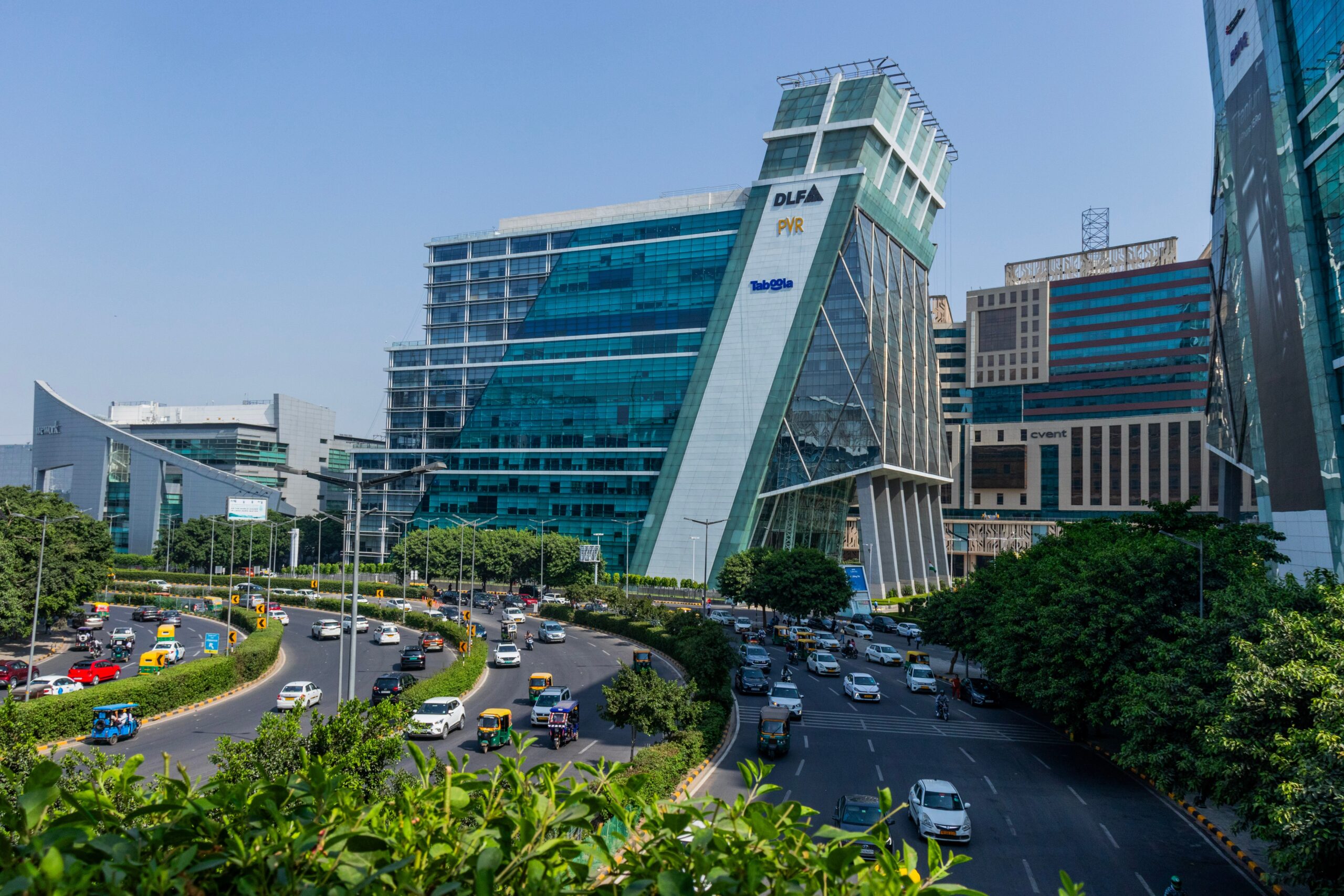
Gurugram’s skyline is dotted with several commercial and residential high-rise towers, especially in DLF City and many other areas. There are several proposed and ongoing projects that will alter the skyline even further with mega towers. Several mirrored and glass façade buildings now dominate the skyline, alongside office towers and luxury condos. The skyline has given Gurugram the reputation of a global Anywhere City, just like Dubai and other global hubs. In fact, the city has close to 2,000 high-rises, with close to 10 buildings over 40 stories, as per estimates.
Buying a house in Gurugram involves the following steps:
Renting a house in Gurugram means following these steps: