Hyderabad
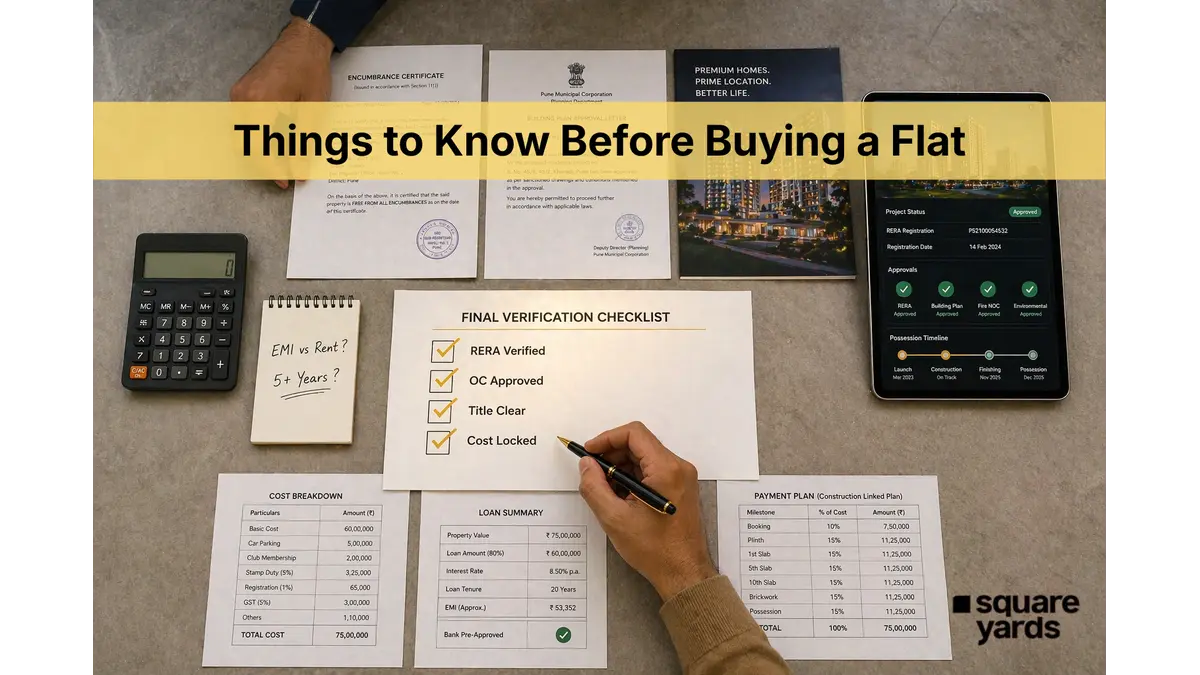
Before buying a flat in India, you must know: verify RERA registration, check legal title and encumbrance certificate, understand carpet area vs. built-up area, calculate total cost (including stamp duty, GST, registration), verify Occupancy Certificate, check builder credibility, review payment plan, and inspect construction quality.
Buying a flat is one of the biggest financial decisions most Indian families will ever make. Yet many buyers get so caught up in price negotiations and interior design that they forget the basics- verifying documents, checking builder track records, and inspecting what they’re actually paying for.
According to ANAROCK Research, India’s top 7 cities sold over 4.1 lakh residential units in 2024- a 11% year-on-year jump. With that kind of demand comes risk: rushed decisions, incomplete paperwork, and buyers realising too late that their dream home has a legal dispute attached to it.
This property documents checklist covers everything – from what documents to check before buying a flat to the flat handover checklist you need at possession. Read this before you sign anything.
Before anything else, confirm that the builder legally owns the land and has received all necessary government approvals. Check the RERA registration number on your state’s RERA portal, verify the sanctioned building plan, and ensure there are no pending disputes or litigation on the property. A clear title is non-negotiable – it protects your ownership for decades.
The quoted price is rarely the final price. Stamp duty (5–7%), registration charges (~1%), GST on under-construction flats, parking fees, club membership, and floor-rise charges can add 15–20% on top of the base cost. Always ask for a complete cost sheet in writing before you commit to anything.
Location drives both lifestyle and long-term value. Check proximity to schools, hospitals, metro stations, and employment hubs. Research upcoming infrastructure – a metro line or expressway in the pipeline can push property prices up significantly. Good location means better rental income and stronger resale value when you eventually decide to sell.
Here is the essential property documents checklist every flat buyer in India must verify before signing any agreement:
Pro tip: Consult a registered property lawyer to verify all these documents independently. The cost of legal due diligence is a fraction of what you’d spend fighting a dispute in court.
The builder-buyer agreement is a legally binding contract that spells out the flat’s carpet area, payment schedule, possession date, penalty clauses for delays, and what happens if the project is cancelled. Read every clause carefully – especially the force majeure and delay penalty sections. Under RERA, builders must pay interest for delays at the SBI MCLR + 2% rate, which is a strong buyer protection. Never accept a verbal promise; everything must be in the registered agreement.
Land ownership documents prove that the developer has clear rights to build on that specific plot. Ask for the original title deed, the registered sale deed in the builder’s name, and – in joint development projects – a copy of the Joint Development Agreement (JDA) between the landowner and developer. Also check the land-use conversion certificate to ensure the land is approved for residential construction, not agricultural or industrial use.
No-Objection Certificates (NOCs) from various departments – fire department, water and sewage authority, electricity board, and environmental clearance for large projects – are required before a building can be legally occupied. Additionally, check if the project has been approved by major banks and housing finance companies (HFCs). Bank approval is a good indicator of legal and financial credibility, and it also means home loans are readily available for buyers.
Your home loan eligibility depends on your income, credit score, existing debts, and the property’s valuation. As per RBI guidelines, banks can finance up to 90% of the property value for loans up to ₹30 lakhs, and up to 80% for loans between ₹30–75 lakhs. This means you’ll need to arrange a down payment of 10–20% from your own savings – plus stamp duty, registration, and other charges that banks typically do not fund. Always check your CIBIL score before applying; a score above 750 gives you access to better interest rates and faster approval.
Hidden costs are where many first-time buyers get blindsided. Beyond the base price, you may be charged for preferential location (corner flat, park-facing, higher floors), clubhouse membership, parking, power backup infrastructure, and society corpus fund. A 1,000 sq ft flat priced at ₹60 lakh can easily end up costing ₹70–72 lakh all-in. Is buying a flat a good investment? Yes – if you account for the total cost upfront and match it against realistic rental yields (typically 2–3% in major Indian cities) and long-term appreciation potential.
During your pre-possession inspection, check every wall for cracks, damp patches, and uneven plastering. Test all taps, geysers, and drainage lines for leaks or blockages. Switch on every electrical point and verify that MCB switches, earthing, and wiring meet IS 732 standards. Ceiling heights, door-frame alignment, and tile-laying quality are easy to spot and expensive to fix later. Document every defect with photos and submit in writing before signing the possession letter.
Under RERA, builders must disclose and sell flats based on carpet area – not super built-up area. Physically measure the carpet area with a tape or laser measure and compare it against what’s mentioned in your agreement. Also check that every room – especially kitchens and bathrooms – has adequate cross-ventilation or mechanical ventilation. Poor ventilation leads to mold, poor air quality, and higher air-conditioning costs throughout the year.
At the time of flat handover, the builder must provide you with several critical documents. These include the Occupancy Certificate, the original sale deed, the registered builder-buyer agreement, an NOC from the builder’s bank (releasing the property from their construction loan), property tax receipts up to date, and the society share certificate or allotment letter. Keep all of these documents in a safe, fireproof location – you will need them for resale, home loan top-ups, and inheritance.
A builder’s track record is one of the most telling indicators of what your experience will look like. Visit two or three of their completed projects in person – not just as a shopper, but as an inspector. Talk to existing residents about maintenance quality, how quickly the builder responded to defects, and whether the possession was on time. Online forums, Google reviews, and state RERA complaint portals are also valuable research tools.
Platforms like Square Yards list verified projects across India with detailed builder profiles, buyer reviews, and project completion histories – making it easier to compare builders side by side before committing. If a developer has a history of delays, litigation, or RERA violations, those are serious warning signs that no amount of attractive pricing should override.
Evaluate amenities honestly – not just by the brochure list but by their practical usability. Verify whether the clubhouse, gym, pool, and landscaping are complete and well-maintained. Ask what the monthly maintenance charges are and what they cover. Maintenance charges in premium projects can run ₹3–8 per sq ft per month – a 1,500 sq ft flat could cost ₹5,000–12,000 monthly. Understand who manages maintenance and what the handover process to the Residents’ Welfare Association (RWA) looks like.
Safety infrastructure is a non-negotiable checklist item. Confirm that the society has 24/7 security, CCTV coverage in common areas, video doorbell provisions, and fire safety systems compliant with NBC (National Building Code) norms. For parking, get written confirmation of your designated covered parking spot – whether it is stilt, podium, or basement – and check if visitor parking is adequate. Parking disputes are among the most common issues in residential societies post-possession.
Use this master checklist before you sign the dotted line:
The Title Deed and Encumbrance Certificate are the most critical. The Title Deed confirms ownership, and the EC confirms that the property is free from loans or disputes. Without these two being clean, no other document matters.
Yes. Under the Real Estate (Regulation and Development) Act, 2016, all residential projects with more than 8 units or covering more than 500 sq m of land must be registered with the state RERA authority before they can be marketed or sold. Always verify on the official RERA portal of your state.
A flat handover checklist is a physical inspection of the flat before you accept possession. It covers walls, plumbing, electrical points, carpet area measurement, ventilation, and a review of all handover documents. It matters because once you sign the possession letter, fixing defects becomes significantly harder and often falls on your own expense.
Buying a flat can be a good investment if the location is right, the builder is credible, the documentation is clean, and you factor in the true all-in cost. Rental yields in major Indian cities average 2-3%, while long-term capital appreciation in well-located projects has historically ranged from 5-12% per year. It is less liquid than stocks or mutual funds, so consider your holding period carefully.
Occupying a flat without an OC is technically illegal. You may face issues getting a water or electricity connection in your name, face difficulties securing a home loan, be ineligible for GST exemption (applicable only to ready-to-move OC-certified flats), and encounter serious complications at the time of resale.
Yes. Every state has its own RERA portal. For example, MahaRERA for Maharashtra (maharera.mahaonline.gov.in), RERA Haryana (hrera.org.in), and UP RERA (up-rera.in). Simply enter the project name or registration number to verify all details including timelines, approvals, and any complaints filed against the builder.
Carpet area is the actual usable floor area within your flat’s walls. Super built-up area includes common areas like lobbies, staircases, and the builder’s loading factor – and can be 25-40% more than the carpet area. Under RERA, all transactions must be based on carpet area, so compare prices only on this basis.