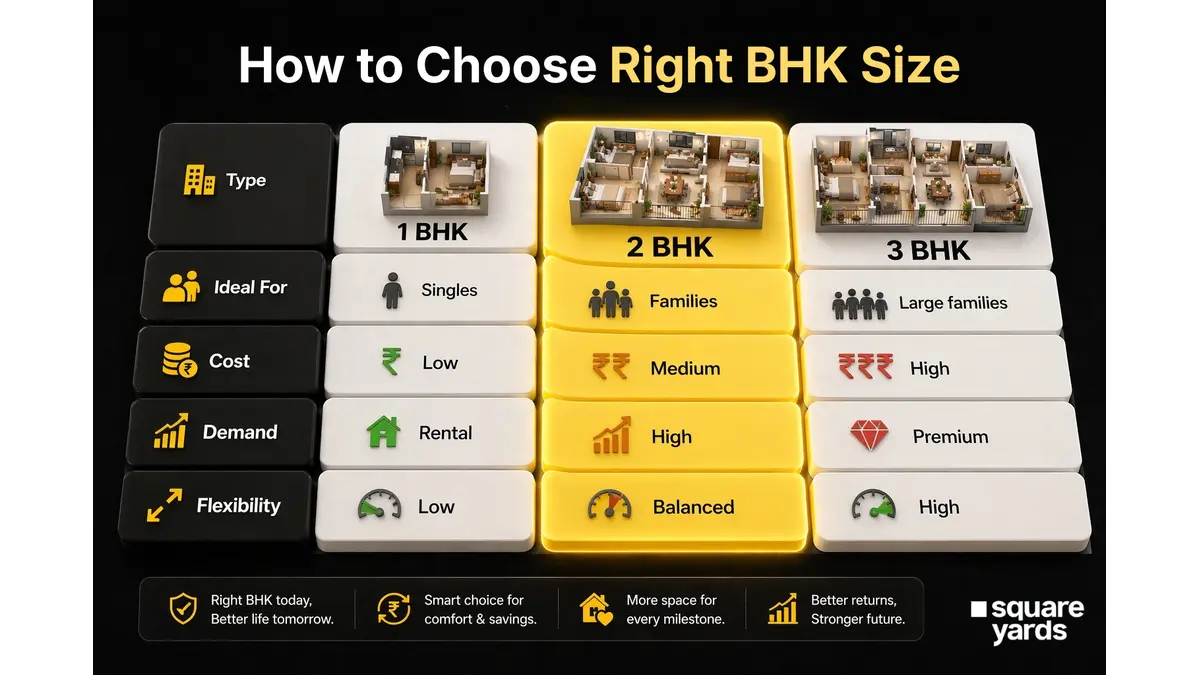
Choosing the right BHK size is one of the most consequential decisions in your property buying journey in India. Buy too small and you outgrow your home in a few years, facing costly transaction costs to upgrade. Buy too large and you lock capital in excess space while paying higher EMIs, stamp duty, maintenance charges, and property taxes than you need.
The BHK system — Bedroom, Hall, Kitchen — provides a straightforward framework for comparing residential configurations. But the right BHK for you depends on a constellation of factors: your current and planned family size, lifestyle requirements, work-from-home needs, budget, investment goals, and the specific micro-market you are buying in.
This definitive guide walks you through a structured, objective process for choosing the right BHK size — whether you are a first-time homebuyer, a growing family upgrading your home, or an investor building a residential portfolio. By the end of this guide, you will have a clear framework to make a confident, well-informed BHK size decision.
Step-by-Step Guide
- Assess Your Current and Planned Family Size: Start with your household composition today and in the next 7–10 years. Single person or couple (no children planned): 1 BHK is adequate. Couple planning children or with 1 young child: 2 BHK is ideal. Family with 2 children: 2 BHK (if children are young) or 3 BHK (if near/in teenage years). Multi-generational household (3 generations): 3 BHK minimum, ideally 4 BHK. The basic rule: 1 bedroom per adult couple + 1 bedroom per pair of children above age 8.
- Calculate EMI Affordability for Each BHK Size: Use the 40% EMI rule: your total monthly loan EMI should not exceed 40% of gross monthly household income. Approximate price benchmarks in mid-segment Indian cities: 1 BHK (₹30–₹60 lakh) → EMI ₹18,000–₹38,000/month; 2 BHK (₹50–₹1 crore) → EMI ₹30,000–₹65,000/month; 3 BHK (₹80 lakh–₹1.8 crore) → EMI ₹50,000–₹1,20,000/month. Each BHK step up typically adds 40–60% to the base price.
- Factor in Work-From-Home Requirements: If 1 or more household members work from home permanently or frequently, add 1 room to your baseline requirement. A family of 3 with 1 WFH member ideally needs a 3 BHK rather than a 2 BHK — using one bedroom as a dedicated home office for focused work without disrupting family routines. Post-pandemic WFH trends have permanently increased the practical BHK requirement for most Indian professional households.
- Consider Investment vs End-Use Intent: If buying for end-use: choose based on genuine family needs + a 7-year horizon. If buying primarily for investment/rental: 2 BHK delivers the best balance of rental demand, capital appreciation, and liquidity in most Indian markets. 1 BHK is optimal for high-yield rental investment in IT corridors and student markets. 3 BHK and above serve premium rental segments with higher yield but lower liquidity.
- Evaluate Location vs BHK Size Trade-Off: This is the most underappreciated BHK decision factor: in Indian real estate, location quality typically delivers greater quality-of-life impact than BHK size. A 2 BHK in a central, well-connected neighbourhood almost always outperforms a 3 BHK in a distant suburb on both lifestyle satisfaction and investment return. If budget is fixed, choose location over size.
- Check Resale and Rental Demand in Target Market: Before finalising BHK size, validate the secondary market demand: 2 BHK — fastest to resell and rent across all Indian markets; highest liquidity. 3 BHK — strong demand in premium markets; may take longer in oversupplied suburban locations. 1 BHK — high rental demand in IT and student hubs; lower resale demand in family-oriented markets. Studio — very high yield; niche resale market.
- Visit Properties Across BHK Sizes Before Deciding: Always visit actual apartments — not just floor plans — across the BHK sizes you are considering in your target project or locality. Physical visits reveal: actual bedroom dimensions vs. stated sizes, kitchen usability, natural light quality, balcony size, and how the space actually feels to live in. Many buyers change their BHK preference after a physical visit.
Key Factors / Checklist
- Family size assessed — current and 7-year forward projection
- EMI affordability calculated using 40% gross income rule
- Work-from-home space requirement evaluated
- Investment vs. end-use intent clearly defined
- Location quality vs. BHK size trade-off consciously decided
- Resale and rental demand for target BHK in target market verified
- Physical visits to show flats across BHK sizes completed
- Floor plan efficiency checked — bedroom sizes, kitchen dimensions, balcony
- Total cost of ownership (price + stamp duty + GST + maintenance) compared across BHK options
- Partner/family alignment on final BHK choice confirmed
Expert Tips
- The 7-year rule: Choose the BHK size that will comfortably accommodate your family’s needs 7 years from today — not just today. Transaction costs in Indian real estate (stamp duty, registration, brokerage on buy and sell) mean upgrading within 3–5 years is expensive.
- Efficient 2 BHK often beats inefficient 3 BHK: A well-designed 2 BHK with 900 sq ft carpet area and efficient layout often delivers more livable space than a poorly designed 3 BHK with 950 sq ft and cramped third bedroom. Evaluate floor plan quality alongside size.
- The premium for a right-sized home in the right location compresses over time: Paying a 20% premium for a well-located 2 BHK vs. a peripheral 3 BHK often proves the better decision within a 5-year window, as the central 2 BHK appreciates faster and commands stronger rentals.
- For investors, calculate yield per sq ft not just per unit: A smaller BHK in the same project typically generates higher rent per sq ft. A 2 BHK generating ₹25,000/month from 750 sq ft (₹33/sq ft) usually outperforms a 3 BHK generating ₹35,000/month from 1,200 sq ft (₹29/sq ft) as a yield investment.
- Never compromise on bedroom count for working-from-home households: With remote and hybrid work now mainstream in India, a bedroom that doubles as a home office is a permanent productivity requirement. Stretching from 2 BHK to 3 BHK for a WFH household is one of the clearest-cut BHK decisions.
Common Mistakes to Avoid
- Buying based on today’s family size ignoring a 5-7 year horizon: Many couples buy a 1 BHK thinking they will upgrade when the family grows, only to face double transaction costs — stamp duty, registration, brokerage on sale, stamp duty and registration on new purchase.
- Choosing BHK based on per-sq-ft price, not total cost: A 3 BHK at a lower per-sq-ft rate vs. a 2 BHK may seem economical but the total cost — and therefore total stamp duty, registration, GST, and EMI — is significantly higher.
- Not comparing carpet area across BHK options in the same project: Builders sometimes offer a ‘3 BHK’ with a third bedroom that is 8×8 ft — barely functional. Verify individual bedroom dimensions across configurations before deciding.
- Stretching to a larger BHK in a distant location: Buying a 3 BHK in a location 30–45 minutes from your workplace to ‘get more space’ often results in lower quality of life, higher commute costs, and weaker appreciation compared to a 2 BHK in a better-located project.
- Not consulting your home loan lender before deciding: Your home loan eligibility sets an absolute upper limit on the BHK size you can afford. Get a pre-approved home loan letter before finalising your BHK choice to avoid disappointment after shortlisting.
Conclusion
Choosing the right BHK size is ultimately about aligning your home with your life — your family’s current and future needs, your financial capacity, your lifestyle requirements, and your long-term investment goals. Whether the answer is a 1 BHK, 2 BHK, or 3 BHK, a well-made decision based on the structured framework in this guide will serve you for years.