Scams these days no longer start with the old “send advance, keys later” routine. Today’s frauds are polished, tech-savvy and extremely convincing. These scammers speak well, they know the law, some of them will even look you in the eye and still disappear with your money.
According to media reports, the owner of Catena Homes was arrested in late 2025, for duping around 400 people of over ₹50 crore. The Bangalore based firm rented high-end apartments from actual owners and then sub-leased them to tenants for lump-sum amounts ranging from ₹10 lakh to ₹29 lakh each.
So if you’re house hunting, staying informed about how current rental scams operate is no longer about being cautious. It has become part of renting safely.
Let’s look at what’s actually happening on ground and how tenants can stay a step ahead.
Table of contents
Pay before the visit traps
Even though the internet has made the process of finding a home easier, the next step should always be to visit the property before making any payments.
A common rental fraud, widely reported in Bangalore and Hyderabad, is the advance payment of around ₹2,000-₹3,000 for a visiting pass. Here, tenants are told that they are required to pay a refundable amount before they can visit the flat. Once paid, the scammer disappears and cuts all communication.
Even in high-demand markets like Mumbai and Pune, fake brokers collect viewing fees without access to the property. The volume makes the scam profitable even when individual amounts are small. In all cases, the pattern is consistent and payment is requested before physical access or verification.
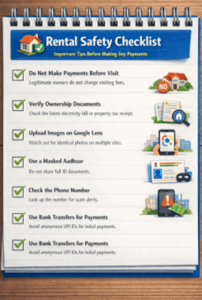
Pro Tip: Legitimate owners never ask for payments before inspecting a home. Never pay before the visit.
Fake video calls
Until recently, a live video call was considered a safety check. In 2025, many renters report WhatsApp video calls with people who appear legitimate, well-dressed, calm, and professional. They give renters a virtual tour of the house and may also show an Aadhaar card to reinforce trust.
Based on recent cases, scammers are now using pre-recorded videos or those made from short-term rented properties. More advanced scams now use AI-based face overlays and voice cloning to create a convincing but false identity. These calls are usually brief, with limited movements and slightly grainy video quality.
After the fake video tour, scammers create a sense of urgency and pressurise renters to immediately pay a token amount or security deposit to block the flat.
Pro Tip: Always treat video calls as a means to support verification and not as a substitute for it.
The QR code trap
There is no doubt that digital payments have streamlined transactions, but they have also handed scammers a new tool.
The pre-lease registration is another common scam doing the rounds. Scammers tell tenants that the house is in high demand and to secure a slot in the queue, they need to submit their details on a portal that appears official. They may also call it the visitor entry approval and hand out a QR Code asking people to scan it to register their Aadhaar.
The moment one enters their PIN for such verification, money is debited from their account. Real society management apps never use UPI QR codes for Aadhaar verification. They will either ask for a photo upload or a manual OTP from the UIDAI website.
Pro Tip: No legitimate rental process requires a UPI PIN to register, verify, or receive a refund. Entering a PIN always authorises payment.
The possession delay scam
Some frauds remain common because they exploit trust and urgency rather than technology. For instance, a man in Chennai was arrested for cheating over 15 people of ₹1.25 crore. He uploaded pictures of his own apartment on online portals and simultaneously signed lease agreements with different people, collecting ₹5 lakh to ₹10 lakh from each.
The classic sign of this scam is being given multiple “handover dates”.
Pro Tip: Never pay the full lease amount until you have received the keys and a registered rental agreement, even if the person claims to own the property.
How scammers misuse legal frameworks
In 2015, the Model Tenancy Act was designed to formalise the largely unregulated rental market. Updates were made to the act in 2025, mandating digital registration and e-stamping of rent agreements. Though this has improved transparency, the procedure has also created opportunities for misuse.
Registration fee illusion
This rental fraud involves scammers claiming that they are initiating the digital agreement registration. Then, they request a payment for stamp duty and registration charges upfront. Often, the amounts are reasonable and the explanation is convincing. A PDF agreement will follow, complete with an official-looking e-stamp number. They either use a fake e-stamp number or one issued for a different transaction altogether.
Most tenants don’t verify these details because they find themselves convinced of the procedure. Eventually, these scamsters succeed because the final verification step is skipped. To check legitimacy, tenants can verify e-stamps on the Stock Holding Corporation of India (SHCIL) portal.
During the legitimate process, stamp duty and registration fees are paid when the lease agreement is officially registered with the sub-registrar’s office. This is done within some weeks of finalising the flat with the landlord.
The legal trap illusion
According to the Model Tenancy Act, security deposits for residential properties need to be paid for 2 months. Scammers use this rule to sound legitimate. Once trust is built, additional charges like security deposits, move-in fees and verification costs begin to surface. They justify these too as standard procedure.
When a payment process becomes layered and unclear, it is designed that way for a reason. Genuine landlords don’t break a deposit into multiple components.
Verification that goes beyond surface checks
To avoid such fraud, renters need to verify information that cannot be easily faked.
Most tenants don’t verify ownership. Land ownership records are public and easy to access through state portals like Mahabhulekh (Maharashtra), Bhoomi (Karnataka) and Bhulekh (Uttar Pradesh). On these portals, tenants can verify the names of the legal owners of the property. If the owner’s name doesn’t match, it’s a red flag.
Also, checking the electricity bill is another way to verify ownership. The consumer number can be verified on the state electricity board’s website. It fetches the name of the person who actually pays the bills. Don’t rely on the PDF.
The most important step before making any kind of payment is to do a ground check. Renters can visit the building by themselves, check if there is someone living there, talk to them or the neighbours, or a guard. Make sure that the flat is genuinely available for rent. Building staff usually know which homes are occupied, vacant or falsely advertised. Sometimes, one quiet conversation can save months of trouble and a large financial loss.
Practical safeguards to avoid fraud
Certain habits that significantly reduce risk:
If a scam occurs
These are some immediate actions that one can take:
- Call the National Cyber Crime Helpline at 1930 to inform them of the scam.
- File a report on the official cybercrime portal. The golden hour of reporting a scam is within 2 hours. This increases the chances of freezing the accounts of the scammers.
- Preserve evidence such as chat records, payment details, listing links, and identity documents shared by the scammer.
Even when recovery is uncertain, reporting helps build data that prevents future fraud.
Wrapping Up
Rental fraud today doesn’t rely on obvious tricks. It works through urgency, incomplete checks and processes that sound official but aren’t. A genuine rental deal, on the other hand, allows time for verification. It leaves behind records that can be checked.
The responsible step is to slow down, verify independently and resist pressure. Because renting wisely is no longer just about finding the right home, but about staying safe in the process.
You Might Also Be Interested In
Real Estate Scams in India: Common Frauds Homebuyers Must Avoid
Online Real Estate Scams
Fake Property Listings Scam
Steps to Verify a Property Before Paying Any Token Amount
Things Fraudsters Say to Convince You to Buy or Rent Faster
FAQs
The most common rental fraud in India include the visiting pass and gate entry scams, where tenants are asked to pay to view a property. Impersonation as Army or paramilitary officers and QR code phishing are other common rental frauds. Fake rental listings reuse photos from real properties and advertise them at slightly below-market prices to attract quick interest. Once contact is made, scammers create urgency and push for an early payment. Paying any amount before physically visiting a property is unsafe. Legitimate landlords do not charge gate passes, visiting fees, or tokens before a visit. Payments should only be made after inspecting the flat in person and verifying ownership documents and reviewing the rent agreement. Tenants can check if a rental listing is genuine or not by reverse-searching the photos using tools like Google Lens. Ownership can be verified by checking state land record portals or inquiring with the building staff and neighbours. Before renting a flat, tenants should confirm ownership by checking the title deed or sale deed and matching it with the latest property tax receipt. The owner’s details should match these records. If a rental fraud occurs, the first step is to contact the National Cyber Crime Helpline at 1930 or report the incident on the cybercrime portal as quickly as possible. Also call your bank to try and freeze the transaction What are the most common rental frauds in India?
How do fake rental listings scam tenants?
Is it safe to pay a token amount before visiting a property?
How can tenants verify a genuine rental listing?
What documents should tenants check before renting?
What should I do if I fall victim to rental fraud?