
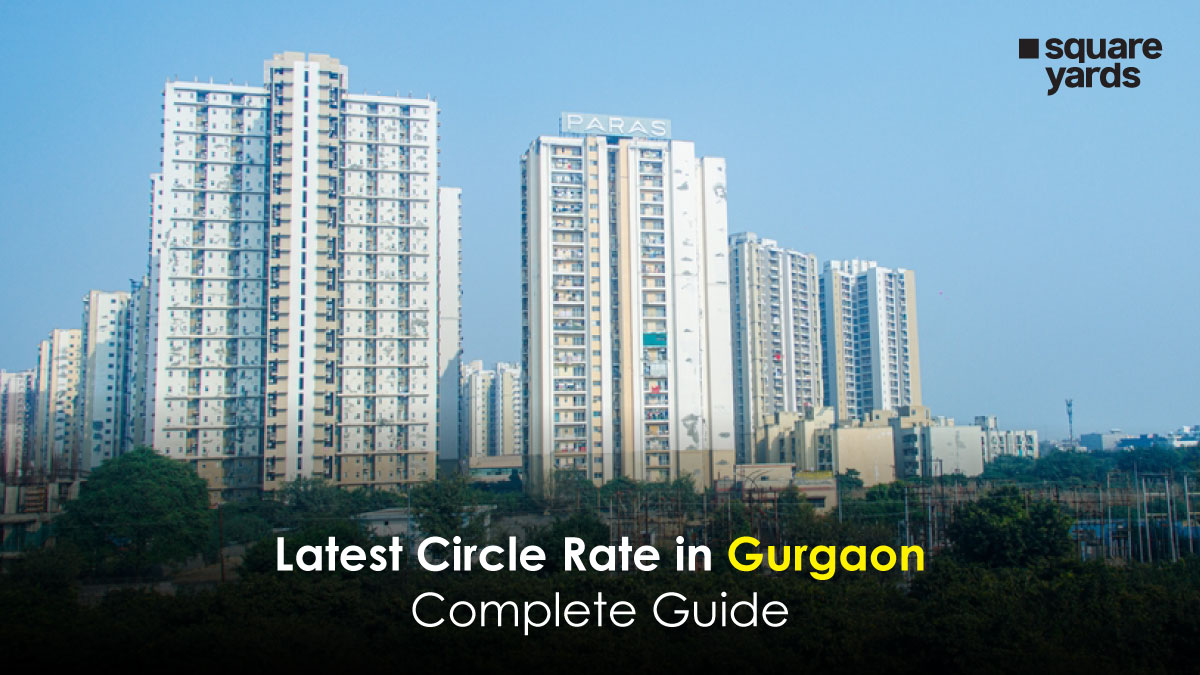
The minimum property value set by the government for transactions in Gurgaon is called the circle rate. If a property’s value is below this rate, it cannot be legally registered. The primary purpose of setting such a benchmark is to ensure transparency and prevent properties from being undervalued in transactions. The district administration sets these rates, and they are subject to periodic revisions in response to market trends, infrastructure development, and demand.
In Gurgaon, the circle rate is also known as CRC (Collector Rate Gurgaon). The circle rate varies across different sectors and localities, depending on the property type, location, and surrounding infrastructure. This means that the value of land or apartments can differ significantly between sectors. In this guide, we explore everything you need to know about the circle rate in Gurgaon, including the sector-wise circle rates, how CRC is calculated, and the latest updates affecting property transactions in the city.
- What is Circle Rate in Gurgaon (CRC)?
- Latest Sector-Wise Circle Rate in Gurgaon
- How is the Gurgaon Circle Rate Calculated?
- Circle Rate vs Market Rate in Gurgaon
- Impact of Circle Rate on Stamp Duty in Gurgaon
- Factors Affecting the Circle Rate in Gurgaon
- How to Check the Official Gurgaon Circle Rate Online?
- Recent Updates in Gurgaon Circle Rates
- The Bottom Line
What is Circle Rate in Gurgaon (CRC)?
The circle rate in Gurgaon is the minimum property value set by the government for registering real estate transactions. Also known as the collector rate or ready reckoner rate, it serves as a baseline to prevent property undervaluation, ensuring that transactions are not recorded below a certain threshold. The district administration establishes these rates and periodically reviews them based on factors such as infrastructure development, property demand, and market trends.
The primary purpose of setting a circle rate is to facilitate a fair calculation of taxes and registration fees, preventing buyers and sellers from declaring lower property values to avoid higher costs. It is important to note that these rates differ based on property type, residential, commercial, and agricultural, with commercial properties generally having higher rates due to their potential for revenue generation.
Latest Sector-Wise Circle Rate in Gurgaon
The circle rate in Gurgaon varies significantly in various sectors and localities. Different benchmark values apply to residential plots, builder floors, apartments, and commercial properties. Therefore, it is only normal for the sector-wise circle rate in Gurgaon to differ between older residential sectors, premium corridors, and newly developing areas. Moreover, it is also important to remember that the actual property rates in Gurgaon are slightly higher than the circle rates. Below is an indicative table of circle rates across some key sectors and localities in the city:
|
Sector/Locality |
Circle Rate 2025 (per sq ft) |
|
Sector 1 |
₹52900 |
|
Sector 2 |
₹55300 |
|
Sector 3 |
₹52900 |
|
Sector 3A |
₹52900 |
|
Sector 4 |
₹53000 |
|
Sector 5 |
₹55300 |
|
Sector 6 |
₹52900 |
|
Sector 7 |
₹55300 |
|
Sector 12 |
₹52900 |
|
Sector 12A |
₹55300 |
|
Sector 14 |
₹74800 |
|
Sector 15 |
₹74800 |
|
Sector 16 – 17 |
₹71600 |
|
Sector 17 (P) |
₹57700 |
|
Sector 21 |
₹55300 |
|
Sector 22 |
₹57700 |
|
Sector 22A |
₹55300 |
|
Sector 23 – 23A |
₹55300 |
|
Sector 27 |
₹52900 |
|
Sector 28 |
₹71600 |
|
Sector 38 |
₹64900 |
|
Sector 40 |
₹71600 |
|
Sector 42 |
₹72700 |
|
Sector 43 |
₹79300 |
|
Sector 104 – 106, 109 – 115 |
₹52900 |
|
DLF Old Colony |
₹79300 |
|
DLF Qutub Enclave Phase 2 |
₹88100 |
|
Palam Vihar (Sushant Lok) |
₹64000 |
|
New Palam Vihar |
₹39000 |
Premium Corridors in Gurgaon
Due to their prime locations and infrastructure, several corridors in Gurgaon command significantly higher property rates. Areas along Golf Course Road, Golf Course Extension Road, and established gated communities such as DLF Phases and Sushant Lok all fall into this category of premium real estate zones. Offering better connectivity, luxury residential developments, and easy access to commercial hubs, these locations often have higher collector rates.
Affordable vs Premium Sectors
Those familiar with Gurgaon’s real estate landscape would know about the divide between the older, developed sectors and the emerging residential zones. The central sectors, such as Sector 14, Sector 42, and Sector 43, are well-established and close to major employment hubs. These areas, therefore, enjoy a higher circle rate in Gurgaon. On the other hand, newer sectors along the Dwarka Expressway (Sectors 104 – 115), despite rising market demand, have lower base circle rates.
Old Gurgaon vs New Gurgaon Rates
The difference between Old Gurgaon and New Gurgaon also influences the sector-wise circle rates in the city. Older HUDA sectors, i.e., those near MG Road, IFFCO Chowk, and Golf Course Road, have higher benchmark values. Meanwhile, areas like Dwarka Expressway, Sohna Road, and Southern Peripheral Road fall under New Gurgaon. While these areas are witnessing an increase in infrastructure and residential development, the collector rates remain comparatively lower.
How is the Gurgaon Circle Rate Calculated?
The calculation of the circle rate takes into account several factors. The key factor is the property’s location: properties in prime sectors, business hubs, or developed residential areas generally have higher rates. Next come the sector demand and infrastructure, as areas with strong housing demand, better civic facilities, and planned development attract higher government valuations. Another important distinction while calculating the circle rate is the type of property. The rate will differ depending on whether the property is a residential plot, apartment, agricultural land, or commercial space. Finally, before revising the CRC Gurgaon, officials review market transaction data and property sale trends to reflect contemporary real estate conditions best.
Circle Rate vs Market Rate in Gurgaon
While buying or selling property, the stakeholders need to understand the difference between the circle rate and the market rate. The circle rate for Gurgaon is a minimum value fixed by the government for property registration. On the other hand, the property rates in Gurgaon in the open market depend on demand, location, and negotiations between buyers and sellers. This table illustrates the main differences between the two:
|
Factor |
Circle Rate |
Market Rate |
|
Definition |
Government minimum property value |
Actual transaction value |
|
Determined By |
Government authorities |
Buyer–seller demand |
|
Usage |
Stamp duty calculation |
Real purchase price |
|
Variation |
Usually lower |
Often higher in prime areas |
In most cases, the market price of property in Gurgaon is higher than the circle rate, especially in popular sectors with strong demand. However, when the market phases are lower, the circle rates can exceed the actual property rates, making transactions more difficult. Before finalising any property deal, it is recommended to understand this key distinction.
Circle rates and market value in Gurgaon localities
|
Sector / Locality |
Circle Rate 2025 (per sq ft) |
Approximate Market Value (per sq ft) |
% Difference |
|
₹52,900 |
₹64,000 |
+21% |
|
|
₹55,300 |
₹68,000 |
+23% |
|
|
₹52,900 |
₹65,000 |
+23% |
|
|
Sector 3A |
₹52,900 |
₹64,000 |
+21% |
|
₹53,000 |
₹64,500 |
+22% |
|
|
₹55,300 |
₹67,000 |
+21% |
|
|
₹52,900 |
₹63,500 |
+20% |
|
|
₹55,300 |
₹67,500 |
+22% |
|
|
₹52,900 |
₹64,000 |
+21% |
|
|
₹55,300 |
₹68,000 |
+23% |
|
|
₹74,800 |
₹95,000 |
+27% |
|
|
₹74,800 |
₹96,000 |
+28% |
|
|
Sector 16–17 |
₹71,600 |
₹90,000 |
+26% |
|
Sector 17 (P) |
₹57,700 |
₹72,000 |
+25% |
|
₹55,300 |
₹70,000 |
+27% |
|
|
₹57,700 |
₹72,000 |
+25% |
|
|
Sector 22A |
₹55,300 |
₹69,000 |
+25% |
|
Sector 23–23A |
₹55,300 |
₹68,000 |
+23% |
|
₹52,900 |
₹65,000 |
+23% |
|
|
₹71,600 |
₹95,000 |
+33% |
|
|
₹64,900 |
₹82,000 |
+26% |
|
|
₹71,600 |
₹90,000 |
+26% |
|
|
₹72,700 |
₹100,000 |
+38% |
|
|
₹79,300 |
₹115,000 |
+45% |
|
|
Sector 104–106, 109–115 |
₹52,900 |
₹70,000 |
+32% |
|
DLF Old Colony |
₹79,300 |
₹115,000 |
+45% |
|
DLF Qutub Enclave Phase 2 |
₹88,100 |
₹130,000 |
+48% |
|
Palam Vihar (Sushant Lok) |
₹64,000 |
₹80,000 |
+25% |
|
₹39,000 |
₹45,000 |
+15% |
Impact of Circle Rate on Stamp Duty in Gurgaon
The main function of the circle rate is to provide a standardised amount against which stamp duty and registration charges are imposed. The calculation of these taxes is directly linked to the Gurgaon circle rate, which acts as the minimum benchmark for property valuation. The main rule here is that stamp duty is calculated on the higher of the two values, between the actual transaction price and the collector rate, to prevent undervaluation of property during registration. So even if the buyer can negotiate a price below the market value, the buyer must still pay the stamp duty based on the government-set value. This ensures that the government receives the correct tax regardless of the negotiation.
Effect on buyers
For buyers, the collector rate in Gurgaon determines the minimum cost involved in property registration. If the market price is lower than the circle rate in Gurgaon, buyers may end up paying higher stamp duty, which increases the overall purchase cost.
Effect on sellers
Sellers are also affected because property transactions must be registered at or above the Gurgaon circle rate. This can sometimes limit pricing flexibility, especially in slower markets where actual demand may be lower.
Impact on taxation
The collector rate of Gurgaon also influences taxation. Property transactions recorded at higher values increase transparency and ensure that government revenue from stamp duty and registration charges remains consistent.
Reduction of black money
One of the main reasons governments maintain the circle rate in Gurgaon is to discourage the use of unaccounted cash in property deals. By setting a minimum valuation through the Gurgaon circle rate, authorities aim to reduce undervalued transactions and promote a more transparent real estate market.
Factors Affecting the Circle Rate in Gurgaon
Circle rates are not permanent and subject to periodic revisions by the district administration. What these revisions are based on is also a main factor influencing the market value of property in Gurgaon. Authorities study these factors to determine whether the CRC Gurgaon should be increased, decreased, or kept unchanged.
Infrastructure development
Infrastructure projects have a direct impact on the Gurgaon circle rate. When new roads, flyovers, drainage systems, or civic facilities are developed in an area, property demand usually rises. As infrastructure improves, the government may revise the CRC Gurgaon upward to reflect the higher real estate value in that locality.
Metro connectivity
Areas near metro stations attract more buyers due to easier commuting. As accessibility improves, demand for residential and commercial properties increases, which may lead to a revision in the Gurgaon circle rate.
Commercial growth
The development of office hubs, IT parks, shopping complexes, and business districts also influences the CRC Gurgaon. Regions with strong commercial activity often experience higher demand for real estate. As a result, the government may revise the Gurgaon circle rate to match the growing economic activity in those areas.
Demand for residential property
When more buyers look for homes in a particular sector or locality, property values increase. Authorities, in turn, monitor these market trends before making changes to the CRC Gurgaon.
Government policy changes
Government regulations, taxation policies, and urban planning decisions can also impact the Gurgaon circle rate. Policy changes related to land use, zoning, or property registration sometimes lead to revisions in official property values.
Urban expansion toward New Gurgaon and Dwarka Expressway
Rapid development in emerging areas such as New Gurgaon and the Dwarka Expressway corridor has significantly influenced property rates in Gurgaon. As these areas attract new residential projects and commercial investments, authorities may revise the CRC Gurgaon to reflect the growing real estate potential in these expanding zones.
How to Check the Official Gurgaon Circle Rate Online?
Knowing the official circle rates in Gurgaon is easier than ever with the revenue department’s online portal. Before finalising the transaction, buyers, sellers and investors are recommended to check the ready reckoner rate for Gurgaon.
Here’s how to do it:
- Visit District Gurugram’s official website.
- Find the ‘Department’ option in the menu bar at the top and hover over it to reveal the dropdown menu.
- Select the ‘Revenue’ option.
- In the page that appears, find the ‘Collectrate’ option and click on it.
- You will find a list of PDFs with the various areas in the district. Select the one applicable and check the circle rate.
Other Cities Circle Rate
| Circle Rate in Delhi | Delhi Circle Rate |
| Circle Rate in Noida | Noida Circle Rate |
| Circle Rate in Faridabad | Faridabad Circle Rate |
| Circle Rate in Haryana | Haryana Circle Rate |
| Circle Rate in Up | Up Circle Rate |
Recent Updates in Gurgaon Circle Rates
The sector-wise circle rate in Gurgaon has always been under regular review in response to changing real estate trends and rising property demand across the city. This is done to ensure that valuations remain closer to actual market conditions. In recent years, several localities in Gurgaon have witnessed a gradual increase in circle rates due to rapid development. The sectors near the Dwarka Expressway lead this trend, experiencing notable growth in property demand driven by improved connectivity, large residential projects, and proximity to Delhi. As a result, the Gurgaon circle rate in some of these sectors has been revised upward to reflect the rising real estate activity.
New Gurgaon is yet another region where authorities are closely monitoring property values. This area includes sectors along the Southern Peripheral Road (SPR) and in the development of residential zones. With multiple infrastructure projects, new housing developments, and improved connectivity, the property demand here has ncreased steadily.
Reducing the gap between official rates and actual market prices also remains a priority for the authorities. Measures to align official valuations with real transaction prices remain key. As a result, the Revenue Department revised the circle rates in 2025. Most localities across the city have seen a 10-20% increase in circle rates to reflect market conditions better. The following table details the increase in circle rates from 2024:
|
Sector/Locality |
Circle Rate 2024 (per sq ft) |
Circle Rate 2025 (per sq ft) |
% increase |
|
1 |
₹48000 |
₹52900 |
10 |
|
2 |
₹48000 |
₹55300 |
15 |
|
3 |
₹48000 |
₹52900 |
10 |
|
3A |
₹48000 |
₹52900 |
10 |
|
4 |
₹48000 |
₹53000 |
10 |
|
5 |
₹48000 |
₹55300 |
15 |
|
6 |
₹48000 |
₹52900 |
10 |
|
7 |
₹48000 |
₹55300 |
15 |
|
12 |
₹48000 |
₹52900 |
10 |
|
12A |
₹48000 |
₹55300 |
10 |
|
14 |
₹65000 |
₹74800 |
15 |
|
15 |
₹65000 |
₹74800 |
15 |
|
16 – 17 |
₹65000 |
₹71600 |
10 |
|
17 (P) |
₹50000 |
₹57700 |
15 |
|
21 |
₹48000 |
₹55300 |
15 |
|
22 |
₹48000 |
₹57700 |
20 |
|
22A |
₹48000 |
₹55300 |
15 |
|
23 – 23A |
₹48000 |
₹55300 |
15 |
|
27 |
₹48000 |
₹52900 |
10 |
|
28 |
₹65000 |
₹71600 |
10 |
|
38 |
₹54000 |
₹64900 |
20 |
|
40 |
₹65000 |
₹71600 |
10 |
|
42 |
₹66000 |
₹72700 |
10 |
|
43 |
₹66000 |
₹79300 |
20 |
|
104 – 106, 109 – 115 |
₹44000 |
₹52900 |
20 |
|
DLF Old Colony |
₹72000 |
₹79300 |
10 |
|
DLF Qutub Enclave Phase 2 |
₹80000 |
₹88100 |
10 |
|
Palam Vihar (Sushant Lok) |
₹58000 |
₹64000 |
10 |
|
New Palam Vihar |
₹32000 |
₹39000 |
21 |
Notes*: Rates may be subject to current market risks
The Bottom Line
The circle rate in Gurgaon helps maintain transparency and fairness in the city’s real estate market. Set by the district administration, this government-approved benchmark represents the minimum value at which a property can be registered. This ensures that the property is not undervalued and the stamp duty is calculated accurately.
As seen across various sectors in Gurgaon, the sector-wise circle rate varies significantly by location, infrastructure, and property demand. Prime areas such as Sector 14, Sector 42, Sector 43, and premium localities like DLF Qutub Enclave Phase 2 have higher benchmark values. In contrast, emerging areas like New Palam Vihar or sectors along the Dwarka Expressway have comparatively lower rates.
Despite this variation, actual property rates in Gurgaon are often higher than the circle rate due to market demand. For anyone planning to buy or sell property, checking the latest Gurgaon circle rate or collector rate Gurgaon is essential. Staying up to date with these official values helps ensure accurate registration, proper tax calculations, and smoother property transactions.
Frequently Asked Questions
1. How is the circle rate decided in different Gurgaon sectors?
Authorities determine the circle rate in Gurgaon based on location, infrastructure, property demand, connectivity, and recent market transaction data.
2. Where can I check the Gurgaon CRC list online?
You can check the CRC Gurgaon list on the District Gurugram or Haryana Revenue Department website under the collector rate or revenue section.
3. Does the circle rate differ for residential and commercial property in Gurgaon?
Yes, the Gurgaon circle rate varies by property type, such as residential plots, apartments, commercial spaces, or agricultural land.
4. How does the circle rate affect property registration in Gurgaon?
Property registration value cannot be below the collector rate of Gurgaon, and stamp duty is calculated based on this benchmark or the transaction value, whichever is higher.
5. Is the circle rate revised every year in Gurgaon?
The circle rate in Gurgaon is reviewed periodically by the district administration, but revisions may not necessarily occur every year.
6. Can property be registered below the circle rate in Gurgaon?
No, a property cannot be legally registered at a price below the Gurgaon circle rate, as it is the government’s minimum valuation benchmark.
7. What is the stamp duty based on the circle rate in Gurgaon?
Stamp duty is calculated on the higher value between the actual transaction price and the circle rate in Gurgaon.
8. Is the circle rate the same across all Gurgaon sectors?
No, the sector-wise circle rate in Gurgaon varies by location, infrastructure, and real estate demand.
9. How does the circle rate impact home loan approval in Gurgaon?
Banks often consider the circle rate in Gurgaon as a reference while evaluating property value for home loan approvals.