Bangalore
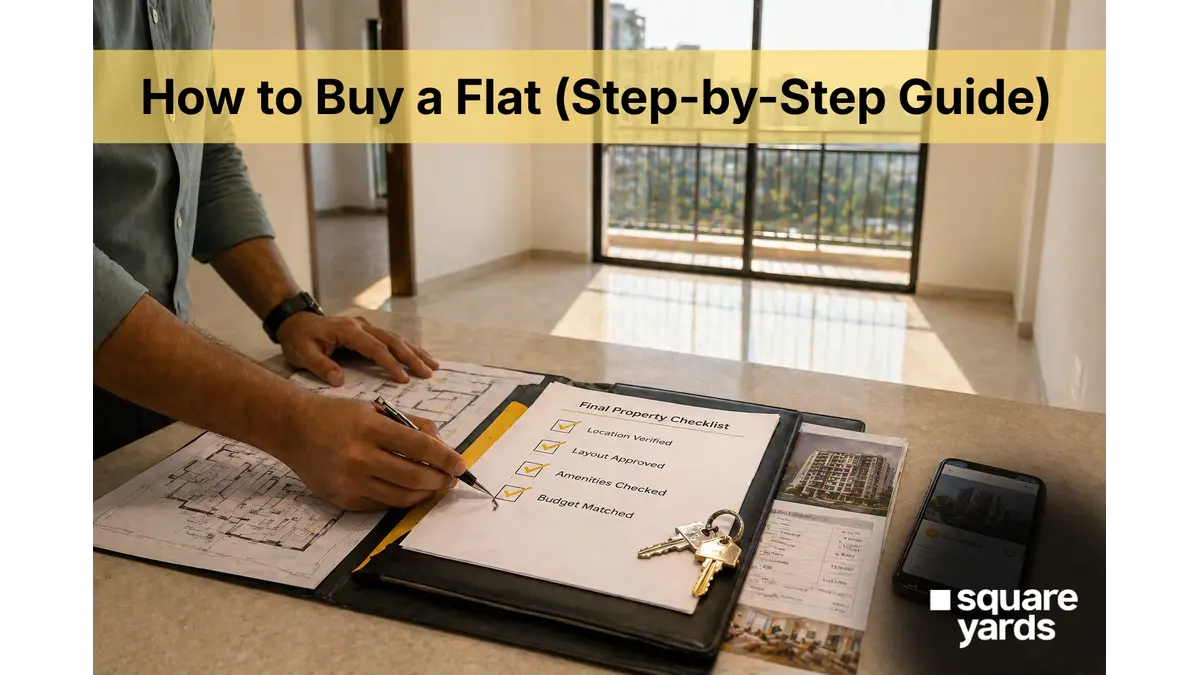
Most people think buying a flat starts with selecting a property, but there’s a lot more involved after that. You usually need to plan your budget, sort out the home loan, check documents properly, complete the paperwork, and then finish the registration before getting the keys.
For many people, buying a flat starts casually. You look at a few listings online, send screenshots to family members, discuss locations, and think about what kind of home would actually suit your daily life. But after some time, the serious questions begin. How much money should you keep aside apart from the flat cost? Is the project legally safe? What happens if the builder delays possession? If you are taking a loan, how much EMI will feel comfortable every month? These are the things that usually confuse buyers the most.
Anyone searching for how to buy a flat in India usually realises very quickly that the process is not only about choosing a property. There are site visits, paperwork, bank approvals, registration formalities, and many small decisions in between that can affect your experience later. The same goes for buyers trying to understand how to buy a flat on loan because financing changes the planning completely. This SquareYards guide explains the entire journey in a clear and practical way so you can understand each stage properly before making one of the biggest purchases of your life.
When planning to buy a flat in India, first determine your total budget by factoring in the flat cost, stamp duty (4–7% depending on the state), registration charges (1%), GST on under-construction properties (5%), and your home loan EMI capacity. If you are exploring how to buy a flat on loan, use SquareYards’ Home Loan EMI Calculator to estimate your monthly outflows before finalising the purchase.
If you are planning how to buy a flat on loan, approach banks or NBFCs such as HDFC Bank, State Bank of India, ICICI Bank, or Axis Bank for pre-approved home loan eligibility. This helps buyers understand their borrowing capacity while improving their negotiating position during the property purchase process. Common documents required to buy a flat in India include 6-month bank statements, 2 years’ ITR, Aadhaar, PAN, and salary slips.
Use filters on SquareYards to shortlist flats based on location, BHK configuration, possession status (ready-to-move vs. under-construction), amenities, and proximity to schools, offices, and metro stations.
Before making any payment, verify that the project is registered under the Real Estate Regulatory Authority on your state’s RERA portal, such as MahaRERA for Maharashtra or RERA Rajasthan. RERA registration helps buyers confirm the project’s legal status, builder accountability, and promised delivery timelines, making it an important step in understanding how to buy a flat safely.
While understanding how to buy a flat in India, it is important to hire a property lawyer to verify documents such as the title deed, encumbrance certificate, approved building plan, completion certificate for ready-to-move properties, occupancy certificate, and land use clearances (NA order). This legal verification step helps buyers avoid disputes, ownership issues, and property fraud before making the final purchase.
As part of how to buy a flat in India, negotiate not only the base selling price but also the payment plan, maintenance deposits, car parking charges, floor rise charges, and promised possession timeline. Buyers exploring how to buy a flat on loan should also clearly understand the construction-linked payment schedule for under-construction projects or the full payment requirement for ready-to-move flats before signing the agreement.
While understanding how to buy a flat in India, make sure you carefully read the Agreement to Sell (ATS), since it legally defines the agreed property price, payment timeline, possession date, and penalty terms. If you are planning to buy a flat on loan, you will generally need to pay a booking amount of around 10–20% of the flat value before the ATS is signed and registered.
If you are planning how to buy a flat on loan, submit the property documents to the bank for legal and technical verification before the loan is approved. Once the checks are completed, the bank issues a Loan Sanction Letter mentioning the approved loan amount, interest rate type (fixed or floating), loan tenure, and EMI schedule. This is an important step in the process of buying a flat in India through home financing.
During the final stage of how to buy a flat in India, pay the required stamp duty through the relevant state government portal, such as GRAS for Maharashtra properties. Once the payment is completed, visit the sub-registrar’s office to register the Sale Deed by carrying original ID proof, PAN card, property documents, and two witnesses. Property ownership is legally transferred only after the registration process is completed.
At the time of possession, inspect the flat carefully to ensure the construction quality, fittings, and promised amenities match which was committed by the builder. As part of flat buying in India, make sure you collect the Occupancy Certificate (OC), Completion Certificate (CC), and all possession-related documents before taking the keys. Once the handover is complete, you can proceed with society registration and utility connections such as electricity, water, and gas.
Before booking the flat, just make sure the basic papers are in place like RERA approval, title papers, sale agreement, OC, and CC. Most buyers ignore this part in the beginning and face issues later.
Carpet area is the space you can actually use inside the flat. Built-up area also includes the walls and balcony areas, while super built-up area adds common spaces like corridors, lifts, and the lobby.
A ready-to-move flat works better for people who don’t want to wait or deal with construction delays. Under-construction flats usually cost less, but you may have to wait a few years before getting possession.
Stamp duty varies by state. Maharashtra: 5–6%, Delhi: 4–6%, Karnataka: 3–5%, Tamil Nadu: 7%, UP: 7%. Women buyers get a 1–2% concession in most states.
The entire process takes 45–90 days for ready-to-move flats (including loan processing, due diligence, and registration). For under-construction flats, the purchase process takes 15–30 days, with possession in 1–3 years.
RERA registration is mandatory for residential projects with more than 8 units or land area exceeding 500 sq. mt. Always verify RERA registration on your state’s RERA website before booking.
Yes, you can purchase through self-funding. However, a home loan offers tax benefits under Section 80C (principal repayment up to ₹1.5 lakh) and Section 24(b) (interest deduction up to ₹2 lakh per annum), making it financially advantageous even if you have the funds.
The Agreement to Sell (ATS) is a preliminary contract that outlines the purchase terms. The Sale Deed is the final legal document that transfers ownership and must be registered at the sub-registrar’s office to be legally valid.