
Vastu Shastra is a traditional Indian system of building design, and its aim is simple: let positive energy move freely through a home. Corner Plot Vastu applies those ideas to plots that sit at a road junction, covering the plot’s direction, its layout and how the house is designed on it. The basics are easy to remember. Keep the northeast corner open, put the kitchen in the southeast and raise the southwest a little. Families who follow Vastu believe this brings happiness, good health and prosperity.
- Overview of Corner Plot
- Is a Corner Plot Good or Bad as per Vastu?
- Importance of Corner Plot as Per Vastu
- Corner Plot vs Regular Plot
- Corner Plot Vastu Direction
- Main Gate Placement on a Corner Plot
- Room Placement on a Corner Plot
- Extended Corner Plot Vastu
- Tips for Corner plot as per Vastu
- Corner Plot to Avoid
- Corner Plot Vastu Dosh Remedies
- Is a Corner Plot a Good Investment?
- Warrping Up
Overview of Corner Plot
A corner plot is a plot that sits where two roads meet, so you get road access on two adjoining sides instead of one. Corner Plot Vastu is about planning a home on such a plot so that it stays balanced. It covers where each part of the house should go, from the kitchen and bedrooms to the bathroom, balcony, stairs and main door. Corner plots already have a natural edge here. With two open sides, they usually get better ventilation, more daylight and extra room for a garden. Still, if the plot’s shape or direction isn’t right and Vastu is ignored, it can lead to a Vastu dosh that needs fixing. Below, we look at why corner plot vastu matters and how to apply it for each direction.
One quick point clears up a lot of confusion. A corner plot gets its name from the two roads, not from the direction your front door faces. So a plot with roads on the north and east is a north-east corner plot, even if you later place the main door on the east road. Facing and corner type are related, but they aren’t the same thing.
Is a Corner Plot Good or Bad as per Vastu?
It depends on which two sides have roads, so a corner plot is neither good nor bad by default. A north-east corner plot is the best of the four. On the other hand, a south-west corner plot is the one that usually needs the most care.
|
Corner plot |
Roads on |
Common Vastu view |
|---|---|---|
|
North-East (Ishanya) |
North and East |
Most favourable |
|
North-West (Vayavya) |
North and West |
Generally good; ranks second |
|
East South / South-East (Agneya) |
South and East |
Mixed; needs careful planning |
|
South-West (Nairutya) |
South and West |
Least favourable; needs remedies |
Note: Vastu sources don’t always agree on south-east and north-west corner plots, so use this table as a broad guide.
Importance of Corner Plot as Per Vastu
Getting Corner Plot Vastu right is what turns those two open sides into an advantage. When the layout follows Vastu, the home is believed to stay calm and prosperous. Here is what a corner plot offers:
- Multi-Directional Alignment: Because the plot faces two directions, you have more freedom to line up rooms and openings with north, south, east and west.
- Better Ventilation and Light: With open space on two sides, fresh air and daylight reach more of the house.
- Visual Spaciousness: The wider frontage makes the property look bigger and more open from the road.
- More Garden Space: There is usually spare land along one side for a lawn, plants or landscaping.
- Optimised Energy Flow: When the layout follows Vastu, energy is believed to move smoothly through the home, which Vastu ties to health, happiness and prosperity.
Corner Plot vs Regular Plot
A regular plot has one road and one obvious front. A corner plot has two, and that changes how you plan almost everything.
|
Point |
Corner plot (two roads) |
Regular plot (one road) |
|---|---|---|
|
Main gate |
Can go on either road; pick the north or east road where possible |
Has to sit on the one road side |
|
Light and air |
Comes in from two open sides |
Mostly from the front and back |
|
Vastu planning |
Both road directions matter, so planning takes more thought |
Planning follows one main direction |
|
Slope |
South-west highest, north-east lowest matters a lot |
Same rule, but the effect is milder |
|
Price |
Usually higher in the same layout |
Usually lower |
|
Privacy and noise |
Less privacy, more traffic on two sides |
More private |
Corner Plot Vastu Direction
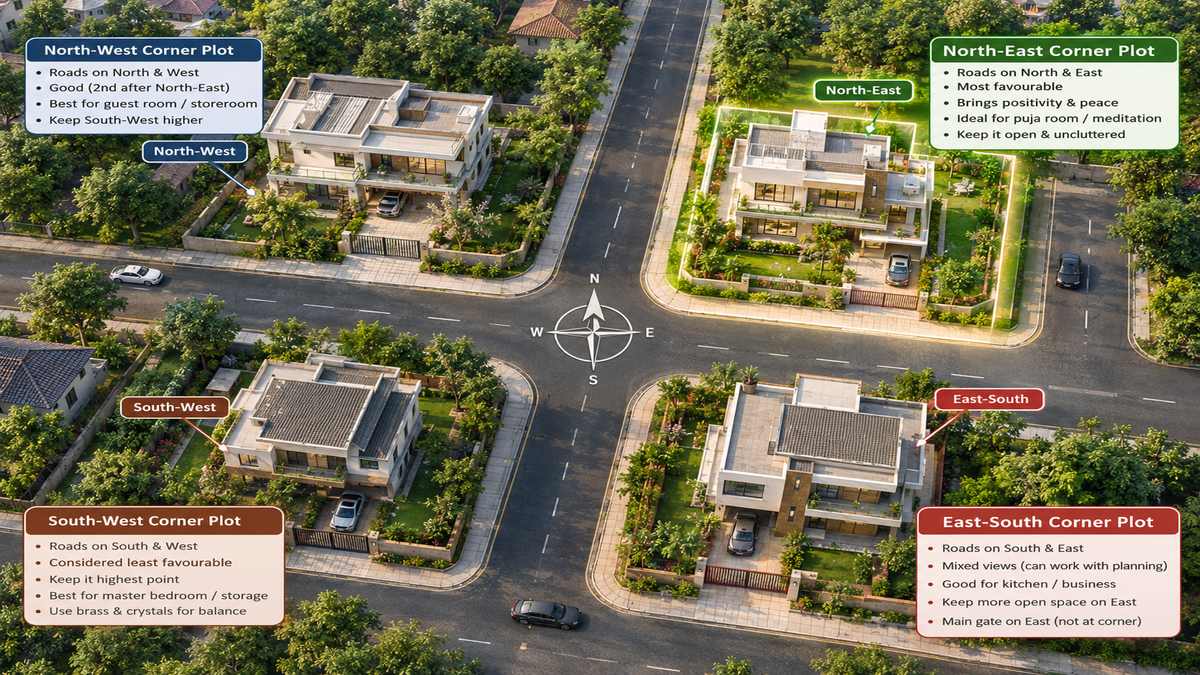
In Corner Plot Vastu, the advice changes with the direction of the plot. So, each corner has its own strengths and its own points to watch. Let’s go through them one by one.
Northeast corner plot vastu
- A northeast corner plot has roads on the north and east sides.
- Of all the corner plots, this one is seen as the most favourable.
- A northeast corner plot of Vastu is linked with positivity, spiritual growth, wisdom and peace.
- Keep this part of the plot open and uncluttered so energy can move freely.
- The northeast corner should sit lower than the southwest corner.
- It’s a good spot for a puja room or a quiet corner for meditation.
Why is this plot so popular? The east road lets in the morning sun, and the open north keeps that side of the house light. When you build, keep the heavier rooms on the south and west, and the compound wall lower on the north and east. An underground water tank or borewell also fits well in the northeast. On the other hand, keep toilets, septic tanks and heavy structures out of this corner. If the northeast corner of your plot is cut or missing, treat it as a Vastu dosh and check the remedies section below.
North-west corner plot vastu
- A north-west corner plot has roads on the north and west sides. It is generally considered good and comes second after the north-east plot, as long as the south-west corner is kept higher.
- The air element (Vayu) rules this corner, so it stands for movement, change and communication.
- It is also linked with the Moon, which Vastu connects to emotions, intuition and the mind.
- A storeroom or guest room fits well here.
- Go for light decor and air-purifying plants in this part of the house.
- Wind chimes and fragrant plants or air fresheners are also popular here.
In practice, a north-west plot is easy to work with. Put the main gate on the north road, towards its north-east end, and keep the master bedroom in the south-west of the house. The north-west zone itself suits a guest room, a storeroom or car parking. Since the west road brings in strong afternoon sun, a few trees or a covered parking area on that side also keep the house cooler. For more on parking, see our guide to Car Parking as Per Vastu.
East south corner plot vastu: Is it good or bad?
- An east south (south-east) corner plot has roads on the south and east sides. Opinions in Vastu are mixed. It can work for a home if you plan it carefully, and many guides see it as a good fit for shops or other commercial use.
- Agni, the fire element, rules this direction, which stands for energy, drive and prosperity.
- Put the main gate on the east side instead of right at the south-east corner.
- Leave more open space on the east side than on the south side.
- It’s the right zone for the kitchen, since both are tied to fire.
- If the plot has an extension, special rocks or pebbles are used to balance it.
So, should you build a home here? You can, if you plan around the fire element instead of fighting it. Keep the kitchen in the south-east of the house, open the main gate on the east road and give the northeast plenty of open space. Some families also add a small water feature in the northeast to balance the fire. Meanwhile, keep the heavier rooms in the south-west. If you’re buying for a shop, restaurant or office, this corner is often seen as a good match, since fire is linked with energy and business drive.
South-west corner plot vastu: Is it good or bad?
- A south-west corner plot has roads on the south and west sides. Most Vastu guides rank it last among corner plots. That said, you can still build a home on it with careful planning and the right remedies.
- The south-west belongs to the earth element, so it stands for stability and a strong connection to your roots.
- It is also linked with Pitru, the ancestors and departed family members.
- This should be the highest part of the plot, with the land sloping gently down towards the northeast.
- Keep the heavier rooms here, like the master bedroom and storage, and leave less open space than in the north and east.
- For extensions, brass and crystals placed in the northwest are a common way to balance them.
Here is how people usually make a south-west plot work. First, raise the south-west so it becomes the highest point, and let the land slope down towards the northeast. Next, keep the tallest and heaviest parts of the house here, such as the master bedroom, a storeroom or the overhead water tank. The compound walls on the south and west should be taller and stronger than those on the north and east. Finally, keep the main gate away from the south-west corner itself.
Timing matters a lot with this plot. It is far easier to get these points right on an empty plot than to correct a house that’s already built. So, if a seller is asking a full corner-plot premium for a south-west plot, factor in the extra planning before you agree on the price.
Thinking of buying a south-west corner plot? Before you pay a token amount, check the slope, the gate position and the plot’s shape with the Square Yards Vastu Calculator.
Main Gate Placement on a Corner Plot
With a corner plot, you get two road sides to choose from for the main gate. Vastu leans towards a gate on the north or east side. It also says not to place the gate right at the corner where the two roads meet.
|
Corner plot |
Commonly preferred gate position |
|---|---|
|
North-East |
North or east side, towards the north-east part |
|
North-West |
North side, towards the north-east part |
|
East South / South-East |
East side, towards the north-east part |
|
South-West |
South side towards the south-east part, or west side towards the north-west part |
Many owners open the main entrance onto the south or west road simply because that road is wider or busier. If you have the choice, though, Vastu prefers the north or east road. Of course, road width, traffic, parking and your approved building plan will also shape where the gate goes.
Room Placement on a Corner Plot
The room layout inside the house stays much the same, whichever corner your plot is on.
|
Room or feature |
Commonly suggested zone |
|---|---|
|
Pooja room |
North-East |
|
Kitchen |
South-East |
|
Master bedroom |
South-West |
|
Guest room or storeroom |
North-West |
|
Toilets and septic tank |
West or North-West |
|
Underground water tank or borewell |
North-East |
|
Open space and garden |
North and East sides |
The compound wall follows the same logic. Keep it lower on the north and east, and taller on the south and west.
Extended Corner Plot Vastu
Sometimes one corner of a plot sticks out beyond the square or rectangle. Vastu doesn’t treat all of these extensions the same way.
|
Extended corner |
Common Vastu view |
What is commonly suggested |
|---|---|---|
|
North-East extension |
Usually considered good |
Keep it open, clean and light, ideally as a garden |
|
North-West extension |
Usually considered a defect |
Separate it with a wall; heavy items like rocks are a traditional practice |
|
South-East extension |
Usually considered a defect |
Avoid the kitchen, main door or master bedroom in the extended part |
|
South-West extension |
Usually considered the most serious defect |
Separate it with a wall and consult a Vastu expert before building |
One simple fix works for most extensions. Build a boundary wall to cut off the extra piece, so the main plot becomes a clean square or rectangle. You can then use the separated bit as a garden or open area.
Tips for Corner plot as per Vastu
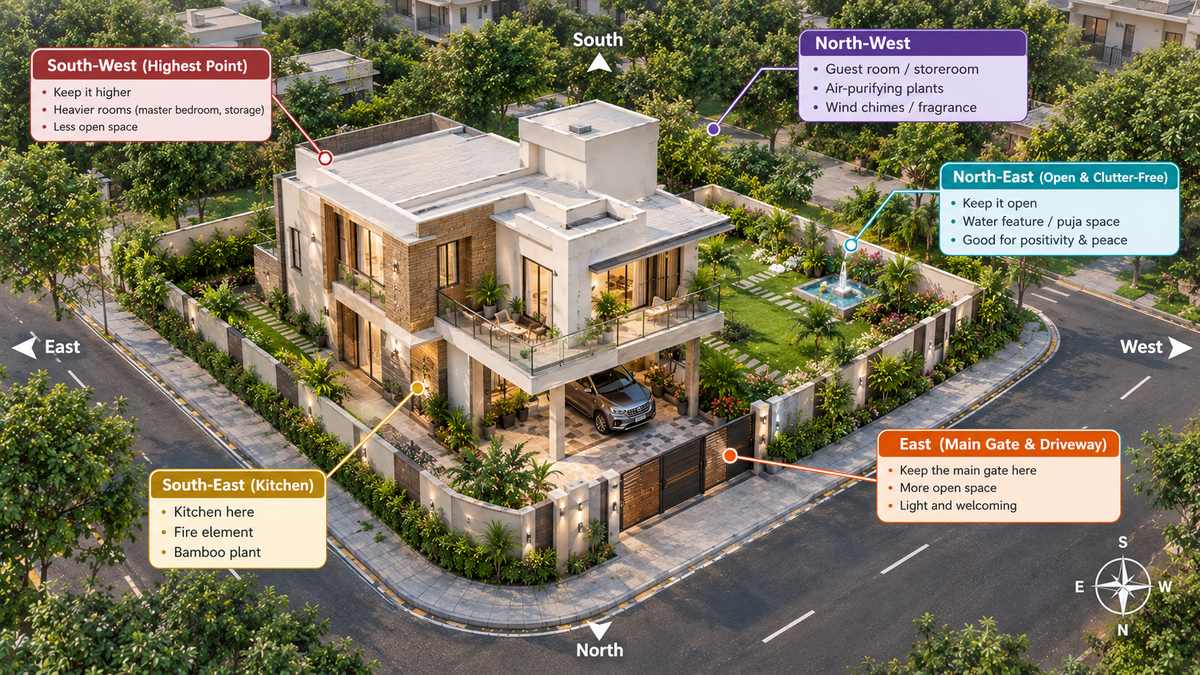
Here are some practical corner plot vastu tips to keep in mind:
- Leave the northeast corner open and free of clutter.
- Put the kitchen in the southeast, where the fire element sits.
- Keep more open space on the north and east sides than on the south and west.
- Make the southwest the highest point of the plot.
- Keep the southwest heavier and less open, so the house feels solid and secure.
- Use light decor and air-purifying plants in the northwest.
- Hang wind chimes or keep fragrant plants or air fresheners in the northwest.
- If the plot has extensions, rocks or pebbles can help balance them.
- A bamboo plant, or even a picture of one, is often placed in the southeast.
- A water feature and a Vastu Kalash in the northeast are popular choices too.
- Build the compound wall lower on the north and east, and higher on the south and west.
Corner Plot to Avoid
North and West Roads: These are called Vayavya plots (also written Vavaya), and they usually aren’t ones to avoid. In fact, they’re generally seen as good, as long as the southwest corner is kept higher than the northeast.
South and East Roads: Known as Agneya plots, these are handled with care in many Vastu guides. The concern is excess fire energy, which is believed to bring money worries and mental stress. Even so, a well-planned layout can make them work.
South and West Roads: Called Nairutya plots, these are the ones most guides suggest avoiding, since they’re linked with negative energy and instability. If you already own one, the remedies below can help.
Opposite Side Roads: Some plots have roads on two opposite sides instead. These need a closer look:
- East-West plots: A lower east side is fine. But if the west side is lower, it’s better to skip the plot.
- North-South plots: A lower north side is fine. A lower south side, however, should be avoided.
Corner Plot Vastu Dosh Remedies
Most corner plot Vastu dosh comes from one of four things: an unfavourable road direction, the wrong gate position, a cut corner or an odd shape. A cut or missing north-east corner is usually taken most seriously. Some fixes you can do right away, while others are better planned before construction starts. Traditional items are optional, and only some families use them.
|
Vastu dosh |
What you can do |
Optional traditional practice |
|---|---|---|
|
South-West corner plot |
Keep the south-west higher and heavier; place the gate away from the south-west |
Vastu pyramids |
|
East South / South-East corner plot |
Place the gate on the east side; keep the kitchen in the south-east |
Bamboo plant, Vastu Kalash in the north-east |
|
Extended corner |
Separate the extension with a boundary wall |
Rocks, pebbles, brass or crystals |
|
Gate at the exact corner |
Shift the gate along the boundary |
None needed |
|
Cut or missing corner, especially the north-east |
Keep the remaining north-east area open, clean and low; consult an architect before building |
Vastu Kalash, Tulsi plant in the north-east |
|
Low walls on the south and west |
Raise the south and west compound walls, or plant tall trees along them |
None needed |
|
Lower south-west, higher north-east |
Correct the levels during site preparation |
None needed |
Before you make any structural change, check your approved building plan and speak to a qualified architect or Vastu expert.
Is a Corner Plot a Good Investment?
Often, yes. Buyers like the extra light, airflow and frontage, and that keeps demand steady when you sell. That’s also why corner plots usually cost more than regular plots in the same layout. Before you pay that extra, though, look at the other side too:
- You’ll pay more than for a regular plot of the same size
- There’s less privacy, since two sides face the road
- Expect more traffic noise and dust
- The boundary wall is longer, so there’s more to secure and maintain
- Local rules may ask for setbacks on both road sides, which can shrink the area you can build on
Who does a corner plot suit best? It’s a good fit if you want a bright home with a garden, plan to build from scratch, or want space for a shop or clinic on the ground floor. If privacy and a quiet street matter more to you, a regular plot in the middle of a lane may be the better buy.
Before you buy, do a quick check:
- Stand on the plot and confirm both road directions with a compass app.
- Look at the slope, the shape and any cut or extended corners.
- Verify the title with Square Yards Title Search.
- See whether the price premium is fair using the Square Yards Property Valuation tool.
- Run the layout through the Square Yards Vastu Calculator.
Warrping Up
Corner Plot Vastu comes down to a few clear rules. Keep the northeast open and clutter-free, place the kitchen in the southeast and make the southwest the highest point. In return, a corner plot gives you better ventilation, more daylight and extra garden space. Each direction brings something different too, like spiritual growth in the northeast and prosperity in the southeast. Just be careful with south-west and south-east corner plots, and plan the gate and ground levels well. Get these right, and you’ll have a balanced home that also makes good practical sense.
Explore More:
| Vastu shastra |
| Pooja Room Vastu |
| Vastu for Window |
| Car Parking as Per Vastu |
Frequently Asked Questions:
1. What is Plot Corner, as per Vastu?
Vastu splits every plot into four corner zones: north-east, south-east, south-west and north-west. Think of them as four rooms of energy, each ruled by its own element, like water in the north-east and fire in the south-east. Where you put the kitchen, bedroom or gate depends on these zones.
2. Is a Corner House Good or Bad as per Vastu?
Mostly, yes. A corner house gets light and air from two sides, which Vastu likes. Still, the corner matters. If the roads are on the north and east, you’re in the best spot. If they’re on the south and east, or the south and west, the house can work, but you’ll need to plan the gate, room layout and levels with more care.
3. How many corners are in a house, as per Vastu?
Four. They are the northeast (Ishanya), southeast (Agneya), southwest (Nairutya) and northwest (Vayavya). Between them sit the four main directions: north, east, south and west.
4. What are the Benefits of a Corner Plot?
A corner plot gets light and air from two sides, looks more spacious, leaves room for a garden and gives you more freedom to align the house with Vastu. Vastu also links it with smoother energy flow.
5. Can we buy a south west corner plot?
Yes, but plan it carefully. Keep the south-west higher and heavier, place the gate away from that corner and have a Vastu expert check the layout before construction.
6. Is a corner flat good as per Vastu?
It can be. Corner flats often have windows on two sides, so they’re brighter and airier than middle units. For Vastu, though, being on the corner of the building matters less than two other things: which way your main door opens and which sides of the flat are open. A corner flat with its open sides on the north and east is a good pick.
7. Is a 5-corner house good or bad according to Vastu?
Vastu isn’t keen on 5-corner or 6-corner plots, because odd shapes leave some zones cut or stretched. That doesn’t make the plot useless, though. Most people fix it by building a boundary wall that marks out a square or rectangle for the house, and then using the leftover corners as a garden or parking.
8. Which corner plot is best as per Vastu?
The north-east corner plot, with roads on the north and east sides. The north-west corner plot comes next. Both are easier to plan than plots with a road on the south side.
9. Is a south east corner plot good for a house?
It can work, but it isn’t the first choice. Keep the kitchen in the south-east, open the gate on the east road and leave the northeast open. Many owners also find this corner well suited to a shop or office.