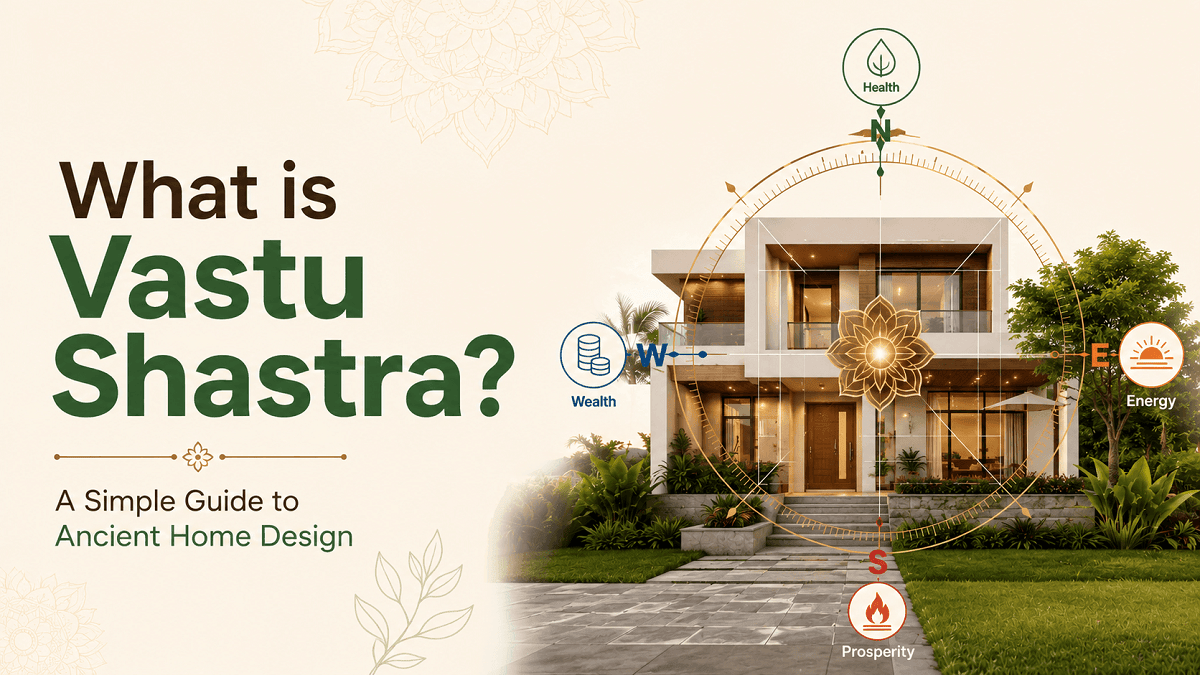
Most people hear Vastu Shastra and think it is some complex ritual-based belief system that only applies to people who are very traditional. That is not really accurate. At its core Vastu Shastra is about how the space you live in affects the way you feel, sleep, work and relate to others. It is an ancient Indian system of architecture that has been shaping how homes and buildings are designed for thousands of years and a surprising amount of it lines up with what modern architects and interior designers say about natural light, ventilation and spatial balance.
This guide covers what Vastu Shastra actually means, the five elements it is built around, how different house-facing directions work, room-by-room placement guidelines and what mistakes most homeowners unknowingly make.
What does Vastu Shastra mean and where did it come from?
The word Vastu in Sanskrit refers to a dwelling or plot of land. The root word “vas” simply means to live or reside. Shastra means doctrine or teaching. Put it together and you get the science of dwelling which is a reasonable description of what this system does.
Vastu Shastra comes from ancient Sanskrit texts called Vastu-Vidya which laid out principles for how buildings should be designed, how land should be prepared, how spaces should be arranged and how measurements should be calculated. These were practical architectural manuals not just spiritual texts. The Pink City of Jaipur built around 1727 CE and even projects like Gandhi Smarak Sangrahalaya reflect Vastu principles in their design.
What makes this system different from most architectural frameworks is that it does not just look at function and aesthetics. It considers how natural forces like sunlight, wind, geomagnetic fields and gravity interact with a built space and how those interactions affect the people living inside.
The Five Elements at the Heart of Vastu
Vastu Shastra is built around the idea that everything in the universe is made up of five fundamental elements called Pancha Bhootas. A home that balances these five elements creates an environment where positive energy flows naturally.
|
Element |
Direction |
What It Represents |
|
Earth (Prithvi) |
Southwest |
Stability and grounding |
|
Water (Jal) |
Northeast |
Flow, purification and healing |
|
Fire (Agni) |
Southeast |
Energy, transformation and heat |
|
Air (Vayu) |
Northwest |
Movement, communication and growth |
|
Space (Akasha) |
Centre |
Infinity, consciousness and openness |
Each element has a zone in the home that belongs to it. When you place a water feature in the northeast or put your kitchen in the southeast you are not following a superstition. You are aligning the function of that space with the elemental energy that naturally dominates that zone.
The Eight Directions and What Each One Means
Vastu divides a home or plot into eight directions. Each direction is governed by a specific deity and carries a distinct energy:
- North is governed by Kubera and is associated with prosperity and wealth
- South is controlled by Yama and represents strength and discipline
- East is ruled by the Sun and brings vitality, success and new beginnings
- West is governed by Varuna and connects to creativity and fulfilment
- Northeast or Ishanya is ideal for spirituality and learning
- Southeast or Agneya is linked to the fire element
- Southwest or Nairitya represents stability and grounding
- Northwest or Vayavya governs movement and change
Knowing this is useful because it tells you why certain rooms work better in certain corners of the house.
The Vastu Purusha Mandala
The Vastu Purusha Mandala is a sacred geometric grid that maps a cosmic being onto the layout of a building. Ancient texts describe Vastu Purusha with his head in the northeast and his feet in the southwest. The grid divides a site into either 64 or 81 squares. The 81-square version applies to homes and commercial buildings.
The most important zone in this grid is Brahmasthan which is the central square governed by Lord Brahma. This space should always be kept open, well-lit and free from heavy walls, columns, toilets or staircases. Traditional Indian homes used to have an open central courtyard here. In modern homes architects adapt this as an atrium or skylight. The principle is the same: keep the centre of your home breathing.
Vastu Guidelines for Different House Facing Directions
The direction your main entrance faces sets the energy tone for your entire home. Different directions have different strengths and each works well when designed the right way.
Vastu for North Facing House
North facing homes are connected to Kubera, the deity of wealth. This is why north facing properties have such a strong reputation for financial growth.
The main door placement matters a lot here. The most auspicious position is the 5th pada called Soma which is linked to the moon and is said to bring both financial benefits and spiritual wellbeing. If that is not possible the 3rd pada (Mukhya) or 4th pada (Bhallat) are good alternatives.
Key room placements for a north facing home:
- Master bedroom in the southwest, west or south corner
- Kitchen in the southeast or northwest
- Face east while cooking
- Living room in the northeast, east or north zone
- Avoid placing the staircase in the northeast direction
One practical advantage of north facing homes is that they stay cooler. They do not get harsh afternoon sun which makes them more comfortable in summer.
Vastu for South Facing House
South facing homes have an unfair reputation. The truth is a south facing home designed the right way can be just as auspicious as any other direction. It suits people with a strong Mars presence in their birth chart and the direction receives high-energy sunlight throughout the day.
The main door should be in the most favourable positions known as Vitatha (3rd pada) or Gruhakshat (4th pada). These positions are said to bring prosperity and a strong public reputation. The 4th pada specifically benefits business owners and those running factories or manufacturing units. The one entrance to always avoid in a south facing home is the southwest. That particular placement is consistently associated with financial instability and health problems.
Room placement for south facing homes:
- Master bedroom in the southwest for stability
- Kitchen in the southeast facing east while cooking
- Puja room in the northeast corner
- Bathrooms in the northwest or west
Vastu for East Facing House
East facing homes capture morning sunlight. The Sun governs this direction and brings natural light that genuinely improves health and energy levels. It is a strong direction for homes where students or professionals need focus and mental clarity.
The best positions for the main door are the 3rd pada (Jayant) and 4th pada (Indra). The Jayant position brings success that is proportional to your effort. The Indra position is said to build connections with influential people and those in positions of authority. Ancient temples like Tirupati Balaji and Jagannath Puri used these exact entrance placements.
Room placement for east facing homes:
- Master bedroom in the southwest with the bed against south or west walls
- Kitchen in the southeast facing east while cooking
- Puja room in the northeast with slightly lower ceilings than other rooms
- Bathrooms in the southeast or northwest but never in the northeast
Vastu for West Facing House
West facing homes attract evening sunlight and are associated with Saturn. This brings discipline, maturity and long-term stability when balanced well. This direction suits people in politics, leadership, creative fields and the arts.
Good main door positions are the 3rd pada (Sugreev) and 4th pada (Pushpdant). Sugreev is particularly good for traders and business people as it supports financial growth and children’s education. Pushpdant supports steady and stable financial progress over time.
Room placement for west facing homes:
- Master bedroom in the southwest corner
- Kitchen in the southeast or northwest
- Living room in the northwest, northeast or north
- Bathrooms in the northwest
- Avoid large glass windows on west walls as they bring in too much afternoon heat
Worried About Your Home Vastu? Have Vastu Consultant Advice for Your Home
Room by Room Vastu Guide for Your Home
Kitchen Direction as per Vastu
The southeast corner is the ideal location for your kitchen. This is the zone of Agni or the fire element which naturally supports cooking and promotes health. If southeast is not possible the northwest is the next best option.
Within the kitchen:
- Place the cooking stove in the southeast corner
- Always face east while cooking
- Put the sink in the northeast or north direction
- Keep the sink and stove at a distance from each other
- Never place a kitchen in the northeast which is a water zone or in the southwest
Bedroom and Bed Direction as per Vastu
How you sleep and which direction your head points during sleep has a direct impact on sleep quality. Here is what Vastu recommends:
|
Head Direction |
Effect |
|
South |
Best. Aligns with Earth’s magnetic field. Deeper sleep, better circulation |
|
East |
Good. Improves focus and mental clarity. Suits students and professionals |
|
West |
Acceptable. Can lead to vivid dreams |
|
North |
Avoid completely. Causes restless sleep, fatigue and long-term health problems |
The bed itself should be in the southwest corner of the bedroom with the headboard against the south or west wall. Avoid placing the bed under beams and never position the legs of the bed facing the bedroom entrance.
Living Room Placement
The best zones for a living room are north, east or northeast. These directions bring in natural light and create an energetically welcoming space for guests.
Practical tips for the living room:
- Place heavy sofas against the south or west walls
- The sofa should face north or east
- Put the TV unit in the southeast corner
- Avoid placing the TV or sofa in the northeast corner as this disrupts mental peace
Bathroom and Toilet Placement
The northwest is the ideal direction for bathrooms because the air element in this zone naturally supports movement and prevents moisture from stagnating. The southeast is an acceptable alternative.
When inside the bathroom the toilet seat should be positioned so you face north or south. Avoid east or west facing positions. The most important rule here is to never place a bathroom in the northeast which is the sacred spiritual zone of the home or in the southwest which is the stability zone.
Main Entrance Guidelines
Your main door sets the energy of the entire home. The best directions are north, east or northeast:
- Northeast attracts maximum positive energy from morning sunlight and supports spiritual wellbeing
- North connects with Kubera and draws wealth and financial success
- The door should open clockwise and inward so positive energy can enter freely
- Avoid south, southwest or southeast entrances as these directions are linked to financial instability, conflicts and aggressive energy in the home
How to Choose and Design Your Plot
Plot Shape and Size
Not all plots are equal in Vastu. Here is a simple guide:
|
Plot Shape |
Vastu Suitability |
|
Square |
Most auspicious. Equal energy in all directions |
|
Rectangle (1:2 ratio) |
Works well for residential use |
|
Gomukhi (narrow front, wide back) |
Good for homes and residences |
|
Shermukhi (wide front, narrow back) |
Better suited for commercial properties |
|
Triangular or L-shaped |
Avoid. Creates energy imbalance |
Slope also matters. Plots that slope toward the north or northeast invite positive energy and are considered ideal for peace and prosperity. Plots sloping toward the south or southwest can create mental stress and financial difficulties over time.
For soil quality look for red or brown coloured fertile soil. Black clay or sandy soil tends to cause dampness and structural instability which creates ongoing practical problems beyond any Vastu considerations.
Colours for Different Directions
Using the right colours in each zone of your home subtly supports the energy associated with that direction:
- North walls: Green tones promote growth
- South walls: Pink or coral red bring warmth and vitality
- East walls: White for purity and clarity
- West walls: Blue for calm and balance
- Northeast zone: Soft green or light blue to support spirituality
- Bedrooms in general: Avoid dark colours like black or deep red as these create restlessness
Most Common Vastu Mistakes Homeowners Make
These are the errors that come up most often and that are worth knowing before you build, buy or renovate:
- Placing the main entrance in the southwest blocks positive energy and invites financial instability
- Putting the kitchen in the northeast creates a direct conflict between the fire element of the kitchen and the water element of that zone which leads to health problems
- Having the master bedroom in the northeast disturbs peace and affects decision-making
- Placing a toilet in the northeast obstructs mental clarity and prosperity
- Putting an overhead water tank in the northeast causes ongoing stress. The southwest is the correct position for this
- Leaving the Brahmasthan or centre of the home cluttered blocks energy flow throughout the entire house
How Vastu Shastra Benefits Your Home and Health
When your home is designed or arranged in line with Vastu principles the most noticeable improvements tend to show up in three areas.
Better Physical and Mental Health
Homes that are oriented well for natural light and ventilation are genuinely healthier environments. This is not just a Vastu claim. Environmental psychology research consistently shows that built environments affect sleep quality, stress levels and mood. A kitchen in the southeast, good cross-ventilation and a clutter-free central area all contribute to a home that feels easier to live in day to day.
Improved Energy Flow
Decluttered spaces allow energy to move freely. Fresh air removes what feels stagnant. Keeping entrances well-lit and obstacle-free is the single most practical thing anyone can do to improve the energy of a home regardless of whether they believe in Vastu or not.
Vastu in Modern Architecture
Contemporary architects are increasingly working Vastu principles into compact apartments and sustainable building designs. Maximising natural light, optimising ventilation direction and keeping the centre of a floor plan open are all ideas that show up in both traditional Vastu texts and modern green building guidelines. Vastu-compliant properties in India also consistently show stronger resale value because a large section of buyers actively look for this.
When Should You Consult a Vastu Expert
A professional Vastu consultation makes the most sense in three situations. First when you are choosing a plot or finalising a floor plan before construction. Second when you are doing major renovation work. Third when you have moved into an existing property and want to assess what adjustments might improve the space. Experienced consultants offer site visits, detailed written reports and follow-up support.
Explore more about Vastu Shastra :
|
Vastu Topic |
Link |
|
Pooja Room Vastu |
|
|
Ganesh Murti for Home |
|
|
South West Facing House |
|
|
Wall Clock as per Vastu |
|
|
Direction for Mirror as per Vastu |
|
|
North East Facing House |
|
|
Seven Horses Painting Direction |
|
|
Vastu for Office |
|
|
Septic Tank Vastu |
|
|
Vastu Compass |
Conclusion
Vastu Shastra does not ask you to tear your home apart. It asks you to pay attention to how your home is oriented, where your key rooms are placed and whether the central space of the house is free and open. Those are not unreasonable things to think about.
Start with the basics. Check which direction your entrance faces. Make sure your bedroom is in the southwest and your head points south or east when you sleep. Keep your kitchen away from the northeast. Clear the centre of your home. These small adjustments are where most of the practical benefit comes from and they cost nothing to try.
FAQs About Vastu Shastra
1. What is Vastu Shastra in simple terms?
Vastu Shastra is an ancient Indian system of architecture that guides how homes and buildings should be designed and oriented. The name comes from Sanskrit and means the science of dwelling. It aligns spaces with natural forces like sunlight, wind and geomagnetic fields to create environments where people feel and function better.
2. What are the five elements in Vastu Shastra?
The five elements are Earth, Water, Fire, Air and Space. Earth is associated with the southwest and represents stability. Water is linked to the northeast and represents flow and healing. Fire belongs to the southeast and governs energy and heat. Air occupies the northwest and represents movement. Space sits at the centre and reflects openness and consciousness.
3. Which direction is best for a house according to Vastu?
North and east facing homes are generally considered the most auspicious. North facing homes connect with Kubera the deity of wealth and are good for financial growth. East facing homes capture morning sunlight and are associated with new beginnings and vitality. That said every direction can be auspicious when the entrance and rooms are placed correctly.
4. Which direction should your head face while sleeping according to Vastu?
South is the best direction for your head to face while sleeping as it aligns with Earth’s magnetic field and promotes deeper sleep. East is a good second option especially for students and professionals who need mental clarity. North is the one direction to avoid as it is consistently associated with disturbed sleep and fatigue.
5. What is Brahmasthan and why is it important?
Brahmasthan is the central zone of your home or plot. In the Vastu Purusha Mandala it is governed by Lord Brahma and is considered the most energetically sensitive area of any space. It should be kept open, well-lit and completely free from heavy furniture, water tanks, toilets or staircases. Blocking this area is one of the most common and impactful Vastu mistakes homeowners make.
6. Does Vastu Shastra have any scientific basis?
Several core Vastu principles align closely with modern architectural and environmental science. Orienting homes to maximise natural light, ensuring good cross-ventilation, avoiding harsh afternoon sun on living areas and keeping central spaces open are all guidelines that appear in both Vastu texts and contemporary sustainable design frameworks. While some ritual aspects of Vastu are not scientifically validated the underlying spatial and directional principles have demonstrable practical effects on comfort, health and energy efficiency.