
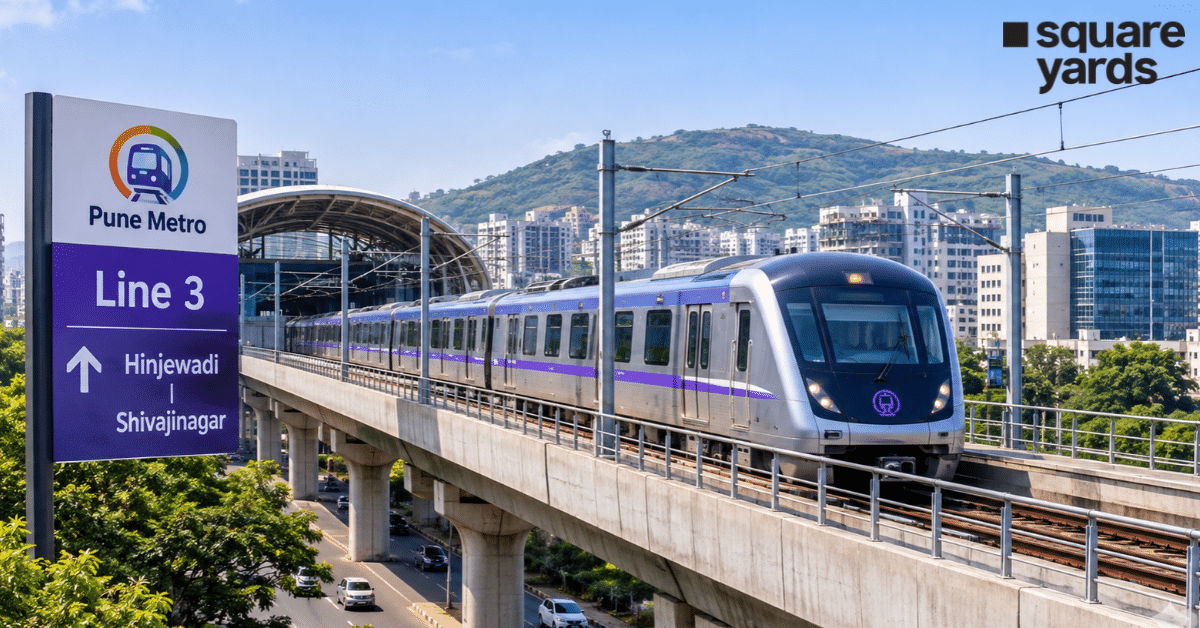
Pune Metro Line 3, connecting Hinjewadi’s IT hub with central Pune, is expected to begin passenger operations on November 4, 2026, with 17 of its 23 stations opening initially. The proposed inauguration follows safety clearance for the 23-km elevated corridor, which was developed to improve public transportation connectivity between Hinjewadi, Wakad, Balewadi, Baner, Aundh, and Shivajinagar. The project will offer an alternative to road travel along one of Pune’s busiest employment corridors, particularly for IT professionals commuting to Rajiv Gandhi Infotech Park. The remaining stations are expected to become operational after receiving the necessary safety approvals.
Pune Metro Line 3: Key project highlights
The Pune Metropolitan Region Development Authority (PMRDA) is implementing Pune Metro Line 3 under a public-private partnership model. Developed through Pune IT City Metro Rail Limited, the project is the first metro corridor in Pune to follow this implementation structure.
|
Particulars |
Details |
|
Metro corridor |
Hinjewadi to Shivajinagar |
|
Metro line |
Line 3 |
|
Total length |
23.203 km |
|
Total stations |
23 |
|
Initial operational stations |
17 |
|
Project type |
Elevated metro corridor |
|
Implementing authority |
PMRDA |
|
Development model |
Public-private partnership |
|
Project cost |
Rs 8,313 crore |
|
Main purpose |
Connecting Hinjewadi IT Park with central Pune |
Connectivity benefits and localities covered by Pune Metro Line 3
The corridor starts at Maan in Hinjewadi and terminates at the District Court station in Shivajinagar. Its alignment passes through Rajiv Gandhi Infotech Park, Wakad, Balewadi, Baner, and Aundh before reaching Pune’s central administrative and educational districts. Major stations along the route include Megapolis Society, Quadron Business Park, Dohler, Infosys Phase 2, Wipro Technologies Phase 2, Pall India, Shivaji Chowk, Hinjewadi, Wakad Chowk, Balewadi Stadium, NICMAR, Ramnagar, Laxmi Nagar, Balewadi Phata, Baner Gaon, Baner, Krushi Anusandhan, YASHADA, Savitribai Phule Pune University, RBI, Agriculture College, Shivajinagar, and District Court.
The most significant connectivity advantage will be for employees traveling to Hinjewadi’s IT parks. The existing road network is congested during office hours, mainly around Hinjewadi, Wakad, and the approach roads connecting the IT park to central Pune. Stations serving Quadron Business Park, Infosys Phase 2, Wipro Technologies Phase 2, and other commercial establishments will also make public transport more accessible to employees working within the IT park.
Wakad and Balewadi will benefit from improved access to the employment clusters in Hinjewadi and the established commercial areas of central Pune. Residents of Baner and Aundh will gain a direct metro connection to Shivajinagar, reducing dependence on road-based transport to reach educational institutions, government offices, and commercial establishments. Stations near Savitribai Phule Pune University and Agriculture College will also serve students, faculty members, and visitors.
Pune Metro Line 3: Interchange stations
Line 3 will add an important west-central connection to Pune’s existing metro network, which currently operates on two main corridors: Line 1 between PCMC and Swargate, and Line 2 between Vanaz and Ramwadi. Both corridors meet at Civil Court, the network’s principal interchange station.
The Hinjewadi-Shivajinagar corridor will connect to this interchange via a separate station near the existing Civil Court Metro station. A foot overbridge of approximately 200 meters is being developed near Kamgar Putala to connect the District Court station on Line 3 with the existing Civil Court station. This will allow passengers to transfer between Line 3 and both operational corridors without making the entire journey by road. A separate interconnection is also planned between the Line 3 station and the underground Shivajinagar station.
The interchange arrangements will give commuters from Hinjewadi and western Pune access to destinations along the PCMC-Swargate and Vanaz-Ramwadi corridors, enabling travel to several parts of the city through a connected metro system. Proposed expansions of the existing network, including extensions toward Nigdi, Katraj, Wagholi, and Chandni Chowk, will further increase Civil Court’s importance as a transfer point.
Real estate impact of Pune Metro Line 3
The metro is expected to strengthen the residential and commercial appeal of western Pune, mainly in localities where housing development has expanded alongside the city’s IT and business districts.
Market insights: Pune
|
Locality |
Average price per sq ft |
Top builders |
|
Hinjewadi |
Rs 11,500 – 13,500 |
Kolte Patil, Kumar, Vilas Javdekar |
|
Wakad |
Rs 11,500 – 13,500 |
Kolte Patil, Goel Ganga, Vilas Javdekar |
|
Balewadi |
Rs 14,500 – 16,000 |
Vilas Javdekar, Rohan, Mantra |
|
Baner |
Rs 15,000 – 17,000 |
Kolte Patil, Kumar, Vilas Javdekar |
|
Aundh |
Rs 17,500 – 19,500 |
Goel Ganga, Kumar, Rohan |
|
Shivajinagar |
Rs 21,000 – 23,000 |
Goel Ganga, Kohinoor, Rohan |
Source: Square Yards Research
Hinjewadi and Wakad are among the most directly connected markets. Hinjewadi has a strong concentration of IT campuses, commercial buildings, and large residential projects serving employees in the technology sector. Metro connectivity will enhance the appeal of housing near the IT park by addressing a key concern for residents: daily commuting. Wakad, which has evolved into a residential destination with established housing societies, shopping centers, and educational facilities, could benefit from better access to both Hinjewadi and central Pune.
Balewadi and Baner have well-developed residential and commercial property markets, with premium housing projects, office spaces, shopping centers, and established social facilities. Balewadi also has a strong commercial presence due to its proximity to the sports and entertainment facilities around the stadium. Metro access could strengthen demand for properties within convenient reach of stations, particularly among professionals seeking established residential locations without sacrificing connectivity to Hinjewadi.
Aundh has a mix of premium residential developments, established commercial establishments, hospitals, and educational institutions. The university belt includes several educational institutions and established residential areas. Line 3 will improve access to these institutions and nearby residential localities, making travel to and from the area more convenient.
Shivajinagar will benefit from its status as a central transportation and administrative district. Its existing educational institutions, government offices, and proximity to the railway station make it an important urban destination. The interchange with the existing metro lines will further solidify its position as a commercial hub.
Disclaimer: The image is generated using AI for illustrative purposes. It does not represent the actual status of the project or location.