
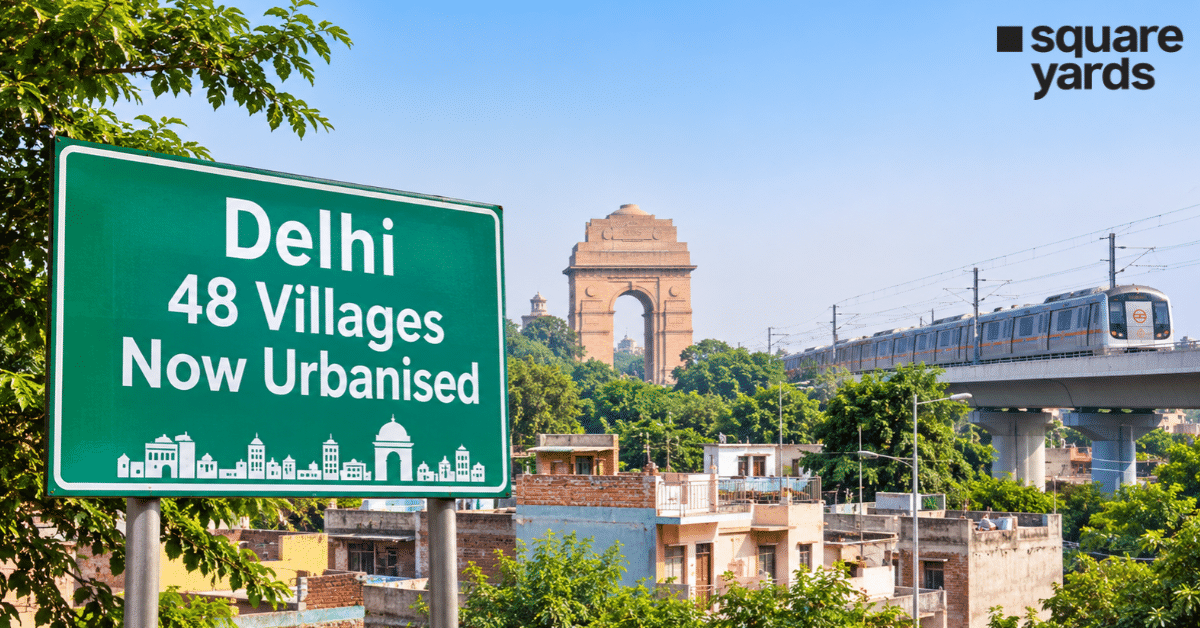
Delhi has formally brought its last 48 rural villages into the urban framework, completing the urbanization of all 357 villages in the national capital. A notification issued under Section 507(a) of the Delhi Municipal Corporation (DMC) Act, 1957, removes these villages from the rural classification and brings their old inhabited settlements, along with their entire revenue estates, under the urban category.
The development follows the Municipal Corporation of Delhi’s September approval of the proposal, which followed a DDA recommendation. The 48 villages are spread across seven revenue areas, with a significant concentration in Outer North and South-West Delhi. These include Bijwasan, Ghuman Hera, Dhansa, Fatehpur Beri, Chandan Hola, Palla, and Mungeshpur.
The decision completes a process in which 309 villages had already been urbanized in earlier phases. It also brings the remaining rural areas under Delhi’s urban planning framework, enabling better coordination of civic infrastructure, development rules, and land use.
What are the changes in administrative regulations?
The notification under Section 507(a) of the DMC Act changes the legal classification of the 48 villages from rural to urban. This matters because their development and administration will now fall under the framework governing Delhi’s urban areas.
Following a village’s urbanization, its Gram Sabha is dissolved, and its assets are transferred to the Central Government under Section 150(3) of the Delhi Land Reforms Act. The land can then be placed under the DDA’s control under Section 22(1) of the Delhi Development Act. The change also allows the MCD, DDA and other government departments to coordinate urban development more effectively. The MCD can focus on civic services such as roads, drainage, sewerage, sanitation and water supply, while the DDA oversees broader urban planning and land-use development.
The move also supports Delhi’s long-term plans under the proposed Master Plan 2047, which focuses on land pooling, green spaces, area redevelopment and development around public transport.
Land use and real estate impact in the new urban villages
The urbanization of the 48 villages brings a substantial land area into Delhi’s urban development framework. Previously, these villages continued to operate under rural land-use provisions despite increasing urban activity around them. Their agricultural land was governed by the Delhi Land Reforms Act, 1954, which restricted agricultural land use for residential, commercial, and industrial purposes. Urbanization changes their classification from rural to urban, bringing these areas under the DMC Act and the Delhi Development Act.
Bijwasan, Dhansa, and Ghuman Hera are among the largest villages in the group. Unlike developed parts of Delhi, where little vacant land is available, these villages still have large areas of agricultural and undeveloped land. The South-West Delhi villages, particularly Bijwasan, Kangan Heri, Ghuman Hera, Jhatikara, and Dhansa, could be relevant to future planned development because of their proximity to Gurugram and the airport region. Chandan Hola and Fatehpur Beri also offer potential for development within the southern urban expansion belt.
The DDA’s land pooling policy envisages planned development through landowner participation, with land assembled into larger development sectors for residential, commercial, and infrastructure purposes. The applicable planning zones, sector boundaries, and implementation decisions will determine where this applies.
The larger real estate implications could include planned residential layouts, plotted development, and commercial or logistics uses, depending on the permitted land use. Land availability also creates scope for infrastructure-led development rather than fragmented construction.
What does it mean for the residents?
For existing residents, their areas can now be integrated into urban civic planning, creating a basis for more systematic provision of roads, water supply, sewerage, drainage, street sanitation, and other municipal services. The move also aligns the classification of these villages with their ongoing urban development. As surrounding areas expanded, these villages continued to face limitations imposed by rural land-use regulations and fragmented infrastructure planning.
Residents of previously urbanized villages have reported difficulties with land mutation, which involves updating ownership details in official land records. The urbanization process has historically raised questions about ownership documentation, Gram Sabha land, and the transfer of land records.
The development also brings future construction and land-use changes under the applicable urban planning and building regulations. This provides a formal framework for development control, but residents and landowners will still need to follow the relevant approval processes. For agricultural households, the transition also carries implications for the future use and administration of land. While the change removes the rural classification, it does not mean that every agricultural parcel can immediately be converted into a residential or commercial property.
Newly urbanized villages in Delhi: Complete list
The following grouping organizes the villages into broad geographical micromarkets based on their locations. These are indicative geographical clusters and not officially notified real estate micromarkets.
|
Micromarket |
Newly urbanized villages |
Indicative price per sq ft |
|
Narela-Bawana and Outer North |
Bakoli, Hamidpur, Palla, Qulakpur, Singhola, Sungarpur Delhi, Sungarpur Shahdara, Tajpur Kalan, Tehri Daulatpur, Rajpur Kalan, Ochandi, Mungeshpur, Shahpur Garhi, Nizampur, Rasidpur, Chatesar |
Rs 2,100 – 2,900 |
|
North Delhi – Jagatpur |
Pur Delhi, Jagatpur Delhi |
Rs 3,300 – 4,900 |
|
North-West Delhi – Sultanpuri |
Sultanpur Mazara |
Rs 2,000 – 2,500 |
|
North-East Delhi – Shahdara and Burari belt |
Pur Shahdara, Sabapur Delhi, Badarpur Khadar, Baqiabad, Khanpur Khani, Jafarabad, Jagatpur Shahdara, Badarpur, Mazra, and Burari |
Rs 4,800 – 7,800 |
|
South Delhi – Chhatarpur and Fatehpur Beri |
Fatehpur Beri, Chandan Hola |
Rs 5,300 – 6,600 |
|
South-West Delhi – Bijwasan and Dwarka belt |
Badusarai, Devrala, Bijwasan, Nanak Heri |
Rs 5,200 – 5,800 |
|
South-West Delhi – Najafgarh and Dhansa belt |
Ghuman Hera, Jainpur, Jhatikara, Kangan Heri, Raghopur, Rawta, Shikarpur, Bakargarh, Dhansa, Galibpur, Issapur, Kair, Mundhela Kalan, Mundhela Khurd, Surakhpur |
Rs 2,000 – 3,000 |
|
South-East Delhi – Mayur Vihar belt |
Chak Chilla |
Rs 5,000 – 6,000 |
Source: Square Yards Research