
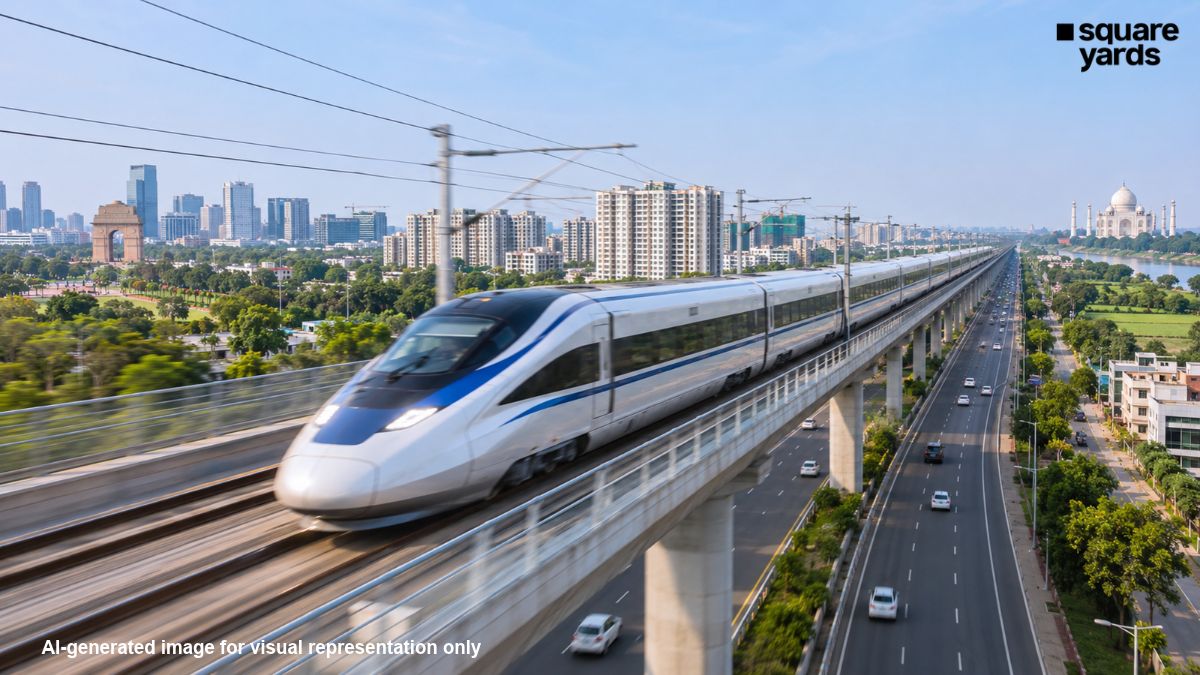
Prime Minister Narendra Modi has approved the Northern Bullet Train Corridor, bringing attention to real estate markets between Delhi and Agra. Union Railway Minister announced the approval in Varanasi on Saturday, outlining a high-speed rail network designed to reduce travel time across northern India. The project aims to improve intercity connectivity, which could influence housing demand and property investment in nearby regions. However, the extent of its impact will depend on the final railway alignment, station locations, and accessibility.
Delhi-Agra Bullet Train corridor: Journey in 59 minutes
The Northern Bullet Train Corridor will begin in Delhi and connect Agra, Kanpur, Ayodhya, Lucknow, and some northern sites. According to the Railway Minister, the Delhi-Agra journey will take just 59 minutes once the project is operational.
The proposed travel time between Delhi and Kanpur is 1 hour and 45 minutes, while Delhi to Lucknow will take 2 hours and 12 minutes. The network is expected to improve connectivity across major cities in northern and eastern India.
The project will use Indian engineering, Indian-made materials and local workers under the Make in India plan. Tickets are expected to cost much less than air tickets. However, the exact fares have not been announced.
Faster connectivity could benefit commuters and businesses
The proposed railway network could make intercity travel more convenient for working professionals, students, business owners and families. Shorter journeys may improve access to employment opportunities and commercial centers across different cities.
Improved connectivity could also influence residential preferences, with some homebuyers considering properties outside major employment hubs. Local businesses, tourism establishments and commercial developments may benefit from easier regional travel. However, the completion date and final station sites are not yet confirmed.
Delhi-Agra corridor puts property markets into focus
The proposed high-speed rail network could influence residential demand across the Delhi-Agra belt, particularly in areas that gain convenient access to future railway stations. Property rates differ widely in Delhi, Noida, Greater Noida, Jewar, Mathura and Agra. The effect on each place will depend on roads, the number of homes for sale, ease of reaching stations, and current demand.
South-East Delhi could gain connectivity advantage
Sarai Kale Khan and nearby areas could benefit if high-speed trains become easier to reach. Better links could lift interest for homebuyers, and improved transport connectivity may support interest in residential and commercial properties, although the locality-level impact remains uncertain.
Noida Expressway housing demand could strengthen
Noida’s housing projects along the Noida Expressway may attract buyers seeking better connectivity. According to Square Yards, the average apartment asking price there is about Rs 12,800 psf. Sectors 147 and 148 could gain indirectly if stations become easy to reach.
Note: The rate covers the whole Expressway area, not these two sectors.
Greater Noida could attract more homebuyers
Greater Noida offers residential developments across different price segments, making it another property market to watch as regional connectivity improves. The average apartment asking price of Greater Noida is about Rs 8,500 psf, according to Square Yards.
Faster regional travel could encourage working professionals and families to explore housing opportunities outside Delhi. However, the impact on individual neighborhoods will depend on railway accessibility and supporting transport infrastructure.
Jewar property market draws infrastructure interest
Jewar is already linked to Noida International Airport and development activity in the surrounding YEIDA region. According to the Square Yards data, average villa asking prices in Jewar stood at approximately Rs 2,200 psf in March 2026.
The proposed bullet train could add to the region’s infrastructure appeal if convenient connections become available.
Yamuna Expressway could see fresh property interest
The Yamuna Expressway corridor has several residential and commercial developments across emerging sectors of Greater Noida. Average apartment asking prices were about Rs 9,800 per sq ft in September 2026, according to Square Yards data. Demand for flats, plots and shops could rise with new rail links. Growth will also depend on local roads, infrastructure, finished housing projects and jobs.
Mathura and Vrindavan housing markets gain attention
Mathura and Vrindavan have residential markets supported by tourism, religious activities and demand for permanent and second homes. According to the Square Yards report, average apartment asking prices in Mathura stood at about Rs 9,050 psf in March 2026. Whereas Vrindavan recorded average apartment asking prices of around Rs 10,850 psf in September 2026. Better links with Delhi could bring more visitors and buyers. The effect on Itauli, Mathura and Vrindavan will depend on the final track route and station access.
Agra property market could attract buyers
Agra could experience changes in residential and commercial demand if the proposed high-speed rail corridor delivers shorter journeys from Delhi. Average apartment prices in Agra stood at around Rs 3,750 psf in September 2026. Faster travel may help residential properties, tourism businesses and shops. Developing areas near Etmadpur may also draw interest if a rail link is finalized.
Bullet train launch could influence housing demand
Once operational, the Northern Bullet Train Corridor could change how buyers evaluate residential locations between Delhi and Agra. Reduced travel time may encourage some homebuyers to consider properties outside established employment centers.
Improved accessibility could also create opportunities for local businesses, tourism, and commercial development in connected regions. For property markets along the wider Delhi-Agra belt, the next significant developments will be finalizing the railway alignment and ensuring reliable connections to nearby residential areas.