
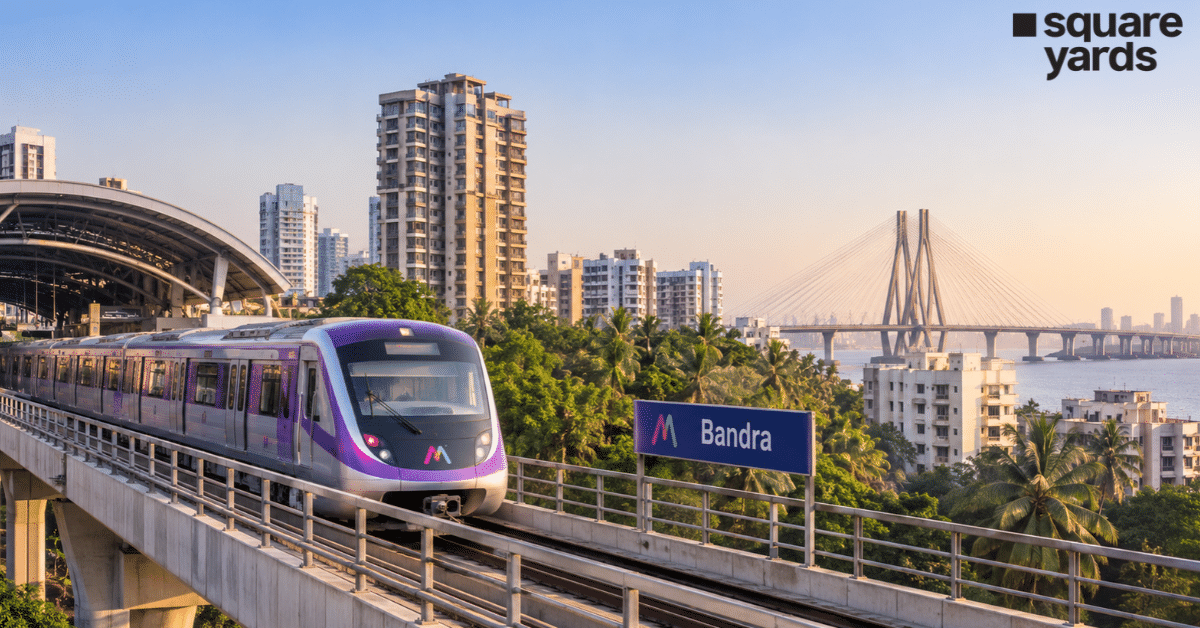
Mumbai Metro Line 2B is approaching another major construction milestone, with the MMRDA targeting November 18, 2026, to install the final three girders near Juhu Circle. The 23.64-km elevated corridor will connect D N Nagar in Andheri West with Mandale via Bandra, BKC, Kurla, and Chembur, with 19 stations planned along the route. While the Mandale-Diamond Garden section and its extension to Chembur are already operational, the next major opening is targeted for March 31, 2027, covering the 7.53-km Andheri West-Saraswat Nagar stretch. The remaining Saraswat Nagar-Chembur section is scheduled to open in 2028.
Key highlights of Mumbai Metro Line 2B
Metro Line 2B is an east-west corridor designed to connect Mumbai’s western suburbs with the eastern suburbs and major commercial districts. Its alignment brings several residential, business, and transport centers onto a single metro route, reducing the need for commuters to depend on road-based transfers between these areas.
|
Project feature |
Details |
|
Corridor |
D N Nagar-Mandale |
|
Total length |
23.643 km |
|
Number of stations |
20, all elevated |
|
Project cost |
Rs 10,986 crore |
|
Depot |
Mandale, spread across 31.4 hectares |
|
Western terminal |
D N Nagar, Andheri West |
|
Eastern terminal |
Mandale, Mankhurd |
|
Key locations covered |
Andheri, Juhu, Santacruz, Bandra, BKC, Kurla, Chembur and Mankhurd |
|
Operational sections |
Mandale-Diamond Garden and Diamond Garden-Chembur |
|
Next opening target |
Andheri West-Saraswat Nagar, March 2027 |
|
Remaining section |
Saraswat Nagar-Chembur, targeted for 2028 |
Connectivity advantages and localities covered by Metro Line 2B
Metro Line 2B will create a direct east-west connection between the western suburbs and the eastern parts of Mumbai, covering areas that currently depend heavily on suburban trains and road transport for cross-city travel. Its western section passes through D N Nagar, Juhu, Vile Parle and Santacruz, with stations at ESIC Nagar, Prem Nagar, Indira Nagar, Nanavati Hospital, Khira Nagar and Saraswat Nagar. The corridor then enters Bandra, connecting National College and Bandra Metro before reaching the commercial district of BKC.
The route continues through the Income Tax Office, ILFS, and MTNL Metro stations in BKC before reaching S G Barve Marg and Kurla East. It then moves toward the Eastern Express Highway, Chembur, Diamond Garden, Shivaji Chowk, BSNL Metro, Mankhurd, and Mandale. This alignment brings several residential pockets, educational and healthcare institutions, commercial establishments, and established transport nodes within reach of the metro.
For commuters traveling between Andheri, Juhu and Bandra, the line will provide an alternative to congested arterial roads and multiple suburban train changes. The BKC section will be particularly useful for employees traveling from the eastern suburbs and western residential areas to the business district. Similarly, residents of Kurla, Chembur and Mankhurd will gain a direct metro connection towards Bandra and Andheri, reducing dependence on buses, autos and private vehicles for longer journeys.
The line also serves areas with substantial daily movement around hospitals, educational institutions and local commercial centers. Nanavati Hospital station, for instance, will improve access to the healthcare facility, while the stations around Juhu and Santacruz will serve residential and institutional catchments. For people living in Mankhurd and Mandale, the corridor will provide a faster way to reach the western suburbs without having to make the entire journey by road or through multiple suburban rail connections.
Mumbai Metro Line 2B: Key interchanges
One of the corridor’s most important features is its integration with Mumbai’s existing and planned public transportation infrastructure. At D N Nagar, Metro Line 2B will connect with Metro Line 1, which runs between Versova and Ghatkopar. This will allow commuters from the eastern suburbs to continue toward Andheri East, Marol, and Ghatkopar. At the other end of the western section, the Bandra Metro station will provide access to Bandra’s Western Railway station.
The Income Tax Office station in BKC will connect to Metro Line 3, the Aqua Line, which links Cuffe Parade with Aarey. This interchange will provide commuters from Chembur, Kurla, and Mankhurd with access to the city’s southern business districts, including Worli, Lower Parel, and the island city. The Kurla East station will connect to the suburban railway network, including the Central Railway station and Lokmanya Tilak Terminus. It will also link to Metro Line 4, which is under development between Wadala and Kasarvadavali.
Further east, Chembur station provides access to the Harbor Line and the Mumbai Monorail. The metro station is around 200 meters from Chembur railway station and approximately 100 meters from the V N Purav Marg Monorail station. Mankhurd will provide another connection with the Harbor Line. The corridor’s integration with these networks makes it more than a standalone east-west route. It will serve as a connecting link between multiple metro corridors, suburban rail services and the Monorail, allowing commuters to plan journeys across different parts of Mumbai with fewer road-based transfers.
Key interchanges at a glance:
- D N Nagar – Metro Line 1 (Versova-Ghatkopar)
- Income Tax Office (BKC) – Metro Line 3 (Cuffe Parade-Aarey)
- Kurla East – Metro Line 4 (Wadala-Kasarvadavali)
- Chembur – Mumbai Monorail (Sant Gadge Maharaj Chowk-Chembur)
- Bandra Metro – Western Railway (Churchgate-Dahanu Road)
- Chembur – Harbor Line (CSMT-Panvel)
- Mankhurd – Harbor Line (CSMT-Panvel)
Real estate impact of Mumbai Metro Line 2B
The real estate impact of Metro Line 2B will vary across its route because the corridor passes through established premium residential markets, commercial districts, and emerging redevelopment locations. In Andheri West, the line will improve connectivity in an established residential area with media offices, shopping centers, educational institutions, and popular neighborhoods such as Lokhandwala and Versova. Its benefits will be relevant to areas around Juhu Circle and ESIC Nagar, where access to the wider western and eastern suburbs will improve.
Price insights: Mumbai
|
Locality |
Average price per sq ft |
Top builders |
|
Andheri West |
Rs 38,000 – 55,000 |
Lodha, Kalpataru, Hiranandani |
|
Juhu |
Rs 50,000 – 80,000 |
Lodha, Kalpataru, Rustomjee |
|
Santacruz |
Rs 28,000 – 65,000 |
Kalpataru, Rustomjee, Wadhwa Group |
|
BKC |
Rs 45,000 – 65,000 |
Sunteck, DB Realty, Parinee Realty |
|
Kurla |
Rs 22,000 – 32,000 |
Ruaparel, Piramal, Om Developers |
|
Chembur |
Rs 25,000 – 45,000 |
Kalpataru, Hiranandani, Rustomjee |
|
Mankhurd |
Rs 18,000 – 29,000 |
DB Realty, Charisma, Mangal Moorti |
Source: Square Yards Research
Juhu and Santacruz have more established, land-constrained residential markets, with redevelopment playing an important role in adding new housing supply. Improved access to BKC and Kurla could make it attractive for professionals working in these business districts. Bandra East and BKC will benefit from easier access to residential catchments across both sides of the city. BKC’s concentration of corporate offices and financial institutions makes the metro connection particularly relevant for its commercial property market.
Further east, Kurla has a distinct property market shaped by railway infrastructure, commercial activity, wholesale businesses and redevelopment. The new connection could improve the appeal of residential pockets away from the main transport junctions. Chembur’s established residential market and ongoing redevelopment will benefit from an additional transport option alongside its existing railway, monorail, and road links. Mankhurd and Mandale could see greater interest as improved connectivity makes these eastern locations more accessible to employment and commercial districts across Mumbai.
Disclaimer: The image is generated using AI for illustrative purposes. It does not represent the actual status of the project or location.