
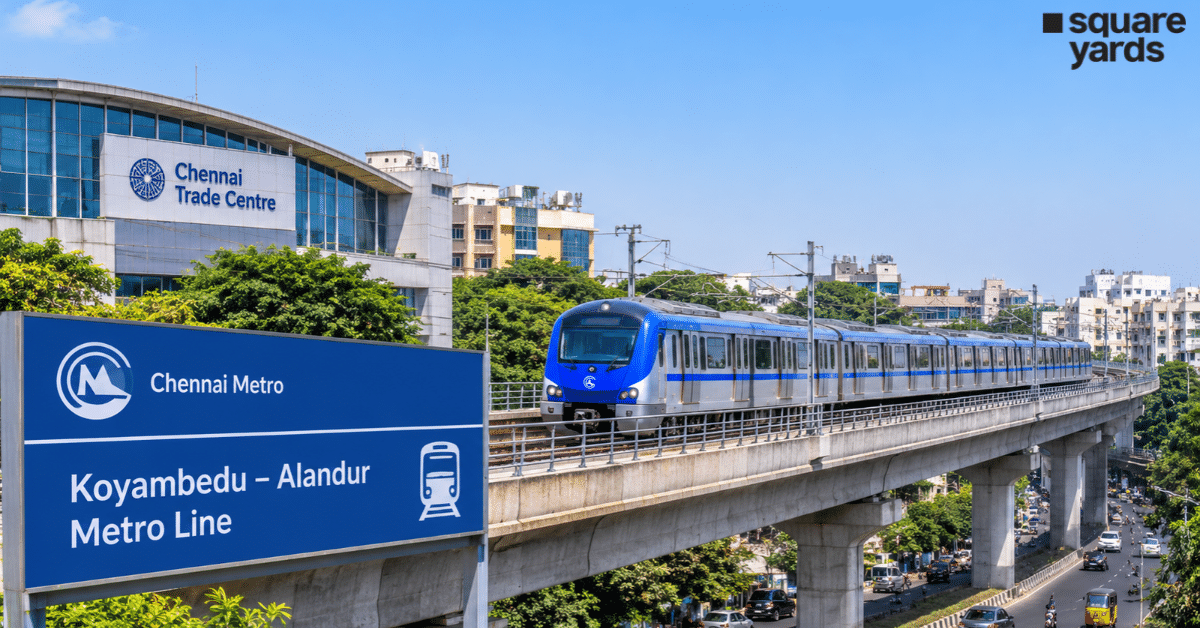
Chennai Metro Rail Limited has set a 45-day target to complete the remaining track-laying work between Chennai Trade Center and Alandur on the Phase II Red Line. The nearly 15-km Koyambedu-Alandur stretch will form part of Corridor 5, connecting Koyambedu with Alandur through several established areas, including Virugambakkam, Valasaravakkam, Ramapuram and Manapakkam. The elevated line will improve access to the Metro network for western Chennai residents and provide connections to the existing Blue and Green lines at Alandur and Koyambedu. It will also serve important destinations such as the DLF IT SEZ and Chennai Trade Center. The section is expected to open in 2027, with March being the projected target.
Koyambedu-Alandur Metro project highlights
The Koyambedu-Alandur section is part of Chennai Metro Phase II’s 47-km Red Line, which will eventually connect Madhavaram Milk Colony with Sholinganallur. The initial operational section will cover several established residential, commercial, and institutional areas in western Chennai. Its alignment also includes elevated infrastructure shared with the Phase II Yellow Line, allowing the two corridors to serve overlapping parts of the city.
|
Project feature |
Details |
|
Metro corridor |
Corridor 5 (Red Line) |
|
Project phase |
Chennai Metro Phase II |
|
Section |
Koyambedu to Alandur |
|
Approximate section length |
15 km |
|
Total Red Line length |
47 km |
|
Total Red Line stations |
45 |
|
Remaining track work towards Alandur |
Approximately 4.5 km |
|
Expected opening |
March 2027 |
Connectivity advantages and localities covered
The Red Line will pass through Koyambedu Market, Natesan Nagar, Virugambakkam, Alwarthirunagar, Valasaravakkam, Karambakkam, Alapakkam, Mugalivakkam, Ramapuram, Manapakkam, Chennai Trade Center and Butt Road before reaching Alandur. This alignment connects several western Chennai residential areas with major commercial and transport destinations.
For commuters, the biggest advantage is the additional travel option across the Arcot Road and Mount-Poonamallee Road belts. Residents of Virugambakkam, Valasaravakkam and Alwarthirunagar will gain access to the wider Metro network without depending entirely on road-based transport. Stations around Ramapuram and Manapakkam will also serve employees and visitors traveling to the DLF IT SEZ, offices along Mount-Poonamallee Road, and the Chennai Trade Center.
The southern section will improve access to Butt Road and Alandur, while the northern end will connect passengers to Koyambedu’s wholesale market and bus terminal area. This will provide residents of western Chennai with a direct Metro connection to Koyambedu’s bus terminal and wholesale market, the DLF IT SEZ, Chennai Trade Center, and the interchange stations at Alandur, reducing their reliance on long road trips and multiple bus transfers.
Interchanges within the Chennai Metro network
The Koyambedu-Alandur section is expected to link Corridor 5 to the existing Phase I network and other Phase II routes. At Koyambedu, passengers can interchange with the operational Green Line, which connects Chennai Central to St Thomas Mount. The station also provides access to the CMBT transport complex.
At Alandur, the Red Line will connect with both the Blue and Green lines. The Blue Line provides access to Guindy, the airport, and northern Chennai, while the Green Line connects passengers to central Chennai and St Thomas Mount. This interchange will make the new section useful for commuters traveling beyond the western suburbs.
The Red Line will eventually extend from Koyambedu toward Madhavaram in the north and Sholinganallur in the south. Its southern alignment will connect to St Thomas Mount, where passengers can access the suburban railway network. The complete corridor will create a north-south connection across several parts of Chennai that currently have limited direct Metro access.
Real estate impact of the Koyambedu-Alandur Metro
Price insights: Koyambedu-Alandur belt
|
Locality |
Average price per sq ft |
Top builders |
|
Koyambedu |
Rs 6,900 – 13,300 |
Radiance Realty, Ramaniyam, Akshaya |
|
Virugambakkam |
Rs 8,000 – 14,000 |
Ceebros, Royal Splendour, Appaswamy |
|
Valasaravakkam |
Rs 8,000 – 13,200 |
Radiance Realty, ETA Star, Ceebros |
|
Mugalivakkam |
Rs 7,000 – 11,500 |
Shriram, India Builders, Royal Splendour |
|
Ramapuram |
Rs 8,000 – 12,000 |
Kgeyes, Step Stones, Appaswamy |
|
Manapakkam |
Rs 8,500 – 12,500 |
Shriram, TVS Emerald, DLF |
|
Alandur |
Rs 7,200 – 10,800 |
Casagrand, Appaswamy, Rajni Foundation |
Source: Square Yards
The project will affect property markets differently along its alignment. Koyambedu’s property market is driven by its wholesale market, bus terminal, warehouses, hotels, and nearby commercial establishments. The proposed redevelopment of the former CMBT site, spanning about 36 acres, could bring additional retail, hotel, and office projects to the area. The new Metro connection will make these commercial spaces easier to reach, enhancing Koyambedu’s appeal as a business and trading destination.
Virugambakkam and Valasaravakkam have well-established housing markets with apartments, independent houses, local shops, and civic facilities. Their location between central Chennai and the western suburbs makes them popular with homebuyers. The new Metro line could boost their appeal by giving residents a direct connection to other parts of the city. Valasaravakkam could also attract more tenants seeking an established residential area with convenient Metro access.
Mugalivakkam, Ramapuram, and Manapakkam have seen growth in both housing and office developments, especially around the DLF IT SEZ and Mount-Poonamallee Road. Manapakkam is a popular residential location for people working in nearby offices. The Metro will connect these areas directly to Koyambedu and Alandur, making daily travel easier for residents and office workers. The new stations could also encourage more housing and commercial projects in Ramapuram and Mugalivakkam.
The Chennai Trade Center and Butt Road areas have several exhibition venues, offices, institutions, and residential properties. The Metro will make it easier for visitors and businesses to reach the Trade Center during exhibitions and events. It could also increase demand for nearby office spaces, hotels, and other commercial properties. Alandur is already a major Metro interchange with several offices, commercial establishments, and institutions nearby. The new Corridor 5 connection will further enhance its importance as a transport and business hub.
Disclaimer: This image is generated using AI for illustrative purposes. It does not represent the actual status of the project or location.