
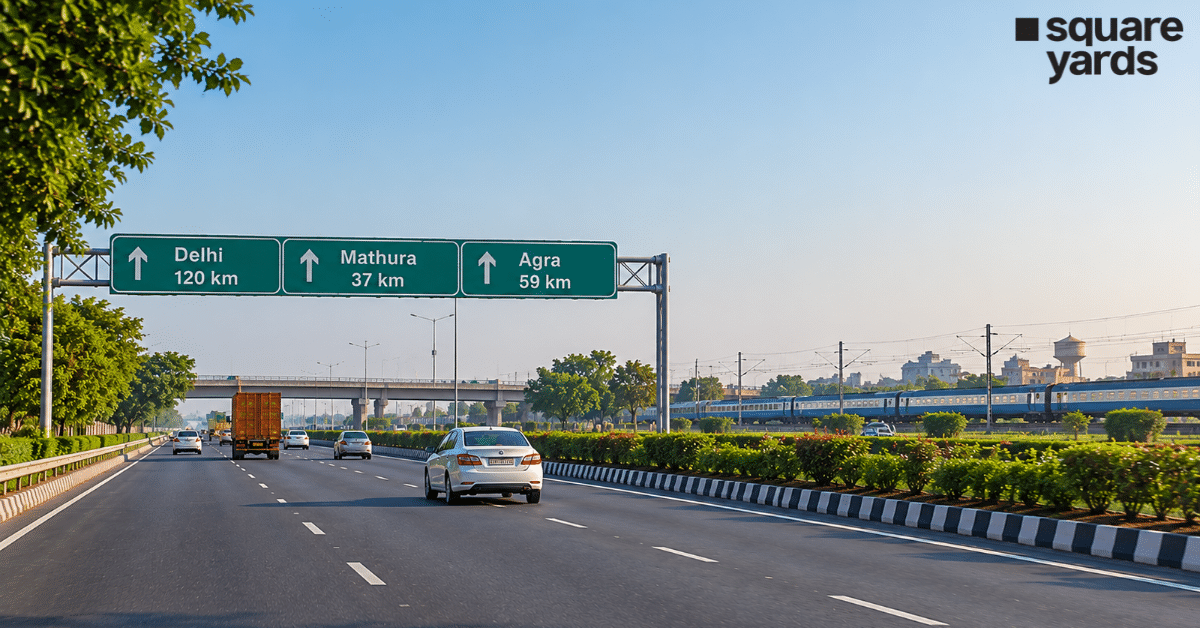
The Delhi-Agra road corridor is set for a major infrastructure upgrade, with road development projects worth Rs 1,123.56 crore receiving approval on November 17, 2026. The project will cover sections of National Highways 44 and 19 across Haryana’s Faridabad and Palwal districts and Uttar Pradesh’s Mathura and Agra districts. It includes three road overbridges, four flyovers and four vehicle underpasses to address congestion at railway crossings and busy road intersections. The corridor currently handles approximately 68,000 passenger car units of traffic every day, including freight, industrial, commuter and tourist vehicles. The proposed improvements aim to streamline traffic movement between Delhi, Haryana and Uttar Pradesh while improving road safety and reducing delays along the route.
Delhi-Agra Corridor: Key highlights
The approved project focuses on improving traffic movement along the existing highway network rather than developing an entirely new road corridor. Its key features include:
|
Project details |
Information |
|
Project cost |
Rs 1,123.56 crore |
|
Corridor |
Delhi-Agra |
|
National highways covered |
NH-44 and NH-19 |
|
States covered |
Haryana and Uttar Pradesh |
|
Districts covered |
Faridabad, Palwal, Mathura and Agra |
|
Road over bridges |
3 |
|
Flyovers |
4 |
|
Vehicle underpasses |
4 |
|
Daily traffic volume |
Approximately 68,000 PCUs |
|
Primary objective |
Reduce congestion, improve connectivity and enhance road safety |
Infrastructure works along the Delhi-Agra Corridor
The infrastructure package includes three main types of road structures, supported by service road improvements. Each component addresses a different source of congestion along the corridor.
Three road over bridges
The corridor carries substantial freight and industrial traffic alongside private vehicles and passenger transport. Three ROBs will be constructed to address delays at railway crossings. At these locations, road traffic often has to wait for trains to pass, resulting in vehicle queues that can extend onto adjoining roads. The new bridges will allow vehicles to cross railway tracks without stopping for passing trains.
Four flyovers
The project will also include four flyovers at busy road intersections. These structures will allow traffic travelling along the highway to bypass selected junctions instead of waiting at ground-level crossings. The improvements are expected to reduce congestion at existing bridges and road intersections, where local and through traffic currently compete for road space.
Four vehicle underpasses
Four VUPs will be developed to facilitate movement between areas located on either side of the highway. These structures will allow local vehicles to cross beneath the main road without disrupting traffic travelling along the highway.
Connectivity benefits of the Delhi-Agra Corridor
The project will cover four districts across Haryana and Uttar Pradesh. These areas have different traffic requirements, ranging from daily commuting and industrial transportation to tourism and intercity travel.
Faridabad
Faridabad’s position as an industrial and residential centre makes it one of the key stretches along the Delhi-Agra highway. The route handles daily commuter traffic between Delhi, Ballabhgarh and Palwal, alongside freight movement linked to the city’s industrial establishments. Railway crossings and busy intersections, particularly around Ballabhgarh, add to travel delays. The proposed ROBs and grade-separated junctions will address these bottlenecks, allowing industrial vehicles and daily commuters to move through the stretch with fewer interruptions.
Palwal
Palwal connects southern Haryana with Mathura and other parts of Uttar Pradesh, making it an important transit point for passenger and commercial traffic. Its highway network also serves nearby industrial areas and residential developments. The project proposes two flyovers in the district, along with underpasses at locations including Mitraol and Mundkati Chowk. These structures will provide dedicated crossing points for local traffic while allowing vehicles travelling towards Delhi and Agra to pass through without negotiating busy road-level intersections.
Mathura
Mathura’s importance as a religious tourism destination brings considerable traffic to the Delhi-Agra highway, particularly from Delhi-NCR and neighbouring states. The route also serves local commuters and commercial vehicles travelling between Haryana and Uttar Pradesh. By addressing congestion along this stretch, the proposed road structures will make access to Mathura’s major attractions more convenient and provide a smoother connection towards Palwal and Agra.
Agra
Agra’s tourism, hospitality and commercial sectors depend significantly on its road connections with Delhi and other cities in Uttar Pradesh. The Delhi-Agra highway carries visitors heading to the Taj Mahal and other attractions, as well as local passenger and freight traffic. The proposed flyovers, ROBs and underpasses will ease movement at identified congestion points, helping separate through traffic from vehicles accessing local roads and commercial areas.
Delhi-Agra Corridor: Impact on real estate
The infrastructure upgrade has implications for real estate across Faridabad, Palwal, Mathura and Agra, particularly in areas that depend on the highway for commuter and commercial connectivity.
In Faridabad, the improvements are relevant to residential and industrial areas along the NH-44 corridor. The city has an established industrial base, and highway connectivity plays an important role in the movement of workers, goods and commercial vehicles. Reducing delays at railway crossings and major intersections could improve access between industrial areas, residential localities and adjoining districts.
Residential development, plotted projects and industrial activity form important parts of its property market in Palwal. Its location between Faridabad and Mathura also makes highway connectivity relevant to people commuting between these areas. The proposed flyovers and underpasses could improve access to locations along the highway, particularly those that currently experience delays at major junctions.
In Mathura, the project is relevant to both residential and commercial real estate. The city’s tourism economy supports demand for hotels, guest houses, retail establishments and other visitor-oriented businesses. More efficient highway movement could benefit properties and commercial establishments that depend on tourist traffic. It could also improve connectivity for residents travelling towards Delhi-NCR and Agra. Agra’s established tourism and commercial sectors stand to benefit from smoother movement along the highway. Better access between Mathura and Agra could support businesses linked to tourism, hospitality and retail, while improving connectivity for residents and local businesses.
Disclaimer: The image is generated using AI for illustrative purposes only. It does not represent the actual status of the project or location.