
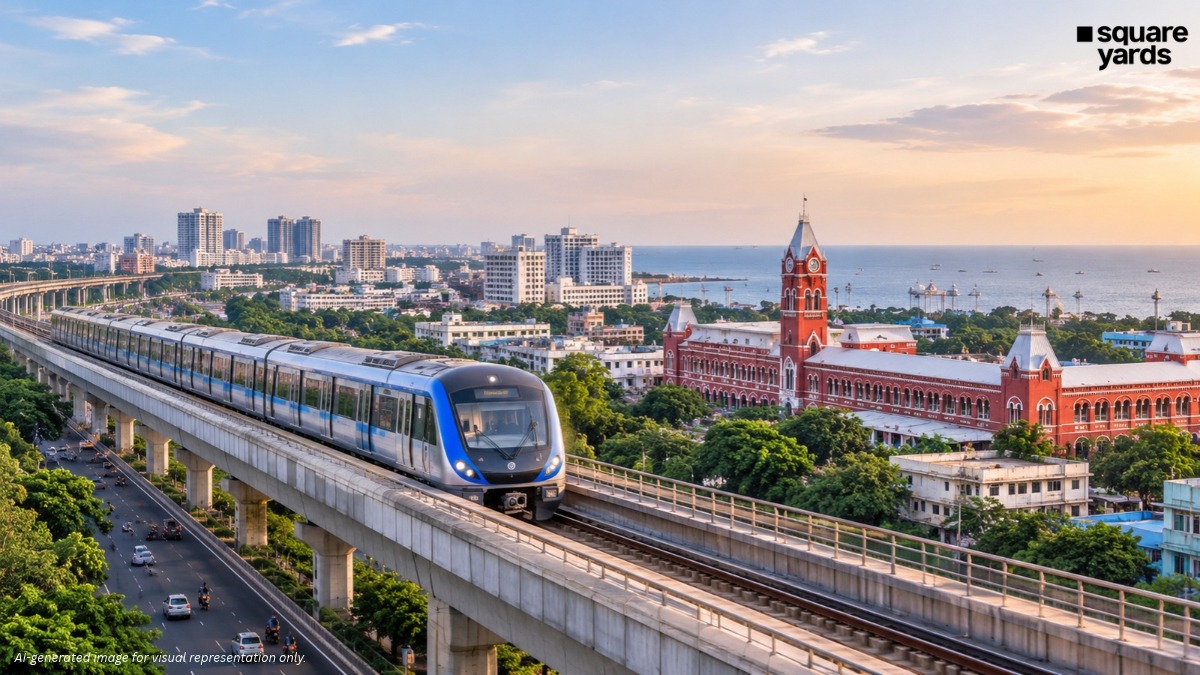
The Tamil Nadu government, on November 11, 2026, sanctioned Rs 45.5 crore to prepare an Integrated Master Plan for the expanded Chennai Metropolitan Area (CMA), bringing a 5,904-sq-km region under a common long-term development framework.
The exercise is significant as the city’s urban footprint extends well beyond its traditional limits, towards Sriperumbudur, Kancheepuram, Chengalpattu, Tiruvallur and other surrounding growth centres.
A regional master plan can influence which areas are earmarked for residential and commercial development, where industrial and logistics activity can expand and which transport and civic infrastructure corridors may support future growth.
Why has Chennai’s metropolitan area been expanded?
The expansion reflects the way the city’s economy and residential development have spread across district boundaries. Areas such as Sriperumbudur, Kancheepuram, Chengalpattu and Tiruvallur have become increasingly connected to Chennai through industrial activity, employment, housing and transport networks.
People may live in one district, work in another and depend on Chennai for specialised healthcare, education, business and other services. Infrastructure in these locations is therefore closely linked to the functioning of the wider metropolitan region.
The expansion has increased the CMA from approximately 1,189 sq km to 5,904 sq km. The expanded area includes contiguous parts of Kancheepuram, Tiruvallur, Chengalpattu and Ranipet districts.
The enlarged CMA currently has three broad planning jurisdictions:
|
Existing planning arrangement |
Area |
|
CMDA planning area |
1,189 sq km |
|
Local planning areas under (DTCP) |
1,617 sq km |
|
Areas outside a formal planning framework |
3,098 sq km |
|
Total expanded CMA |
5,904 sq km |
Chennai Metropolitan Development Authority (CMDA)*
Local planning areas under Directorate of Town and Country Planning (DTCP)*
More than half the expanded region falls outside a formal planning framework. The new exercise is expected to address this gap and provide a coordinated approach to development across the entire metropolitan area.
What will the comprehensive master plan change?
The master plan is expected to establish a long-term framework for:
- Land-use planning and the distribution of residential, commercial, industrial and institutional development.
- Integrated transport and regional connectivity.
- Housing requirements and future employment centres.
- Water security, drainage and flood management.
- Environmental protection, climate adaptation and sustainable use of natural resources.
- Social infrastructure, public amenities and digital infrastructure.
- Implementation, monitoring and coordination between government agencies.
Real estate impact: Which areas could benefit?
The expanded CMA creates a much larger geography for future development planning. A coordinated framework could make some peripheral markets more attractive for long-term investment.
Sriperumbudur and the western industrial belt
The western side of the metropolitan region has an established industrial and manufacturing presence. A more coordinated approach to transport, logistics, worker housing and supporting commercial infrastructure could strengthen the relationship between industrial employment centres and nearby residential markets.
This may create opportunities for housing, rental accommodation, warehouses, industrial support services and commercial development. However, the actual locations suitable for each use will depend on the final zoning and infrastructure proposals.
Kancheepuram and its surrounding areas
Kancheepuram has the potential to play a larger role within the expanded metropolitan region. Better regional transport planning and the identification of suitable development areas could support residential, commercial and institutional activity. Its future growth will depend on how effectively it connects with Chennai and other employment centres.
Chengalpattu and the southern growth corridor
Chengalpattu and its surrounding areas are important to the southern expansion of the metropolitan region. A clearer planning framework could help coordinate housing, industrial activity, transport and civic infrastructure as development spreads further from the city. Areas with stronger access to transport and employment centres may attract greater interest, subject to the final land-use plan.
Tiruvallur and the northern growth belt
The northern side of the metropolitan region has a mix of industrial, logistics and residential activity. Better integration of roads, transport networks and employment locations could support further development in suitable areas. The master plan may also help address the infrastructure requirements of settlements that are urbanising without a common regional framework.
Peripheral villages and emerging town centres
The impact may be particularly important for smaller towns and villages that are now part of the expanded CMA. Their inclusion in a wider planning exercise could bring more clarity on development permissions, infrastructure requirements and future land use. But it could also mean that environmentally sensitive or infrastructure-constrained locations face restrictions on construction.
These are regional development possibilities, not confirmed project announcements or predictions of property-price increases.
Water security and flood management
The wider metropolitan region includes rivers, lakes, reservoirs, wetlands and coastal systems that extend beyond the boundaries of the core city. These natural features are connected to drinking water supply, groundwater recharge and flood management. Construction that blocks drainage channels or encroaches on water bodies can create risks that affect neighbourhoods far beyond the immediate development site.
CMDA’s own planning documents identify the challenge of balancing water security with flood management across the metropolitan area. The expanded master plan is expected to consider catchment protection, groundwater replenishment, climate adaptation and environmental resilience alongside future land use.
This could have a direct bearing on real estate. Areas with adequate water infrastructure, drainage capacity and access to civic services may be better placed to accommodate residential and commercial growth. Locations with flood exposure, restricted development conditions or environmental sensitivities may face tighter planning controls.
Project status: Government sanctions Rs 45.5 crore, consultant selection next
The government has now moved the planning exercise into its formal implementation stage. The sanctioned amount will be released over three financial years:
|
Financial year |
Allocation |
|
2026 – 27 |
Rs 10 crore |
|
2027 – 28 |
Rs 22 crore |
|
2028 – 29 |
Rs 13.50 crore |
|
Total |
Rs 45.50 crore |
A long-term planning shift for Chennai’s real estate market
The expanded region already functions through interconnected housing, employment, industrial and transport networks. What has been missing is a common framework to guide how these networks develop and where future growth should be supported. The new master plan is intended to address that gap.
For real estate, its significance lies in where housing can expand, which industrial and commercial locations receive supporting infrastructure, how peripheral towns connect to employment centres and which natural areas need protection.