
The proposed Delhi Metro Phase V(B) expansion includes eight corridors, including a link between Yashobhoomi in Dwarka and Rajiv Chowk in Gurugram. The other seven routes have Delhi government approval and are awaiting clearance from the Center. Together, those seven corridors are planned to have 65 stations, according to reports.
The proposal could improve access to outer and densely populated parts of Delhi and create a new Metro connection between Dwarka and Gurugram. However, the routes are still pending approval, and no construction or opening dates have been announced for Phase V(B).
Delhi Metro Phase V(B): Proposed route details
|
Proposed corridor |
Reported details |
|
Yashobhoomi Dwarka Sector 25–Rajiv Chowk, Gurugram |
Submitted for approval. A July 2026 DPR proposed a 20-km underground corridor with five stations; the alignment and stations remain subject to approval. |
|
Dhaunsa Bus Stand (Najafgarh)–Nangloi |
11.9 km; nine elevated stations, with interchanges at Nangloi and Dhansa Bus Stand. |
|
Central Secretariat–Kishangarh |
15.9 km; 10 stations, including nine underground. |
|
Samaypur Badli–Narela DDA Sports Complex |
12.9 km; eight elevated stations, extending the Yellow Line. |
|
Kirti Nagar–Palam |
9.9 km; six stations, including five underground, extending the Green Line. |
|
Jor Bagh–Mithapur |
Nearly 17 km; 12 stations, including seven underground. |
|
Mayur Vihar Phase III–Shastri Park |
13.2 km; eight stations, including a 9-km underground stretch. |
|
Keshav Puram–Rohini Sector 34 |
16.3 km; 12 elevated stations. |
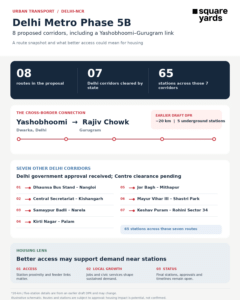
The seven Delhi-approved routes await the Center’s approval. The Yashobhoomi–Gurugram link is also proposed for Phase V(B), but its details are based on an earlier draft DPR and may change. That draft outlined a route through Bijwasan, Kapashera, Sector 22, and IFFCO Chowk, with five underground stations.
Proposed Metro links could reshape access across Delhi
The Yashobhoomi–Gurugram proposal could improve access between Dwarka Sector 25 and central Gurugram. If approved broadly along the draft alignment, areas such as Bijwasan, Kapashera, and Sector 22 could gain direct Metro access. Final station locations and interchanges will determine which neighborhoods have the most convenient connections.
Other routes would extend connectivity to Narela, Rohini Sector 34, Palam, Nangloi, and Mayur Vihar Phase III. New stations in these areas could make daily journeys easier and improve residents’ access to jobs and services. The impact is likely to vary by locality: for homebuyers and renters, a station within walking distance or linked by feeder transport may matter more than simply being near the route.
Gurugram also has a separate sanctioned Metro project: the 28.5-km Millennium City Center–Cyber City corridor, with a spur to Dwarka Expressway. It is distinct from the proposed Yashobhoomi–Rajiv Chowk link but forms part of Gurugram’s wider planned transport network.
Asking prices offer a snapshot of selected areas
The data lists average residential asking prices in selected localities near the proposed corridors. These are listing prices, not registered transaction values, and do not indicate that the proposed Metro routes have affected prices.
|
Locality |
Average asking price |
|
Dwarka Sector 25 |
About Rs. 11,250 psf |
|
Palam |
About Rs. 7,600 psf |
|
About Rs. 5,000 psf |
|
|
About Rs. 21,250 psf |
|
|
Mayur Vihar |
About Rs. 17,050 psf |
Source: Square Yards Research
The figures provide market context for parts of the proposed network. They are not directly comparable without accounting for differences in property type, location, age, project, and available listings.
Housing impact will depend on approvals and local access
The proposed Delhi Metro corridors could help meet housing demand by improving access to workplaces, services, and other parts of the city. The Yashobhoomi–Gurugram route may benefit Dwarka, Bijwasan, Kapashera, and Sector 22 if the final alignment includes stations in these areas. Extensions toward Narela and Rohini could also improve commuting options in north Delhi, while proposed links through Palam, Nangloi, and Mayur Vihar may strengthen connectivity for established residential areas.
These are potential benefits, not evidence of a current increase in demand or prices. The routes still need the necessary approvals, and station locations, interchange arrangements, and feeder services will determine how useful each corridor is to nearby residents. Job creation, housing supply, roads, and civic services will also influence whether improved Metro access supports sustained residential growth.
For now, Phase V(B) signals a proposed expansion across several Delhi neighborhoods and a possible new Metro link to Gurugram. Its effect on the property market will become clearer once the routes are approved and their alignments and delivery timelines are confirmed.