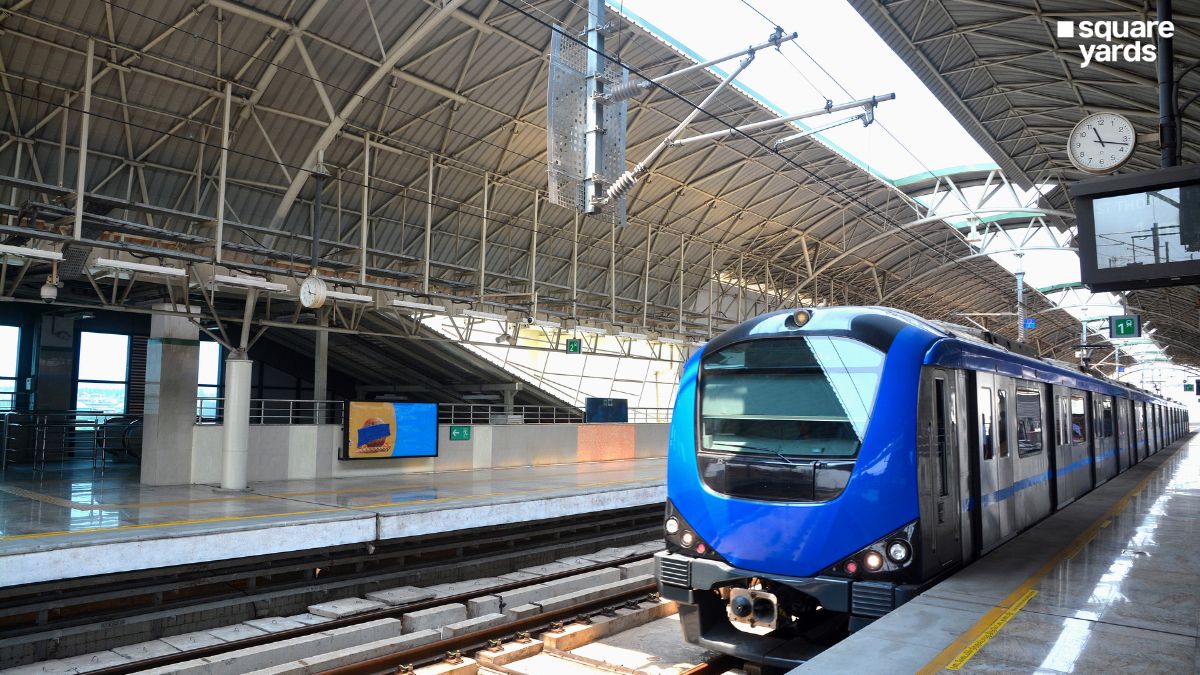
Chennai’s latest infrastructure pipeline is now adding a new layer to the city’s growth story. With more than Rs 60,000 crore linked to major urban transport and infrastructure projects, the Tamil Nadu capital is moving toward a model where faster commutes, smoother freight movement and better access to commercial districts could directly influence property demand in the city.
The southern city’s real estate market is driven by the growing strength of employment hubs, education clusters, healthcare infrastructure and port-led commerce. A significant example is the latest announcements for major projects such as Chennai Metro Phase-2 and the Port-Maduravoyal elevated corridor, which point to a wider mobility-led transformation, something that could become the prime driver of the region’s real estate growth over the next decade.
Two-fold real estate growth drivers of the city
Most cities focus either on passenger mobility or freight efficiency. Chennai is trying to improve both.
The Port-Maduravoyal corridor is a logistics-first project. It is meant to move container traffic and port-bound freight more efficiently while reducing pressure on city roads. Chennai Metro phase-2, meanwhile, is a people-first project. It is designed to connect residential, commercial, IT, healthcare and institutional zones through mass transit.
This combination is powerful because a city cannot grow only by moving people. It also needs to move goods, services, workers, business travelers, students and daily commuters with less friction. From a real estate perspective, this creates metro-led residential and rental corridors alongside port and road-led logistics and commercial corridors.
Chennai Port-Maduravoyal elevated corridor: Real estate impact
The National Highways Authority of India is expected to complete the much-delayed Chennai Port-Maduravoyal elevated corridor by November 2027. To be developed at an estimated cost of Rs 3,500 crore, the 20.9-km road project includes a double-tier structure that would boost connectivity for key locations such as Sivananda Salai, College Road, Spur Tank Road and Koyambedu.
The improved connectivity is set to increase the real estate growth and demand for commercial spaces will boost from this corridor project.
The long-term number is even more important. The upgraded corridor is expected to support Chennai Port’s cargo capacity expansion from 53 MTPA to nearly 200 MTPA by 2047. That is a major economic signal.
A higher-capacity port needs stronger back-end real estate: storage, distribution, packaging, trucking, service facilities and employee housing. This can make western and north-western Chennai more relevant for commercial and logistics-linked investment.
Metro Phase-2: Chennai’s real residential repricing trigger
If the port corridor strengthens Chennai’s logistics economy, Metro phase-2 is the bigger residential trigger.
Chennai Metro Rail Limited’s official project status shows phase-2 as an 118.9 km network with 128 stations across three corridors:
|
Impacted Corridor |
End-to-End Points |
Distance |
|
Corridor 3 |
Madhavaram to SIPCOT |
45.8 km |
|
Corridor 4 |
Lighthouse to Poonamallee Bypass |
26.1 km |
|
Corridor 5 |
Madhavaram to Sholinganallur |
47.0 km |
The estimated project completion cost is Rs 63,246 crore, and the project is proposed for completion by the end of 2028.
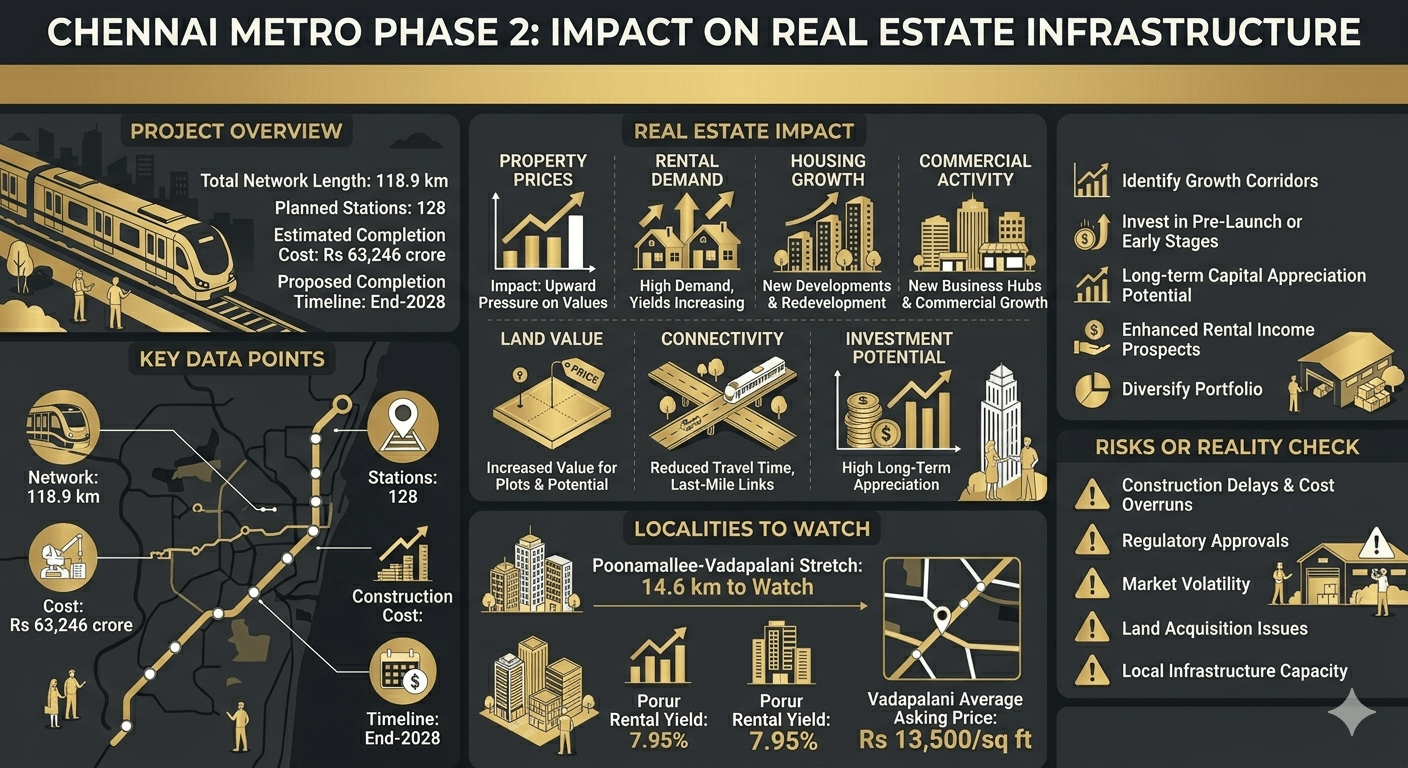
For homebuyers, this is not a small expansion. It changes the basic geography of convenience. Localities that were earlier road-dependent may become transit-linked. This can directly influence rental demand, resale value and buyer preference.
Influence on key micro-markets of Chennai
Infrastructure is a future trigger, but price data tells us where the market already stands. Square Yards locality data gives useful asking-price signals for the Chennai micro-markets likely to be influenced by Chennai Metro phase-2 and the port corridor.
- Porur: Square Yards data shows Porur’s average apartment for sale is priced at around Rs 7,550 per sq ft, with an average rental rate of Rs 50 (psf) and a rental yield of 7.95%. Ready-to-move projects in the locality are priced around Rs 6,750 (psf) and have shown 10.88% growth, while under-construction projects average around Rs 6,850 (psf).
Square yards analysis suggests Porur’s next phase will depend on how quickly Metro Phase-2 improves actual commuting convenience. If Porur gets reliable station access and road conditions improve after construction, the locality can strengthen its position as a west Chennai rental and end-user market.
- Vadapalani: Vadapalani’s average apartment asking price stands around Rs 13,500 (psf), according to Square Yards, with ready-to-move projects averaging around Rs 9,100 (psf).
Vadapalani may not deliver the sharpest percentage appreciation because it is already a mature market. But it can gain from stronger liquidity, better rental stickiness and higher preference among buyers who want central-west connectivity without moving into older core areas.
- Koyambedu: Square Yards places Koyambedu’s average apartment asking price at around Rs 8,500 (psf). Ready-to-move properties are valued around Rs 8,750 (psf), while new launches offer a lower entry point at around Rs 7,800 (psf). The locality has seen pricing fluctuations, with rates moving from Rs 11,950 (psf) in June 2025 to Rs 8,500 (psf) by March 2026 after peaking in September 2025.
Experts recommend that investors be careful with the entry price. It is better suited for buyers who understand project-specific value and rental demand rather than those chasing a generic infrastructure story.
This is why one cannot apply a single “metro will increase apartments for sale in Chennai” logic across the city. Each market will respond differently depending on starting price, rental depth, construction status, road access and station usability.
One of the biggest mistakes buyers make in infrastructure-led markets is assuming that every nearby project will benefit equally. In reality, the benefits concentrate around usable access points, stable roads, strong social infrastructure and real demand.
Chennai’s real estate premium will move toward functionality
The Port-Maduravoyal corridor can strengthen the logistics economy. Chennai Metro Phase-2 can expand residential and rental depth. Together, they can make Chennai more efficient, more investable and more livable.
The winners will be localities where infrastructure is usable, prices are still rational, rental demand is visible and daily life becomes easier. Porur, Vadapalani and Koyambedu each offer a different opportunity, but they also carry different risks.
For buyers and investors, the lesson is clear: invest in the access, the demand, the yield, the road, the station and the neighborhood. Because in Chennai, the next premium will belong to the address that works better.