
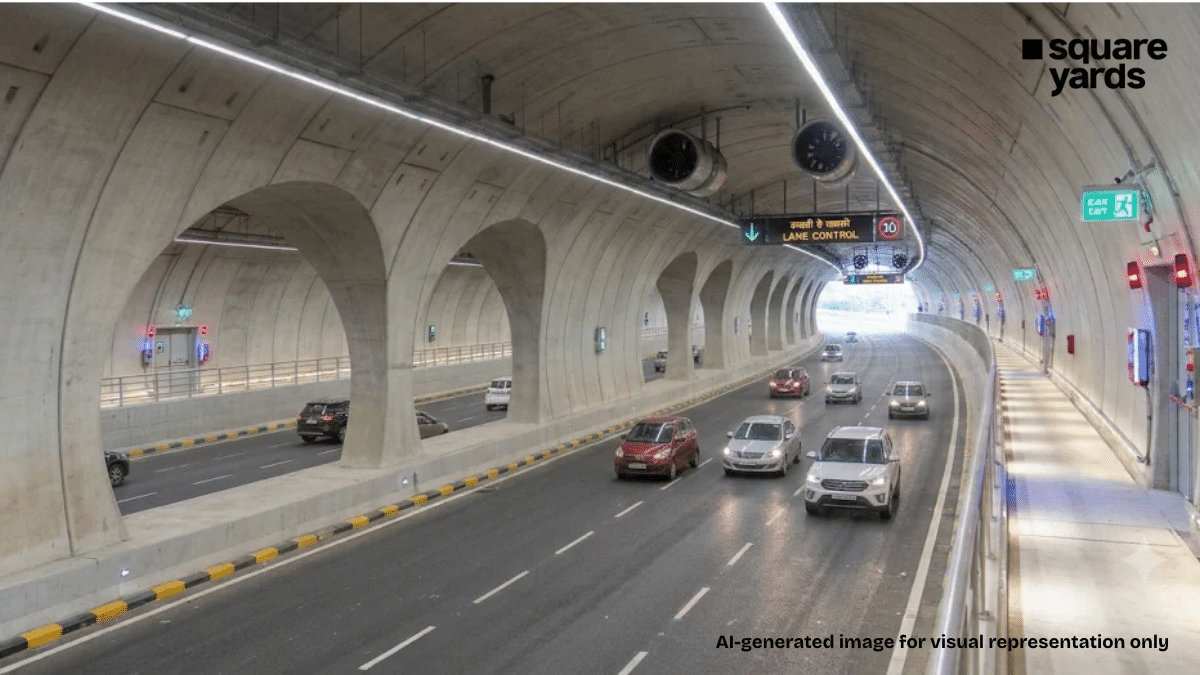
Maharashtra CM approved Mumbai’s proposed underground road network on November 19, 2026. The Mumbai Metropolitan Region Development Authority (MMRDA) plans to develop tunnels connecting the Bandra-Kurla Complex (BKC), Dharavi, the Bandra-Worli Sea Link, and Mumbai Airport. The project aims to reduce road congestion by creating alternative underground routes and is estimated at Rs 53,928 crore. Construction will begin after the required funding, technical preparations, and statutory clearances are completed.
Mumbai underground road network project: Key details
The proposed project will cover approximately 30.87 km of tunnels in each direction, with a combined construction length of 61.74 km. The network will be developed in two phases, connecting Mumbai’s western and eastern road corridors. The proposed project will also provide access to major business centers and transport facilities.
|
Project details |
Information |
|
Project name |
Mumbai underground road network |
|
Developing authority |
MMRDA |
|
Approval date |
November 19, 2026 |
|
Estimated cost |
Rs 53,928.2 crore |
|
Total tunnel construction length |
61.74 km |
|
Traffic lanes |
Three lanes per tunnel |
From Bandra to Ghatkopar: Areas likely to benefit from the proposed tunnels
The project’s proposed alignment covers several established residential areas and employment centers. Around BKC and Dharavi, underground connections may provide alternative routes towards the Coastal Road and Bandra-Worli Sea Link, reducing dependence on busy surface roads.
Towards the north, the planned connections will extend through Bandra East, Vakola and Vile Parle. Access towards Mumbai Airport’s Terminal 2 may also improve travel options for residents and employees working near the airport.
The second phase will cover Andheri East, Asalpha and Sakinaka, with connections towards the Eastern Express Highway near Ghatkopar. Chunabhatti could also gain better access to commercial centers through the proposed network.
These locations already offer different housing options and price ranges. Therefore, understanding their existing property values is important before assessing whether the new routes could influence buyer preferences.
A closer look at property prices along Mumbai’s proposed tunnel routes
Square Yards data shows considerable differences in residential property prices across these neighborhoods. In established western locations, Bandra West and Worli report average prices of approximately Rs 67,450 and Rs 66,300 per square foot (psf), respectively.
Commercial hubs and nearby residential markets also command higher rates. Bandra Kurla Complex averages Rs 54,250 psf, while Bandra East stands at approximately Rs 56,150 psf.
In comparison, Dharavi records an average apartment asking price of around Rs 19,100 psf, although ready-to-move properties average approximately Rs 33,350 psf.
Further north, Vakola averages Rs 29,500 psf, while Vile Parle East stands at Rs 42,850 psf. Along the eastern corridor, Andheri East records approximately Rs 31,700 psf, compared with Rs 22,450 psf in Sakinaka; meanwhile, Chunabhatti and Ghatkopar East average Rs 27,850 psf and Rs 28,400 psf, respectively.
These price differences indicate why buyers may compare locations beyond established premium areas if commuting becomes more convenient.
Can better road access bring more homebuyers to these locations?
For working buyers in BKC or central Mumbai, the ability to travel more conveniently from lower-priced neighborhoods could become an important consideration. Locations such as Vakola, Dharavi and Chunabhatti may receive greater attention if the completed tunnels reduce daily travel difficulties.
Similarly, residential markets around Andheri East, Sakinaka and Ghatkopar could benefit from easier access to employment centers and transport facilities. This may encourage buyers to consider areas they previously avoided because of traffic congestion.
However, the project’s influence will not be uniform. Property demand will depend on actual travel-time savings, housing availability, neighborhood facilities, and final road connections.
How does Mumbai’s underground road network differ from other road projects?
Unlike flyovers or road widening, Mumbai’s proposed underground network will add road connections beneath existing infrastructure. It is designed to connect the Coastal Road, Bandra-Worli Sea Link, BKC, Mumbai Airport, and both express highways. The tunnels will accommodate three traffic lanes and support a proposed maximum speed of 80 kmph. Emergency cross-passages are planned at approximately 300-meter intervals.