

Noida International Airport at Jewar is gradually becoming the center of a multi-directional infrastructure network connecting the National Capital Region (NCR) with western, central, and eastern Uttar Pradesh. The airport is linked to the Yamuna Expressway and is gaining additional road connections through projects such as the Delhi-Mumbai Expressway link, the proposed Jewar-Ganga Expressway corridor and the Faridabad-Jewar route. Plans for regional rapid transit, metro connectivity and freight infrastructure are also expected to widen its catchment.
The network is taking shape across several directions. To the north and east, the Eastern Peripheral Expressway (EPE), the proposed Akshardham-EPE corridor and the Ghaziabad-Jewar Namo Bharat link are expected to improve access from Ghaziabad and other parts of the NCR. To the south, the DND-Faridabad-Sohna corridor and the Faridabad-Jewar Expressway will strengthen links with Faridabad and southern Haryana. The Delhi-Mumbai Expressway connection will provide a route towards western India, while the Yamuna Expressway and the proposed Ganga Expressway link will connect the airport with a wider network across Uttar Pradesh.
The development is also extending beyond passenger movement. The Dedicated Freight Corridor (DFC), airport cargo facilities, logistics hubs and industrial clusters are expected to support goods movement and export-oriented businesses. Together, these projects are positioning Jewar as a potential aviation, logistics and urban development hub rather than a standalone airport.
Noida International Airport: latest developments and operational status
Noida International Airport began commercial flight operations on June 15, 2026, marking a major step in Jewar’s development. The cargo terminal opened two days later, on June 17, adding an early freight-handling component to the airport ecosystem.
The airport has been developed as a greenfield facility in Jewar, Gautam Buddha Nagar, under a public-private partnership involving Zurich Airport International AG and the governments of Uttar Pradesh and India. The Square Yards 2026 research report places the airport’s planned land area at approximately 5,000 hectares and notes a long-term capacity vision of up to 225 million passengers annually across its development phases. The report estimates the overall project cost at around Rs 30,000 crore.
The airport is planned for phased expansion. The initial phase includes a passenger terminal, runway, air traffic control facilities, and cargo infrastructure. Subsequent phases will add terminals, runways, taxiways, aircraft parking bays, and expanded cargo terminals. This phased approach is intended to increase passenger and cargo capacity as air traffic grows.
UP Cabinet approves proposal to rename Jewar Airport
The Uttar Pradesh Cabinet approved a proposal on October 9, 2026, to rename Noida International Airport as Narendra Modi International Airport, Noida-Jewar. Chief Minister Yogi Adityanath announced the decision after a Cabinet meeting in Lucknow.
The Chief Minister said the Cabinet had expressed gratitude to Prime Minister Narendra Modi for the airport project and described it as a major addition to Uttar Pradesh’s infrastructure. The proposed name recognizes the Prime Minister’s contribution to the airport’s development, which the state expects to become a major aviation hub.
Airport conducts SAKSHAM 2026 emergency preparedness exercise
On October 29, 2026, Noida International Airport conducted a full-scale emergency preparedness exercise, SAKSHAM 2026, to assess its response systems and coordination with government and emergency agencies.
The exercise took place between 2 pm and 6 pm and followed International Civil Aviation Organization guidelines. Participants included IndiGo, the Airports Authority of India, Central Industrial Security Force, Uttar Pradesh Police, the National Disaster Response Force, district health and disaster management authorities, fire and emergency services, airport medical teams, and hospital partners.
The simulated emergency tested alert activation, firefighting, rescue operations, response-team deployment, and traffic management. It also assessed the creation of a green corridor for transporting casualties to designated medical facilities, along with communication protocols and response timelines.
Noida International Airport connectivity network: key road and transit corridors
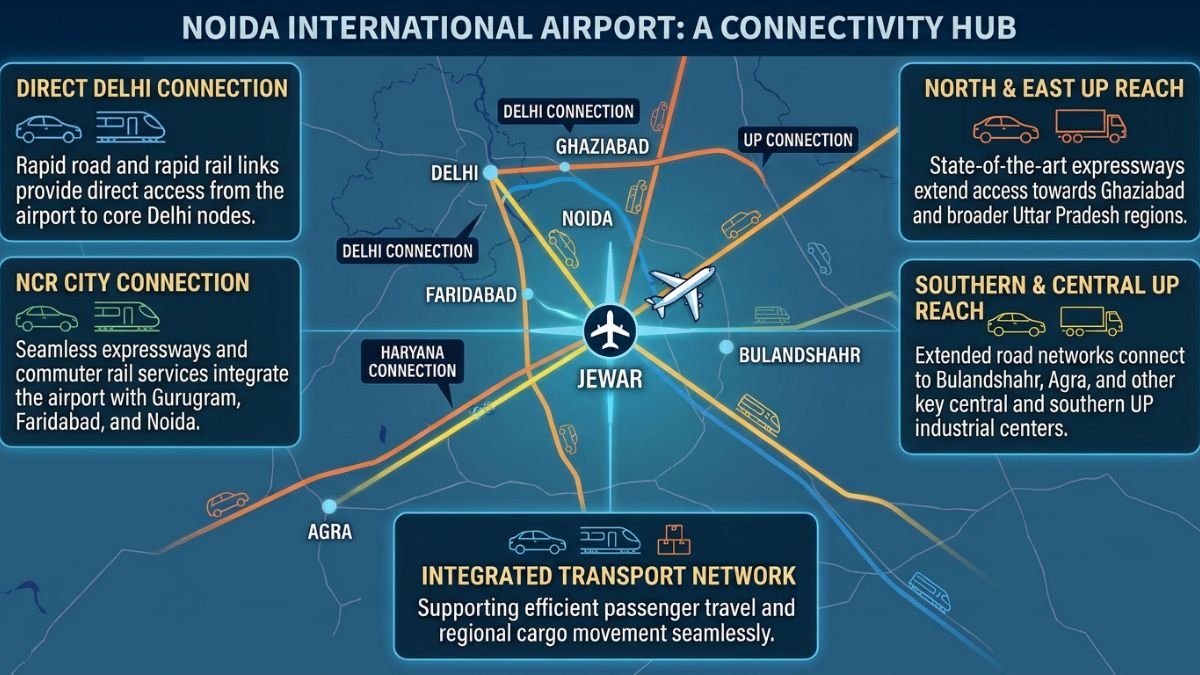
The airport’s connectivity plan extends across several highways, expressways, and public transport projects. Some connections are already available, while others are at the approval, planning, or detailed project report stage. Together, they will improve access from Delhi, Haryana, western Uttar Pradesh, and the wider NCR.
Yamuna Expressway: the primary road connection
The Yamuna Expressway is the principal road corridor serving Noida International Airport. It connects the Greater Noida region with Agra and provides airport access through the interchange near Dayanatpur village in Jewar.
The expressway is central to the airport’s regional development because it links the airport area with Greater Noida and the wider western Uttar Pradesh market. It also provides access to planned residential sectors, industrial areas and logistics developments under the Yamuna Expressway Industrial Development Authority (YEIDA).
The Square Yards research report identifies the Yamuna Expressway residential spine, including sectors such as 18 and 22 and Gaur Yamuna City, as an important area for housing development. It also identifies logistics and manufacturing clusters as key parts of the wider economic network.
Eastern Peripheral Expressway and Akshardham-EPE corridor
The Eastern Peripheral Expressway provides an important connection between the Noida International Airport region and several parts of the NCR. Its wider network links areas around Greater Noida, Ghaziabad, Faridabad, Palwal, and other peripheral urban centers, allowing traffic to bypass some congested sections of Delhi.
The proposed Akshardham-EPE corridor is expected to strengthen the connection between east Delhi and the Eastern Peripheral Expressway. Once developed, it could provide a more direct route for traffic traveling from Delhi towards Greater Noida and Jewar, reducing dependence on congested city roads.
Ghaziabad-Jewar Namo Bharat corridor
The proposed Ghaziabad-Jewar Namo Bharat corridor is one of the major public transport projects planned for the airport. The National Capital Region Transport Corporation (NCRTC) has moved the proposal to the detailed project report stage.
The latest plan shared for the corridor covers about 72.44 km and proposes 22 stations, in addition to the existing Ghaziabad station. It is designed to combine Namo Bharat and metro services, connecting Ghaziabad with Greater Noida West, central Greater Noida, Dankaur, YEIDA sectors, and Noida International Airport.
The proposed alignment includes Ghaziabad South, Greater Noida West sectors 4 and 2, Knowledge Park V, Surajpur, Pari Chowk, Ecotech VI, Dankaur, YEIDA North Sector 18 and Central Sector 21 before reaching the airport. The service plan proposes metro operations between Ghaziabad and Ecotech VI, with Namo Bharat services operating along selected stations. Seven stations are proposed to be common to both systems.
DND-Faridabad-Sohna and Faridabad-Jewar connectivity
The southern approach to Jewar is expected to improve through the DND-Faridabad-Sohna corridor and the proposed Faridabad-Jewar road connection.
The DND-Faridabad-Sohna route is part of a wider effort to improve movement between Delhi, Faridabad and southern Haryana. It provides an important approach towards the Faridabad-Ballabhgarh side, from where the proposed airport link is expected to continue towards Jewar.
The Faridabad-Jewar Expressway is planned as a greenfield connection that will improve access from Faridabad and nearby areas to the Noida International Airport. The route is expected to reduce dependence on local roads and provide a more direct connection for passengers and commercial traffic.
Delhi-Mumbai Expressway link through the Faridabad-Ballabhgarh
The Union Cabinet approved a project in March 2026 for a greenfield link corridor connecting the Noida International Airport with the Delhi-Mumbai Expressway. The project cost was reported at around Rs 3,630.77 crore, with the proposed link covering approximately 31.4 km.
The six-lane corridor is intended to provide a direct road connection between the airport and the Delhi-Mumbai Expressway, improving access from Faridabad, South Delhi and parts of Haryana. It is also expected to strengthen the movement of goods between the airport’s cargo facilities, industrial areas and the national highway network.
Jewar-Ganga Expressway link: connecting the airport with western and central UP
The Uttar Pradesh Cabinet approved the Jewar-Ganga Expressway link in August 2026 at an estimated cost of Rs 8,585.51 crore. The proposed 74.467-km, six-lane greenfield corridor will be expandable to eight lanes and connect the Yamuna Expressway region with the Ganga Expressway through Bulandshahr.
The corridor is planned to begin near Bhaipur Brahman village in Gautam Buddha Nagar and terminate near Bahapur village in Bulandshahr. The Uttar Pradesh Expressways Industrial Development Authority (UPEIDA) will develop it, with the state government funding the project.
The proposed route is divided into two sections. The first will connect Bhaipur Brahman with Bichaula in Bulandshahr, while the second will extend from Bichaula towards Bahapur near the Ganga Expressway. The project involves land acquisition across villages in the two districts.
The link is expected to improve access to Noida International Airport for travelers and businesses from western and central Uttar Pradesh.
Chilla Elevated Road, Yamuna Pushta and the Noida Expressway
Delhi-Noida connectivity is another important part of the airport’s wider catchment. The Noida-Greater Noida Expressway provides the existing road connection towards Greater Noida and the Yamuna Expressway, while the Chilla Elevated Road and Yamuna Pushta corridor are expected to improve access from Delhi and east Delhi.
The Chilla Elevated Road project is intended to improve the connection between the Chilla side of Delhi and Noida. The proposed link is relevant to airport traffic because congestion at the Delhi-Noida border can add to overall journey times, even when the onward route towards Jewar is relatively clear.
Rail, metro and last-mile connections to Jewar Airport
Road infrastructure is only one part of the airport’s connectivity plan. The region is also expected to gain from metro extensions, rapid transit and proposed rail links that can expand the airport’s passenger catchment.
Noida Metro Aqua Line extension
The Noida Metro Aqua Line is expected to help connect the airport region with the existing metro network. Plans for an extension towards the airport are intended to improve access from Noida and Greater Noida, including residential and commercial areas along the corridor.
The proposed Ghaziabad-Jewar Namo Bharat corridor is also expected to connect with the Aqua Line at Pari Chowk. This would link regional rapid transit with the existing metro network, allowing passengers to travel between different parts of the NCR and the airport.
Proposed rail link towards Chola
Plans have also been discussed for a rail connection between Noida International Airport and Chola railway station in Bulandshahr. The proposed link could connect the airport with the wider railway network and support access from areas beyond the immediate NCR.
The project should be treated as a planned connection at this stage. Its final route, implementation schedule and integration with airport transport facilities will determine its eventual role.
Film City pod taxi proposal
YEIDA has also proposed a pod taxi system between Noida International Airport and the planned Film City in Sector 21. The proposal covers a route of approximately 14.5 km with 12 stations.
The system is intended to provide a dedicated last-mile connection between the airport and the Film City development. If implemented, it could support movement between the airport, commercial facilities and entertainment-related businesses in the YEIDA region.
Dedicated Freight Corridor and airport cargo connectivity
The airport’s long-term role will depend not only on passenger traffic but also on its ability to handle goods movement. The Dedicated Freight Corridor is therefore an important part of the wider infrastructure picture.
The Square Yards research report identifies the DFC and associated railway infrastructure as key links supporting industrial development around the airport. The report’s connectivity map, based on the YEIDA Master Plan 2041, shows industrial areas positioned around both the expressway network and freight routes.
This arrangement is relevant for manufacturing units, logistics parks, warehousing facilities, and export-oriented businesses. Industrial production from the region can move through rail-linked freight infrastructure, while high-value and time-sensitive cargo can use the airport’s air cargo facilities.
The airport region is also planned to accommodate logistics hubs, electronics manufacturing, a medical device park, apparel and textile parks, and other industrial projects. The report identifies manufacturing proposals involving semiconductor, solar, electronics, air-conditioning components, and automobile components.
Noida International Airport and the emerging aerotropolis
The airport is being developed alongside a wider urban and economic plan for the Yamuna Expressway region. The Square Yards research report describes this as an aerotropolis-led development model, where residential, commercial, industrial, institutional and logistics uses are planned around an airport. The report identifies five broad investment zones:
- Airport Core Zone: Aviation, cargo, logistics and commercial activity, with potential demand for rental housing and serviced apartments.
- Yamuna Expressway Residential Spine: Planned residential sectors, plotted developments and townships, including Sectors 18 and 22 and Gaur Yamuna City.
- Industrial Corridor: Manufacturing and logistics clusters expected to generate demand for affordable and mid-income housing.
- Fintech and Institutional Zone: Planned knowledge-sector and institutional developments that could support premium housing and integrated townships.
- Peripheral Growth Areas: Locations expected to gain from the gradual expansion of infrastructure and improved access.
The report suggests that the market could move through different stages. In the short term, investor interest and plotted development may remain prominent. Over the medium term, industrial and logistics activity could support employment and increase demand for apartments and rental housing. Over the longer term, the region could develop into a more integrated urban ecosystem, provided that infrastructure, jobs and social facilities progress together.
Square Yards property prices around Jewar Airport
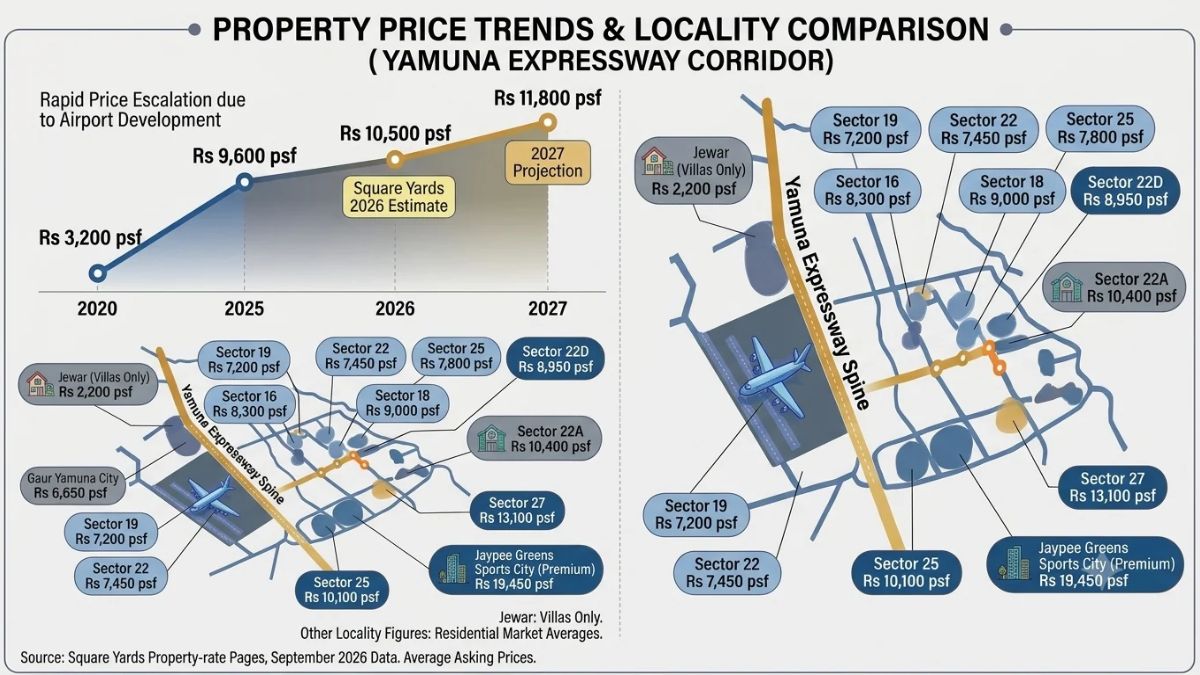
The airport’s development has changed the property-market profile of the Yamuna Expressway corridor. Square Yards’ 2026 research report tracks a rise in average apartment rates from around Rs 3,200 per square foot (psf) in 2020 to approximately Rs 9,600 psf in 2025. Its pricing chart places the average at around Rs 10,500 psf in 2026, with a projection of Rs 11,800 psf for 2027.
Jewar is the closest market, while locations such as Gaur Yamuna City and Sectors 18, 22A, 22D, and 23D offer a broader view of the residential market developing along the corridor.
|
Locality |
Average asking price (psf) |
|
Rs 2,200 |
|
|
Rs 6,550 |
|
|
Rs 7,200 |
|
|
Rs 7,450 |
|
|
Rs 7,800 |
|
|
Rs 8,050 |
|
|
Rs 8,300 |
|
|
Rs 8,950 |
|
|
Rs 9,000 |
|
|
Rs 10,400 |
|
|
Rs 13,100 |
|
|
Rs 19,450 |
Source: Square Yards property-rate pages, September 2026 data. Rates are average asking prices, not registered transaction values. Jewar’s quoted rate is specifically for villas; the other locality figures represent their respective residential market averages.
Industrial, commercial and hospitality development around the airport
The airport’s economic influence is expected to extend beyond housing. YEIDA’s planned industrial and commercial developments are intended to create an ecosystem around aviation, manufacturing, trade, logistics and tourism. The Square Yards report identifies the following developments as part of the wider airport-led growth plan:
- Film City
- Electronic City
- Fintech City
- Medical Device Park
- Logistics Hub
- Apparel and Textile Parks
- Semiconductor and electronics manufacturing
- Solar manufacturing
- Air-conditioning and automobile component manufacturing
These projects could support demand for industrial land, logistics facilities, office space, hotels and serviced accommodation. The Noida International Airport may also improve tourism access to Agra, Mathura, and Vrindavan, while the Buddh International Circuit and proposed Film City could add event- and entertainment-related demand.
For the residential market, employment will be the main driver. Industrial and commercial activity can generate housing demand from managers, engineers, technicians, airport employees, logistics workers, and service providers.
Noida International Airport’s next phase depends on execution across the network
The airport has entered its operational phase, but the wider connectivity network is still being built. The Yamuna Expressway provides the existing road backbone, while the Delhi-Mumbai Expressway link, Jewar-Ganga corridor, Ghaziabad-Jewar Namo Bharat project and other regional connections are expected to expand its catchment over the coming years.
The airport’s longer-term role will also depend on cargo operations, the Dedicated Freight Corridor, industrial project execution and the development of residential and commercial facilities across the YEIDA region. The SAKSHAM 2026 emergency exercise shows that airport authorities are also continuing to test operational preparedness as activity scales up.
Together, these developments could turn Jewar into a major transport and economic node for the NCR and Uttar Pradesh. The next stage of its real estate story will depend on how effectively the road, rail, freight and industrial networks connect with one another and translate into regular passenger movement, employment and local demand.