
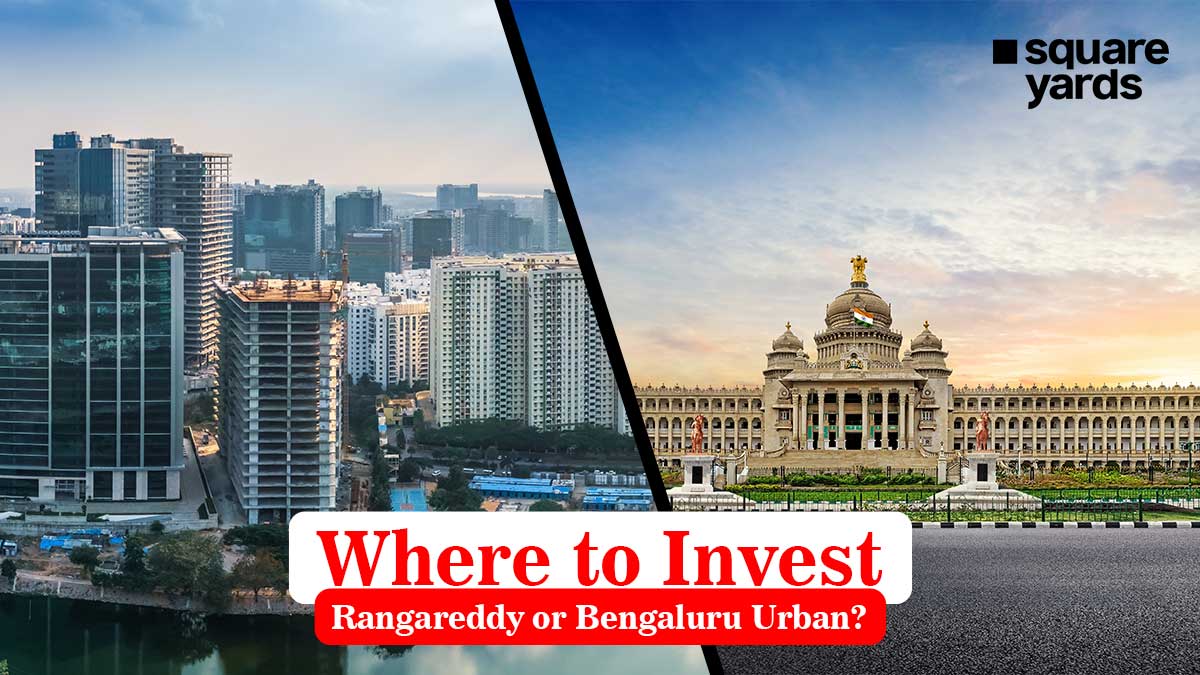
For years, the idea of economic power in India revolved around Mumbai, Delhi NCR, and Chennai. Yet, quietly and steadily, the South built a different story, one driven by technology, infrastructure, and consistency. Today, Rangareddy in Telangana and Bengaluru Urban in Bengaluru, Karnataka, stand as proof that India’s growth axis has tilted south.
According to the Economic Survey 2024–25, Rangareddy has recorded a GDP per capita of ₹ 11.46 lakh, ranking it among the richest districts in India. Close behind, Bengaluru Urban stands third at ₹ 8.93 lakh, leaving several traditional metros trailing. The numbers are impressive, but what’s more important is what they represent: a new kind of urban growth where planning and productivity work together.
Table of contents
- Rangareddy District: The Engine Behind Hyderabad’s Growth Story
- Bengaluru Urban: The Consistent Performer
- A Growth Pattern Built on Planning, Not Overstretching
- Infrastructure That Defines Growth of Bengaluru Urban and Rangareddy
- The Shift in Hyderabad Real Estate and Bengaluru Urban
- The Ripple Effect on Neighbouring Regions of Rangareddy and Bengaluru Urban
- Quality of Life: The Silent Advantage
- Comparing Economic Profiles Of Rangareddy & Bengaluru Urban
- Real-Estate Investor Sentiment
- Government Push and Digital Governance
- Forecast: 2025 – 2030
- The Centre of Gravity Has Shifted for Bengaluru Urban & Rangareddy
Rangareddy District: The Engine Behind Hyderabad’s Growth Story
Rangareddy district, now one of India’s richest by GDP per capita, carries a large share of the Hyderabad real estate and services economy. Much of Hyderabad’s technology and business output sits inside this district. A large share of the city’s technology and services output is generated here.
What Drives Rangareddy’s High Productivity
- HITEC City, Gachibowli, the Financial District and Kokapet all sit within Rangareddy.
- These clusters house IT, BFSI, consulting, biotech and global capability centres.
- Fast road links connect offices with the airport and industrial parks along the western arc.
- The workforce is mostly young and tech-focused, with talent coming in from across India.
Infrastructure That Supports Daily Movement
- The Outer Ring Road (ORR) acts as the main loop for airport and office commutes.
- The Regional Ring Road is drawing new projects toward Shankarpally, Kismatpur and Sangareddy.
- Access via Shamshabad provides companies with dependable long-haul connectivity.
- The metro extension toward Raidurg and the link roads from Narsingi and Khajaguda help ease peak traffic.
Real Estate Pattern on the Ground
- Tellapur, Kollur, Kokapet and Osman Nagar see steady housing absorption.
- Most mainstream projects fall in the ₹6,000–9,000 per sq ft range.
- Apartments near Gachibowli and the Financial District often move into higher price brackets.
- Large developers such as My Home, Aparna, Prestige and SAS remain active across these belts.
Bengaluru Urban: The Consistent Performer
Bengaluru Urban ranks third nationally with a GDP per capita of around ₹8.93 lakh. It remains one of the strongest service-led districts in Bengaluru, Karnataka, supported by a steady flow of jobs and investments. Recent numbers place Bangalore’s GDP among the country’s most stable urban economies.
What Gives Bengaluru Its Economic Weight
- A broad mix of IT services, product engineering, deep tech, mobility and biotech.
- Many of India’s unicorns and global capability centres operate from this district.
- Strong university and research presence keeps talent flowing into the city.
- Steady employment across large companies and mid-size tech firms keeps demand stable.
How Bengaluru Moves People and Work
- Kempegowda Airport’s Terminal 2 improves long-distance connections.
- The Namma Metro expansion, including Purple and Green lines, eases cross-city travel.
- The Suburban Rail Project links major residential pockets with job corridors.
- Outer zones such as Hebbal, Devanahalli, Thanisandra, and Hennur have become new growth belts.
Housing Behaviour Across Micro-Markets
- Sarjapur Road, Whitefield and Bellandur continue to draw tech workers.
- Northern pockets near the airport see strong demand from frequent flyers and global firms.
- Prices commonly range from ₹8,000 to ₹14,000 per sq ft in mid- and upper-mid-range buildings.
- Premium zones such as Indiranagar and parts of Koramangala command higher numbers.
A Growth Pattern Built on Planning, Not Overstretching
In both Rangareddy and Bengaluru Urban, expansion followed a planned model, with major corridors and transport grids built early. This approach shaped how each district’s GDP per capita strengthened over time. Roads, ring corridors, airports, and transport grids were laid out long before the real estate rush started.
Here’s what that planning looks like in practice:
- States cleared large urban corridors early instead of patchwork widening later.
- Key job centres were placed near highways and metro lines, not deep in crowded areas.
- Industrial clusters and tech parks were connected to airports from day one, which kept logistics clean and predictable.
- Housing grew around these networks, so new townships didn’t need to wait years for basic access.
- Both governments kept approvals smoother and faster, which removed the usual stop-start pattern seen in other metros.
Infrastructure That Defines Growth of Bengaluru Urban and Rangareddy
Infrastructure remains the foundation behind why Rangareddy and Bengaluru Urban appear so high on India’s GDP per capita lists. Airports, ring roads and metro lines were completed before large real estate clusters expanded. As a result, new projects in outer belts still feel reachable for workers, logistics stay predictable for companies, and real estate demand spreads out instead of getting stuck in a small core.
|
Parameter |
Rangareddy (Telangana) |
Bengaluru Urban (Karnataka) |
|
Airport |
Rajiv Gandhi International Airport |
Kempegowda International Airport (T2 operational) |
|
Metro |
Hyderabad Metro (Phase I + expansion) |
Namma Metro (Purple, Green, Yellow + Suburban Rail) |
|
Ring Roads / Expressways |
Outer Ring Road, Regional Ring Road (underway) |
NICE Road, Peripheral Ring Road (planned) |
|
Industrial Zones |
Pharma City, ITIR, Aerospace Park |
Peenya, Electronic City, KIADB parks |
|
Housing Hotspots |
Kokapet, Tellapur, Kollur |
Hebbal, Whitefield, Sarjapur Road |
The Shift in Hyderabad Real Estate and Bengaluru Urban
The real estate story in both districts reflects the same confidence found in their GDP charts.
- Hyderabad-Rangareddy leads in affordability and new supply.
- Bengaluru Urban dominates in end-user demand and rental stability.
Developers are betting on mixed-use formats like blending homes, offices, and retail under one roof. Projects like Prestige City, My Home Bhooja, and Sobha Royal Pavilion show how urban design is evolving to meet hybrid lifestyles. Rental yields in both regions hover between 3 and 5%, supported by a large migrant professional population.
The Ripple Effect on Neighbouring Regions of Rangareddy and Bengaluru Urban
Growth in these districts doesn’t stop at city limits.
- Around Hyderabad, adjoining zones such as Medchal-Malkajgiri, Maheshwaram, and Sangareddy are rapidly urbanising. Warehousing and logistics parks near Patancheru now support the state’s export economy.
- Near Bengaluru, districts like Tumakuru, Ramanagara, and Kolar are absorbing manufacturing spill-over. These belts form part of the Bengaluru-Chennai Industrial Corridor (BCIC), a national-scale project linking ports with production hubs.
Quality of Life: The Silent Advantage
Where older metros struggle with congestion and cost, southern cities offer relative balance. Both Rangareddy and Bengaluru Urban maintain wider roads, better drainage, and more open space per capita. Parks like KBR National Park in Hyderabad or Cubbon Park in Bengaluru remain active lungs within the city core. Climate plays its part too. Bengaluru’s mild temperatures and Hyderabad’s dry air support year-round livability. This is an often-overlooked factor for migrant professionals choosing where to settle.
The retail scene is catching up fast. From Forum Falcon City to Sarath City Capital Mall, lifestyle infrastructure is now a core part of every new township, not an afterthought.
Comparing Economic Profiles Of Rangareddy & Bengaluru Urban
Rangareddy and Bengaluru Urban both post strong numbers, but the way each district builds its economy is slightly different. One leans on a broad mix of IT, biotech, pharma and aerospace. The other runs on a dense tech and start-up engine that feeds steady jobs and rental demand. The contrast becomes clearer when you look at the core metrics side by side.
|
Indicator (2024–25) |
Rangareddy (Telangana) |
Bengaluru Urban (Karnataka) |
|
GDP Per Capita |
₹ 11.46 lakh |
₹ 8.93 lakh |
|
Dominant Sectors |
IT Services, Biotech, Pharma, Aerospace |
IT, Start-ups, Electronics, Mobility |
|
Population (Base) |
~7 million |
~13 million |
|
Average Housing Range |
₹ 6,000 – 12,000 per sq ft |
₹ 8,000 – 18,000 per sq ft |
|
Rental Yield Range |
3 – 4 % |
3.5 – 5 % |
|
Upcoming Infra Projects |
Regional Ring Road, Pharma City |
Peripheral Ring Road, Suburban Rail |
Real-Estate Investor Sentiment
Investor activity in Hyderabad real estate and Bengaluru, Karnataka, continues to reflect confidence across both districts. The underlying demand aligns with high GDP per capita indicators. REITs and alternative investment funds are acquiring commercial assets in both cities. The presence of IT parks backed by long-term leases gives investors predictable yields.
Residential investors view the markets differently:
- Rangareddy offers room for appreciation as infrastructure expands.
- Bengaluru Urban provides liquidity, and properties sell or rent quickly due to the steady inflow of jobs.
Developers are responding with sustainable features: solar roofs, EV-charging stations, and rainwater harvesting are becoming standard. These eco-friendly add-ons not only improve liveability but also qualify projects for green-building incentives, a growing factor for institutional funding.
Government Push and Digital Governance
Telangana and Karnataka’s state governments actively court investors.
- Telangana’s TS-iPASS single-window system guarantees time-bound industrial approvals.
- Karnataka’s Ease of Doing Business reforms have reduced average project clearance time by nearly 40 per cent.
E-governance platforms such as Dharani (for land records) and Kaveri Online Services simplify real estate transactions. The transparency helps developers, agents, and homebuyers alike to get flats in Bengaluru easily.
Forecast: 2025 – 2030
Analysts expect both districts to maintain annual GDP growth between 7 and 8%, comfortably above the projected national average.
- Rangareddy will benefit from the completion of the Regional Ring Road, Hyderabad Airport Metro, and large-scale employment from Pharma City and Data Centre Park projects.
- Bengaluru Urban will gain from the Peripheral Ring Road, the Blue and Pink Metro Lines, and suburban-rail links that connect satellite towns.
- Residential supply is likely to expand toward Kokapet-Mokila and Devanahalli-Hoskote, respectively. Commercial absorption may exceed 10 million sq ft annually in each market by 2027.
The Centre of Gravity Has Shifted for Bengaluru Urban & Rangareddy
The South is no longer the alternative; it’s the benchmark, combining livability, governance, and opportunity. For Hyderabad real estate watchers, Bengaluru’s tech belt, or investors deciding where the future lies, the answer is already visible on the map: it’s south of the Vindhyas, where cities grow by design, not by chance.
Frequently Asked Questions
Why is real estate demand rising in the Rangareddy district?
Rangareddy sits close to Hyderabad’s major job hubs like HITEC City, Gachibowli and Kokapet. ORR access keeps commutes short, and new projects near Tellapur and Kollur stay affordable compared to city-core prices.
What makes Bengaluru Urban a stable real estate market?
Bengaluru Urban stays steady because employment is predictable. Tech parks, start-ups and research centres keep talent moving in, which supports rentals and absorption throughout the year. Areas like Sarjapur Road and Whitefield also have metro expansion.
How do property prices compare between Rangareddy and Bengaluru Urban?
Mid-segment homes in Rangareddy generally fall in the ₹6,000-9,000 per sq ft range, with higher numbers near the Financial District. Bengaluru Urban sits higher, about ₹8,000-14,000 per sq ft in active corridors.
Which micro-markets are seeing the fastest growth in each district?
Kokapet, Kollur, Tellapur and Osman Nagar lead growth in Rangareddy, thanks to new infrastructure and proximity to job centres. In Bengaluru Urban, Whitefield, Hebbal, Bellandur, and airport-side belts such as Devanahalli see the most traction due to metro lines, airport links and rental demand.
Is it a good time for investors to buy in these South Indian markets?
Yes. Rangareddy offers appreciation potential as projects follow the ORR and the Regional Ring Road. Bengaluru Urban provides strong liquidity because rental demand stays high. Both markets benefit from constant job creation, making them suitable for long-term investors rather than short-term speculation.