
If you own property in Visakhapatnam there is one thing worth knowing right away. Paying your GVMC property tax before April 30 every year gets you a 5 percent rebate on the total amount. That is real money saved just by paying a few months early. The Greater Visakhapatnam Municipal Corporation has made the whole payment process digital and much faster than it used to be. Whether you own a home, a shop or a piece of land, this guide tells you everything you need to know about paying your property tax in 2026, how it is calculated and how to avoid the penalties that catch many people off guard.
What is GVMC Property Tax
The Greater Visakhapatnam Municipal Corporation is the main civic body that runs the city of Visakhapatnam in Andhra Pradesh. Property tax is an annual charge that every property owner in the city pays to this body. The money collected goes toward keeping the city running. Roads, drainage systems, street lighting, water supply and waste management all depend on this fund.
The way GVMC calculates your tax is different from what many people expect. It is not based on how much your property is worth in the market. Instead it is based on something called the Annual Rental Value or ARV. This is simply an estimate of how much rent your property could earn in a year if it were rented out. Even if you live in the property yourself and never rent it to anyone, GVMC still assigns it an ARV and calculates tax on that figure.
The law that governs this is Section 85(2) of the Municipal Councils Act. Under this law residential property tax cannot go above 25 percent and non-residential or commercial property tax cannot go above 33 percent of the ARV.
Who Has to Pay GVMC Property Tax
Anyone who owns property within the limits of GVMC has to pay this tax. It does not matter whether you are using the property, renting it out or leaving it empty. All of the following are required to pay:
- Homeowners living in their own property
- Landlords who have rented out their homes or apartments
- Shop and office owners
- Owners of warehouses or storage spaces
- Owners of vacant land plots
- People who own properties used for both residential and commercial purposes
If your property falls inside Visakhapatnam city limits, the tax applies to you.
Why Paying on Time Actually Matters
GVMC collects property tax in two parts every year. The first payment is due by the end of June. The second is due by the end of December. If you miss either deadline GVMC adds a penalty of 2 percent every month on whatever amount you have not paid.
To put that in simple numbers, if your annual tax is Rs 10,000 and you are three months late, you end up paying an extra Rs 600 on top of the actual tax. The longer you wait the bigger the penalty grows. Paying on time is always the cheaper option.
There is another practical reason to stay on top of payments. You need a valid property tax receipt to access several municipal services in Visakhapatnam including water supply connections and sanitation facilities. Without it some services become difficult to access and getting property-related approvals from GVMC can take much longer.
How to Pay GVMC Property Tax Online in 2026
The entire payment can be done from home. You do not need to visit any office or stand in a queue. There are two main ways to pay online.
Paying Through the CDMA Portal
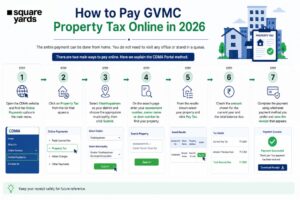
The official portal is cdma.ap.gov.in. This is the platform run by the Commissioner and Directorate of Municipal Administration. Here is how to use it:
Step 1 — Open the CDMA website and find the Online Payments option in the main menu
Step 2 — Click on Property Tax from the list that appears
Step 3 — Select Visakhapatnam as your district and choose the appropriate municipality, then click Submit
Step 4 — On the search page enter your assessment number, owner name or door number to find your property
Step 5 — From the results shown select your property and click Pay Tax
Step 6 — Check the amount shown for the current year and the total balance due
Step 7 — Complete the payment using whichever payment method you prefer and save the receipt that appears
If you have your assessment number ready the entire process takes less than ten minutes.
Paying Through the Pura Seva App
If you prefer using your phone the Pura Seva app is the official GVMC application for property tax payments. You can download it from the Google Play Store or the Apple App Store.
Once you install it, tap Register and enter your mobile number, email address and a username. You will get an OTP on your phone to verify your number. After that set a password and log in.
Go to the GVMC property tax section inside the app and enter your property details including zone, district and municipality. The app will show your property information. Check that everything looks correct then tap Pay Tax and choose how you want to pay. Your receipt is generated immediately after the payment is done and you can download it right away.
The Smart Vizag app works in the same way if you are already using that platform.
Payment Methods Accepted
Both the CDMA portal and the Pura Seva app accept the following payment options:
- Credit cards and debit cards
- Net banking
- UPI
- Bharat QR code
- Paytm
- EMI options
There are enough choices to cover most payment preferences.
How to Download Your Receipt
Your payment receipt is an important document. Keep it safely because you will need it when accessing municipal services or applying for property-related approvals.
On the CDMA portal, go through the same search steps until your property appears. On the right side of your property listing look for the option called View DCB. Click it and a detailed page opens showing your payment history for the current and previous years. Download and save it.
On the Pura Seva app the receipt appears automatically as soon as your payment is confirmed. Download it from the screen and store it somewhere easy to find.
How GVMC Property Tax is Calculated
What is Annual Rental Value
As mentioned earlier your tax is based on the Annual Rental Value of your property. GVMC looks at several things to decide what this value is.
Your location in the city matters a lot. Visakhapatnam is divided into eight zones and properties in different zones carry different base valuations. The zones are Madhurawada, Asilmetta, Suryabagh, Gnanapuram, Gajuwaka, Vepagunta, Anakapalle and Bheemunipatnam.
Other things that affect the ARV calculation include:
- The plinth area which is the total covered built-up area of your property
- The type of construction and overall condition of the building
- How old the building is
- How close the property is to major roads, markets or other landmarks
- What facilities and amenities are available in that area
Two houses that look similar but are in different zones can have very different tax amounts because the ARV for each is different.
Tax Rates for Residential Properties
Residential property tax in Visakhapatnam follows a slab system where the rate increases as the ARV goes higher.
|
ARV Range |
Tax Rate |
|
Up to Rs 600 |
Exempt |
|
Rs 601 to Rs 1,200 |
17% |
|
Rs 1,201 to Rs 2,400 |
19% |
|
Rs 2,401 to Rs 3,600 |
22% |
|
Above Rs 3,600 |
30% |
Properties with an ARV of Rs 600 or less pay nothing at all. This gives relief to lower-value residential properties.
Tax Rate for Commercial Properties
Commercial properties such as shops, offices and warehouses all pay at a flat rate of 30 percent of the ARV. There are no slabs for commercial properties. Whatever the ARV of your commercial space the rate stays the same at 30 percent.
How to Save Money on Your Property Tax
The Early Payment Rebate
This is the most straightforward saving available to every property owner. Pay your full annual tax before April 30 and GVMC gives you a 5 percent discount on the total amount.
So a tax bill of Rs 10,000 becomes Rs 9,500 if you pay before April 30. You have to pay the full year’s amount in one go to get this benefit. Splitting the payment into the two installments does not qualify.
GVMC data shows that nearly half of all property tax collected every year comes in through this early payment scheme. That tells you how widely people take advantage of it. Mark April 30 on your calendar every year.
Age-Based Deductions on Your Property
The older your building is the lower your taxable ARV. GVMC applies deductions to the ARV before calculating your final tax based on how old the property is.
|
Building Age |
Deduction on ARV |
|
25 years or less |
10% |
|
25 to 40 years |
20% |
|
More than 40 years |
30% |
Here is what this means in practice. Say your property’s ARV is Rs 5,000 and the building is 30 years old. A 20 percent deduction brings the ARV down to Rs 4,000. Your tax is then calculated on Rs 4,000 instead of Rs 5,000. That is a meaningful reduction.
Properties That Get Full Exemption
Residential properties with an ARV of Rs 600 or less are fully exempt from paying property tax. Charitable institutions and religious establishments may also be exempt depending on state government notifications from time to time.
The state government has also offered temporary relief in the past. In March 2024 for example interest charges on property tax dues were waived until March 31 of that year. Senior citizens and low-income property owners may also be eligible for additional concessions based on specific state government guidelines. Check with GVMC or the CDMA portal for the most current information on these concessions.
Penalties to Watch Out For
The penalty for late payment is 2 percent per month on the outstanding amount. This adds up faster than most people expect.
|
Months Late |
Penalty on Rs 10,000 Tax |
|
1 month |
Rs 200 |
|
3 months |
Rs 600 |
|
6 months |
Rs 1,200 |
|
12 months |
Rs 2,400 |
The only way to avoid this is to pay by June 30 for the first installment and by December 31 for the second. Or better still, pay the full amount before April 30 and also get the 5 percent rebate.
Paying at a Physical Centre
If you prefer to pay in person rather than online you can visit the nearest Purva Seva Centre or citizen service centre in Visakhapatnam.
Carry your property assessment slip and your holding number or unique property number when you go. Give your property details to the person at the counter including your zone, district and corporation name. Pay the amount and collect the receipt before you leave.
If you are not sure where the nearest centre is call the GVMC helpline at 1800 425 00009.
Changing Your Property Tax Records
Converting Vacant Land Tax to House Tax
If you have finished constructing a building on a plot that was previously paying vacant land tax you need to update this in GVMC records. The process is done online.
Go to the official GVMC website and click on Online Services then Property Tax. Select the option that says File Your Addition or Alteration. This section covers the conversion from vacant land tax to house tax. Choose your correct zone and district, enter your assessment number and submit the request. GVMC officials review and approve these changes.
Filing a Tax Revision Petition
If you think the tax you have been assessed is too high you can formally challenge it. The key condition is timing. You have to submit your revision petition within 15 days of receiving the special notice from GVMC.
Go to the CDMA website and find the Property Tax section. Click on Submit Your General Revision Petition. Select your property details including zone and district and enter your assessment number. Follow the instructions on the screen to complete the submission. GVMC reviews the petition and lets you know the outcome.
Frequently Asked Questions
1. What is the last date to get the 5 percent rebate on GVMC property tax?
You need to pay your full annual property tax before April 30 to get the 5 percent rebate. The entire year’s amount has to be paid in one transaction. Paying in installments does not qualify for the discount.
2. How does GVMC calculate property tax in Visakhapatnam?
GVMC uses the Annual Rental Value method. It estimates how much rent your property could earn in a year and applies a tax rate to that figure. Residential properties pay between 17 and 30 percent depending on the ARV slab. Commercial properties pay a flat 30 percent. The final amount also depends on your zone, the age of the building and the plinth area.
3. What is the penalty for late payment of GVMC property tax?
GVMC charges 2 percent per month on any amount that is overdue. The first installment is due by June 30 and the second by December 31. If you miss these deadlines the penalty keeps adding every month until you pay.
4. Can I pay GVMC property tax on my phone?
Yes. Download the Pura Seva app from the Google Play Store or Apple App Store. Register with your mobile number, log in and go to the GVMC property tax section. Enter your property details, check the amount and pay using your card, UPI, net banking or Paytm. A receipt is generated immediately.
5. Does the age of my building reduce my property tax?
Yes. Buildings up to 25 years old get a 10 percent deduction on the ARV before tax is calculated. Buildings between 25 and 40 years old get a 20 percent deduction. Buildings older than 40 years get a 30 percent deduction. The older the building the lower the effective taxable value.
6. What happens if I do not pay GVMC property tax for a long time?
Monthly penalties of 2 percent keep adding to your outstanding amount. Over time this can become a large sum. You may also face difficulty accessing municipal services and getting property-related approvals from GVMC. Clearing dues as early as possible reduces the total amount owed.
7. Is there a helpline number for GVMC property tax queries?
Yes. You can call the GVMC helpline at 1800 425 00009 for help with locating a payment centre or resolving any queries related to property tax in Visakhapatnam.