

If you’re buying or selling property in Andhra Pradesh, you’ll end up on IGRS AP sooner or later. It’s the website of the state’s Registration and Stamps Department, at registration.ap.gov.in. From here you can pull out an encumbrance certificate (EC), see the government value of a plot, download a copy of a registered deed and work out how much stamp duty you’ll pay.
First, here’s the number most people come looking for. On a normal sale deed, you pay 7.5% of the property value in total: 5% stamp duty, 1% registration fee and 1.5% transfer duty. The rest of this guide shows you how each service on the portal works, step by step, and what to keep ready before you start.
- IGRS AP at a Glance
- What is IGRS AP? Understanding the Portal
- How to Log In to IGRS AP (CARD PRIMME)
- Step-by-Step Guide to IGRS AP Property Registration
- AP Stamps and Registration: Stamp Duty and Charges Explained
- IGRS AP EC Search and Market Value Services
- Essential Documents and Additional IGRS AP Services
- Latest Updates on IGRS AP
- Conclusion
IGRS AP at a Glance
|
Detail |
Information |
|
Full form |
Inspector General of Registration and Stamps |
|
Department |
Registration and Stamps Department, Government of Andhra Pradesh |
|
Official website |
registration.ap.gov.in |
|
Document entry and slot booking |
cardprimme.rs.ap.gov.in (CARD PRIMME) |
|
Main services |
EC, certified copy, market value, prohibited properties, duty fee calculator, slot booking |
|
Stamp duty on sale deed |
5% |
|
Registration fee |
1% |
|
Transfer duty |
1.5% |
|
Grievance helpline |
14544 |
What is IGRS AP? Understanding the Portal
IGRS Full Form and Official Portal
IGRS is short for Inspector General of Registration and Stamps. It’s the head office of the department that registers property documents and collects stamp duty in Andhra Pradesh. The work it does is set out in the Registration Act, 1908, and the Indian Stamp Act, 1899.
You might see IGRS written as “Integrated Grievance Redressal System” on a few websites. But that’s wrong for this portal. In Andhra Pradesh, IGRS means the Inspector General of Registration and Stamps. Its head office is in Tadepalli, and it covers all 26 districts of the state.
The website also runs all day and all night. You don’t need to log in to check an EC or the market value. You only need an account when you want to enter a document for registration or book a time at the office, and that part runs on a system called CARD PRIMME.
IGRS AP vs Meebhoomi: Which One Do You Need?
A lot of people mix these two up, and it’s easy to see why, because both are about land, but they’re run by different departments and they show different things.
|
Portal |
Run by |
What it shows |
|
IGRS AP (registration.ap.gov.in) |
Registration and Stamps Department |
Registered deeds, EC, certified copies, market value, stamp duty |
|
Meebhoomi (meebhoomi.ap.gov.in) |
Revenue Department |
Adangal, 1-B, ROR and village maps |
So think of it this way. IGRS AP tells you what has been registered on a property. Meebhoomi tells you whose name is in the revenue records. If you’re buying land, look at both.
Key Services on IGRS AP
Most of what you’d once have queued up for at a Sub-Registrar Office (SRO) is now on the portal:
- EC search, which shows every sale, gift or loan registered on a property
- Certified copies (CC) of registered documents
- Market value of land and buildings, as fixed by the government
- The prohibited properties list, so you know a property can be registered
- Public Data Entry and slot booking for your SRO visit
- A duty fee calculator for stamp duty and fees
- Deed details and past transactions for flats, plots and document numbers
- Marriage, society, firm and chit registration, and notary details
Who Can Use IGRS AP Services?
Anyone can, because you don’t have to live in Andhra Pradesh or own property there to search an EC, check the market value or look at the prohibited list. Buyers, sellers, lawyers and banks all use these checks before a deal or a loan.
However, registering a document is a little different. You’ll need an account, and everyone signing the deed needs an Aadhaar number, because the SRO checks each person’s fingerprints on the day.
How to Log In to IGRS AP (CARD PRIMME)
A lot of people search for the IGRS AP login and then aren’t sure where it is. It’s on the CARD PRIMME page, and you only need it to enter a document or book a slot.
- Open registration.ap.gov.in and click Public Data Entry, or go straight to cardprimme.rs.ap.gov.in.
- If it’s your first time, register with your name, mobile number and email ID.
- If you already have an account, log in with your email, mobile number or Aadhaar, then type in the OTP you get.
- After you log in, you can start a new document or carry on with one you saved earlier.
Step-by-Step Guide to IGRS AP Property Registration
Online Property Registration Process
You’ll do half of this at home and half at the SRO. Here’s the half you can do online:
- Log in to CARD PRIMME and click New Document.
- Choose what kind of document it is. For most buyers, that’s a sale deed.
- Choose the district, mandal, village and SRO where the property is.
- Fill in the property details. Buying farmland? Choose Rural and enter the survey number and the area. Buying a plot, house or flat? Choose Urban and enter the door number, ward and block.
- Add the buyer, the seller and two witnesses, with their Aadhaar numbers.
- Look at the market value the system shows. Your stamp duty is based on it.
- Pay the stamp duty and fees online by net banking, UPI or card, and save the receipt.
- Write down your application number. You’ll be asked for it at the SRO.
Still, one thing to know: filling in the form online doesn’t mean your document is approved. The Sub-Registrar still checks everything at the office and can ask you to correct something.
Slot Booking for Sub-Registrar Office Visit
Once you’ve entered the document and paid, book a time to visit the SRO.
- Log in to CARD PRIMME and open your saved document.
- Click Slot Booking.
- Choose a free date and time at your SRO.
- Confirm it, and take a screenshot so you have the details on the day.
Slots can run out at the start of the month, and even more so just before market values go up. If you can, book a few days early.
Document Submission and Verification
Everyone has to turn up on the day: you, the seller and two witnesses. Bring the original papers, Aadhaar and PAN cards, the payment receipt and your application number.
At the office, each of you gives a fingerprint so your Aadhaar can be checked, and the staff go through the originals. The Sub-Registrar then reads the deed out to everyone, and you all sign it. That’s when it’s registered, and you get the deed back. Lost it later? You can always download a certified copy from the portal.
AP Stamps and Registration: Stamp Duty and Charges Explained
Current Stamp Duty Rates in Andhra Pradesh
Stamp duty is the tax you pay to the state when a property changes hands. In Andhra Pradesh, a sale deed carries 5% stamp duty. It’s charged on the government market value or your deal price, whichever is more. Men and women pay the same rate here, as the state doesn’t give women buyers a lower rate.
But different documents carry different rates:
|
Document |
Stamp duty |
|
Sale deed |
5% |
|
Gift deed to a family member |
2% |
|
Gift deed to a non-family member |
5% |
|
Partition deed |
2% |
|
Release deed |
3% |
|
Agreement of sale-cum-General Power of Attorney |
6% |
|
Development or construction agreement |
5% |
|
Lease (under 10 years) |
0.4% |
|
Lease (10 to 20 years) |
0.6% |
|
Mortgage deed |
0.5% to 2%, depending on possession terms |
Registration Fee, Transfer Duty and User Charges
But stamp duty isn’t the only cost. On a sale deed, you also pay a 1% registration fee and 1.5% transfer duty. The transfer duty helps update civic and property tax records. Add it all up and you get the 7.5% total.
Also, a few documents cost less to register. If you’re gifting a property to family or exchanging one, the fee drops to 0.5%. It won’t go below ₹1,000 or above ₹10,000. A partition deed is even simpler, at a flat ₹1,000.
There’s also a small user charge: ₹100 if the property is worth up to ₹50,000, and ₹200 if it’s worth more.
|
Charge on a sale deed |
Rate |
|
Stamp duty |
5% |
|
Registration fee |
1% |
|
Transfer duty |
1.5% |
|
Total |
7.5% |
|
User charges |
₹100 (up to ₹50,000) or ₹200 (above ₹50,000) |
How to Calculate Stamp Duty Using IGRS AP
You don’t need to do the maths yourself. The portal has a Duty Fee Calculator that does it for you.
- On registration.ap.gov.in, open the Duty Fee Calculator.
- Pick the nature of the document, then the major and minor code that match your deed.
- Type in the consideration value. That’s just the price you and the seller have agreed on.
- Click Calculate. You’ll see the stamp duty, registration fee, transfer duty and total.
Here’s how it works out on a ₹50 lakh flat. You’d pay ₹2.5 lakh as stamp duty, ₹50,000 as the registration fee and ₹75,000 as transfer duty. So you’re looking at ₹3.75 lakh, plus the small user charge.
Payment Methods for Stamps and Registration
Most people pay online while entering the document, using net banking, UPI or a debit or credit card. After you pay, download the e-challan or receipt and take it to the SRO. However, you can also pay by challan at the SRO if you’d rather do it in person. And if you need e-stamp paper, the portal’s Find section has a list of licensed stamp vendors near you.
IGRS AP EC Search and Market Value Services
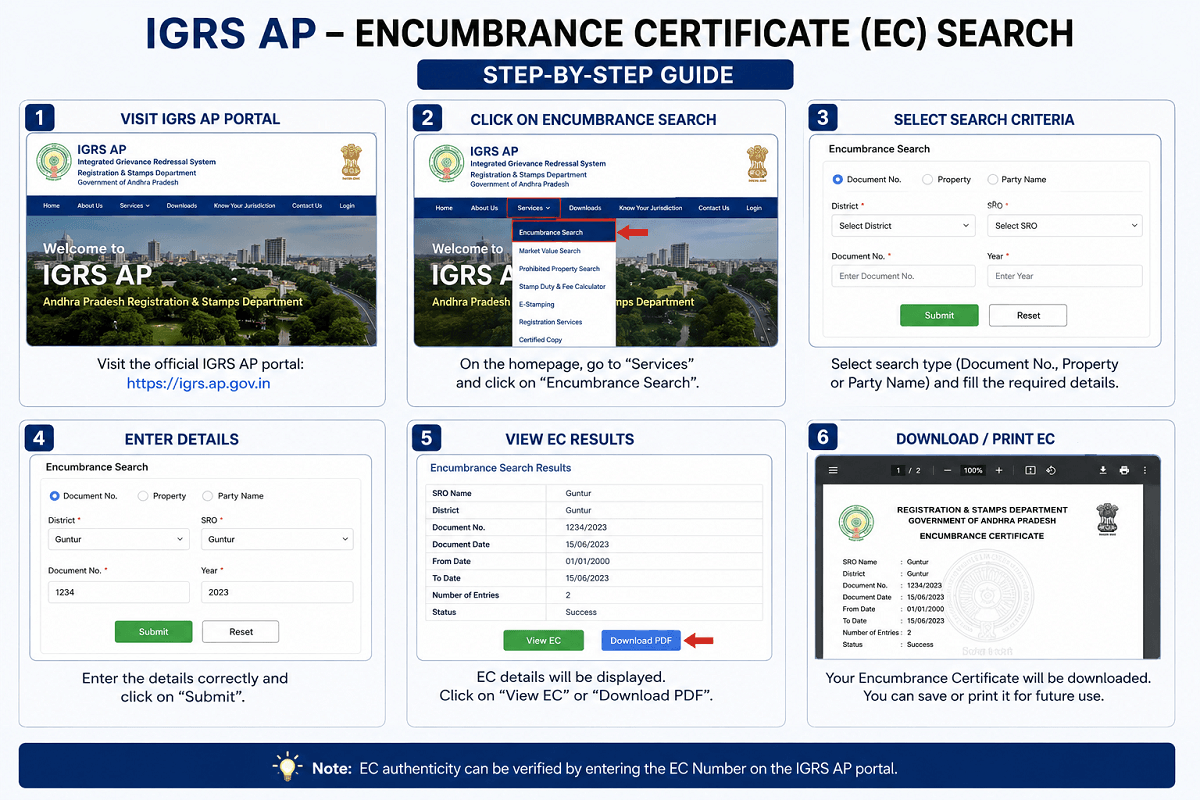
How to Search for Encumbrance Certificate on IGRS AP
An EC lists every registered deal on a property, from sales and gifts to loans. That’s why banks ask for it before giving a home loan, and you should look at it before paying any advance. The online records start from 1 January 1983.
- Go to registration.ap.gov.in and open Encumbrance Search (EC).
- Pick the type of EC. The “EC for information” is free and needs no login. A signed EC is the one banks and courts accept.
- Search by document number, survey number, plot number or house number.
- Choose the district, the SRO and the years you want to check.
- Type the captcha and click submit.
You’ll see the owners, the property details and every deal registered in those years. If you get Form 15, there are registered deals or loans on the property, so read through them carefully. If you get Form 16, it’s a “nil encumbrance” certificate, which means nothing was registered in that period.
How to Download Your EC
For the free EC, just open the result and then save it as a PDF from your browser’s print menu. If you need a signed EC for a bank, log in through CARD PRIMME, apply for it, and download it when it’s ready.
If Your EC Search Shows Nothing
This happens a lot, and it’s rarely a problem with the property. Most of the time, one of the search details is off. Check that you picked the SRO where the deed was actually registered, since that isn’t always the nearest one. Next, try a wider period of years. If you searched by survey number, try the document number instead, or the other way round.
Also remember that online records only start from 1983. For anything older, or if the website still shows nothing, you can apply for an EC at the SRO itself. Take the property details and your ID, fill in the application there and pay the small fee.
Understanding IGRS AP Market Value Tool
The market value is the lowest value the government will accept for registering a property. You pay stamp duty on this value or your deal price, whichever is higher.
- On the portal, open Market Value.
- Pick agricultural or non-agricultural land.
- Choose your district, mandal and village or ward.
- Click submit to see the basic rate per square yard or per acre.
For a building in a town or city, there’s also a door-number-wise option that shows the rate for that exact building. And if you want to keep the rates, save the page as a PDF from your browser.
But these values do change. The department revised urban market values and building rates from 1 February 2026, so check the latest figure just before you register.
Checking IGRS AP Prohibited Properties List
Before you buy, note that some properties simply can’t be registered. Government land, assigned land, temple and endowment land, Wakf land and properties attached by a court all fall in this group. They’re listed under Section 22A of the Registration Act.
- On the portal, open Prohibited Property Search.
- Pick Rural or Urban.
- Choose your district, mandal and village.
- Enter the survey or door number and click submit.
If the property you want shows up on this list, stop there and speak to a lawyer before you pay anything. The seller can’t give you a clean title to it.
Downloading Certified Copies (CC)
A certified copy is an official copy of a registered deed. To get one, open Certified Copy on the portal, then enter the district, SRO, document number and year, and submit. You can then download it as a signed PDF.
Essential Documents and Additional IGRS AP Services
Documents Required for Property Registration in AP
First, get your papers together before your slot, so you don’t have to make a second trip.
From the seller:
- The original title deed, along with the older deeds that show how the property came to them
- An EC, usually for the last 13 to 30 years, as the buyer’s bank or lawyer asks
- The latest property tax receipt
- Adangal and 1-B from Meebhoomi, for farmland
- Aadhaar and PAN card
From the buyer:
- Aadhaar and PAN card
- Address proof
- Passport-size photos
For the property, if they apply:
- The approved building plan
- An occupancy certificate, for a newly built home
- A land conversion order, if farmland is being used for a house
How to Find Your Sub-Registrar Office (SRO)
If you don’t know which SRO handles your property, open Know Your SRO on the portal. Pick your district, mandal and village, and it shows the SRO’s name, code and address. You’ll need the right SRO for EC searches, certified copies and booking a slot.
How to Access Village Directory on IGRS AP
Open Village Directory on the portal. First, you’ll get a list of districts with their codes. Pick your district and mandal to see the villages. It comes in handy when a form asks for a village code.
Checking Deed Details and Registration Status
To look up an older deal, open List of Transactions. Choose whether you’re searching by document number, layout plot or apartment. After that, pick the district, SRO, document number and year, and submit. The registration details show up on screen.
Other Search Tools on the Portal
There are also two more searches worth knowing about. Integrated Property Wise Transactions lets you pick a district, mandal, village and survey number, and see the deals registered on that land. Then there’s Search by Name, which helps when you don’t have a document number, since you can look for a registered document using a person’s name instead.
Other Registrations on IGRS AP
The department doesn’t just deal with property. It also registers Hindu and Special Marriages, societies and firms, and keeps records of chit funds and notaries. Each one has its own section on the portal, with forms you can download.
Latest Updates on IGRS AP
For now, the biggest recent change is the market value revision. From 1 February 2026, the department raised urban market values and building rates across the state. Since stamp duty depends on market value, registering a property now costs more in many towns and cities. Also, urban values tend to be reviewed more often than rural ones.
Conclusion
IGRS AP has taken a lot of the running around out of property work in Andhra Pradesh. You can check an EC, see the market value, look at the prohibited list and work out your stamp duty on your phone. The only time you really need to go to the SRO is on the day you register. Before you sign anything, check three things on the portal: the EC, the prohibited list and the current market value. After that, get your papers ready, book your slot early and take everything with you on the day. If something goes wrong, you can call the department’s grievance helpline on 14544.
Discover IGRS For Other States
| States | IGRS |
| Rajasthan | IGRS Rajasthan |
| Odisha | IGR Odisha |
| Maharashtra | IGR Maharashtra |
| Telangana | IGRS Telangana |
| Uttar Pradesh | IGRSUP |
Frequently Asked Questions
1. What is the full form of IGRS in Andhra Pradesh?
It stands for Inspector General of Registration and Stamps. That’s the office in charge of registering property and collecting stamp duty in the state. On its website, you can search an EC, get a certified copy, check the market value and the prohibited list, work out your stamp duty and book a slot at the SRO.
2. What are the stamp duty and registration charges in Andhra Pradesh?
For a sale deed, it’s 5% stamp duty, 1% registration fee and 1.5% transfer duty. That adds up to 7.5%. Gifting to family costs much less: 2% stamp duty and a 0.5% fee, which stays between ₹1,000 and ₹10,000.
3. How do I search for an EC on IGRS AP?
Open registration.ap.gov.in and click Encumbrance Search. The basic EC is free and needs no login. For a bank, you’ll want the signed one instead. Enter the document, survey, plot or house number, choose the district, SRO and years, and you’re done.
4. What documents do I need to register a property in AP?
The seller brings most of them. That means the original title deed with the older deeds behind it, an EC, the last tax receipt, and their Aadhaar and PAN. For farmland, add the Adangal and 1-B from Meebhoomi. You, as the buyer, only need your Aadhaar, PAN, address proof and a few photos. Sometimes the SRO also asks for the building plan, an occupancy certificate or a land conversion order.
5. How do I book a slot at the SRO on IGRS AP?
Log in to CARD PRIMME, open the document you saved and click Slot Booking. Then pick a date and time and confirm. Book a few days early if you can, because slots run out fast.
6. Is the EC on IGRS AP free?
The basic one is. You can see it without logging in. The signed EC that banks and courts ask for needs a login and costs a little.
7. How old an EC can I check online?
Online records go back to 1 January 1983. For anything older, you’ll need to ask at the SRO.
8. What's the difference between IGRS AP and Meebhoomi?
IGRS AP tells you what’s been registered on a property, like sale deeds, loans and the EC. Meebhoomi is run by the Revenue Department and shows land records such as Adangal, 1-B and ROR. When you’re buying land, check both.
9. What if the property is on the prohibited list?
Stop and talk to a lawyer before you pay anything. Land under Section 22A, like government, assigned or temple land, can’t be registered. So the seller has no clean title to give you.
10. What is the IGRS AP helpline number?
It’s 14544. The department set it up for complaints, so call it if your EC, registration or any other service runs into trouble.
11. Can I buy property in AP with a power of attorney?
Not safely. A power of attorney only lets someone sign for the owner. It doesn’t make you the owner. To own the property, you need a sale deed registered in your name. So if the seller offers a “GPA sale”, ask for a proper sale deed.
12. Is there a time limit to register a will?
No, there isn’t. Registering a will is optional, and you can do it any time in your life. But a registered will is much harder to challenge later, which is why many families get it done.
13. My EC has a wrong detail. What should I do?
Take your registered deed to the SRO where the property was registered. If it’s just a mistake in their record, they can look into it. If the mistake is in the deed itself, like a wrong survey number, you’ll usually need a rectification deed. A lawyer can draft that for you.