
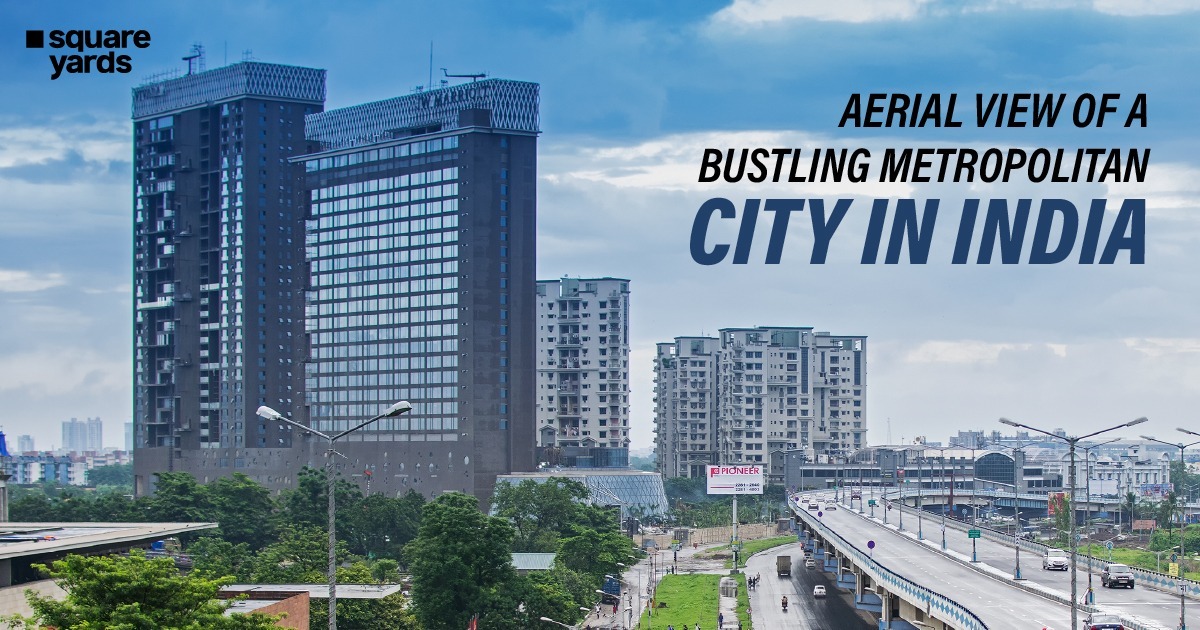
If you searched for metropolitan cities in India, you probably want one of three things: the complete list, a clear explanation of what makes a city metropolitan, or specific data like population figures and rankings. This guide has all of it.
The term gets used loosely in everyday conversation, often swapped with metro city or tier-1 city. They are related but not identical. The difference matters, especially when you are looking at property, jobs or government schemes tied to specific city classifications.
- What is a Metropolitan City? Meaning and Definition
- How Many Metropolitan Cities Are in India?
- List of Metropolitan Cities in India — Top 8 with Population
- Is Your City a Metropolitan City? — Common Queries Answered
- Metropolitan City vs Metro City — Is There a Difference?
- Metropolitan Cities in India — Key Economic and Social Facts
- Metropolitan Cities in South India
- New and Upcoming Metropolitan Cities in India
- Metropolitan Cities and Real Estate
- Conclusion
What is a Metropolitan City? Meaning and Definition
|
A metropolitan city in India is an urban agglomeration with a population of 10 lakh (1 million) or more. This definition is set by the 74th Constitutional Amendment Act of 1992, which also established Metropolitan Planning Committees (MPCs) for such cities. As of the 2011 Census, India had 53 urban agglomerations with a population of over 10 lakh. |
The word metropolitan comes from the Greek ‘metropolis’, meaning mother city. In the Indian context, it carries a specific legal meaning tied to population thresholds and governance structures.
Not every large city is officially called a metropolitan city in government classification. The 74th Amendment introduced a three-tier urban governance structure and defined metropolitan areas as those having a population of 10 lakh or above. These cities are required to have Metropolitan Planning Committees to coordinate planning across the urban agglomeration.
|
Classification |
Population Threshold |
Governance |
Examples |
|
Metropolitan city (74th Amendment) |
10 lakh (1 million)+ |
Metropolitan Planning Committee |
Mumbai, Delhi, Kolkata, Chennai |
|
Municipal Corporation city (large) |
5 lakh+ |
Municipal Corporation |
Surat, Jaipur, Lucknow |
|
Tier-1 city (informal classification) |
Varies by usage |
No specific constitutional definition |
Mumbai, Delhi, Bengaluru, Hyderabad |
|
Urban Agglomeration (Census) |
1 lakh+ |
Census unit, not governance |
All major cities |
How Many Metropolitan Cities Are in India?
|
India has 8 commonly recognised metropolitan cities: Mumbai, Delhi, Kolkata, Chennai, Hyderabad, Bengaluru, Ahmedabad and Pune. However, as per the 74th Constitutional Amendment definition (population of 10 lakh+), the 2011 Census counted 53 urban agglomerations crossing this threshold. The number depends on which definition you apply. |
The confusion around ‘how many’ comes from different classification systems being used simultaneously. Here is how the numbers break down:
- 4 original metro cities (historically): Mumbai, Delhi, Kolkata, Chennai
- 6 metro cities (commonly cited): above 4 plus Hyderabad and Bengaluru
- 8 metro cities (current widely accepted list): above 6 plus Ahmedabad and Pune
- 53 urban agglomerations (Census 2011): all cities with 10 lakh+ population
- When the 2021 Census data is released, this number will likely exceed 60
List of Metropolitan Cities in India — Top 8 with Population
|
Rank |
Metropolitan City |
State |
Population (Census 2011) |
Urban Agglomeration Pop |
|
1 |
Mumbai |
Maharashtra |
1.24 crore (city) |
2.06 crore (UA) |
|
2 |
Delhi |
Delhi |
1.10 crore (city) |
2.63 crore (UA) |
|
3 |
Kolkata |
West Bengal |
45 lakh (city) |
1.41 crore (UA) |
|
4 |
Chennai |
Tamil Nadu |
46 lakh (city) |
87 lakh (UA) |
|
5 |
Bengaluru |
Karnataka |
84 lakh (city) |
1.02 crore (UA) |
|
6 |
Hyderabad |
Telangana / AP |
67 lakh (city) |
77 lakh (UA) |
|
7 |
Ahmedabad |
Gujarat |
55 lakh (city) |
73 lakh (UA) |
|
8 |
Pune |
Maharashtra |
31 lakh (city) |
61 lakh (UA) |
Population figures are from Census 2011 as the 2021 Census results are still being released. Current populations are estimated to be significantly higher. Mumbai’s urban agglomeration population is now estimated at over 2.5 crore, making it the largest metropolitan area in India and one of the largest in Asia.
Is Your City a Metropolitan City? — Common Queries Answered
Several specific city queries appear in the search data. Here are direct answers.
Is Hyderabad a Metropolitan City?
Yes. Hyderabad is one of India’s 8 major metropolitan cities. It is the capital of Telangana and is jointly administered with Andhra Pradesh. The Hyderabad urban agglomeration had a population of over 77 lakh in the 2011 Census, well above the 10 lakh threshold. Hyderabad is also classified as a mega city given its population exceeds 40 lakh.
Is Surat a Metropolitan City?
Surat has a population well above 10 lakh and qualifies as a metropolitan city under the 74th Amendment definition. The 2011 Census recorded Surat’s population at around 45 lakh. However, Surat is not typically included in the commonly cited list of 6 or 8 metro cities, which is an informal grouping based on economic and infrastructure significance rather than just population.
Is Varanasi a Metropolitan City?
Varanasi had a population of around 12 lakh in the 2011 Census, which crosses the 10 lakh threshold. Under the strict constitutional definition it qualifies. However, it is not classified as a major metropolitan city in most government planning frameworks and is not included in the commonly cited 8 metro cities list.
Is Kolkata a Metropolitan City?
Yes. Kolkata is one of India’s original and oldest metropolitan cities, part of the historic four-metro group along with Mumbai, Delhi and Chennai. The Kolkata metropolitan area is one of the largest in South Asia with an estimated population of over 1.5 crore currently.
Is Bhopal a Metropolitan City?
Bhopal crossed the 10 lakh population mark and qualifies under the constitutional definition. However, like Varanasi, it is not included in the major metropolitan cities list that most people refer to when they ask about metro cities in India.
Metropolitan City vs Metro City — Is There a Difference?
In everyday usage, metropolitan city and metro city mean the same thing. Both refer to large, economically significant urban areas. However, technically:
|
Term |
Definition |
Used by |
|
Metropolitan city |
Urban area with 10 lakh+ population per 74th Amendment |
Constitutional / legal context |
|
Metro city (informal) |
The 4, 6 or 8 largest cities by economic and urban significance |
Media, business, job classifieds |
|
Mega city |
City or UA with 40 lakh+ population (UN definition) |
International urban planning |
|
Metropolitan area |
Entire urban agglomeration including suburbs and satellite towns |
Census classification |
|
Tier-1 city (informal) |
Top 8 cities by economy, infrastructure and population |
Real estate, business classification |
For most practical purposes: if you are looking for job listings, real estate or bank account openings that ask for city classification, metro city and metropolitan city are treated as equivalent.
Metropolitan Cities in India — Key Economic and Social Facts
The 8 metropolitan cities account for a disproportionately large share of India’s economic activity.
- Mumbai contributes approximately 6.16% of India’s total GDP and is home to the BSE and NSE stock exchanges
- Delhi is India’s largest commercial hub for government, services and retail, and its NCR agglomeration is the largest urban economy
- Bengaluru generates over 38% of India’s software export revenue and hosts over 1,000 MNC offices
- Chennai is called the Detroit of India for its automobile manufacturing cluster
- Hyderabad has HITEC City as a major IT and pharma hub, attracting over Rs 50,000 crore in IT investment annually
- Pune has the highest concentration of automobile, IT and engineering companies in Maharashtra after Mumbai
- Ahmedabad is the textile and diamond trading capital and hosts GIFT City, India’s first IFSC
- Kolkata is the gateway to Northeast India and Southeast Asia, with major port and logistics infrastructure
Metropolitan Cities in South India
South India has three cities in the major metropolitan list: Chennai, Hyderabad and Bengaluru. Together they form the three most significant IT and industrial hubs in peninsular India.
|
City |
State |
Key Sectors |
Metro Rail Status |
|
Chennai |
Tamil Nadu |
Automobiles, IT, manufacturing, port |
Chennai Metro operational |
|
Hyderabad |
Telangana |
IT, pharma, defence, aerospace |
Hyderabad Metro operational |
|
Bengaluru |
Karnataka |
IT/ITeS, aerospace, biotech |
Bengaluru Namma Metro operational |
Several other South Indian cities are growing toward metropolitan status. Kochi, Thiruvananthapuram, Coimbatore and Visakhapatnam have all crossed or are approaching the 10 lakh threshold and have varying levels of metropolitan governance infrastructure.
New and Upcoming Metropolitan Cities in India
As India’s urbanisation accelerates, more cities are crossing the 10 lakh population threshold. Cities being watched for metropolitan classification in the 2021 Census cycle include:
- Surat — already qualifies by population, growing rapidly post-2011
- Jaipur — population around 40 lakh in current estimates
- Lucknow — capital of UP with accelerating urban growth
- Nagpur — Maharashtra’s second-largest city and a proposed government hub
- Indore — fastest-growing city in MP, consistently rated cleanest city in India
- Visakhapatnam — proposed executive capital of Andhra Pradesh with strong industrial growth
The official expansion of the metropolitan cities list depends on the 2021 Census data and subsequent government notification. The 74th Amendment framework allows states to notify Metropolitan Planning Committees for qualifying cities.
Metropolitan Cities and Real Estate
From a property and real estate perspective, metropolitan cities attract the most investment, have the highest property prices and the most active rental markets.
|
Metro City |
Avg Property Rate (2025-26) |
Rental Yield |
Property Market Character |
|
Rs 18,000 to Rs 55,000/sq ft |
2 to 3% |
Premium, constrained supply, island geography |
|
|
Rs 5,000 to Rs 20,000/sq ft |
2 to 4% |
Spread across NCR, varied by micro-market |
|
|
Rs 5,500 to Rs 18,000/sq ft |
3 to 4% |
IT-driven, strong rental demand |
|
|
Rs 5,000 to Rs 15,000/sq ft |
3 to 4.5% |
Developer friendly, growing fast |
|
|
Rs 4,500 to Rs 12,000/sq ft |
3 to 4% |
Stable, manufacturing belt driven |
|
|
Rs 5,000 to Rs 14,000/sq ft |
3 to 4% |
IT and auto industries sustain demand |
|
|
Rs 3,500 to Rs 9,000/sq ft |
3 to 4% |
Affordable premium, GIFT City driving growth |
|
|
Rs 3,000 to Rs 8,000/sq ft |
3 to 4% |
Most affordable metro, large stock |
Conclusion
Metropolitan cities are India’s urban engines. Whether you call them metro cities, metropolitan areas or tier-1 cities, the 8 cities on this list concentrate the largest share of the country’s jobs, investment, infrastructure and population growth.
The official number depends on which definition you use. The constitutional threshold of 10 lakh gives you 53 cities by 2011 Census data. The common understanding of major metropolitan cities gives you 8. When the 2021 Census results are fully released, both numbers will go up.
For practical purposes: if a city is on this list of 8, it qualifies as a major metropolitan city by any measure. If you are deciding where to buy property, take a job or start a business, these are the cities that carry the depth of opportunity, infrastructure and market liquidity that makes urban India tick.
Don’t Miss It!
| Smart City Ludhiana | Ludhiana Smart Cities Projects & Mission |
| Smart City Dholera | Dholera Smart Cities Projects & Mission |
| Safest Cities in India | Safest Cities in India 2024 to Live By NCRB |
| Smart City Nagpur | Nagpur Smart Cities Projects & Mission |
| Smart City Karnal | Karnal Smart Cities Projects & Mission |
| Smart City Ajmer | Ajmer Smart Cities Projects & Mission |
| Smart City Karnal | Karnal Smart Cities Projects & Mission |
| Cleanest Cities in India | Cleanest Cities in India to Explore and Cherish! |
| Smart City Udaipur | Udaipur Smart Cities Projects & Mission |
| Smart City Bhopal | Bhopal Smart Cities Projects & Mission |
| Smart City Varanasi | Varansi Smart Cities Projects & Mission |
| Smart City Udaipur | Udaipur Smart Cities Projects & Mission |
Frequently Asked Questions:
1. What are the metropolitan cities in India?
The 8 major metropolitan cities in India are Mumbai, Delhi, Kolkata, Chennai, Hyderabad, Bengaluru, Ahmedabad and Pune. Under the 74th Constitutional Amendment definition (10 lakh+ population), the 2011 Census identified 53 urban agglomerations as metropolitan. The commonly used list of 8 refers to the most economically and demographically significant urban centres in the country.
2. What is the meaning of metropolitan city in India?
A metropolitan city in India is an urban area with a population of 10 lakh (1 million) or more, as defined by the 74th Constitutional Amendment Act of 1992. These cities are required to have Metropolitan Planning Committees for coordinated urban governance. The term is sometimes used informally to refer to the largest and most developed cities regardless of the exact population threshold.
3. How many metropolitan cities are there in India?
There are 53 urban agglomerations with a population of over 10 lakh as per the 2011 Census, which is the constitutional definition of a metropolitan city. However, the commonly accepted list of major metropolitan cities in India is 8: Mumbai, Delhi, Kolkata, Chennai, Hyderabad, Bengaluru, Ahmedabad and Pune. Historically, only 4 cities (Mumbai, Delhi, Kolkata, Chennai) were called metro cities.
4. What is the difference between a metropolitan city and a metro city?
5. What is the largest metropolitan city in India?
Mumbai is the largest metropolitan city in India by population density and economic output. However, Delhi’s National Capital Region (NCR) has the largest urban agglomeration population, estimated at over 3 crore in current estimates. Mumbai’s urban agglomeration population is around 2.5 crore, making it the second-largest urban area. By GDP contribution, Mumbai is the largest.
6. Are there metropolitan cities in South India?
Yes. Three of India’s 8 major metropolitan cities are in South India: Chennai (Tamil Nadu), Hyderabad (Telangana) and Bengaluru (Karnataka). These three cities are also the primary IT and industrial hubs of peninsular India. Several other South Indian cities including Kochi, Coimbatore and Visakhapatnam are growing rapidly and may be classified as major metros in upcoming Census cycles.
7. What is the difference between a metropolitan city and a tier-1 city?
Metropolitan city has a legal definition under India’s 74th Constitutional Amendment: a city or urban agglomeration with a population of 10 lakh or more. Tier-1 city is an informal classification used in business, real estate and job markets, typically referring to the top 8 cities. The two lists largely overlap but are not identical. Tier-1 city has no official government or Census definition.
8. Is Pune a metropolitan city in India?
Yes, Pune is one of India’s 8 major metropolitan cities. With a population of around 31 lakh in the 2011 Census and significantly higher current estimates, Pune qualifies both by the constitutional threshold and by its economic and infrastructure development. Pune is particularly significant for automobile manufacturing, IT and engineering industries in Maharashtra.
9. What is a metropolitan area in India?
A metropolitan area in India refers to the complete urban agglomeration of a city including its surrounding satellite towns, suburbs and districts that are economically and socially integrated with the core city. For example, the Delhi Metropolitan Area includes not just Delhi but parts of Haryana and Uttar Pradesh. Metropolitan areas are typically much larger in population than the city limits alone.
10. Which is the best metropolitan city to live in India?
There is no single best metropolitan city for everyone. Bengaluru is often cited for its IT job market, pleasant climate and work-life balance. Pune offers similar IT and manufacturing opportunities with lower costs than Mumbai. Hyderabad has good infrastructure, lower property prices and a strong job market. Mumbai offers the highest salaries but the highest costs. Delhi NCR gives the widest range of sectors and connectivity. The best city depends on your career, budget and lifestyle priorities.