
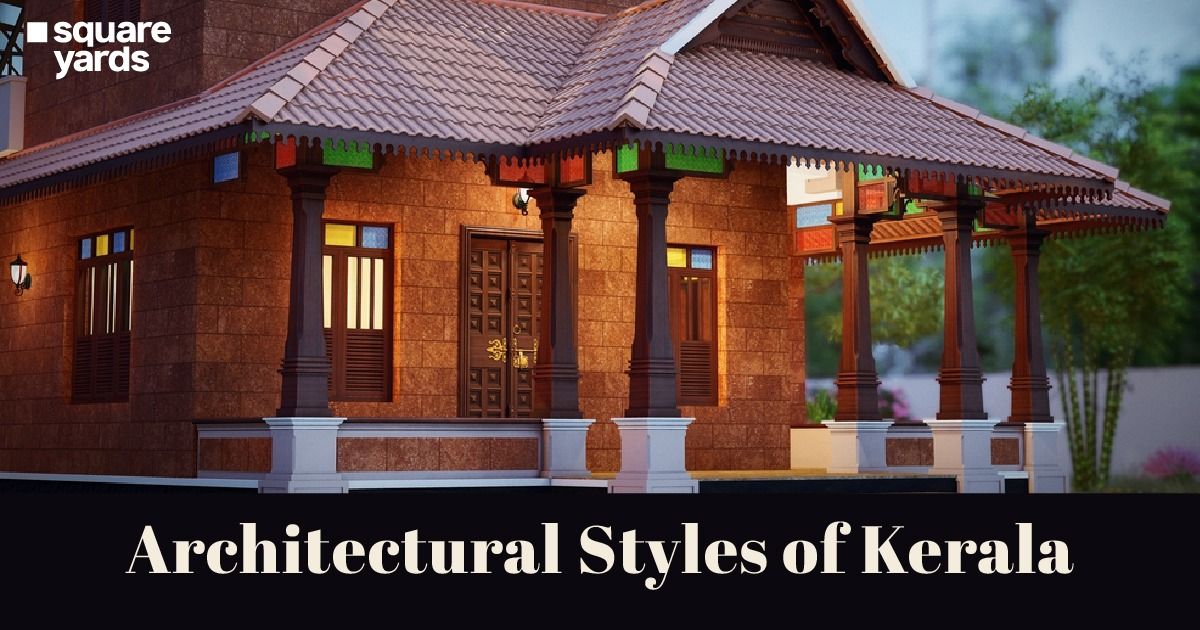
Say which Kerala house design style has four blocks and which has eight, and plenty of articles will get it backwards. Not a small mix-up. The Malayalam words literally spell out the answer, and somehow it still gets swapped constantly.
A Kerala house is a residential design rooted in Thachushastra (the science of carpentry) and Vastu Shastra, built around sloped roofs, wooden detailing, and a central open courtyard to handle Kerala’s tropical monsoon climate. Kerala house design, at its core, comes down to solving for one thing: heavy rain and constant heat. Nalu means four. Ettu means eight. Pathinaru means sixteen. Each number tells you exactly how many blocks that house style has.
This guide covers the real architectural features, corrects the block-count confusion, and walks through traditional, modern, small, and budget Kerala house designs with honest cost ranges.
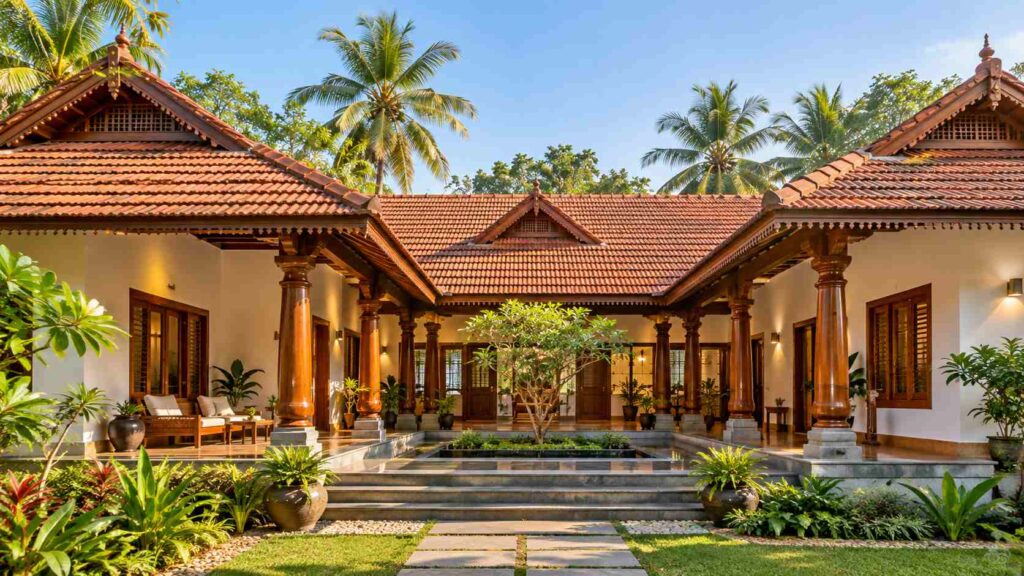
Kerala House vs. Kerala House Design: Two Different Searches
Search “Kerala House” on its own, and Google’s own answer engine leads with something unexpected: the official Kerala state guest house in New Delhi, not architecture at all. Search “Kerala House Design” instead, and you land squarely in the world of Nalukettu courtyards and sloped roofs. Same three words at the start, genuinely different intent.
Kerala House, New Delhi, is the state government’s liaison office on Jantar Mantar Road, near Patel Chowk Metro Station. It handles official coordination between Kerala and the central government, and it’s genuinely well known locally for its canteen, authentic Kerala meals, fish fry, appam and parotta, at prices most restaurants can’t match. If that’s what brought you here, you’re looking for a government building, not a home style, and this guide won’t cover room bookings or canteen timings.
Everything else in this guide is about the second meaning: Kerala house design, the architectural style. That’s the real focus here, and it’s what the rest of this page covers in depth.
What Is Kerala House Design?
Kerala house design is a regional architectural style built specifically for tropical, monsoon-heavy weather. Kerala home design and Kerala house design are really the same thing, just two common ways people phrase the search. Sloped roofs shed heavy rain, wooden detailing keeps interiors cool, and a central courtyard pulls light and air into every room around it. Search engines and homeowners alike often call this kerala home design or simply home models kerala, all pointing at the same regional style.
A few quick facts worth knowing:
- Two old sciences shape the whole style: Thachushastra for carpentry, Vastu Shastra for how rooms get placed
- Steep, sloped clay-tile roofs, that’s the feature everyone spots first, built to shed monsoon rain fast
- Right in the middle sits the Nadumuttam, a courtyard open to the sky, anchoring the whole layout
- Teak, laterite stone, clay, all pulled from nearby, which is exactly why the house suits the climate so well
Every feature here solves a real problem. This isn’t decoration. It’s climate-first engineering with centuries of refinement behind it.
Nalukettu vs. Ettukettu vs. Pathinarukettu: Getting the Numbers Right
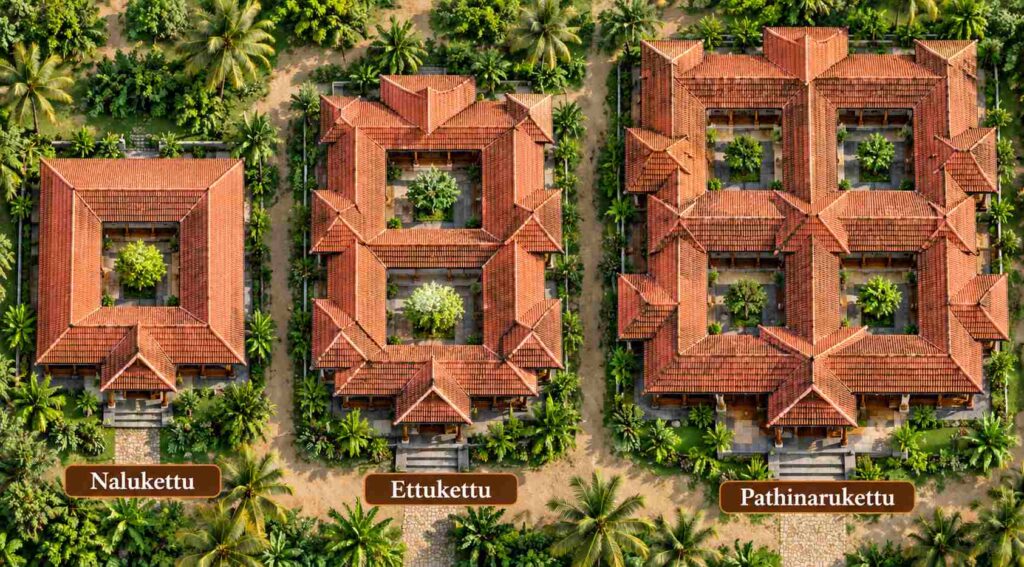
Nalukettu has four blocks and one courtyard. Ettukettu has eight blocks and two courtyards. Pathinarukettu has sixteen blocks and four courtyards. The names literally tell you this. Nalu (four), Ettu (eight), Pathinaru (sixteen), each paired with “kettu,” meaning built-up block.
|
Style |
Blocks |
Courtyards |
Traditionally Built By |
|---|---|---|---|
|
Nalukettu |
4 |
1 |
Most traditional homesteads |
|
Ettukettu |
8 |
2 |
Wealthier joint families |
|
Pathinarukettu |
16 |
4 |
Royal families, largest estates |
The four main blocks in a Nalukettu are named by direction: Vadakkini (north), Padinjattini (west), Kizhakkini (east), and Thekkini (south). Bigger families built the Ettukettu or Pathinarukettu version of the same idea. More blocks, more courtyards, more room for an extended household under one roof.
Core Architectural Features
A handful of features show up across nearly every genuine Kerala house design, traditional or modern.
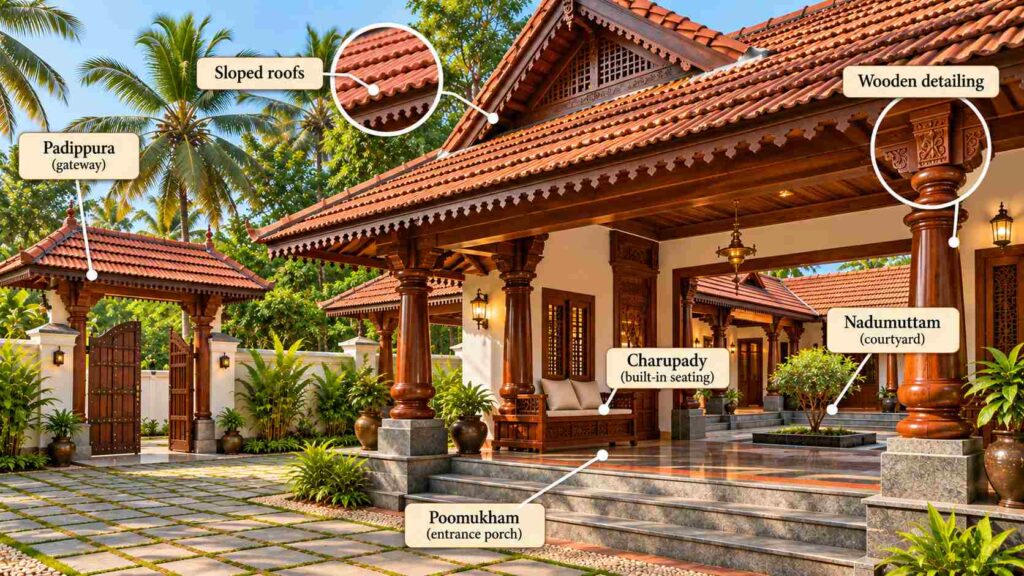
- Sloped roofs. Steep clay tiles let monsoon rain run off fast, and the house stays cooler than one sitting under a flat concrete slab.
- Nadumuttam (courtyard). Open to the sky, right in the center, pulling light and air into every room around it.
- Poomukham (entrance porch). Covered, decorated, usually the most detailed spot in the whole house.
- Padippura (gateway). A tiled, arched entrance at the compound wall. This is where the property actually starts.
- Charupady (built-in seating). Wooden benches built right into the verandah, made for sitting and talking.
- Wooden detailing. Teak and rosewood carvings on columns, doors, windows, doing structural work and looking good while at it.
Kerala House Design Interior: Accents Worth Knowing
Interior accents matter just as much as the structure in a genuine Kerala house design. A few details show up again and again.
- Aattu Kattil. A heavy wooden swing hung from brass chains, usually placed in the main living area or central corridor. Genuinely functional, not just decorative.
- Earthy palettes. Natural wood tones, plain white walls, and warm terracotta, often paired with traditional Kerala mural art on a feature wall.
- Teak and rosewood joinery. Carved pillars, false ceilings, and heavy wooden doors, the same materials used structurally outside show up again indoors.
None of this needs the full traditional scale to work. A single Aattu Kattil or one mural-accented wall can carry the Kerala look into an otherwise modern interior.
Kerala House Style: Traditional vs. Modern Contemporary
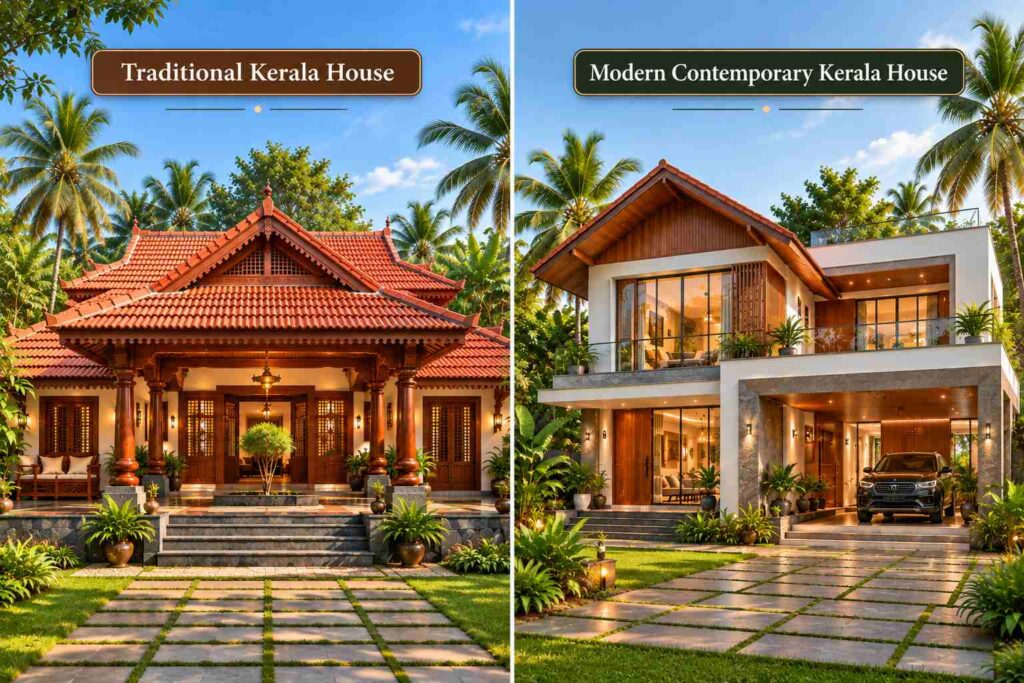
Traditional Kerala house design keeps the sloped roof and courtyard logic intact using teak, laterite, and clay. Modern contemporary Kerala homes, sometimes searched as contemporary house design in Kerala, keep that same climate logic, just swapping in concrete, glass, and steel for lower upkeep.
A modern Kerala house typically goes with a lighter roof slope, large glass windows, open floor plans, and concrete columns instead of load-bearing walls. A lot of contemporary builds actually mix roof types entirely, a flat concrete slab over one section for a usable balcony, paired with a steep sloped, tiled roof over the main structure to still handle heavy rain properly. Integrated carporches, driveways built right into the facade’s geometric lines rather than tacked on separately, are another signature contemporary touch. The core idea sticks around here. Ventilation and rain still matter just as much, they just get handled with newer materials instead of old ones. If you’re weighing both directions for an actual purchase, our houses for sale in Kochi guide covers what’s actually available in the current Kerala market, traditional and modern alike.
Small & Budget-Friendly Kerala House Design
A small Kerala house design typically fits on 600 to 1,500 sq ft, using a single floor or a compact double floor instead of a full Nalukettu footprint. This kerala small house design approach leans on exposed laterite stone, keeps the roof flat or only slightly sloped, and saves the good woodwork just for the front porch.
Keeping the courtyard small, or dropping it entirely in favor of a simple open-plan living area, is honestly one of the most effective ways to cut both cost and square footage while keeping the Kerala look recognizable. Brick jali work or aluminum louvers are another smart budget move, they block direct sun and let a breeze through without needing full air conditioning, and they cost far less than a full teak facade. A basic single-storey layout with a covered porch and a few traditional touches, exposed wood beams, a tiled roof section, can still read as authentically Kerala-style without the full traditional scale.
Kerala House Design by Plot Size
Plot size shapes how much of the traditional layout you can realistically fit in. A full Nalukettu needs real space for four wings and a courtyard. Smaller plots call for a scaled-down interpretation instead.
For general Indian plot-size planning that applies regardless of regional style, our guides on 15×30, 20×30, and 30×40 house plans cover room layouts and dimensions you can adapt with Kerala-style sloped roofs and courtyard touches.
Kerala House Construction Cost
Kerala house construction typically costs somewhere in the same broad range as other Indian states, though traditional wood-heavy builds run higher. Skilled carpentry labor and premium timber add up fast. As a general estimate, a basic contemporary Kerala-style home commonly falls in the ₹1,800 to ₹2,800 per square foot range, while a traditional Nalukettu-style build with genuine teak detailing can run considerably higher.
This is a planning range, not a fixed quote. Actual costs shift significantly with how much traditional woodwork you include, local material availability, and labor rates in your specific district. Get quotes from two or three local contractors familiar with Kerala-style construction before you finalize a budget.
Don’t miss It!
|
Types of Houses |
|
|
Ghar Ka Naksha |
|
|
Cabin House |
|
|
Open House |
|
|
Construct a House |
|
|
2 Storey House Design |
|
|
Duplex House |
|
|
Standalone Building |
|
|
Condominium |
|
|
Kutcha House |
Wrapping Up
Kerala house design isn’t just a look. It’s a climate-first system refined over generations, and getting the basics right (starting with the fact that Nalukettu genuinely means four blocks, not eight) actually matters if you want to understand it properly. Whether you’re drawn to a full traditional Nalukettu or a modern concrete home with the same sloped roof and courtyard logic, the underlying principles stay exactly the same.
Start with your plot size and budget. Decide how much traditional detailing you actually want to keep. Bring your plan to an architect familiar with Kerala’s climate and materials, and run the layout through our Vastu calculator to check it against traditional direction principles before finalizing anything. If you’re exploring the Kerala property market directly, our Nalukettu house listings in Thrissur show what a genuine traditional layout looks like in the current market.
Frequently Asked Questions:
1. What is Kerala-style house design called?
No single name, honestly, it comes down to size. Nalukettu (four blocks), Ettukettu (eight blocks), Pathinarukettu (sixteen blocks), all three built around a central courtyard.
2. Can I build a Kerala house under 5 lakh rupees?
Maybe, for a very basic single room or a tiny single-floor structure using bare-minimum materials in a rural area. A real Kerala-style home with proper sloped roofing and any traditional touches costs a lot more than that. Check with local builders before you count on this number.
3. What is a Nalukettu?
Four blocks, one courtyard, that’s the whole shape of it. Traditional joint families used this as their standard homestead design, built around the open Nadumuttam at the center.
4. What is the difference between Nalukettu and Ettukettu?
Nalukettu: four blocks, one courtyard. Ettukettu: eight blocks, two courtyards, basically two Nalukettu structures pushed together. Only the wealthiest families could actually afford to build the bigger version.
5. What are the main types of Kerala house designs?
Three traditional types exist: Nalukettu, Ettukettu, and Pathinarukettu, split apart by block count and courtyard number. A genuine Kerala traditional house always fits one of these three categories. Beyond those, modern contemporary Kerala homes and budget-friendly small house designs are what most people actually search for today, and both are just as common when people search home models Kerala broadly.
6. Is Kerala house design suitable for other Indian states?
The core ideas travel well. Sloped roofs for rain, courtyards for airflow, both work fine anywhere hot, humid, or rain-heavy. This house style in Kerala didn’t emerge by accident, it solves climate problems that plenty of other states share too. Materials might need to change based on what’s available locally.
7. What makes a Kerala house design modern or contemporary?
Same roof-and-courtyard logic, different materials. Swap teak and clay for concrete, glass, and steel, and you get large windows, open layouts, and a lot less upkeep than a full timber build needs.
8. Do Kerala houses always need a courtyard?
No. Traditional Nalukettu-style homes do, but modern and small budget designs often skip it and go with an open-plan living area instead, keeping the airflow benefit without giving up the extra space it would take.
9. Can I build a Kerala house in 20 lakhs?
Yes, this is a realistic budget for a compact single-floor home, roughly under 1,000 sq ft, using standard concrete construction and minimal traditional detailing. Real examples exist around this range, a 956 sq ft modern budget home has been built for around ₹17 lakh in Kerala, though your actual cost depends on location and finishes.
10. s "Kerala House" also a place in Delhi?
Yes. Kerala House in New Delhi is the state government’s official guest house and liaison office on Jantar Mantar Road, best known locally for its canteen. It has nothing to do with home architecture, see the section above for the full picture.
11. Which type of house is best in Kerala?
Depends entirely on your plot and budget, there’s no single “best.” A full Nalukettu suits a large joint family with real space to spare. A modern contemporary design fits a smaller urban plot better. A compact single-floor budget build makes the most sense if cost is the main concern. All three follow the same climate logic, just at different scales.