
Ever noticed how two houses on the exact same plot size can feel completely different to live in? That usually comes down to one thing: the naksha they were built from.
Ghar ka naksha means house floor plan in Hindi, a technical drawing showing room layout, wall placement, doors, windows, and plumbing before construction starts. It’s the one document every architect, contractor, and municipal office needs to see before a single brick gets laid.
This guide covers real layouts by BHK, actual plot-size options, a complete Vastu direction table, and honest cost ranges. Everything you need before you sit down with an architect or open a design app.
What Is Ghar Ka Naksha?
Ghar ka naksha is the Hindi term for a house plan, a detailed, top-down drawing of a home’s layout. Every wall, door, window, and staircase shows up exactly where it’ll actually sit, drawn to scale.
A few quick facts worth knowing:
- It shows room dimensions, wall thickness, and door and window positions, all drawn to exact scale
- It includes technical layers most people never think about: electrical points, plumbing lines, foundation details
- You need an approved naksha to get construction permission from your local municipal body in almost every Indian city
- It’s different from a site plan, which shows the whole plot, driveway, garden, boundary, not just the house itself
Think of your ghar ka naksha as the one document everyone on your build keeps coming back to. Your architect, your contractor, the electrician, and the government office reviewing your permit application, all working off the same page.
Ghar Ka Naksha by Plot Size
Different plot sizes need genuinely different naksha designs. Not just a scaled-up or scaled-down version of the same layout. Here’s where to find detailed guidance for common Indian plot sizes.
|
Plot Size |
Total Area |
Best For |
Detailed Guide |
|---|---|---|---|
|
15×30 ft |
450 sq ft |
Narrow urban plots, single floor or 2-floor builds |
|
|
20×30 ft |
600 sq ft |
1 BHK to 2 BHK layouts, compact city plots |
|
|
30×40 ft |
1,200 sq ft |
2 BHK to 3 BHK, single floor or duplex |
|
|
1,200 sq ft (any shape) |
1,200 sq ft |
Full BHK breakdown and single floor vs. G+1 comparison |
If your plot doesn’t match one of these exactly, the closest guide above still gives you a solid starting reference. Room ratios scale reasonably well between nearby plot sizes anyway.
Ghar Ka Naksha by Room Count
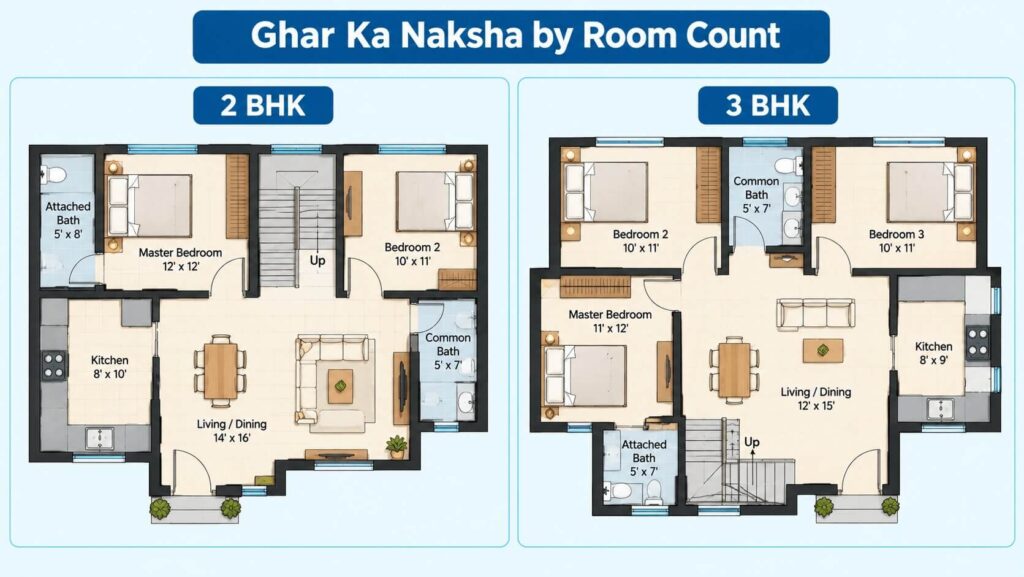
2 BHK Ghar Ka Naksha
A 2 BHK naksha typically fits comfortably on a 600 to 1,000 sq ft plot. Expect a master bedroom around 12×12 ft, a second bedroom around 10×11 ft, a living-dining area around 14×16 ft, and a kitchen around 8×10 ft.
3 BHK Ghar Ka Naksha
A 3 BHK naksha needs tighter planning, usually starting around 1,000 to 1,400 sq ft. Rooms run smaller than a 2 BHK version, typically 10×10 ft to 11×12 ft per bedroom. Living and dining often merge into one open space just to make room for that third bedroom.
4 Room Ghar Ka Naksha
A 4-room layout, whether that means 4 bedrooms or a mix of bedrooms, hall, and kitchen, generally needs 1,200 sq ft or more to stay comfortable. Squeeze it onto a smaller plot, and individual rooms shrink fast, sometimes down to 9×10 ft each, leaving very little space for common areas.
Vastu Ke Anusar Ghar Ka Naksha (Vastu-Based Layout)
Vastu Shastra is a traditional Indian design system, and plenty of families build it into their ghar ka naksha from the very first draft. According to Wikipedia’s entry on Vastu Shastra, the practice dates back to ancient Indian architectural texts and centers on aligning a building with directional and natural energy principles. Here’s where each room commonly goes.
|
Room |
Recommended Direction |
|---|---|
|
Main entrance |
North or East |
|
Kitchen |
Southeast |
|
Master bedroom |
Southwest |
|
Living room |
North or East |
|
Pooja room |
Northeast |
|
Bathroom |
Northwest or West |
|
Staircase |
South or West |
These placements are general guidelines, not gospel, and even Vastu consultants disagree with each other on the finer points. If Vastu genuinely matters to your family, bring a consultant in before finalizing the naksha. Moving a wall on paper costs nothing. Moving it after construction starts is a completely different story. Our Vastu calculator can also give you a quick compliance check on an existing layout.
North-Facing vs. East-Facing Ghar Ka Naksha
The direction your plot faces changes how the naksha gets planned, especially around the main entrance and room placement.
Uttar mukhi ghar ka naksha (north-facing) is widely considered auspicious in Vastu, tied to wealth and growth. The main entrance sits on the north wall, and this orientation reportedly suits people in banking, finance, or trade particularly well, at least according to Vastu tradition.
Purv mukhi ghar ka naksha (east-facing) is built around catching the morning sun. The main entrance faces east, the master bedroom typically sits in the southwest, and living areas favor the north or northeast for natural light through the day. Want the room-by-room detail? Our north-facing and east-facing house Vastu guides go a lot deeper into each orientation. If your plot faces south or west instead, our guides on south-facing and west-facing house Vastu, or the broader Vastu directions for house guide, cover those orientations in the same depth.
How to Design Your Ghar Ka Naksha (Step-by-Step)
Designing a ghar ka naksha follows a fairly consistent process, whether you’re working with an architect or a design app.
- Measure your plot. Get the exact length and width first, everything else depends on this one number.
- Decide your room count. How many bedrooms, bathrooms, and common areas does your family actually need?
- Choose your facing direction. Note which way your plot’s main road-facing side points, it shapes both entrance placement and Vastu planning.
- Sketch a rough layout. Block out room positions on paper or in a design app first. Details come later.
- Apply Vastu principles, if that’s your thing. Adjust room placement using the direction table above.
- Add technical details. Wall thickness, door swings, window placement, plumbing points, all of it goes in once the basic shape is settled.
- Get it reviewed by a professional. A structural engineer or architect checks the final naksha before you apply for municipal approval.
Simple vs. Modern Ghar Ka Naksha Design Ideas
A simple ghar ka naksha keeps the layout rectangular and straightforward. Fewer curves, fewer odd angles, lower construction cost. Usually the right call for smaller plots or tighter budgets.
A modern ghar ka naksha design leans into open floor plans, larger windows, and clean minimal facades. A few ideas worth considering:
- Open-plan living-dining. Merging these two spaces makes a small home feel noticeably bigger.
- Large windows. More natural light, less need for daytime artificial lighting.
- Vertical storage. Tall kitchen cabinets and built-in wardrobes save floor space on compact plots.
- Simple, clean elevation. A narrow frontage rarely has room for heavy ornamental detailing anyway, and a clean facade usually photographs and ages better.
Common Symbols Used in a Ghar Ka Naksha
Reading a naksha stops feeling like guesswork once you know what the standard symbols mean.
|
Symbol |
Meaning |
|---|---|
|
Thick solid line |
Main structural wall |
|
Thin solid line |
Partition wall or built-in feature |
|
Thin dotted line |
Overhead feature, like a cabinet or archway |
|
Quarter-circle with a line |
Door, showing swing direction |
|
Small gap in a wall line |
Window |
|
Circle next to a rectangle |
Toilet |
|
Arrow or compass mark |
North direction indicator |
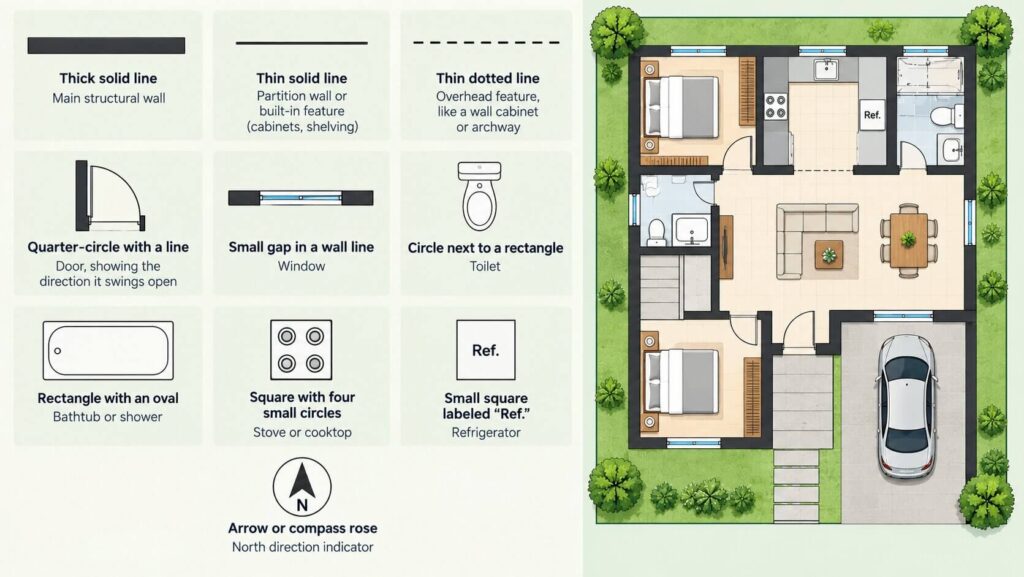
Knowing these means you can actually read your own naksha, instead of just nodding along while an architect explains it to you.
Ghar Ka Naksha Cost: What to Expect
Getting a ghar ka naksha made typically costs anywhere from a few thousand rupees for a basic layout to considerably more for a fully detailed, architect-designed plan with 3D renders. The exact number comes down to plot size, how much detail you want, and whether you’re hiring an individual architect or a design service.
As a rough average, a basic 2D naksha for a small to mid-sized home commonly falls in the ₹3,000 to ₹15,000 range. A complete package with 3D visualization, structural details, and Vastu consultation runs considerably higher. Treat any figure you see online as a general starting point, not a fixed quote, and get quotes from two or three architects or naksha services before committing to one.
Wrapping Up
A ghar ka naksha is more than a technical drawing. It’s the decision-making tool that keeps expensive mistakes from happening once construction actually starts. Settle your plot size, room count, and facing direction early, and the rest of the planning genuinely gets easier.
Whether you’re working with a 15×30 plot or a full 30×40 site, start with the layout that fits your actual family, not the one that looks impressive online. Bring your naksha to an architect to fine-tune the technical details, and you’re building on solid ground, in every sense of the phrase.
Don’t miss It!
|
Types of Houses |
|
|
Cottage House |
|
|
Cabin House |
|
|
Open House |
|
|
A-Frame House |
|
|
Narrow House |
|
|
Duplex House |
|
|
Service Apartments |
|
|
Penthouse |
|
|
Kutcha House |
Frequently Asked Questions:
1. What is ghar ka naksha?
Ghar ka naksha is the Hindi term for a house plan or floor plan, a technical drawing showing a home’s layout, room dimensions, walls, doors, and windows, drawn to scale before construction begins.
2. What is a 3D house design?
Same layout, but with depth added, furniture, finishes, the works, instead of flat lines on paper. Mainly there to help you actually picture the space before construction starts. Most architects and design apps can spin one up straight from a standard 2D naksha.
3. How to design a house?
Measure the plot first, always. Then lock down your room count and figure out which way the plot faces. From there it’s a rough sketch, Vastu tweaks if you’re going that route, then the technical stuff, wall thickness, plumbing points, before a professional signs off and you head into approval.
4. What is a village house design like?
Think open courtyards, wide verandas, everything spread across one floor instead of stacked upward. A gaon ka ghar ka naksha usually assumes a joint family too, so bedrooms tend to open onto one shared central space rather than a private hallway.
5. How much does it cost to build a house?
Somewhere between ₹1,500 and ₹3,500+ per square foot in India, and that’s just construction, the naksha itself is a separate line item. Quality tier and city both push this number around a lot, so check with local contractors before you commit to a figure.
6. What is the best Vastu direction for the main entrance?
North or East, hands down, the two most recommended directions in Vastu Shastra. Both get tied to positive energy flow, and East has the added bonus of catching that morning light straight through the door.
7. Can I make my own ghar ka naksha without an architect?
For your own reference, sure, plenty of free tools let you sketch a rough layout. The moment it needs to go in front of a municipal office for approval, though, a licensed architect or structural engineer has to prepare or sign off on it.
8. What is the difference between naksha and a house map?
None, really. Indians use “naksha” and “house map” to mean the exact same thing, a detailed floor plan with room layout and structural details spelled out.
9. How many rooms can fit in a small ghar ka naksha?
On a 600 sq ft plot, comfortably 1 to 2 bedrooms with a living area and kitchen. Squeezing in more rooms on the same footprint means each room gets noticeably smaller.
10. Is Vastu compulsory for a ghar ka naksha?
Not at all, it’s tradition, not law. Plenty of homeowners follow it purely by choice, and municipal approval couldn’t care less about Vastu alignment anyway, structural and safety compliance is all they’re checking for.