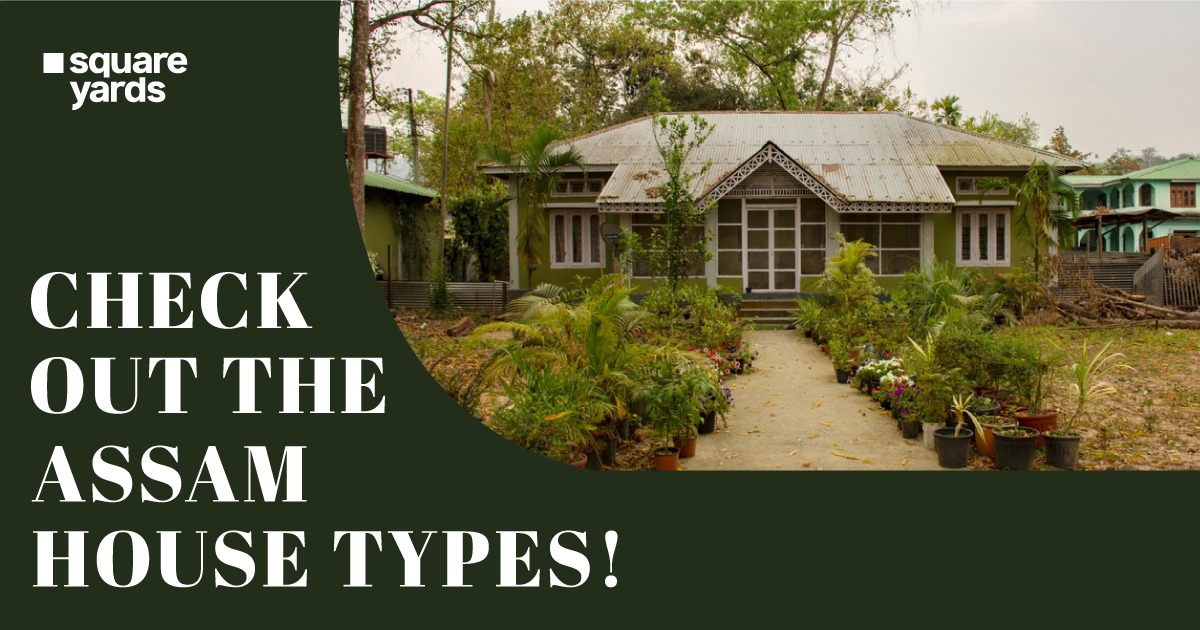
Ask most articles when Assam type house design started, and you’ll get “1950.” That’s wrong by more than half a century. Not a small mix-up.
Assam type house design is an earthquake-resistant, flood-resilient architectural style from Northeast India, built with lightweight materials like bamboo, timber, and ikra reed on a raised plinth. It emerged after the 1897 Shillong earthquake, not 1950, when colonial engineers noticed something interesting: traditional local homes survived while brick buildings collapsed.
This guide covers the real history, the actual architectural features, front design ideas, the honest difference between traditional and modern versions, and what construction genuinely costs.
What Is Assam Type House Design?
Assam type house design is a construction style engineered specifically for earthquakes and heavy monsoon rain, using lightweight materials instead of rigid ones. The logic is simple, honestly kind of elegant once you see it: a structure that flexes survives a tremor better than one that resists it rigidly and then shatters.
A few quick facts worth knowing:
- Timber posts, often Sal or Gamari wood, sit on a raised brick or stone base
- Walls are usually bamboo or ikra reed panels, coated in mud or cement plaster
- Roofs slope steeply on purpose, cut at sharp angles so rain never sits and pools
- Wide verandahs wrap around the front, sometimes the sides too, doubling as shaded space to sit outside
These houses aren’t just old-fashioned. They’re specifically engineered. Every feature solves a real problem this region actually faces.
The Real History of Assam Type House Design
Assam type house design emerged after the 1897 Shillong earthquake, an event estimated between magnitude 8.0 and 8.7 depending on the source, that flattened nearly every British-built brick structure in the region. Traditional local homes, built from bamboo and mud, came through largely intact.
Colonial engineers, working alongside a team led by Japanese seismologist Fusakichi Omori, studied why the local techniques held up. They formalized those methods into what became known as Assam-type construction, a hybrid blending traditional local materials with more structured, standardized building methods.
The 1950 Assam-Tibet earthquake, another massive event at magnitude 8.7, came 53 years later. It became a genuine real-world proof test. Buildings using Assam-type construction held up again, confirming the style actually worked. But the style itself was already over 50 years old by then. It wasn’t born from that quake. It was tested by it.
Core Architectural Elements
Every genuine Assam-type house shares five core elements, regardless of size or budget.
|
Element |
Purpose |
|---|---|
|
Steep sloping roof |
Sheds heavy monsoon rain fast, prevents pooling and leaks |
|
Raised plinth |
Elevated brick, stone, or concrete base protects against flash floods |
|
Flexible timber frame |
Vertical posts flex rather than break during earthquakes |
|
Ikra or bamboo walls |
Lightweight infill keeps the structure light and seismic-safe |
|
Broad verandah |
Wraparound porch shades the house and doubles as outdoor living space |
Each element earns its place here. This isn’t decorative architecture. It’s a direct engineering response to Assam’s specific climate and seismic risk.
Assam Type House Front Design Ideas
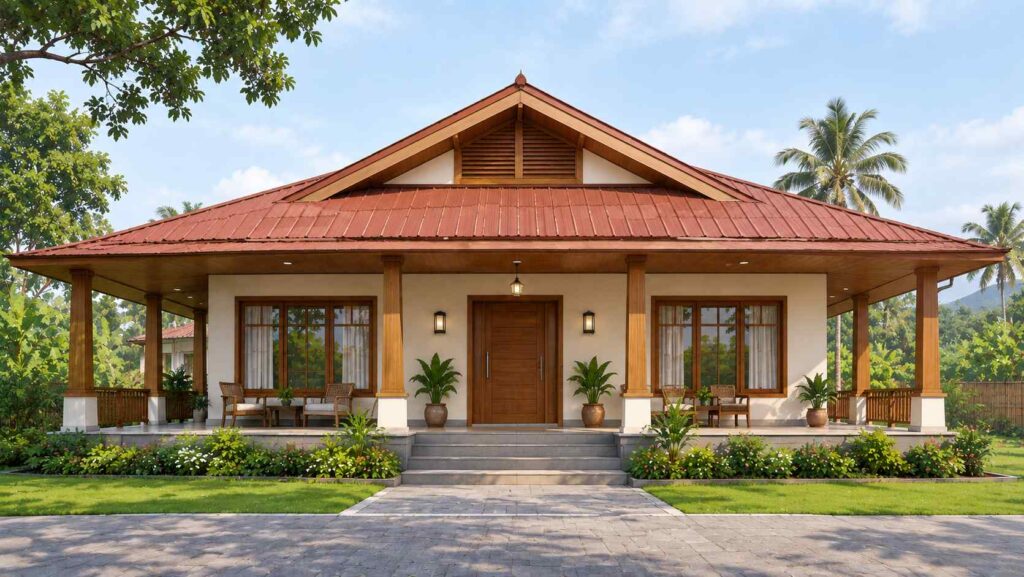
A good Assam type house front design leans on the verandah and roofline as the main visual features, not applied decoration stuck on afterward. Here’s what actually shows up on well-designed fronts, whether you’re building in Guwahati or a smaller Assam town.
- A wide covered porch running the full front. This is the single most recognizable feature, and it’s not just for looks, it actually does something.
- Wooden posts holding up the roof overhang. The natural wood tone looks great against plastered walls.
- Big windows, spaced out evenly. Old designs used generous window openings so air could move through, keep that in a modern build too.
- Warm, earthy colors. Terracotta, warm browns, off-white plaster, all of it echoes the traditional materials even if you’re not actually using them.
- A visible sloped or gabled roof from the front. The roof shape is a defining look here, don’t bury it behind a flat parapet.
Traditional vs. Modern Assam Type House Design
Modern versions keep the same engineering logic but swap in updated materials for durability and lower maintenance.
|
Feature |
Traditional |
Modern |
|---|---|---|
|
Framing |
Local Sal or Gamari timber posts |
Mild steel, concrete columns, or timber |
|
Walls |
Ikra reed or woven bamboo with mud-dung plaster |
Exposed brick, AAC blocks, or cement plaster |
|
Roofing |
Natural thatch or plain corrugated sheets |
Colored metal tiles, glass sections, partial concrete slabs |
|
Ventilation |
Fully natural, cross-breeze via tall windows |
Large glass panes blended with occasional AC |
Neither version is “more correct.” A modern Assam-type home still runs on the same core logic. Flexible frame, raised base, steep roof, just built with materials that need less upkeep over time.
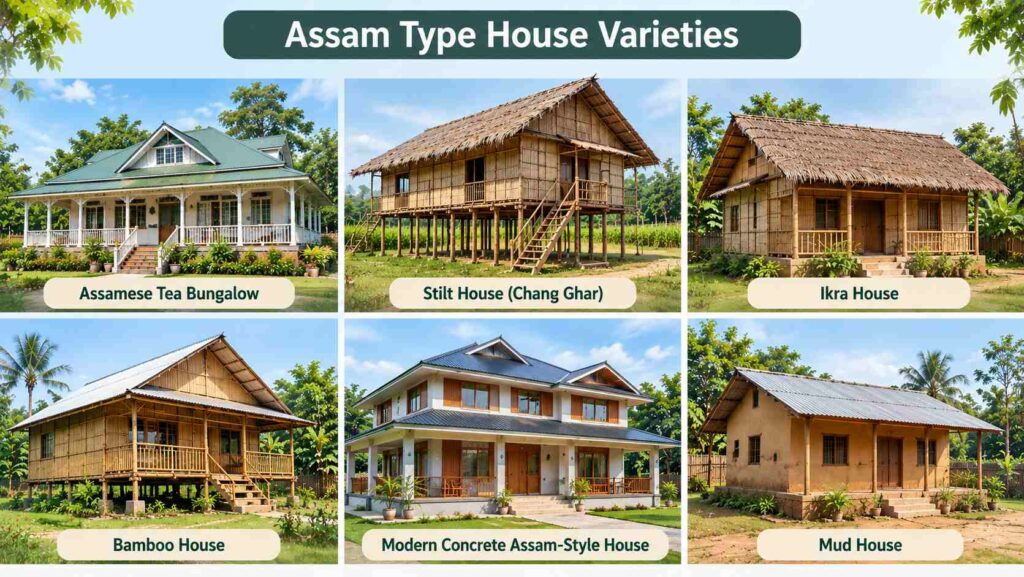
Popular Varieties of Assam Type House Design
Several recognized types show up repeatedly across the region, each suited to different needs and budgets.
- The Assamese Tea Bungalow. A colonial-era style built for British tea estate managers. Rectangular, sloped roof, raised platform. Wide verandahs and tall ceilings give it away instantly.
- The Stilt House (Chang Ghar). Here’s a real clarification worth knowing. This one’s technically a separate tradition, belonging to the Mishing tribe, and it sits on full stilts, not the short raised plinth true Assam-type houses use. People lump it in under “Assam type” constantly, in searches and everyday talk, even though it’s architecturally its own thing.
- Ikra House. The classic version. Bamboo frame, ikra reed walls plastered in mud, thatch or GI sheet on top.
- Bamboo House. Nearly all treated bamboo. Light, and genuinely earthquake-resistant.
- Modern Concrete Assam-Style House. Multi-storey, concrete, but keeps the sloped roof and verandah look. Leans harder on AC for comfort than the old versions ever needed to.
- Mud House. Simpler, more rural, closer to a kutcha build than real Assam-type engineering, though people group it in casually anyway.
A few other terms occasionally show up in search results and photo listings: Jhap houses, floating homes, and longhouses. These are far less documented in academic or architectural sources, and mostly appear in a handful of consumer articles rather than established references. Treat them as regional or informal naming, not confirmed architectural categories.
Construction Cost of an Assam Type House
An Assam type house typically costs less than a standard RCC home of the same size. Bamboo and timber simply cost less than steel and cement in equivalent quantities. As a general estimate, basic Assam-type construction using traditional materials often falls in a lower range than conventional concrete construction, though modern versions using steel framing and concrete narrow that gap considerably.
This is a planning range, not a fixed quote. Exact costs move a lot depending on which materials you pick, whether skilled labor is easy to find nearby, and how much of the build stays traditional versus goes modern. If you’re building specifically in Guwahati, our piece on how new infrastructure is reshaping the city’s property map is worth a look for locality-level context. Confirm current rates with local contractors familiar with the region before finalizing a budget.
Wrapping Up
Assam type house design isn’t a relic. It’s a genuinely engineered response to a real problem: how do you build safely in a region that gets hit by both earthquakes and heavy floods. The style has held up for over 125 years, since 1897, not 1950, and it deserves to be understood correctly.
Whether you’re drawn to a traditional ikra build or a modern concrete version with the same sloped roof and verandah, the underlying logic doesn’t change. If you’re planning something similar in a different region, our guide on kutcha house design covers another India-specific vernacular style worth comparing against.
Don’t miss It!
|
Types of Houses |
|
|
Ghar Ka Naksha |
|
|
Cabin House |
|
|
Open House |
|
|
Modern House Design |
|
|
2 Storey House Design |
|
|
Duplex House |
|
|
Standalone Building |
|
|
Kerala House Design |
|
|
Kutcha House |
Frequently Asked Questions:
1. What is an Assam-type house?
A house built to survive earthquakes and heavy flooding, that’s the short version. Bamboo, timber, ikra reed, all sitting on a raised base, topped with a steep roof and wide verandahs. Comes from Northeast India.
2. Can I design an Assam-type house under 5 lakh rupees?
Maybe, for a basic single-storey home using traditional materials on a compact layout. Depends heavily on your plot, local labor rates, and what materials you can actually get nearby. Talk to local contractors before you bank on that number.
3. Who designed the Assam-type house?
It came together after the 1897 Shillong earthquake. Colonial engineers, working with a team led by Japanese seismologist Fusakichi Omori, studied why the local homes survived while British brick buildings didn’t, then turned what they learned into a standardized building method.
4. What are five types of homes in Assam?
Inside Assam-type architecture specifically: the Tea Bungalow, the Stilt House (Chang Ghar), the Ikra House, the Bamboo House, and the Modern Concrete Assam-style house.
5. Why do houses in Assam have slanting roofs?
Rain runs off fast instead of sitting and pooling. That’s the whole point, and it’s why leaks and water damage stay rare on a well-built Assam-type roof.
6. Why are Assam type houses built on raised plinths?
Floods. A raised base keeps the house dry when monsoon water rises, and the space underneath doubles as storage.
7. Is Assam type house design the same as a stilt house?
Not quite. Real Assam-type houses sit on a short raised base. Stilt houses (Chang Ghar) go up on full-height stilts and come from a separate Mishing tribal tradition entirely. People mix the two up constantly, but they’re not architecturally the same thing.
8. Can Assam type house design work outside Northeast India?
The core idea, flexible frame, raised base, steep roof, holds up fine anywhere earthquakes or flooding are a real risk. Materials might need to change based on what’s actually available locally.