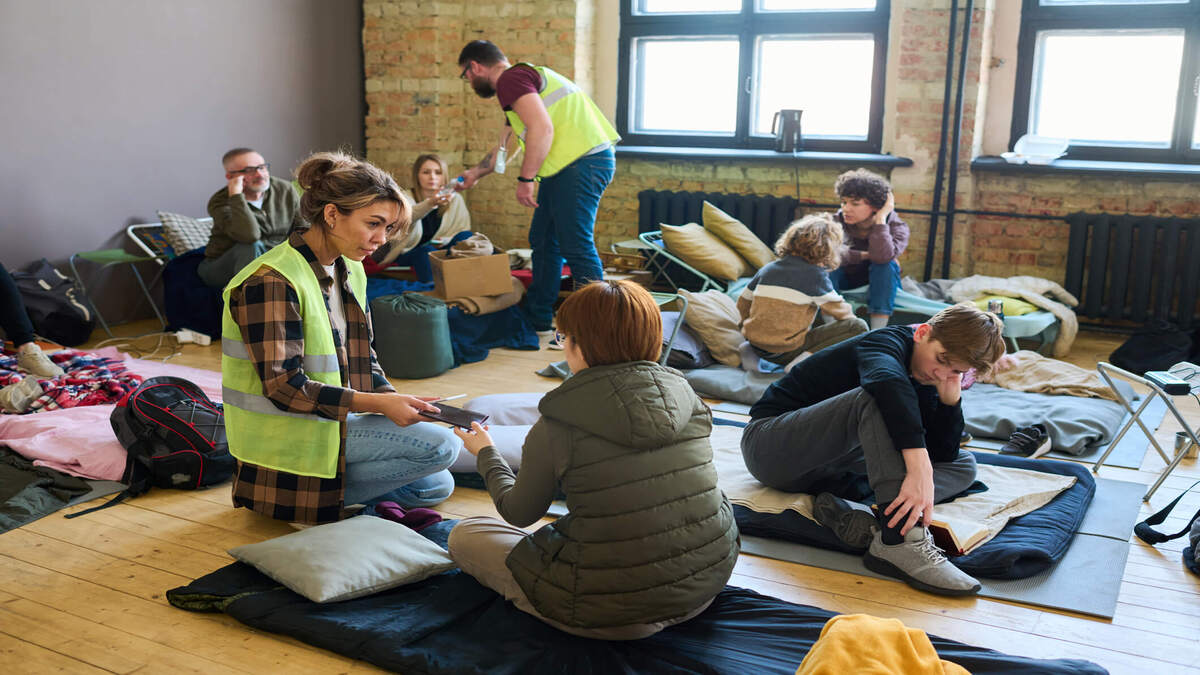
A shelter home is a temporary residential facility that provides safety, food, and basic care to people facing homelessness, abuse, or crisis, run by the government, NGOs, or religious organizations. The idea behind it is simple enough: nobody should end up with nowhere to go.
This guide walks through the real meaning, the different types, how these buildings actually get designed and built, who qualifies to stay, and the legal framework that holds the whole system together in India.
What Is a Shelter Home?
A shelter home gives people facing homelessness, abuse, or an emergency somewhere to stay until they can move toward something more permanent. Think of it less as a hotel and more as a bridge, one that gets someone from crisis back to stable ground.
A few quick facts worth knowing:
- Government bodies, NGOs, and religious or charitable organizations typically run these facilities
- Some emergency and night shelters operate around the clock, though hours vary by facility and by the programme running it
- Section 6 of India’s Domestic Violence Act legally obligates shelter homes to accept survivors once a protection officer makes the request
- How long someone can stay depends on the type of shelter, the programme’s own rules, and the individual’s circumstances, there’s no single nationwide duration
The word “shelter” carries a lot of weight here. It’s not just four walls and a roof. It’s food, safety, and a starting point for rebuilding a life.
Types of Shelter Homes
India’s shelter system splits into several distinct categories, each built around a specific group of people in need.
- Night shelters. Basic overnight accommodation for homeless individuals, usually run under a state’s urban development board.
- Children’s homes. Housing for orphaned, abandoned, or at-risk children, governed under the Juvenile Justice Act.
- Women’s shelters. Safe housing for survivors of domestic violence or trafficking, now largely run as Shakti Sadan under the Mission Shakti framework.
- Old-age shelters. Residential care built for abandoned or destitute elderly people.
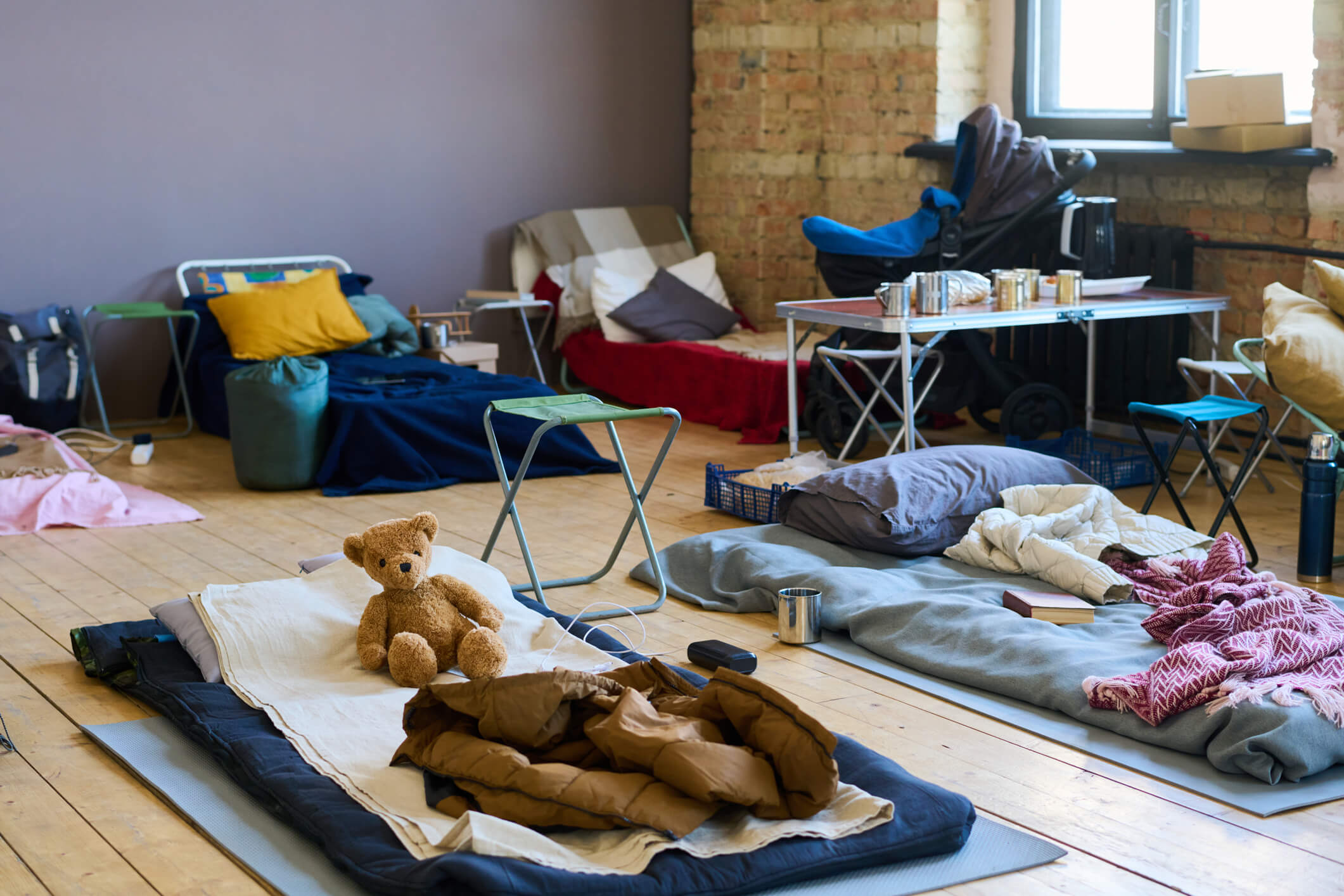
- Disaster and emergency shelters. Fast, temporary structures set up after floods, earthquakes, or other crises, arguably the most architecturally distinct category on this list.
One example worth knowing by name: Krishna Kutir in Vrindavan, run by the Ministry of Women and Child Development, holds the title of India’s largest shelter home for widows. It houses 1,000 women and opened its doors in 2018.
Shelter Home Facilities and Features
A genuine shelter home covers a consistent set of basic needs, regardless of who’s running it.
- Food, clean water, and an actual bed, the non-negotiable baseline
- Bathing and toilet facilities, often shared but working properly
- Basic medical care, or at minimum, a referral system to nearby healthcare
- Counseling and emotional support, especially common in women’s and children’s shelters
- Legal aid access, so residents can navigate documentation and their own rights
- Education or vocational training, aimed at helping people stand on their own again
Every one of these facilities points toward the same goal: recovery, not just survival for the night.
Shelter Home Design and Architecture
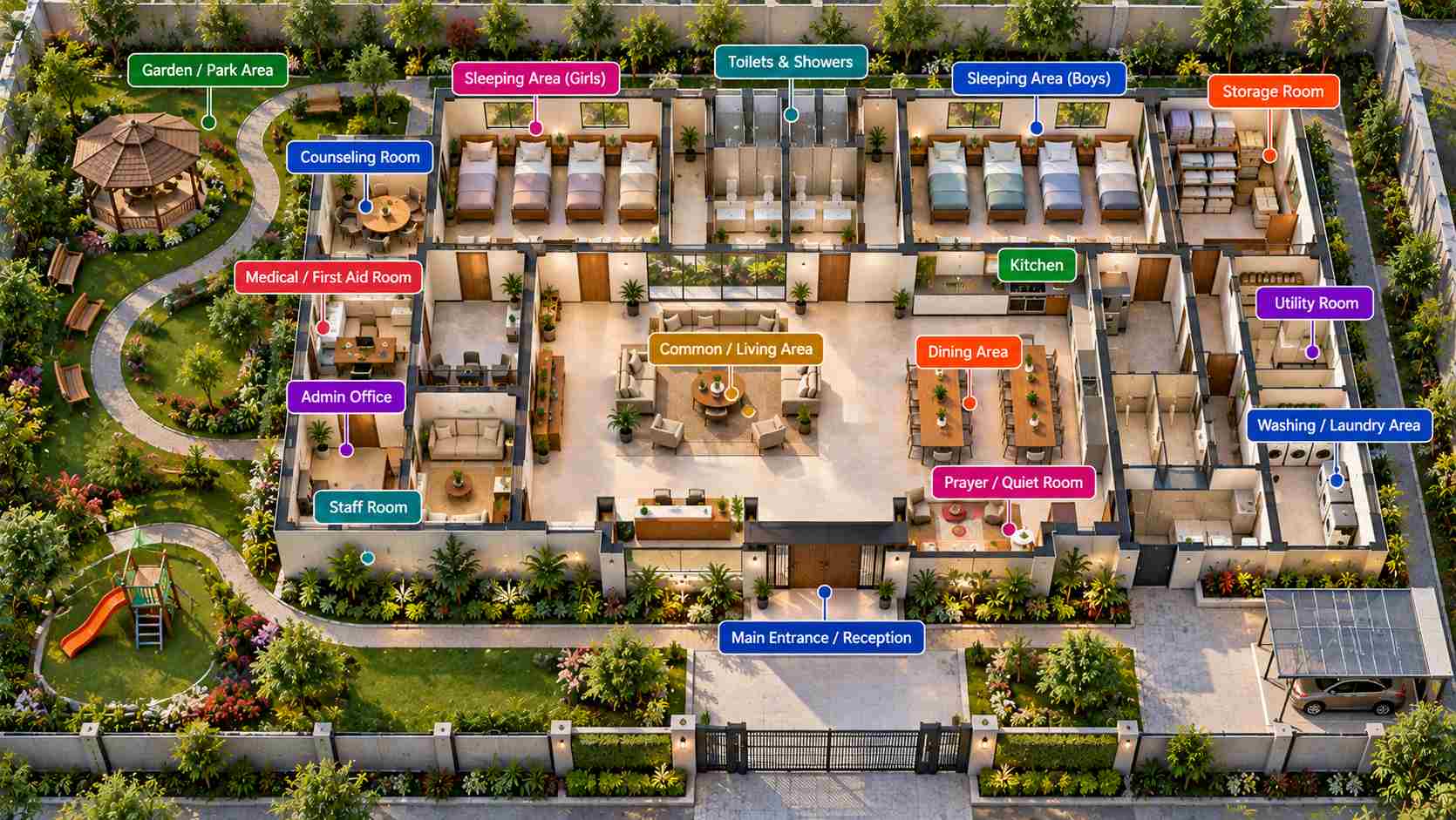
Good shelter home design starts with safety and dignity, not just protection from the weather. Most general housing articles never get this far, but shelter home architecture actually follows its own set of principles.
A field of academic research called trauma-informed design (TID) studies exactly this question. Research on shelters for runaway children suggests that physical features such as layout, natural light, and the character of shared spaces can influence how safe and supported residents feel, right down to details like swapping harsh institutional corridors for softer, more home-like common areas.
A few design principles show up again and again in well-built shelter homes:
- Separate zones for sleeping, eating, and counseling, so residents aren’t packed into one shared space all day
- Natural light and ventilation, prioritized over cutting costs, since both can affect mental wellbeing
- Entrances that feel secure without feeling like a prison, balancing safety against a sense of freedom
- Materials picked for durability and easy cleaning, given how often occupants change
Small shelter home design and emergency shelter construction increasingly pull from disaster-relief innovation too. Rapid-assembly emergency shelter kits, designed to go up quickly and hold up against weather, are an active area of design work aimed at getting displaced families into safe, dignified structures faster after a disaster. That same thinking, fast, resilient, and dignified, is starting to shape temporary shelter home construction well beyond disaster response alone.
Who Can Access a Shelter Home?
Access to a shelter home depends on the type of facility, its eligibility rules, and whoever operates it, there’s no single, universal open-door policy. Different shelters exist for different groups: people experiencing homelessness, women in distress, children needing protection, older people without family support, and those displaced by disasters.
Most shelter homes, whichever group they serve, also connect residents to counseling, legal aid, medical care, and job training. The point isn’t indefinite housing, it’s helping someone get to a place where they can stand on their own again.
How to Find a Shelter Home Near You
Most Indian cities run their shelter homes through a dedicated urban shelter board or a state women and child development department, and each keeps a public list in a format similar to Delhi’s official night shelter registry.
|
What You’re Looking For |
Where to Check |
|---|---|
|
General homeless night shelters |
Your city’s Urban Shelter Improvement Board (Delhi’s is DUSIB) |
|
Women in distress or trafficking survivors |
State Women and Child Development Department, or the Shakti Sadan scheme directly |
|
Children needing care |
Local Child Welfare Committee under the Juvenile Justice Act |
|
Elderly or destitute individuals |
State social welfare department, or NGOs like HelpAge India |
No dedicated city portal available? Calling 181 (the national women’s helpline) or 1098 (Childline) connects you to the nearest verified shelter no matter which state you’re in.
Shelter Homes for Animal
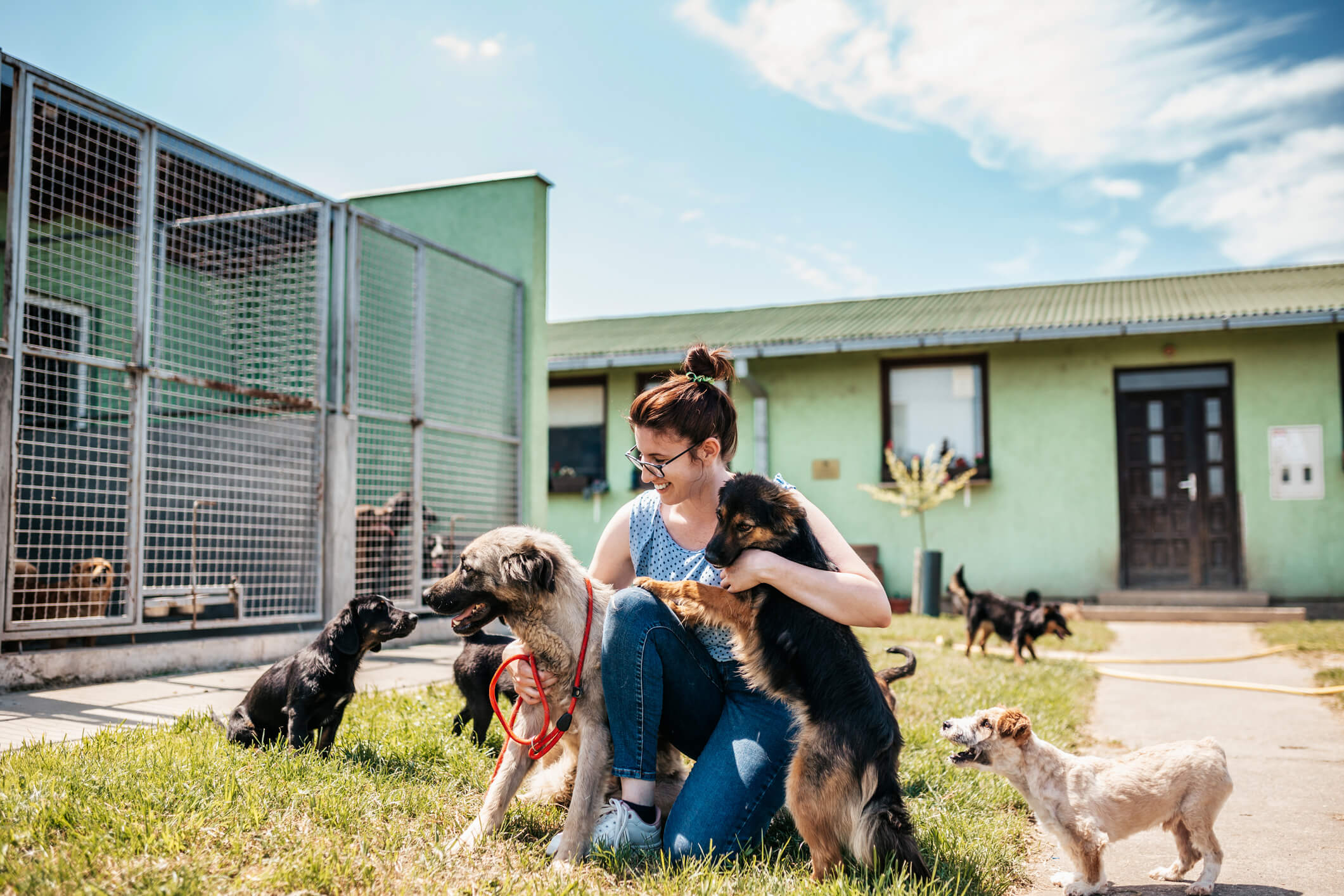
Shelter houses for animals in India are a refuge for homeless animals, providing them with a safe place to live, food, water, and medical care. They provide a safe place for abandoned, neglected, or abused animals and give them a second chance at life.
The purpose of shelter homes for animals in India is to provide a safe and healthy environment for animals and to give them an opportunity to find a loving home. They are also a place for animals to receive medical care and to be spayed or neutered. Animals in these shelters are cared for by trained staff and volunteers.
The Features of shelter homes for animals in India vary, depending on the organisation and its Budget.
- Some shelters have a more extensive staff and can provide more services such as vaccinations, dental care, and behavioural training. Other shelters may only have a few volunteers and may not be able to provide as many services.
- In addition to providing a safe home for animals, some shelters also offer adoption services. This allows people to find a new home for an animal in need and provide them with a loving family.
- Shelter houses for animals in India are also a place for people to learn about animal welfare.
Here are some of the shelter homes for animals which are situated in the capital of the nation- Delhi:
- Sanjay Gandhi Animal Care Centre (SGACC)
- Friendicoes
- The Charity Bird Hospital
- Red Paws Rescue
- All Creatures Great And Small
- Jeevashram
- People For Animals
Government Framework Governing Shelter Homes
Real legal structure backs shelter homes in India, not just charitable intent. The Juvenile Justice Act governs children’s homes, the Domestic Violence Act legally requires shelter homes to accept survivors on request, and Shakti Sadan, the scheme formed by merging Swadhar Greh and Ujjawala Homes under Mission Shakti from April 2022, funds and regulates women’s shelters nationwide.
That legal backing exists for good reason. A widely reported abuse case at a Bihar shelter home in 2018 exposed serious oversight failures and led directly to stricter social audits and monitoring requirements across the country. Anyone researching or building shelter housing today needs to understand this regulatory layer just as much as the physical design.
Government-backed affordable housing schemes intersect with shelter home policy too, since the actual end goal is moving people from temporary shelter into permanent housing. Our coverage of PMAY-U crossing 1 crore completed houses shows how India’s affordable housing push connects to this bigger picture, and our guides on LIG flats and HIG flats cover the income-linked housing categories many shelter residents eventually move toward. Full scheme details are available on the Ministry of Women and Child Development’s official Shakti Sadan page.
Where Can I Find Shelter Homes in Delhi?
|
S. No. |
Institute Name with Address |
Age Bracket |
Accommodation Strength |
|
1 |
Observation Home for Boy –I Prayas Behind Ambedkar Stadium Delhi Gate, New Delhi 110024 |
Only Boys up to 18 years |
50 |
|
2 |
Adharshila Observation Home for Boys – II, Sewa Kutir Complex, Kingsway Camp, Delhi. |
Only Boys up to 18 years |
100 |
|
3 |
Annexe- Adharshila Observation Home for Boys –II, I, Magzine Road, Delhi. |
16 to 18 years |
10 |
|
4 |
Observation Home for Girls, Nirmal Chhaya Complex, Jail Road, New Delhi. |
Only Girls up to 18 years |
50 |
|
5 |
Special Home, 1, Magzine Road, Delhi. |
Only Boys up to 18 years |
20 |
|
6 |
Place of Safety, 1, Magzine Road, Delhi. |
Boys up to 18 years |
20 |
|
7 |
Phulwari Children Home for Boys – I Alipur, Delhi. |
Only Boys aged 12-18 years |
200 |
|
8 |
Ashiana cChildren Home for Boys –II Alipur, Delhi. |
Only Boys aged 6-12 years |
100 |
|
9 |
Ujjawal Children Home for Boys –I Lajpat Nagar New Delhi. |
Only Boys aged 6-12 years |
100 |
|
10 |
Uday Children Home for Boys –II, Lajpat Nagar, New Delhi. |
Only Boys of 12-18 years age |
100 |
|
11 |
Anupama Children Home for Girls –I Jail Road New Delhi. |
Only Girls of 2-18 years age. |
150 |
|
12 |
Anukriti Children Home for Girls-II Jail Road, New Delhi. |
Only Girls aged 0-12 years |
100 |
|
13 |
Sharda Greh, Children Home for Girls – III Nari Niketan jail Road. New Delhi. |
Only Girls up to 18 years (victims of abuse) |
25 |
|
14 |
Children Home for Girls –IV, Room No. 5, Short Stay Home for WomenNirmal Chhaya Complex, Jail Road, New Delhi. |
Pregnant girls/women with maternity care (CHG-I) |
15 |
|
15 |
Sukhanchal School and Home for Mentally Retarded (Girls), Asha Kiran Complex, Awantika, Delhi. |
Mentally challenged children of all categories (6-18 years) |
75 |
|
16 |
Pragati Institution for severely and profoundly Mentally Retarded (Children & Adult), Asha Kiran Complex, Awantika, Delhi |
Severely and profoundly mentally challenged girls (6-18 years) |
200 |
|
17 |
Vikasini Home for Mentally Retarded Children Asha Kiran Complex, Awantika Delhi. |
Mentally challenged girls, mild and moderate category (0-12 years) |
100 |
|
18 |
Village Cottage Home-I (for Boys & Girls), Kasturba Niketan Complex, Lajpat Nagar, New Delhi. |
Children of 0-12 years age. |
40 |
|
19 |
Village Cottage Home –II, (for Boys & Girls), PWD Barracks, B-Block, Kalkaji, New Delhi. |
Children of 0-12 years age |
40 |
|
20 |
Village Cottage Home –III (For Boys & Girls), Kasturba Niketan Complex Lajpat Nagar, New Delhi. |
Children of 0-12 years age |
40 |
|
21 |
Balika Sadan – I, Home for Healthy Children (Male & Female) of Leprosy Affected Person, Nirmal Chhaya Complex, jail Road, New Delhi. |
Children of 6-12 years age |
100 |
|
22 |
Balika Sadan –II Home for Healthy Female children of Leprosy Patients. Nirmal Chhaya Complex, Jail Road, New Delhi. |
Children of 12-18 years age |
50 |
|
23 |
Bal Sadan –I Home for Healthy (Male) Children of Leprosy Patients Timarpur Delhi. |
Children of 12-18 years age |
60 |
|
24 |
Bal Sadan –II Home for Healthy (Male) Children of leprosy Patients, Timarpur, Delhi. |
Children of 6-12 years age |
50 |
|
25 |
Sanskar Ashram For Boys-I Dilshad Garden Opp, G.T.B. Hospital, Delhi. |
Children of 6-12 years age |
50 |
|
26 |
Sanskar Ashram for Boys- II Dilshad Garden, Opp. G.T.B. Hospital, Delhi |
Children of 6-18 years age |
50 |
|
27 |
Sanskar Ashram for Girls, Dilshad Garden Opp, G.T.B. Hospital, Delhi. |
Children of 6-18 years age |
100 |
source – spuwac[dot]in/dpjju2/shelterhomes[dot]php
Wrapping Up
A shelter home is more than a roof over someone’s head. It’s a legally backed, purpose-built space designed to move a person from crisis toward stability, and the ones that work best get the physical design right too, real zoning, real light, real dignity, not just a mission statement on a wall.Researching shelter homes for academic work, NGO planning, or a personal need? Start with the type that matches the situation, then check the relevant state shelter board or helpline for the most current, verified listings.
Don’t miss It!
|
Types of Houses |
|
|
Cottage House |
|
|
Cabin House |
|
|
Open House |
|
|
A-Frame House |
|
|
Narrow House |
|
|
Duplex House |
|
|
Service Apartments |
|
|
Penthouse |
|
|
Kutcha House |
Frequently Asked Questions:
1. What is the shelter home?
A shelter home is a temporary residential facility providing safety, food, and basic care to people facing homelessness, abuse, or crisis. Government bodies, NGOs, or charitable organizations typically run them.
2. Can you provide a list of shelter homes in Delhi?
DUSIB, the Delhi Urban Shelter Improvement Board, maintains the city’s official shelter list and runs close to 200 permanent night shelters across Delhi, alongside temporary winter shelters added during colder months. Check DUSIB’s official portal directly for the current, verified list, shelters open and close over time, so a static list goes out of date fast.
3. Is there a free ashram for homeless ladies in Mumbai?
Women’s shelters in Mumbai generally operate under the Shakti Sadan scheme or through registered NGOs rather than one single named “ashram.” Calling the national women’s helpline (181) connects you to the nearest verified shelter in Mumbai specifically, and gives you current information rather than a name that might already be outdated.
4. How to build a shelter at home?
This usually points to a personal emergency or disaster shelter, a different concept from an institutional shelter home. A basic emergency shelter needs a stable, weatherproof structure, a water source, and secure storage for essentials, principles borrowed from the broader field of emergency shelter design used in disaster relief.
5. What is the difference between a shelter home and an orphanage?
Shelter home is a broad term covering accommodation and support provided to people in need, women, the elderly, disaster survivors, and children among them. Children’s homes, which is the more accurate current term for what’s commonly called an orphanage, specifically provide care and accommodation for children who need protection and support under India’s child-protection framework, the Juvenile Justice Act.
6. What are the design requirements for a shelter home?
Good shelter home design separates sleeping, eating, and counseling spaces, prioritizes natural light and ventilation, and balances security against a non-institutional feel. Research on trauma-informed design suggests these physical details can meaningfully shape how safe and supported residents feel.
7. How long can someone stay in a shelter home?
There’s no single answer, it depends on the type of shelter and the specific programme’s rules. Some facilities set a fixed maximum, others decide case by case, and extended stays are usually possible when someone needs more time to secure stable housing or finish a legal or medical process.
8. Are shelter homes free?
Many government-supported and charitable shelter programmes provide accommodation and basic services without charging residents. Exact arrangements vary by facility and programme, so it’s worth confirming directly with the specific shelter rather than assuming every one works the same way.