
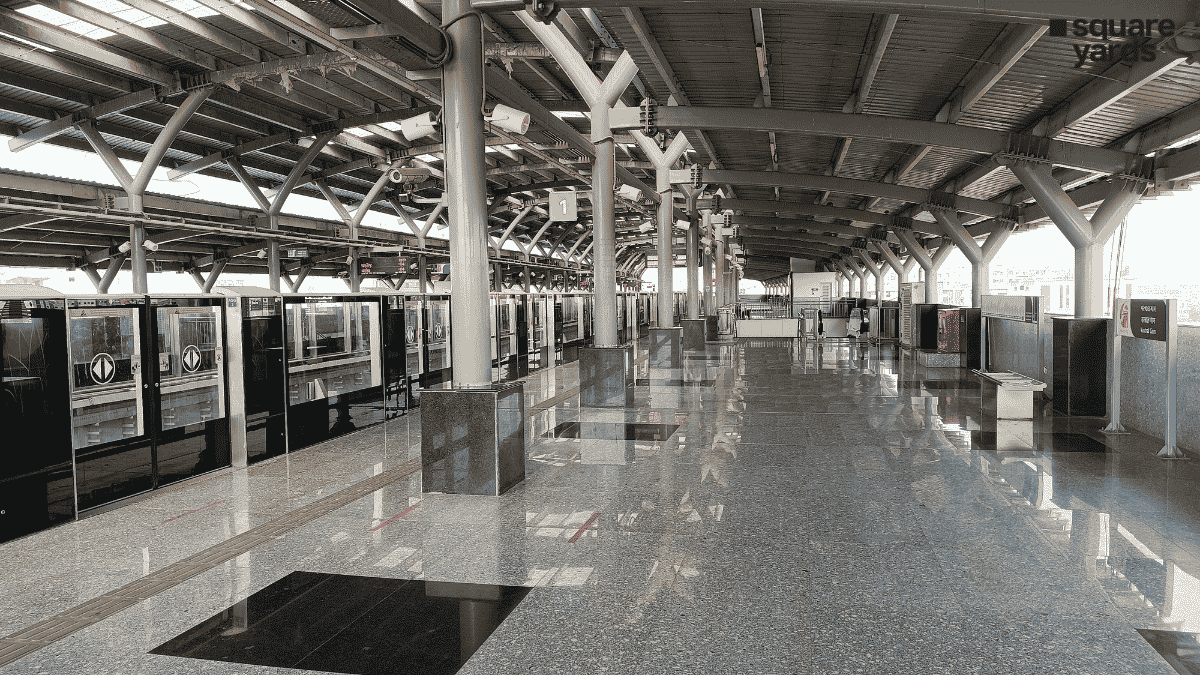
At a time when Ahmedabad, the largest city in the state of Gujarat, is gearing up to host the World Police Games 2029 and Commonwealth Games 2030, the Union Cabinet approved Ahmedabad Metro Phase 2A on June 10, 2026. It put a direct rail link between the city and its international airport on the map for the first time. The 6.032 km corridor is already stirring real estate activity across North Ahmedabad and Sadar Nagar.
What the project covers
On June 10, 2026, the Union Cabinet cleared the Ahmedabad Metro Phase 2A. It is a 6.032 km corridor running from Koteshwar Road to the Sardar Vallabhbhai Patel International Airport. At ₹2,169.04 crore, the approval was more than a commuter-line expansion. It was a formal signal that the Ahmedabad-Gandhinagar urban cluster was entering a new phase of metropolitan planning.
The corridor will add five new stations, Ashram Road, Koteshwar Prachin Mandir, Sabarmati River, Sardar Nagar, and Airport, four of them elevated and one underground. When ready, the metro network across Ahmedabad and Gandhinagar will stretch to 77.63 km, making it one of western India’s largest urban rail grids.
The geography makes Phase 2A different from previous metro expansions. Instead of simply extending an existing trunk line, it creates a direct, uninterrupted rail link between the commercial spine of the old city, the Sabarmati riverfront and the airport. That is a rare combination across just six kilometers.
The congestion challenge and metro solution
Ahmedabad’s northern side has long been among the most obstructed corridors in the city. The airport road carries an excessive share of intercity and intra-city traffic of daily commuters, logistics vehicles, cab-dependent travelers, and business visitors. The city’s rising vehicle density has made the airport trip a hustle for commuters.
Phase 2A addresses this by shifting a meaningful volume of trips into an all-electric rail network. As per the environmental math, every passenger-kilometer moved off fossil-fuel vehicles and onto the metro reduces the city’s per-capita carbon load.
But there are concerns that the metro cannot solve on its own. Cities in the past have treated rail infrastructure as a standalone solution without investing in last-mile connectivity, pedestrian access, and interchange design. That resulted in ridership plateauing below projections. Phase 2A’s long-term utility will depend on how well the surrounding infrastructure evolves alongside the tracks.
How Ahmedabad Metro Phase 2A brings real estate growth
This is the central question for developers, investors, and homebuyers watching the corridor begin working. But the answer differs depending on which station is taken into consideration.
The TOD Magnet Effect
Metro corridors in Indian cities normally bring higher FSI (Floor Space Index) allowances in their wake. Areas within 500 meters of a station to shift from low-density plotted development toward high-rise residential and mixed-use buildings by utilizing an enhanced FSI of up to 4.0. Phase 2A creates five new zones where that process can now begin.
How each Micro-Market is likely to move
Each station on the Phase 2A corridor sits in a different kind of neighborhood, which means the real estate story is different at every stop. Here is how the key pockets are likely to play out.
- Ashram Road & Koteshwar: Ashram Road is already Ahmedabad’s primary address for Grade-A office space, where the baseline rate is ₹7,250 per sq. ft. Koteshwar stands firmly as a high-growth residential hub averaging ₹5,700 per sq. ft. The station here creates a direct rail link between the city’s top commercial places and the airport. That is a combination corporate occupiers and business hotel operators look for. Demand in this pocket is likely to get more competitive.
- Sabarmati Riverfront (North): The southern riverfront has already become a desirable residential and leisure spot. Phase 2A’s Sabarmati River station opens the northern stretch where residential properties trade in an average bracket of ₹6,500 to ₹9,000 per sq. ft. River-facing apartments with metro access are a combination that the current supply does not adequately serve. Developers paying attention to this gap are in a reasonably strong position to command a 15% to 20% pricing premium over landlocked interior projects.
- Sardar Nagar: This is the busiest market on the corridor with average residential capital values between ₹4,500 and ₹5,500 per sq. ft. It is a dense, established neighborhood with older buildings and limited large-format development so far. Metro access pushes redevelopment in areas like this. Older buildings become viable acquisition targets for builders, and mid-segment and affordable vertical housing is likely to be the dominant output. The existing resident base here is large, but their needs should factor into how that redevelopment is managed.
- Bhat & Airport Periphery: Airport-adjacent land in Ahmedabad has been underused compared to similar locations in Hyderabad or Bengaluru, keeping the broader neighborhood baseline competitive at an average of ₹5,250 per sq. ft.. Phase 2A starts to change that. Logistics facilities, warehousing, convention spaces and airport-side retail become more viable once rail connectivity is in place. This end of the corridor is likely to attract the most investor attention in the near term.
Sports Events and Wider Connectivity
The Cabinet approval specifically mentioned the World Police Games 2029 and the Commonwealth Games 2030 as events that Phase 2A will support. Sports infrastructure is expected to come up near the Sardar Patel Sports Enclave and the metro will connect that zone directly to the airport. For large international events, that kind of link is not optional.
Phase 2A also fits into a bigger picture. The Mumbai-Ahmedabad Bullet Train will eventually bring a new kind of intercity traveler into Ahmedabad. If those travelers can connect easily to the metro network without depending on cabs and private transport, it creates a more functional transit option for the region.
Possible challenges
Three issues stand out as areas where execution could make or break the corridor’s usefulness. Each of them is worth taking seriously.
Airport station access
The airport station will be underground. Getting a passenger with bags from the metro platform to the arrivals hall in a comfortable way requires a specific design. It requires covered walkways, luggage-friendly flooring and clear signage. India has a poor track record here. Mumbai’s CSMT metro connection and Bengaluru’s airport metro entry both took years to sort out after opening. Ahmedabad should plan this properly from the start.
Construction near the runway
Underground construction close to active runways is complicated. The civil works will have to stay within strict Airports Authority of India guidelines around vibration, equipment height, and blasting restrictions. Delays in getting those clearances can push back the whole timeline. With the Commonwealth Games 2030 as a deadline, there is not much room for extended slippage.
Disruption in Sardar Nagar during construction
Peak construction will involve around 2,000 workers. In a dense area like Sardar Nagar, that means road blocks, noise, disrupted utilities, and months of inconvenience for residents. Keeping locals informed, hiring from the community where possible and being upfront about timelines will matter more than most project managers like to admit.