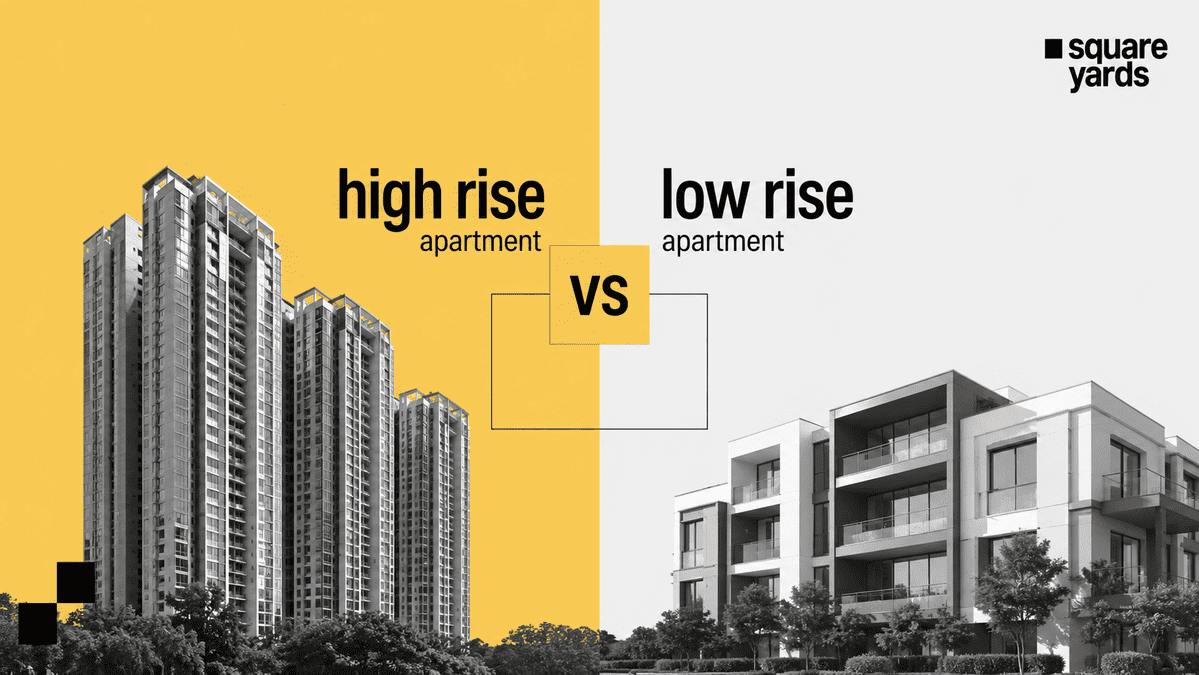
Asha Patel still remembers that afternoon. She’d visited properties three weekends in a row. Talked to four brokers. And still had no clear answer to one simple question. Would she actually like living in a high-rise tower? Or would a quieter low-rise neighbourhood suit her better? Nobody gave her a straight answer. Most just pointed at brochures.
This guide is the conversation Asha never got to have. It covers comparing high-rise living with low-rise neighbourhoods in real, practical terms. No marketing language. No vague lifestyle promises. Just what matters, where buyers go wrong and how to make a call you won’t regret.
High-Rise vs Low-Rise: What You Need to Know First
Most people think they already know which one suits them. They picture a sleek tower with city views – or a quiet lane with trees. And they go from there. That’s the problem.
Comparing high-rise living with low-rise neighbourhoods on gut feel alone skips the variables that actually affect your daily life. And your returns.
Quick Comparison: High-Rise Living vs Low-Rise Neighbourhoods (2026)
|
Feature |
High-Rise Living |
Low-Rise Neighbourhoods |
|
Floor count |
Typically 12+ floors |
Usually up to 4 floors |
|
Community density |
High – shared amenities, lifts, lobbies |
Low – more personal space, direct access |
|
Views & natural light |
Excellent on upper floors |
Ground-level charm, garden access |
|
Maintenance |
Society-managed, higher charges |
Lower overheads, self-managed |
|
Appreciation trend (2025–26) |
Strong in metro corridors |
Stable in tier-2 city peripheries |
|
Rental yield |
Lower headline yield, faster occupancy |
More stable occupancy, mid-segment strong |
|
Ideal for |
Young professionals, investors |
Families, long-term residents |
|
Security |
24/7 controlled entry, CCTV |
Depends on locality |
|
Connectivity |
Metro/transit proximity typical |
Variable; area-dependent |
The Core Principle Behind Property Elevation
Here’s what most buyers miss. People who make good property decisions aren’t smarter or luckier. They just stopped being reactive. They didn’t start thinking about the pros and cons of high-rise living the night before a site visit. They’d already done the thinking weeks earlier.
That shift – from reactive to proactive – is the most important one you can make.
Why this matters more in 2026:
- Metro corridor repricing is accelerating. Infrastructure projects are delivering and prices are moving with them
- High-rise vs low-rise inventory is splitting fast in cities like Bengaluru, Hyderabad and Pune
- FSI policy changes are quietly redrawing what low-rise neighbourhood density looks like in many urban zones
Why Choosing the Right Building Height Matters
Getting building height and community density wrong doesn’t feel dramatic at first. It feels like a slow Tuesday. A commute that’s ten minutes longer than it should be. A lift queue at 9am. A lane that floods every monsoon.
That daily friction adds up. Fast. Getting it right early stacks the odds in your favour – for lifestyle and for long-term value.
Key risks to watch in 2026:
- Maintenance levies in older high-rise societies are climbing – and not stopping
- Low-rise neighbourhoods in tier-1 cities are being targeted for redevelopment
- Tenants now filter on open spaces and natural light. It’s not optional anymore
- RERA timelines on new high-rise projects are running long. Ready-to-move inventory carries a real premium
For a real-time read on values in your area, an online property valuation is a solid starting point.
Key Factors to Evaluate
There’s no shortage of things you could look at. The trick is the order. Try to analyse everything at once and you’ll stall. Work through it in sequence instead – each answer should feed the next question.
Step 1: Establish Your Baseline
You can’t compare clearly until you know what you’re comparing against.
Before you visit a single property, get honest about your constraints:
- Budget ceiling – the real number, including stamp duty, registration and society corpus fund
- Timeline – possession-ready vs under-construction is a different calculation in 2026, on both price and risk
- Non-negotiables – school zones, commute time, floor level preference
- Acceptable risk range – builder track record, RERA status, any pending litigation
Without this, every option feels relative. No decision ever feels final.
Step 2: Map the Market Context
National headlines about real estate are interesting. They’re mostly useless for individual decisions. What matters is the micro-market. The specific pin code. The specific lane. The five-year infrastructure story.
Answer these before you shortlist anything:
- Is this neighbourhood in a high-rise densification zone or a protected low-rise belt?
- What are properties here actually transacting at – not asking price, but registered sale price?
- Is the metro or ring road already running or is it still “coming soon”?
- Who are the typical tenants here – IT workers, families, students?
Step 3: Validate Before Committing
More research isn’t always better research. Cross-checking what you think you know against independent sources is. One focused 48-hour validation window will tell you more than weeks of passive browsing.
Before you sign anything:
- Confirm the builder’s RERA registration and project approval
- Find at least 3 registered transaction prices in the same society or lane
- Check the OC (Occupancy Certificate) is actually in hand for ready-to-move properties
- For resale flats, review society maintenance records and any pending litigation
- Pull flood zone, seismic zone and FSI compliance documents
Common Pitfalls and How to Avoid Them
These mistakes show up in every market and every price bracket. They’re not about intelligence. They come from one root error – reaching for what feels familiar instead of what’s accurate.
|
Pitfall |
Why It Happens |
How to Avoid It |
|
Over-relying on asking price as market value |
Builders and sellers anchor high |
Use SRO-registered transaction data |
|
Ignoring carrying costs in net return calculation |
Excitement overrides analysis |
Factor in maintenance, tax, vacancy |
|
Anchoring on a single data point vs a trend |
Cognitive shortcut |
Track 6–12 months of price movement |
|
Treating liquidity as an afterthought |
Urgency overrides caution |
Map typical days-on-market for the micro-market |
|
Delaying documentation decisions |
Assumed it can be fixed later |
Complete due diligence before token payment |
Every one of these is fixable. It’s just cheaper to fix them before the transaction than after.
A Practical Framework for Decision-Making
A good framework for comparing high-rise living with low-rise neighbourhoods doesn’t need to be clever. It needs to be repeatable. A consistent process you actually use every time will beat a sophisticated one you only apply occasionally.
Applying the Framework to Your Situation
The variables that matter most depend on who you are and what you’re trying to do.
- Short-term investor (2–3 years): Focus on liquidity, rental yield and infrastructure-driven appreciation. High-rise in active metro corridors tends to score better here
- Long-term end-user (8–10 years): Liveability comes first. Community character, schools, how the area feels on a regular evening. Low-rise neighbourhoods in settled zones often hold up better over this horizon
- NRI buyer managing remotely: Builder reputation and professional society management are non-negotiable. High-rise buildings with structured management reduce the risk of owning from abroad
- First-time buyer with family: Monthly outflow matters as much as purchase price. Both typologies can work – it really depends on the city and the specific area
When you’re done, you should have:
- A ranked shortlist of 3–5 properties – not 15
- A clear decision trigger: a price point, a possession date, a yield floor
- A reason to stop comparing and start deciding
What the Data Actually Shows (2025–26)
The broad patterns from Indian real estate data going into 2026 are fairly consistent:
- Cities with real infrastructure delivery – not just announcements – are beating the national appreciation average
- Micro-markets on metro corridors are repricing faster than city-level data suggests. Surrounding areas are not equivalent
- The rental yield gap between premium and mid-segment is real. But the stability story matters more for most long-term investors
Rental Yield Snapshot: High-Rise vs Low-Rise (2026)
|
Segment |
Typical Gross Yield |
Occupancy Stability |
Best Cities |
|
Premium High-Rise (₹1Cr+) |
2.5–3.5% |
Moderate |
Mumbai, Bengaluru, Delhi NCR |
|
Mid-Segment High-Rise |
3–4% |
High |
Pune, Hyderabad, Chennai |
|
Low-Rise Independent/Villa |
2–3% |
Very High |
Ahmedabad, Jaipur, Indore |
|
Low-Rise Plot + Construction |
1.5–2.5% (built) |
Variable |
Tier-2 city peripheries |
Mid-segment yields look lower on paper. But the occupancy stability is meaningfully better. For long-hold investors who need predictable income, that trade-off is worth more than it looks.
How Square Yards Supports You
Deepa Krishnan spent three months trying to work through infrastructure and lifestyle trade-offs in areas around Noida. What finally cut through the noise was working with a Square Yards advisor.
She got verified transaction data for her specific shortlist. Not general market commentary – real registered numbers for the exact localities she was considering. Combined with structured timelines and transaction support, she could make calls with confidence instead of going in circles.
Square Yards covers the full property lifecycle:
- Verified listings across high-rise and low-rise segments in 25+ cities
- Mortgage assistance with rate comparisons across leading lenders
- Rental management for investors who want hands-off ownership
- Interior solutions for new possession properties
- Advisory support from on-the-ground market specialists
Take the Next Step
The gap between a good property decision and a regrettable one usually comes down to one thing – the quality of information at the moment you decide.
Visit Square Yards to access verified market data, current listings and advisory support that puts the right information in your hands before you need it.
Frequently Asked Questions:
1. What is the main difference between high-rise living and low-rise neighbourhoods?
High-rise living means taller, denser buildings with shared amenities and managed common areas. Low-rise neighbourhoods are quieter, less dense and feel closer to a traditional residential community.
2. Is high-rise living better than living in low-rise neighbourhoods for investment in 2026?
Depends on your timeline. High-rise apartments in metro corridors are seeing faster appreciation right now. But low-rise neighbourhoods offer more consistent rental occupancy – which matters more for long-hold investors.
3. Which is more affordable, a high-rise apartment or a low-rise neighbourhood property?
Purchase prices vary by location. But low-rise neighbourhood properties usually have lower ongoing maintenance costs. High-rise living often carries higher society charges, offset by better amenities and stronger location premiums.
4. Are low-rise neighbourhoods safer than high-rise buildings?
Not automatically. High-rise buildings have controlled access and CCTV. Low-rise neighbourhoods rely more on community presence and local familiarity. Both can be very safe – it depends on the area.
5. What should first-time buyers consider when choosing between high-rise and low-rise living?
Start with your daily reality – commute, schools, how much outdoor space you need. Then layer in budget and resale demand. That order works better than starting with the property type.
6. Do high-rise apartments have better resale value than low-rise neighbourhood properties?
In most Indian metros right now, high-rise apartments near transit corridors resell faster. But established low-rise neighbourhoods hold value steadily over longer periods and attract a loyal buyer pool.