
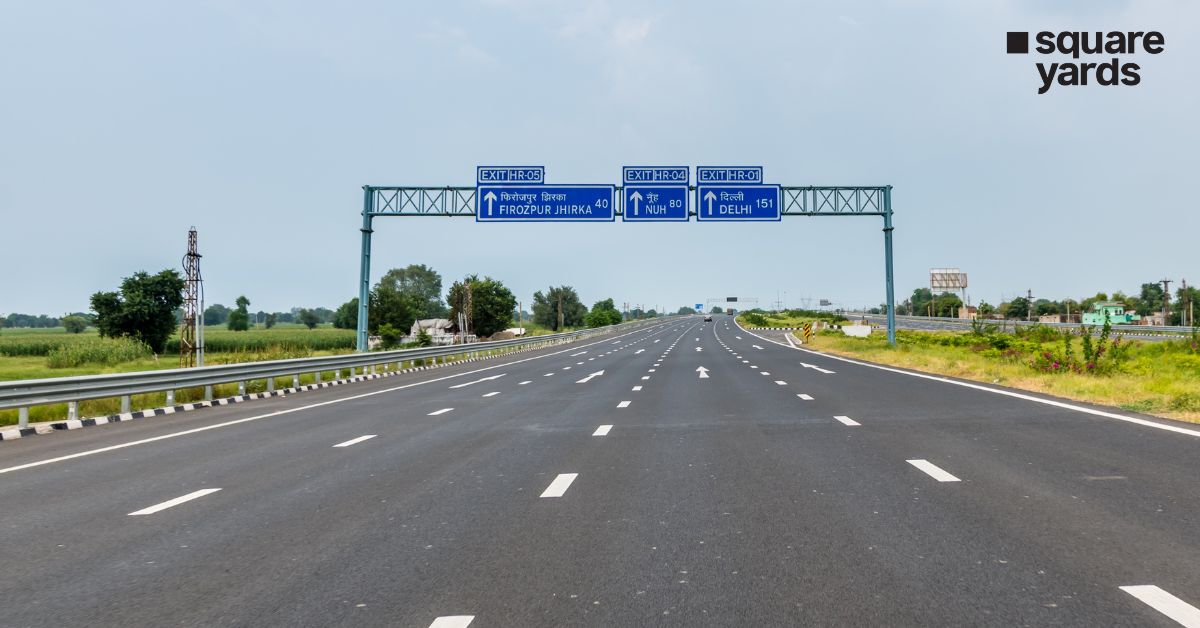
New Delhi: The Union Cabinet recently approved the development of a 31.4 km greenfield link corridor connecting the Delhi-Mumbai Expressway to the upcoming Noida International Airport at Jewar, in a project estimated at under ₹3,600 crore. The six-lane elevated corridor is aimed at improving connectivity between South Delhi, Faridabad, Gurgaon and the Jewar airport region, while strengthening regional logistics and reducing congestion across parts of the NCR.
Officials say the project will serve as a critical last-mile connector, integrating the Delhi-Mumbai Expressway, considered a national mobility backbone, with the upcoming airport, which is expected to emerge as a major hub for cargo, logistics and aviation-linked industries.
Early-Stage Development Corridor
The Faridabad-Jewar belt is still in an early-stage phase of development. Unlike the Yamuna Expressway corridor, which already has an established investment story and a visible residential ecosystem, this corridor currently lacks a strong end-user housing demand, mature social infrastructure, and organised commercial activity.
Areas along the proposed alignment, from Ballabgarh and South Faridabad to Mohana, Chhaysa, and Jewar, are seeing increased interest in plotted developments and land transactions. However, analysts note that demand remains limited and uneven, with potential gains likely to be concentrated around key nodes such as expressway interchanges, airport access points and established residential sectors.
The Jewar airport zone is expected to emerge as the primary economic driver over time, with potential growth in logistics parks, warehousing, hospitality and aviation-linked businesses. Spillover markets such as Sohna, South Gurgaon, and the Faridabad-Gurgaon road belt may also benefit from their relatively stronger infrastructure and existing residential ecosystems.
Where Does the Real Value Lie for the Investors?
For investors, the highest-potential areas are likely to be strategic junction nodes. These include expressway interchanges, airport access points and future mixed-use commercial hubs. The next layer of opportunity lies within the airport influence belt.
Early investors may benefit if future infrastructure is delivered on time and if airport-led economic activity begins to materialise. At the same time, there is also significant downside risk because some locations may remain underdeveloped for years if demand does not emerge at the expected pace. The corridor is also important because it has the potential to evolve into a larger multi-modal logistics and industrial belt.
Development Timeline Outlook
- 2025 – 2026: Speculative activity dominates, and land transactions increase
- 2027 – 2028: Emergence of logistics parks, warehousing clusters, industrial activity, and institutional developers.
- Post – 2028: Gradual residential development with demand concentrated in airport zones, junction nodes, and logistics hubs.
Final Takeaway
The most important takeaway is that the Delhi-Mumbai Expressway link to Jewar is not an immediate trigger for a real estate boom. It is a long-term network unlock that can redefine where the next economic nodes of NCR emerge. For investors, the opportunity lies not in buying across the entire corridor, but in identifying the right nodes before the broader market catches up.