
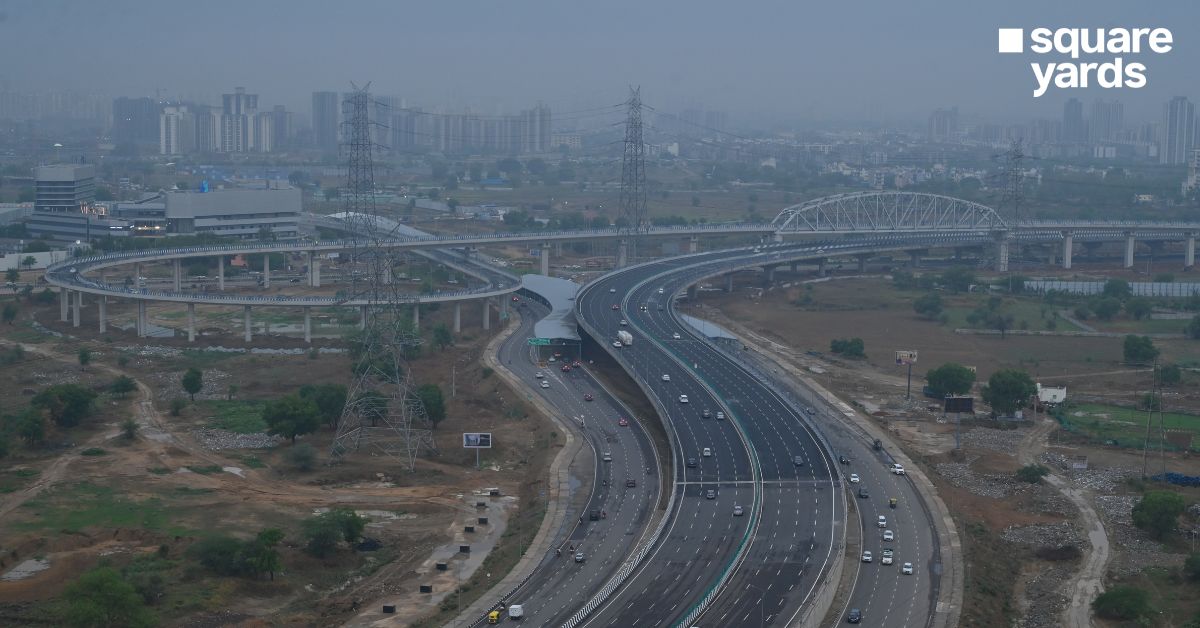
On a typical weekday morning, the stretch near Pataudi Road in Gurugram slows to a crawl. Trucks inch forward, office commuters impatiently switch lanes, and what should be a short drive between emerging sectors often turns into a test of patience. It is this daily friction that planners now hope to eliminate. The National Highways Authority of India (NHAI) is preparing to build a four-lane trumpet interchange at the Pataudi Road junction, an engineering solution designed to keep traffic moving without halts. If completed as planned, the project could fundamentally change how people and goods move between two of Gurugram’s most ambitious developments: Global City and Vision City.
For the uninitiated, Global City is an upcoming mixed-use township envisioned by the HSIIDC along the Dwarka Expressway. The central vision is to develop a modern, self-sustaining smart city with well-planned commercial, residential, and retail spaces. Similarly, Vision City is a future commercial hub comprising jewelry and furniture industries.
Funded by the Haryana State Industrial and Infrastructure Development Corporation (HSIIDC), the Rs 923-crore interchange will not rise above the city but will slip beneath it. It will be constructed 8-9 meters below the existing highway. With 3.2 km of approach roads and looping ramps, the design allows vehicles to merge and exit without encountering a single traffic signal. According to official estimates, construction would likely take about 30 months.
Two ‘cities’ in the making
The scale of what this interchange is meant to serve is considerable. Spread across more than 1,000 acres along the Dwarka Expressway, Global City is planned as a mixed-use district in sectors 36, 36B, 37, and 37B, which are part business hub, part residential zone. Next to it, the 121-acre Vision City is being developed as a specialized commercial center for industries such as gems, jewelry, and furniture.
Together, they form a key part of Haryana’s attempt to build a new urban cluster, which planners describe as self-sustaining and integrated. Internal infrastructure, from roads to drainage and power networks, is already under development, with the first phase expected to be ready by June 2027. But large plans often run into a familiar obstacle: getting people in and out efficiently.
From bottlenecks to free flow
At present, connectivity in this part of New Gurugram is uneven. Routes linking Manesar, Pataudi Road, NH-48, and the Dwarka Expressway are functional but far from seamless. Traffic signals, merging conflicts, and peak-hour congestion slow movement, particularly for commuters traveling between industrial zones and newer residential sectors.
The proposed interchange attempts to bypass these choke points altogether.
A trumpet interchange, a term commonly used for a road that terminates at another road, allows vehicles to loop in and out via grade-separated ramps. In practical terms, it means a driver coming from Manesar could enter Global City or Vision City without stopping, weaving through traffic lights, or crossing opposing lanes. For logistics operators and daily commuters, even small delays can add up. For a city like Gurugram, where distances are short but travel times are often long, the impact could be more pronounced.
More than just a road
The Dwarka Expressway, which is still nearing full operational capacity, is already drawing residential and commercial interest westward. The addition of a signal-free interchange could accelerate that shift, particularly in sectors 80 to 90, where developers and investors are closely watching connectivity improvements.
For businesses, better access often translates into lower logistics costs and more predictable operations. For residents, it can mean shorter commutes and, in some cases, rising property values. Yet such projects also come with familiar questions, around execution timelines, construction disruption, and whether infrastructure can keep pace with the scale of urban ambition.
The inevitable real estate boom
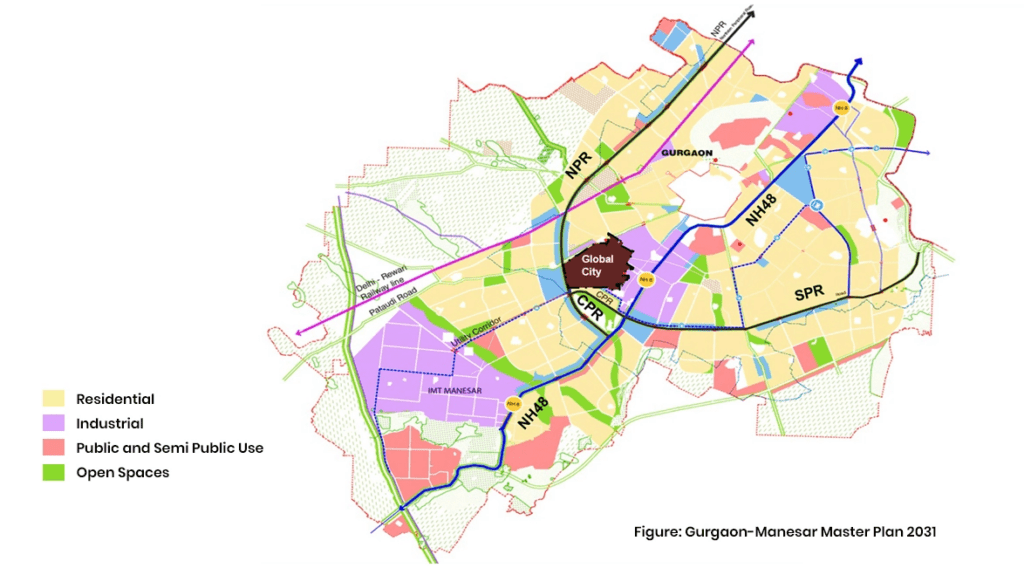
Image Credits: Global City Gurugram
Two future cities are being planned in sectors 36, 36B, 37, and 37B along Dwarka Expressway. With over 1,000 acres of mixed-use development, proximity to NH-48, and connectivity to IGI Airport (20–25 mins), the corridor is poised to catalyze Gurugram’s next real estate surge. In the past, Dwarka Expressway has emerged as Gurugram’s primary real estate growth corridor, accounting for 66% of total housing sales (12,409 units worth ₹25,000 crore in 2023), reflecting strong end-user and investor confidence. Moreover, the corridor has seen up to 83% price appreciation over 6.5 years, with recent annual spikes of 30%, indicating strong momentum and a seller-driven market.
According to Square Yards Research, infrastructure upgrades, including the completion of the Dwarka Expressway, metro extensions, and the development of commercial hubs, will drive demand. Grade-A office supply and retail ecosystems do increase surrounding residential absorption. Early-stage land prices are expected to double over the years, mirroring Cyber City’s growth trajectory.
A city still taking shape
Gurugram’s growth has often been described as rapid and at times uneven, with world-class office towers standing alongside congested roads. Projects like the proposed interchange suggest an attempt to correct that imbalance, bringing infrastructure in line with expansion. Its success will depend not just on design but also on delivery.
For now, the promise is straightforward: a smoother journey through a part of the city that is still under construction. For the thousands who navigate these roads each day, that promise may be reason enough to watch closely.