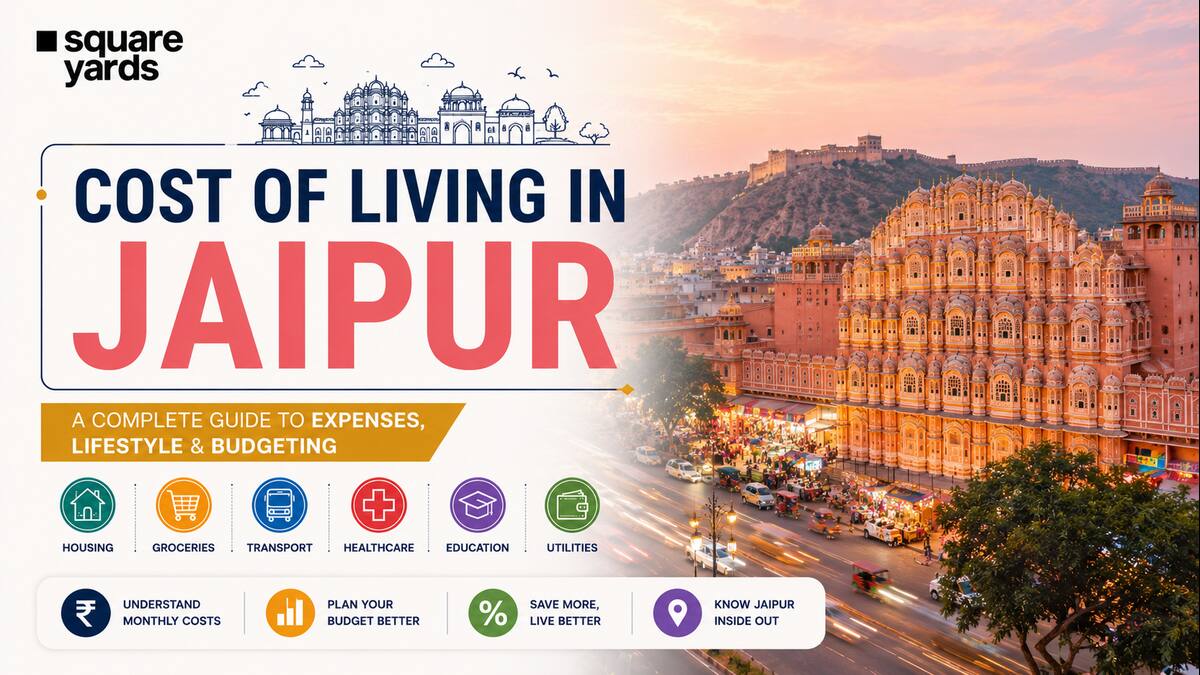
Jaipur is one of those cities where your money stretches noticeably further – not because it lacks infrastructure, but because it has not become as expensive as the metros yet. Hospitals, schools, IT companies, malls – all present. Rent, food, transport – all cheaper, often by a wide margin compared to Bengaluru, Delhi, or Mumbai.
How much cheaper, though, depends on who you are and where you choose to live. A Jagatpura student’s monthly budget looks nothing like a C-Scheme family’s. This guide breaks down the cost of living in Jaipur across every major expense category, for every type of resident – with 2026 figures throughout.
- What Is the Cost of Living in Jaipur in 2026?
- Rent in Jaipur 2026 – What You Pay, Area by Area
- Food Costs in Jaipur: Groceries, Street Food and Dining Out
- Transport Costs in Jaipur – Commuting, Autos and Private Vehicles
- Electricity, Water, Internet and Gas Bills in Jaipur
- Cost of Living in Jaipur for Students, Bachelors, Couples and Families
- Healthcare and School Fees in Jaipur
- Entertainment, Shopping and Lifestyle Costs in Jaipur
- Average Salaries in Jaipur 2026 – Income vs Cost of Living
- Jaipur vs Delhi NCR, Bengaluru and Mumbai – City Cost Comparison
- Why Jaipur Is One of the Best Places to Live in India in 2026
- Conclusion
What Is the Cost of Living in Jaipur in 2026?
For a single person, daily expenses in Jaipur – food, transport, utilities, personal costs – run to about ₹15,000 to ₹25,000 a month before rent. Add a 1 BHK in a mid-range area and you land at ₹22,000 to ₹35,000 total. Couples together typically spend ₹35,000 to ₹55,000. Families of four, once school fees are counted, range from ₹55,000 to ₹90,000 depending on choices.
Monthly budget by household type – Jaipur 2026:
|
Household Type |
Monthly Budget (Approx.) |
|
Single person, no rent |
₹15,000 – ₹25,000 |
|
Single person, rent included |
₹22,000 – ₹35,000 |
|
Couple, all expenses combined |
₹35,000 – ₹55,000 |
|
Family of four, total all-in |
₹55,000 – ₹90,000 |
|
Student in PG or hostel |
₹8,000 – ₹18,000 |
|
Working bachelor, solo 1 BHK |
₹18,000 – ₹30,000 |
Rent in Jaipur 2026 – What You Pay, Area by Area
Rent is the biggest single expense for most Jaipur residents and it shifts significantly depending on which part of the city you choose. Sikar Road and Jagatpura sit at the affordable end – newer constructions, slightly outside the commercial core, but well-connected via the highway network and popular with students and budget renters. Mansarovar, Malviya Nagar, and Tonk Road occupy the mid-range, covering most working professionals. C-Scheme is the city’s premium residential address, with prices that reflect it.
The difference between neighbourhoods is not just the rent number – it is what that rent buys. Mansarovar gets you metro access and a quick commute to Sitapura. Malviya Nagar gives you cafes, IT offices, and a lively street-level experience. Vaishali Nagar offers wide roads, parks, and proximity to Jaipur’s better schools – which is why families tend to concentrate there.
Locality-wise average monthly rents in Jaipur – 2026:
|
Locality |
1 BHK / Month |
2 BHK / Month |
3 BHK / Month |
|
₹7,000 – ₹12,000 |
₹12,000 – ₹20,000 |
₹18,000 – ₹30,000 |
|
|
₹9,000 – ₹15,000 |
₹14,000 – ₹22,000 |
₹20,000 – ₹35,000 |
|
|
₹10,000 – ₹18,000 |
₹16,000 – ₹28,000 |
₹25,000 – ₹45,000 |
|
|
₹14,000 – ₹25,000 |
₹22,000 – ₹40,000 |
₹35,000 – ₹65,000 |
|
|
₹6,500 – ₹11,000 |
₹11,000 – ₹18,000 |
₹16,000 – ₹28,000 |
|
|
₹8,000 – ₹13,000 |
₹13,000 – ₹22,000 |
₹20,000 – ₹35,000 |
|
|
Sikar Road |
₹5,500 – ₹9,000 |
₹9,000 – ₹15,000 |
₹14,000 – ₹22,000 |
|
₹6,000 – ₹10,000 |
₹10,000 – ₹17,000 |
₹15,000 – ₹26,000 |
Best Places to Live in Jaipur – Matched to Your Priorities
Each locality suits a different kind of resident. A quick reference:
- Mansarovar – metro line access, Sitapura IT zone nearby, working professionals
- Malviya Nagar – young professionals, close to tech offices and F&B scene
- Vaishali Nagar – families, wide roads, quality schools and hospitals close by
- C-Scheme and Civil Lines – senior professionals, NRIs, all-premium environment
- Jagatpura – students and budget renters, airport road access, newer stock
- Sikar Road – city’s lowest rents, fast-growing area, suited to first-time renters
Food Costs in Jaipur: Groceries, Street Food and Dining Out
The food cost advantage in Jaipur is immediate. A full vegetarian thali – dal, sabji, roti, rice – costs ₹80 to ₹150 at most local joints away from tourist routes. Street food near M.I. Road or Badi Chaupar is ₹50 to ₹100 per head. Mid-range restaurants with a proper menu very rarely send two people past ₹1,200 – you would have to be ordering alcohol or selecting somewhere quite upscale.
For home cooking, local mandis beat D-Mart and Reliance Fresh on fresh produce pricing by 15 to 25 percent. Vegetable and dairy quality at neighbourhood markets tends to be good. The grocery figures below reflect both mandi and general market rates:
Grocery Prices in Jaipur – 2026
Supermarket prices run 10-20% higher on most items. Mandi prices may be lower than shown.
|
Item |
Avg. Price |
|
Milk, full fat, 1 litre |
₹54 – ₹58 |
|
Bread, 500g |
₹30 – ₹40 |
|
Eggs, dozen |
₹80 – ₹100 |
|
Basmati rice, 1 kg |
₹55 – ₹80 |
|
Tomatoes, 1 kg |
₹25 – ₹55 (seasonal) |
|
Onions, 1 kg |
₹20 – ₹45 |
|
Boneless chicken, 500g |
₹200 – ₹280 |
|
Refined cooking oil, 1 litre |
₹130 – ₹160 |
|
Dal or lentils, 1 kg |
₹80 – ₹140 |
|
Monthly groceries – 1 person |
₹3,500 – ₹6,000 |
|
Monthly groceries – family of 4 |
₹10,000 – ₹16,000 |
Dining Out in Jaipur – Cost by Type of Restaurant
Per-person costs at different dining options across Jaipur:
|
Dining Type |
Cost Per Person |
|
Roadside stall or street food |
₹50 – ₹120 |
|
Local dhaba or thali restaurant |
₹80 – ₹180 |
|
Casual sit-down restaurant |
₹200 – ₹450 |
|
Mid-range restaurant, meal for two |
₹700 – ₹1,500 |
|
McDonald’s / KFC / Subway |
₹300 – ₹450 |
|
Café – cappuccino or cold coffee |
₹90 – ₹200 |
|
Fine dining, two people total |
₹1,500 – ₹3,500 |
Want a number for your specific situation? Use the Square Yards Cost of Living Calculator – enter your locality, household size, and spending habits to get a personalised monthly figure.
Transport Costs in Jaipur – Commuting, Autos and Private Vehicles
Jaipur is a wider city than it looks on a map – the distance from Jagatpura to Malviya Nagar covers roughly 18 km and takes 25 to 35 minutes even without peak-hour traffic. The metro network handles the central corridors well. Bus coverage gets patchy in newer residential zones. Autos are metered at ₹12 to ₹15 per km, though the meter is not always used – especially in tourist-heavy stretches near the old city.
Residents commuting daily from Mansarovar or Malviya Nagar to Sitapura – one of the most travelled work routes in the city – spend roughly ₹1,200 to ₹2,500 a month using public or shared transport. Owning a bike or car adds fuel as the primary ongoing cost.
Transport cost reference – Jaipur 2026:
|
Mode or Expense |
Cost |
|
Jaipur Metro, single journey |
₹10 – ₹35 |
|
City bus, one-way (RSRTC) |
₹10 – ₹30 |
|
Monthly metro or bus pass |
₹500 – ₹700 |
|
Auto-rickshaw per km, metered |
₹12 – ₹15 |
|
Ola, Uber or Rapido per km |
₹12 – ₹18 |
|
Petrol per litre (June 2026 est.) |
₹104 – ₹112 |
|
Diesel per litre |
₹90 – ₹96 |
|
Bike or scooter rental, monthly |
₹2,500 – ₹4,500 |
|
Car fuel, approx. 1,000 km per month |
₹5,500 – ₹7,500 |
Electricity, Water, Internet and Gas Bills in Jaipur
Bills are reasonable through most of the year. Summer is the outlier. Jaipur records temperatures of 44 to 46°C through May and June – that is not exaggerated, and air conditioning in those months is not a luxury. A household with a single AC unit running through the peak months will see electricity bills between ₹3,000 and ₹5,000. Two or three units push the bill to ₹6,000 to ₹8,000 in May and June. Outside that window, a 2-person household typically pays ₹1,200 to ₹2,500 monthly.
JVVNL – Jaipur Vidyut Vitran Nigam Limited – governs electricity supply and tariff slabs in the city. Current slab rates are on their site at jvvnl.in. Broadband is fairly cheap, with 100 Mbps plans starting from ₹499.
Utility bills, 2-person household in Jaipur – monthly averages 2026:
|
Utility |
Monthly Cost |
|
Electricity – rest of year (non-summer) |
₹1,200 – ₹2,500 |
|
Electricity – May/June with 1 AC |
₹3,000 – ₹5,000 |
|
Electricity – May/June with 2-3 ACs |
₹6,000 – ₹8,000 |
|
Water supply, municipal bill |
₹100 – ₹300 |
|
LPG cooking gas cylinder |
₹850 – ₹920 |
|
Broadband, 100 Mbps plan |
₹499 – ₹999 |
|
Mobile prepaid, 1.5 GB/day data |
₹179 – ₹299 |
|
Non-summer total estimate |
₹2,800 – ₹5,000 |
Cost of Living in Jaipur for Students, Bachelors, Couples and Families
Same city, different numbers depending on who is spending. Here is what each household type actually deals with.
Students: Monthly Budget in Jaipur
Universities with a Jaipur presence include Manipal University, Amity, LNM IT, NIMS, Jaipur National University, and the University of Rajasthan. Most students rent PGs in Jagatpura or Mansarovar – both areas have abundant supply at reasonable rates. The single biggest factor affecting a student’s monthly spend is whether the PG includes meals. With a mess, ₹10,000 to ₹12,000 is achievable. Without, figure closer to ₹14,000 to ₹18,000.
Student monthly expenses in Jaipur – 2026:
|
Expense |
Monthly Cost |
|
PG or hostel accommodation |
₹4,500 – ₹8,000 |
|
Food – mess or self-cooked |
₹2,500 – ₹4,500 |
|
Local transport |
₹500 – ₹1,500 |
|
Mobile and internet |
₹400 – ₹700 |
|
Books, stationery, printing |
₹400 – ₹1,000 |
|
Personal and miscellaneous |
₹800 – ₹2,000 |
|
Monthly total |
₹8,000 – ₹18,000 |
Working Bachelors: Solo Living Costs in Jaipur
A 1 BHK in Malviya Nagar or Mansarovar, cooking at home four or five days a week, eating out or ordering the rest – that setup runs to roughly ₹22,000 to ₹28,000 a month. Choosing a flatshare instead of a solo flat removes ₹4,000 to ₹6,000 from that number without any meaningful lifestyle drop.
Monthly expenses for a working bachelor in Jaipur:
|
Expense |
Monthly Cost |
|
Rent – 1 BHK or shared flat |
₹5,000 – ₹14,000 |
|
Groceries, home cooking |
₹3,500 – ₹6,000 |
|
Eating out, occasional |
₹1,000 – ₹2,500 |
|
Transport |
₹1,000 – ₹3,000 |
|
Electricity, internet, phone |
₹1,500 – ₹3,000 |
|
Gym, entertainment, personal |
₹1,500 – ₹3,500 |
|
Monthly total |
₹18,000 – ₹30,000 |
Couples: Combined Household Costs in Jaipur
Two people splitting a 2 BHK in Tonk Road or Mansarovar, sharing groceries and a commute where possible – the total household spend is typically ₹35,000 to ₹55,000 monthly. That is the combined number, not per person. Most couples in comparable Bengaluru or Delhi setups are spending that much on rent alone.
Combined monthly expenses for couples in Jaipur:
|
Expense |
Monthly Cost |
|
Rent – 2 BHK, mid-range area |
₹11,000 – ₹22,000 |
|
Groceries and household |
₹7,000 – ₹12,000 |
|
Transport, both |
₹2,000 – ₹5,000 |
|
Electricity, gas, internet |
₹1,500 – ₹3,500 |
|
Dining out, entertainment |
₹3,000 – ₹6,000 |
|
Monthly total |
₹35,000 – ₹55,000 |
Families: Full Monthly Budget for a Family of Four
The school fee question determines a lot for families. Government schools charge almost nothing. Budget private CBSE runs ₹25,000 to ₹60,000 annually. Premium private schools push ₹70,000 to ₹1.5 lakh per year per child. International schools are ₹1.8 lakh to ₹4 lakh plus. A family with two kids in mid-range private schools, a car, and a 3 BHK in Vaishali Nagar or Jagatpura is looking at ₹55,000 to ₹90,000 a month, total.
Monthly family budget – family of four in Jaipur:
|
Expense |
Monthly Cost |
|
Rent – 3 BHK, good area |
₹16,000 – ₹35,000 |
|
Groceries and household supplies |
₹12,000 – ₹18,000 |
|
School fees per child (private) |
₹2,500 – ₹12,000 |
|
Transport – car fuel + school bus |
₹4,000 – ₹8,000 |
|
Electricity, gas, internet |
₹2,500 – ₹5,000 |
|
Healthcare, consults and meds |
₹1,000 – ₹3,000 |
|
Entertainment and misc. |
₹4,000 – ₹8,000 |
|
Monthly total |
₹55,000 – ₹90,000 |
Healthcare and School Fees in Jaipur
Healthcare in Jaipur is genuinely accessible. SMS Hospital – Sawai Man Singh – handles a high patient volume as the government flagship and remains free or near-free for most procedures. Private options include Narayana Multispecialty, Fortis Escorts, and Manipal Hospital – all equipped for complex procedures and charging ₹300 to ₹800 for a standard OPD consultation. A family floater health insurance policy covering four people costs ₹12,000 to ₹25,000 a year through most major insurers.
School fee ranges by institution type in Jaipur – annual per child, 2026:
|
School Type |
Annual Fees |
|
Government school, Rajasthan Board |
₹500 – ₹2,000 |
|
Budget private, Hindi medium |
₹12,000 – ₹30,000 |
|
Mid-range CBSE private school |
₹30,000 – ₹70,000 |
|
Premium CBSE or ICSE |
₹70,000 – ₹1,50,000 |
|
International or IB school |
₹1,80,000 – ₹4,00,000+ |
|
Playschool or preschool, monthly |
₹2,000 – ₹8,000 |
Entertainment, Shopping and Lifestyle Costs in Jaipur
Jaipur is famous for good reason when it comes to shopping – Bapu Bazaar for block-print textiles, Johari Bazaar for silver and gemstones, Tripolia for brassware. Residents access these at everyday local prices, not the rates that tourists pay near Hawa Mahal. Leisure spending is similarly reasonable – a PVR multiplex at World Trade Park charges ₹180 to ₹500 a ticket, a gym membership runs ₹700 to ₹2,500 monthly, and Jawahar Kala Kendra hosts cultural events at low or no cost through the year.
Lifestyle and entertainment cost reference – Jaipur 2026:
|
Activity or Item |
Approximate Cost |
|
Gym membership, monthly |
₹600 – ₹2,500 |
|
Yoga or fitness class, monthly |
₹800 – ₹2,000 |
|
Multiplex movie ticket |
₹180 – ₹500 |
|
Gents haircut, mid-range salon |
₹150 – ₹400 |
|
Ladies haircut and styling |
₹400 – ₹1,200 |
|
Tennis court rental per hour |
₹350 – ₹1,200 |
|
Netflix or Amazon Prime |
₹149 – ₹499/month |
|
Mid-range jeans – Levi’s or Lee |
₹1,200 – ₹3,500 |
|
Running shoes – Nike or Adidas |
₹2,800 – ₹6,000 |
|
Weekend outing, two people |
₹600 – ₹2,500 |
Average Salaries in Jaipur 2026 – Income vs Cost of Living
Jaipur salaries are lower than Bengaluru or Gurgaon by 15 to 25 percent on comparable roles. That gap is real and worth knowing. What the raw numbers do not show, though, is that the cost base is also 30 to 40 percent lower. Run the actual arithmetic – income minus rent, groceries, transport, and utilities – and the monthly surplus in Jaipur often compares well against what the same profile would retain in a metro city.
A software engineer on ₹55,000 in Jaipur paying ₹14,000 in rent has more disposable income than the same person earning ₹75,000 in Bengaluru and paying ₹28,000 in rent. The salary line looks smaller. The bank balance at month-end frequently does not.
Average monthly take-home salaries in Jaipur – 2026:
|
Job Profile |
Monthly Take-Home (Approx.) |
|
IT / Software Engineer, 3-5 yrs exp |
₹40,000 – ₹80,000 |
|
Civil or Mechanical Engineer |
₹25,000 – ₹55,000 |
|
BPO or Customer Support |
₹18,000 – ₹30,000 |
|
Hotel and Hospitality Professional |
₹15,000 – ₹28,000 |
|
Teacher, private school |
₹15,000 – ₹35,000 |
|
Doctor, private hospital |
₹60,000 – ₹1,50,000 |
|
Fresh Graduate, any sector |
₹12,000 – ₹22,000 |
|
Retail or Store Manager |
₹20,000 – ₹40,000 |
Jaipur’s cost of living index runs roughly 50 to 55% lower than Mumbai and around 30 to 35% below Bengaluru – a gap big enough to meaningfully change the real value of a salary.
Jaipur vs Delhi NCR, Bengaluru and Mumbai – City Cost Comparison
Four categories drive the bulk of most people’s monthly spend. Here is how Jaipur stacks up against the three cities most people are comparing it to – using 2026 figures for mid-range areas of each city:
|
Expense |
Jaipur |
Delhi NCR |
Bengaluru |
Mumbai |
|
1 BHK rent, decent area |
₹8,000-₹14,000 |
₹15,000-₹30,000 |
₹18,000-₹35,000 |
₹22,000-₹50,000 |
|
Monthly groceries, one person |
₹3,500-₹5,500 |
₹5,000-₹8,000 |
₹5,500-₹8,500 |
₹6,000-₹9,000 |
|
Monthly transport, avg commuter |
₹1,000-₹3,500 |
₹2,500-₹6,000 |
₹2,500-₹5,500 |
₹2,000-₹5,000 |
|
Mid-range meal out, two people |
₹700-₹1,500 |
₹1,200-₹2,500 |
₹1,000-₹2,500 |
₹1,500-₹3,000 |
Why Jaipur Is One of the Best Places to Live in India in 2026
Jaipur is famous well beyond its cost advantage. The city has a cultural identity – Amber Fort, Hawa Mahal, City Palace, the bazaars – that makes it liveable in a way that feels different from most Indian cities. Alongside that, the practical infrastructure has improved significantly. Roads are wider than average, the metro network is expanding, and the private healthcare and school ecosystem is strong relative to the cost involved.
More specific reasons that matter if you are weighing a move:
- IT sector has substance – Infosys, TCS, Wipro and HCL operate out of Sitapura and Malviya Nagar
- Jaipur International Airport runs direct flights to Dubai, Singapore, Sharjah and most Indian metros
- Delhi is 3.5 to 4 hours by road on the expressway – proximity to the capital is a practical asset
- Metro Phase 2 is underway – internal city connectivity is improving
- Residential property prices sit 40 to 60% below Bengaluru for comparable product
- City safety index of 70 per Wise.com – among the better-ranked larger Indian cities
- Private hospitals and schools are well-distributed across the city and priced reasonably
Conclusion
The cost of living in Jaipur in 2026 makes a clear case for itself. Rent is lower, food is cheaper, commutes are shorter, and the schools and hospitals are genuinely good relative to what they cost. For students, working professionals, couples, and families alike – Jaipur gives you city-level infrastructure without the city-level bill that usually comes with it.
Frequently Asked Questions:
1. What is the average monthly cost of living in Jaipur in 2026?
A single person including rent spends roughly ₹22,000 to ₹35,000 monthly. Daily expenses without rent – food, transport, utilities, personal costs – run ₹15,000 to ₹25,000. The range shifts noticeably based on locality and lifestyle choices.
2. Is Jaipur cheaper than Bengaluru to live in?
Substantially, yes. Rents in comparable Jaipur areas are 40 to 50% lower. Overall monthly costs for a similar lifestyle come in 30 to 40% cheaper. Salaries are also lower, but the cost difference is usually wider than the pay difference, which is why many professionals find their savings rate improves after the move.
3. What is the average monthly rent in Jaipur?
A 1 BHK in a mid-range, well-connected locality runs ₹7,000 to ₹15,000 per month. Sikar Road and Jagatpura are cheaper. C-Scheme and Vaishali Nagar are pricier. Most people renting a standard 2 BHK end up paying ₹11,000 to ₹22,000 depending on area.
4. Which are the best places to live in Jaipur?
Professionals generally pick Mansarovar or Malviya Nagar. Families with children tend toward Vaishali Nagar or Jagatpura. Students on tight budgets go to Jagatpura or Sikar Road. Anyone looking for premium addresses goes to C-Scheme or Civil Lines.
5. How much does a student spend per month in Jaipur?
Most students land between ₹8,000 and ₹18,000 monthly. PG with a mess included keeps costs on the lower side – under ₹12,000 is doable. Without meals included, or renting privately, ₹14,000 to ₹18,000 is a more realistic figure.
6. How high is the electricity bill in Jaipur in summer?
With one AC running in May and June, a household bill of ₹3,000 to ₹5,000 is typical. Two or more units should be budgeted at ₹6,000 to ₹8,000 for those months. JVVNL publishes current tariff slabs at jvvnl.in.
7. Is Jaipur good for remote workers?
It works well. Broadband is reliable and reasonably priced – 100 Mbps plans start at ₹499. Coworking spaces exist in Malviya Nagar and Vaishali Nagar. Cafes that accommodate laptop workers are multiplying. The cost base is a clear benefit for anyone earning in metros or in foreign currency.
8. What does domestic help cost in Jaipur?
Part-time maid for two hours daily: ₹3,000 to ₹5,000 a month. Full-time live-in helper: ₹8,000 to ₹14,000. Cook visiting twice a day: ₹4,000 to ₹7,000 monthly. Rates are meaningfully lower here than in Delhi or Mumbai for equivalent service.