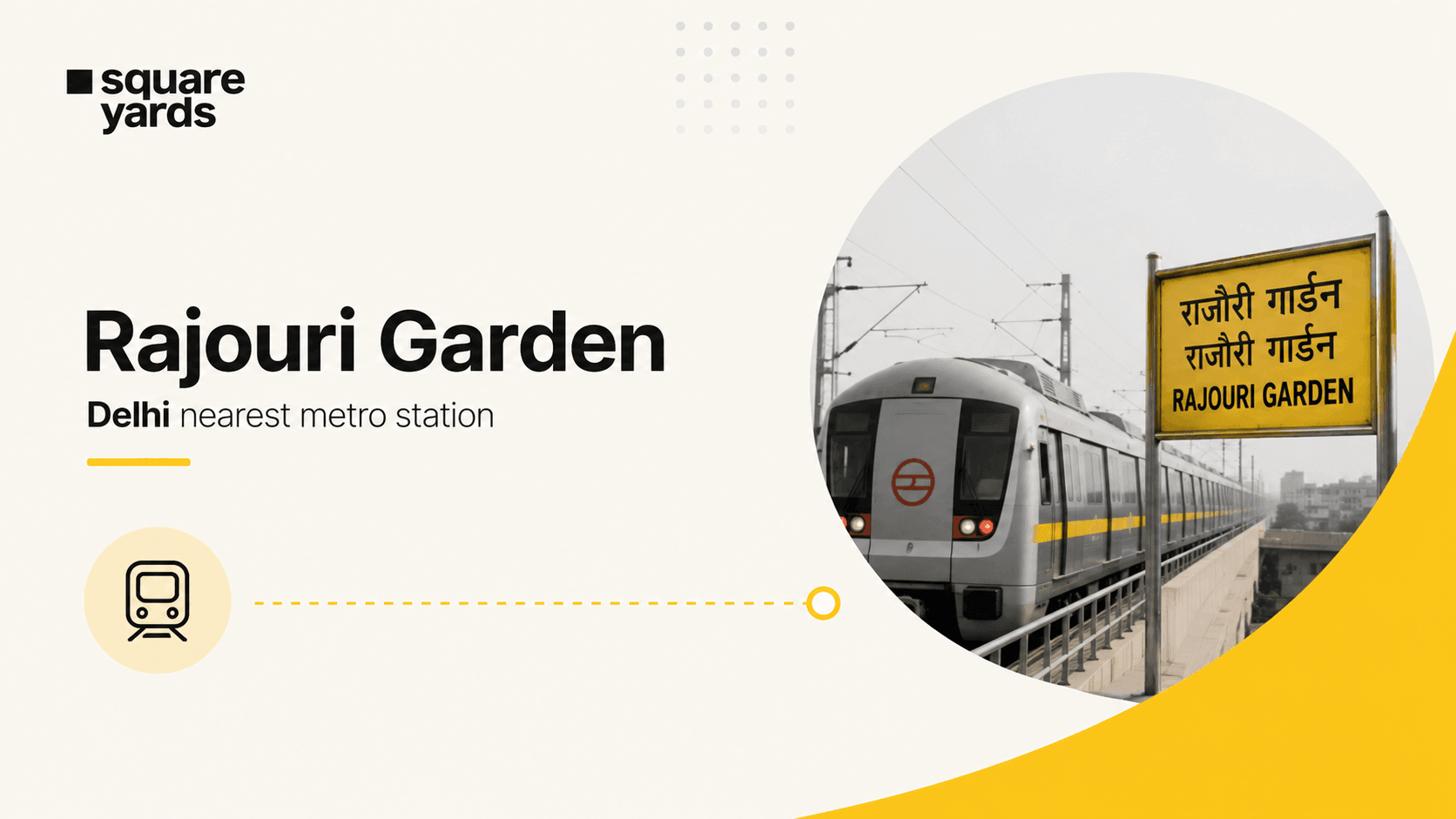
Rajouri Garden doesn’t have to send you looking elsewhere for a metro station. It has one sitting right inside the locality, and that single fact changes the whole conversation compared to most West Delhi neighborhoods that rely on a station a couple of kilometers away.
The station itself is one of the busier interchange points on the Delhi Metro network, which is worth knowing before you even get into distances and platform numbers.
Quick Answer
Rajouri Garden Metro Station is the nearest metro to Rajouri Garden, Delhi, and it’s not “nearest” in the usual sense of a short auto ride. It’s inside the locality, an interchange between the Blue Line and the Pink Line, with four platforms and four tracks. If you live anywhere in Rajouri Garden proper, you’re probably a 5- to 15-minute walk from it.
A few other stations matter too, depending on which stretch of the locality you’re in or where you’re headed. Tagore Garden and Ramesh Nagar sit close by on the Blue Line, and Punjabi Bagh West is the nearest option if the Pink Line side is more convenient for you.
Rajouri Garden Metro Station: The One That Actually Matters
Quick facts
- Lines: Blue Line and Pink Line (interchange)
- Station code: RG
- Structure: Elevated, two platform levels
- Opened: Blue Line in December 2005, Pink Line in March 2018
- Parking: Available
- Daily footfall: Well over 250,000 passengers, making it one of the busiest interchanges in the city
Platform 1 takes you east towards Noida Electronic City. Platform 2 goes the other way, towards Dwarka Sector 21. On the Pink Line side, one platform heads towards Maujpur-Babarpur, and the other loops back towards Majlis Park, since the Pink Line runs more or less in a large circle around the city rather than a straight line.
What this means practically: you can get to Connaught Place in about 20 minutes on the Blue Line, and the Pink Line gives you a way around the city without cutting through the more congested central stretch. For someone commuting to Gurgaon-side offices via Dwarka or heading towards Noida, this station covers both ends without needing an auto at all.
Quick Reference: Other Stations Worth Knowing
You won’t need these often if you already live near the main station, but they come up if you’re on the edges of the locality or heading somewhere specific.
|
Station |
Line |
Relevance |
|
Tagore Garden |
Blue Line |
Western edge of Rajouri Garden, useful if you’re closer to that side |
|
Ramesh Nagar |
Blue Line |
One stop east, near the Rajouri Garden-Moti Nagar border |
|
Subhash Nagar |
Blue Line |
Slightly further west, towards Tilak Nagar |
|
Mayapuri |
Blue Line |
Useful for the industrial area side |
|
Punjabi Bagh West |
Pink Line |
Closer if you’re on the northern edge near Punjabi Bagh |
None of these really change the picture much. Rajouri Garden’s own station handles most of what people need, and the others are more about which exit or entry point saves you a few minutes depending on where exactly you live within the locality.
1. Tagore Garden Metro Station: The Western Edge Option
Quick Facts
- Line: Blue Line
- Distance: Right on the Rajouri Garden-Tagore Garden boundary, roughly 1-1.5 km from central Rajouri Garden
- Travel Time by Auto: 5-10 minutes
Tagore Garden is the station people on the western side of Rajouri Garden end up using without really thinking about it, mostly because doubling back to the main interchange during the evening rush isn’t worth the effort when the mall crowd is pouring out of Pacific Mall and West Gate Mall. It’s a quieter station than Rajouri Garden’s own, and parking is easier to find here too.
How to Reach from Rajouri Garden:
- Auto from the western lanes near Shivaji Enclave: Rs 30-50
- Short enough to walk from most of the western pockets, 10-15 minutes on foot
2. Ramesh Nagar Metro Station: One Stop Towards Moti Nagar
Quick Facts
- Line: Blue Line
- Distance: Roughly 1.5-2 km from central Rajouri Garden
- Travel Time by Auto: 8-12 minutes
Ramesh Nagar sits just past the Rajouri Garden-Moti Nagar border, and it’s mainly useful for residents on that eastern edge who’d otherwise be walking the long way to reach the main interchange. It’s a fairly ordinary Blue Line station, nothing particularly notable about it, but it saves a few minutes if that’s the direction you’re already headed.
3. Subhash Nagar Metro Station: Further West, Towards Tilak Nagar
Quick Facts
- Line: Blue Line
- Distance: Roughly 2.5-3 km from central Rajouri Garden
- Travel Time by Auto: 10-15 minutes
Most Rajouri Garden residents won’t use Subhash Nagar regularly since the main interchange covers the same line anyway. It comes in handy mainly if you’re heading towards Tilak Nagar or that stretch of West Delhi and would rather board directly instead of switching direction at Rajouri Garden first.
4. Mayapuri Metro Station: For the Industrial Area Commute
Quick Facts
- Line: Blue Line
- Distance: Roughly 3-3.5 km from central Rajouri Garden
- Travel Time by Auto: 12-18 minutes
Mayapuri matters more if your daily commute runs through the industrial belt rather than central Delhi. It sees a lot of footfall from workers and traders heading into that area, so it has a different rhythm than the other stations on this list, busier early in the morning and quieter by mid-morning.
5. Punjabi Bagh West Metro Station: The Pink Line Alternative
Quick Facts
- Line: Pink Line
- Distance: Roughly 2-2.5 km from central Rajouri Garden
- Travel Time by Auto: 10-15 minutes
For residents on the northern side of Rajouri Garden, closer to Punjabi Bagh, this station can be a shorter walk than going all the way to the main interchange. It’s also worth using if your destination sits somewhere along the Pink Line’s northern stretch, since it saves you the platform change at Rajouri Garden.
Getting Around From the Station
Rajouri Garden Metro Station connects to a decent spread of local transport once you’re out of the gates. Autos line up outside both main exits, feeder buses run along the main road, and the station has six escalators and two lifts, so it’s not a hassle even during peak hours despite the crowd.
The area right around the station is also where Nehru Market, Pacific Mall, and West Gate Mall sit, so a lot of foot traffic through the station is shoppers as much as commuters. Worth keeping in mind if you’re planning to walk in during evening hours on a weekend.
Timings and Fares
|
Operating Hours |
Peak-Hour Frequency |
Off-Peak Frequency |
Fare Range |
Travel Tip |
|
Around 6:00 AM – 11:00 PM (varies slightly by line and station) |
3-5 minutes on busy lines like the Blue Line |
Typically 7-8 minutes |
Distance-based fares from ₹10 onwards |
Check the DMRC app before late-night travel, as Sunday and holiday timings may differ from regular schedules. |
Is Rajouri Garden a Good Place to Buy Property?
This is where things get interesting, because Rajouri Garden’s real estate story is unusually tied to its metro access, more than most West Delhi localities. The excellent connectivity has significantly boosted demand for property for sale in Rajouri Garden, attracting homebuyers and investors who value quick access to business districts, shopping hubs, and other parts of Delhi. As a result, metro connectivity continues to play a major role in shaping property values and buyer interest across the neighborhood.
Metro connectivity is doing real work here, not just decoration:
A lot of localities claim “metro connectivity” as a bullet point when the station is actually a fifteen-minute auto ride away. Rajouri Garden isn’t in that category. Having a full interchange station inside the locality means residents genuinely skip owning a second car or skip the daily grind of booking cabs. That’s a real, measurable convenience, and it shows up in how the rental market behaves here.
Rental demand stays strong through the year:
Tenant demand in Rajouri Garden comes mostly from working professionals who want to be close to a metro line that reaches both Gurgaon-adjacent areas via Dwarka and central Delhi via the Blue Line’s eastern stretch. Rental yields here run higher than a lot of comparable West Delhi pockets, largely because that dual-line access widens the pool of people who find the location workable.
The area was already built out before the Pink Line arrived:
Schools, hospitals, markets, and restaurants in Rajouri Garden had all of this well before 2018, when the Pink Line extended the station’s reach. The metro added convenience on top of an already mature neighborhood rather than being the thing that put the locality on the map in the first place. That matters if you’re an end-user rather than a pure investor, since it means less waiting around for the area to “develop.”
A Quick Locality Comparison
|
Locality |
Avg. Price per Sq. Ft. |
Metro Access |
|
₹10,000-20,000 |
Own station, Blue + Pink Line interchange |
|
|
₹9,000-15,000 |
Moti Nagar station, Blue Line |
|
|
₹8,000-13,000 |
Tilak Nagar station, Blue Line |
|
|
₹11,000-18,000 |
Punjabi Bagh West, Pink Line |
|
|
₹9,000-14,000 |
Janakpuri West, Blue + Magenta Line |
Wrapping Up
Rajouri Garden’s metro situation is about as good as it gets in West Delhi. There’s no hunting around for the nearest station or debating between two options a couple of kilometers apart the interchange sits right there, connecting you to both the Blue and Pink Lines, and the locality’s real estate market has priced that in fairly clearly. If you’re looking at property for sale in Rajouri Garden, Delhi, the metro isn’t a side note here. It’s one of the main reasons the area commands what it does.
Also Read
| Janakpuri | Janakpuri Delhi Nearest Metro Station |
| Pitampura | Pitampura Delhi Nearest Metro Station |
| Dwarka Sector 12 | Dwarka Sector 12 Nearest Metro Station |
Frequently Asked Questions:
1. What is the nearest metro to Rajouri Garden, Delhi?
Rajouri Garden Metro Station itself, an interchange between the Blue Line and Pink Line, sits inside the locality. Most residents are within a 5 to 15 minute walk.
2. Which lines does Rajouri Garden Metro Station connect to?
The Blue Line, running between Dwarka Sector 21 and Noida Electronic City / Vaishali, and the Pink Line, which loops around the city between Majlis Park and Shiv Vihar.
3. How far is Rajouri Garden from Connaught Place by metro?
Around 20 minutes on the Blue Line, making it one of the more convenient West Delhi localities for a central Delhi commute.
4. Does metro access affect property prices in Rajouri Garden?
Yes, more directly than in most localities. Having a full interchange station inside the area is a big part of why prices here run higher than nearby West Delhi pockets without similar access.
5. Is parking available at Rajouri Garden Metro Station?
Yes, parking is available at the station for those who want to drive in and take the metro onward.