
The price you agree with the seller is never the full cost of a Gurgaon home. The state also wants its share, and it wants it before the sale deed is signed. Stamp duty and registration charges in Gurgaon can easily reach several lakh rupees, even on an ordinary flat.
Here we go through stamp duty in Gurgaon for 2026, property registration charges, flat registry charges and what the new circle rates mean for your bill. You’ll also find a simple stamp duty calculator Gurgaon method with worked examples, plus the steps to get an e stamp paper in Gurgaon online, the documents you need, refunds, tax benefits and the questions buyers ask most.
- What Is Stamp Duty in Gurgaon?
- Stamp Duty vs Registration Charges: What Is the Difference?
- How Circle Rates Affect Your Stamp Duty in Gurgaon
- Latest Stamp Duty Charges in Gurgaon (2026)
- Stamp Duty in Gurgaon Inside Municipal Limits
- Stamp Duty in Gurgaon Outside Municipal Limits
- Joint Ownership: Stamp Duty for Husband and Wife
- Stamp Duty for Builder Floor in Gurgaon
- What is Property Registration Charges in Gurgaon
- Stamp Duty Charges for Other Deeds in Haryana
- How to Calculate Stamp Duty and Registration Charges in Gurgaon
- Factors That Affect Stamp Duty and Registration Charges
- How to Calculate Property Value in Gurgaon
- Recent Circle Rate Changes in Gurgaon
- How to Pay Online Stamp Duty in Gurgaon?
- Stamp Paper Gurgaon Online: Step-by-Step Process
- Documents Required for Property Registration in Gurgaon
- Property Registration Process in Gurgaon, Step by Step
- Tax Benefits on Stamp Duty and Registration Charges
- Penalties for Non-Payment or Underpayment of Stamp Duty
- Conclusion
What Is Stamp Duty in Gurgaon?
Stamp duty in Gurgaon is a state tax you pay when property changes hands. It comes from the Indian Stamp Act, 1899, as applied in Haryana, and it’s what makes your sale deed legally sound. Without proper stamping, the document can’t be relied on as evidence in court. The rate isn’t the same for everyone. It depends on where the property sits and who is buying: inside municipal limits you pay more than outside, women get a lower rate, and joint owners fall in between. New flats and resale flats are treated alike.
Stamp Duty vs Registration Charges: What Is the Difference?
Think of stamp duty as a tax on the document, charged as a percentage of the property’s value. Registration charges are a separate fee for recording the deed at the Sub-Registrar Office under the Registration Act, 1908, and they follow a slab. The buyer pays both before registration, and both use the same value. Once registered, the deed goes on the public record, which protects your title.
How Circle Rates Affect Your Stamp Duty in Gurgaon
Circle rates, also called collector rates, are minimum property values set by the district administration. Duty is charged on whichever is higher: the price you actually paid or the circle-rate value for that locality. Say you buy a flat for ₹80 lakh, but the circle-rate value works out to ₹90 lakh. You still pay duty on ₹90 lakh.
Latest Stamp Duty Charges in Gurgaon (2026)
Two things decide the stamp duty charges in Gurgaon: whether the property lies inside municipal limits, and who the buyer is. Here are the current sale deed rates.
|
Jurisdiction |
Male buyer |
Female buyer |
Joint (male and female) |
|
Within municipal limits |
7% |
5% |
6% |
|
Outside municipal limits |
5% |
3% |
4% |
Stamp Duty in Gurgaon Inside Municipal Limits
Inside municipal limits the urban rate applies. A man pays 7%, a woman pays 5%, and a man and woman buying together pay 6%, all on the higher of agreement value or circle-rate value.
Worked Example: Male Buyer, ₹1 Crore Flat Inside Municipal Limits
|
Item |
Calculation |
Amount |
|
Agreement value or circle-rate value (whichever is higher) |
Assume ₹1,00,00,000 |
₹1,00,00,000 |
|
Stamp duty at 7% |
7% of ₹1,00,00,000 |
₹7,00,000 |
|
Registration charge (slab-based, capped) |
Highest slab applies at this value |
₹50,000 |
|
Total statutory cost |
Stamp duty + registration charge |
₹7,50,000 |
|
Total cost as a percentage of property value |
(₹7,50,000 ÷ ₹1,00,00,000) × 100 |
7.5% |
Stamp Duty in Gurgaon Outside Municipal Limits
Rural and semi-urban properties outside municipal limits get lower rates: 5% for men, 3% for women and 4% for joint owners. Confirm which side of the line your property is on. Picking the wrong one means you underpay, and that causes trouble at registration.
Worked Example: Male Buyer, ₹1 Crore Property Outside Municipal Limits
|
Item |
Calculation |
Amount |
|
Stamp duty at 5% |
5% of ₹1,00,00,000 |
₹5,00,000 |
|
Registration charge (slab-based, capped) |
Highest slab applies at this value |
₹50,000 |
|
Total statutory cost |
Stamp duty + registration charge |
₹5,50,000 |
|
Saving vs same property inside municipal limits |
₹7,50,000 − ₹5,50,000 |
₹2,00,000 |
Stamp Duty and Registration Charges for Female Buyers
Haryana knocks 2 percentage points off the stamp duty for women, in both urban and rural areas. A woman pays 5% instead of 7% inside municipal limits, and 3% instead of 5% outside them. On a ₹1 crore flat that saves ₹2,00,000. You don’t need to apply for it. The registration fee, though, stays the same for everyone.
Worked Example: Female Buyer, Same Property Inside Municipal Limits
|
Item |
Calculation |
Amount |
|
Stamp duty at 5% |
5% of ₹1,00,00,000 |
₹5,00,000 |
|
Registration charge (slab-based, capped) |
Highest slab applies at this value |
₹50,000 |
|
Total statutory cost |
Stamp duty + registration charge |
₹5,50,000 |
|
Saving vs male buyer |
₹7,50,000 − ₹5,50,000 |
₹2,00,000 |
Joint Ownership: Stamp Duty for Husband and Wife
If a man and a woman buy together, the joint rate applies: 6% inside municipal limits and 4% outside. Against a sole male purchase, joint registration saves 1%, or ₹1,00,000 on a ₹1 crore property. Registering only in the woman’s name saves 2%.
Worked Example: Joint Buyers (Husband and Wife), Same Property
|
Item |
Calculation |
Amount |
|
Stamp duty at 6% |
6% of ₹1,00,00,000 |
₹6,00,000 |
|
Registration charge (slab-based, capped) |
Highest slab applies at this value |
₹50,000 |
|
Total statutory cost |
Stamp duty + registration charge |
₹6,50,000 |
|
Saving vs male buyer |
₹7,50,000 − ₹6,50,000 |
₹1,00,000 |
Stamp Duty for Builder Floor in Gurgaon
Haryana has no separate rate for builder floors. The normal sale deed rates apply, based on location and buyer category. So the stamp duty for a builder floor in Gurgaon is 7% for a man, 5% for a woman and 6% for joint buyers inside municipal limits. What changes is the value the duty is charged on. Circle rates are notified by category, such as group housing flats, independent floors and plots, so look up the category your floor falls under. The example below shows how much the buyer category moves the bill.
Worked Example: Builder Floor, Agreement Value ₹1.5 Crore, Circle-Rate Value ₹1.6 Crore
|
Item |
Calculation |
Amount |
|
Value used for duty (whichever is higher) |
Circle-rate value applies |
₹1,60,00,000 |
|
Stamp duty, male buyer at 7% |
7% of ₹1,60,00,000 |
₹11,20,000 |
|
Total with ₹50,000 registration charge, male buyer |
₹11,20,000 + ₹50,000 |
₹11,70,000 |
|
Stamp duty, female buyer at 5% |
5% of ₹1,60,00,000 |
₹8,00,000 |
|
Total with ₹50,000 registration charge, female buyer |
₹8,00,000 + ₹50,000 |
₹8,50,000 |
|
Saving for a female buyer |
₹11,70,000 − ₹8,50,000 |
₹3,20,000 |
Stamp Duty Charges in Other States
| State | Stamp Duty Charges |
|---|---|
| Maharashtra | Stamp Duty in Maharashtra |
| Pune | Stamp Duty in Pune |
| Gujarat | Stamp Duty in Gujarat |
| Uttar Pradesh | Stamp Duty in Uttar Pradesh |
| West Bengal | Stamp Duty in West Bengal |
| Delhi | Stamp Duty in Delhi |
| Madhya Pradesh | Stamp Duty in Madhya Pradesh |
| Rajasthan | Stamp Duty in Rajasthan |
| Karnataka | Stamp Duty in Karnataka |
| Telangana | Stamp Duty in Telangana |
| Goa | Stamp Duty in Goa |
| Andhra Pradesh | Stamp Duty in Andhra Pradesh |
| Kerala | Stamp Duty in Kerala |
| Haryana | Stamp Duty in Haryana |
| Uttarakhand | Stamp Duty in Uttarakhand |
| Jharkhand | Stamp Duty in Jharkhand |
| Assam | Stamp Duty in Assam |
| Punjab | Stamp Duty in Punjab |
| Odisha | Stamp Duty in Odisha |
| Himachal Pradesh | Stamp Duty in Himachal Pradesh |
| Chhattisgarh | Stamp Duty in Chhattisgarh |
| Tamil Nadu | Stamp Duty in Tamil Nadu |
| Jammu and Kashmir | Stamp Duty in Jammu and Kashmir |
| Bihar | Stamp Duty in Bihar |
What is Property Registration Charges in Gurgaon
Property registration charges in Gurgaon are what you pay to register the sale deed at the Sub-Registrar Office. People also call them Gurgaon property registration charges or simply the registry fee. Unlike stamp duty, they don’t change with gender or location. One statewide slab applies, based on the higher of agreement value or circle-rate value, and it tops out at ₹50,000.
Registration Charges in Gurgaon: Slab-wise Breakdown
|
Property value |
Registration charge |
|
Up to ₹50,000 |
₹100 |
|
₹50,001 to ₹5,00,000 |
₹1,000 |
|
₹5,00,001 to ₹10,00,000 |
₹5,000 |
|
₹10,00,001 to ₹20,00,000 |
₹10,000 |
|
₹20,00,001 to ₹25,00,000 |
₹12,500 |
|
Exactly ₹25,00,000 |
₹15,000 |
|
₹25,00,001 to ₹40,00,000 |
₹20,000 |
|
₹40,00,001 to ₹50,00,000 |
₹25,000 |
|
₹50,00,001 to ₹60,00,000 |
₹30,000 |
|
₹60,00,001 to ₹70,00,000 |
₹35,000 |
|
₹70,00,001 to ₹80,00,000 |
₹40,000 |
|
₹80,00,001 to ₹90,00,000 |
₹45,000 |
|
₹90,00,001 and above |
₹50,000 |
With that ₹50,000 cap, Gurgaon registration charges are a small slice of the total on expensive properties. Stamp duty is a big number.
Stamp Duty Charges for Other Deeds in Haryana
The duty changes with the type of document you sign. These are the common ones.
|
Document type |
Urban area |
Rural area |
|
Sale or conveyance deed |
7% |
5% |
|
Gift deed |
5% |
3% |
|
Exchange deed |
8% of higher value |
6% of higher value |
|
General power of attorney |
₹300 |
₹300 |
|
Special power of attorney |
₹100 |
₹100 |
|
Partnership deed |
₹22.50 |
₹22.50 |
|
Loan agreement |
₹100 |
₹100 |
For a gift deed in Gurgaon, gifts to blood relatives may qualify for a concession, but confirm it against current notifications before you count on it. Exchange deeds are charged on the higher of the two values, so they can cost more than a plain sale.
How to Calculate Stamp Duty and Registration Charges in Gurgaon
- Identify the circle rate for your sector or locality and property category.
- Work out the circle-rate value from the area and the notified rate.
- Compare it with the agreement value and take the higher figure.
- Apply the stamp duty rate for your jurisdiction and buyer category.
- Add the registration fee from the slab table, plus any minor charges.
Stamp Duty Calculator Gurgaon: Quick Formula
You don’t need a tool for this. Stamp duty = rate × higher of agreement value and circle-rate value. Registration fee = slab amount for that same value. Total government cost = stamp duty + registration fee. An online stamp duty calculator Gurgaon buyers use just automates those steps, but knowing the formula helps you check any estimate.
Example 1: Urban Flat, Male Buyer
|
Item |
Calculation |
Amount |
|
Agreement value |
Sale price |
₹1,00,00,000 |
|
Circle-rate value |
Notified value |
₹95,00,000 |
|
Value used for duty (whichever is higher) |
Agreement value is higher |
₹1,00,00,000 |
|
Stamp duty at 7% |
7% of ₹1,00,00,000 |
₹7,00,000 |
|
Registration charge (slab-based, capped) |
Highest slab applies at this value |
₹50,000 |
|
Total statutory cost |
Stamp duty + registration charge |
₹7,50,000 |
Example 2: Female Buyer, Property Outside Municipal Limits
|
Item |
Calculation |
Amount |
|
Property value |
Assumed value |
₹40,00,000 |
|
Stamp duty at 3% |
3% of ₹40,00,000 |
₹1,20,000 |
|
Registration charge (slab-based) |
Slab for ₹25,00,001 to ₹40,00,000 |
₹20,000 |
|
Total statutory cost |
Stamp duty + registration charge |
₹1,40,000 |
Factors That Affect Stamp Duty and Registration Charges
- Location: inside or outside municipal limits
- Buyer category: male, female or joint owners
- Property type and the circle-rate category it falls under
- Circle rate revisions and government notifications
- The agreement value compared with the circle-rate value
- The type of deed being executed
- Any rebates or waivers notified for specific cases
How to Calculate Property Value in Gurgaon
Duty is charged on the higher of your agreement value and the value derived from circle rates. The district administration notifies minimum rates for plots, group housing and commercial assets.
Valuing a Residential Flat
Multiply the built-up area by the notified per-square-foot rate for your flat’s category, then compare the answer with your agreement value.
Valuing a House on an Individual Plot
Apply the per-square-yard rate to the plot area, then add the construction value where the notified construction cost rates apply.
Valuing a Plot
Multiply the plot area in square yards by the notified per-square-yard rate for that locality.
Recent Circle Rate Changes in Gurgaon
New collector rates for 2026-27 came into force on 1 April 2026. Officials put the average rise at 15% to 30% across residential, commercial and agricultural land, with jumps of up to 75% in some fast-growing areas. Reported hotspots include Golf Course Extension Road (Sectors 58 to 67), the Dwarka Expressway sectors (102 to 113), New Gurugram (Sectors 81 to 95), and parts of Sohna Road and the Southern Peripheral Road. Around 51% of the district saw no change at all. To check your locality, go to the Gurugram district website, open “New Updates” and choose “Final Collector Rate Year 2026-27”.
How to Pay Online Stamp Duty in Gurgaon?
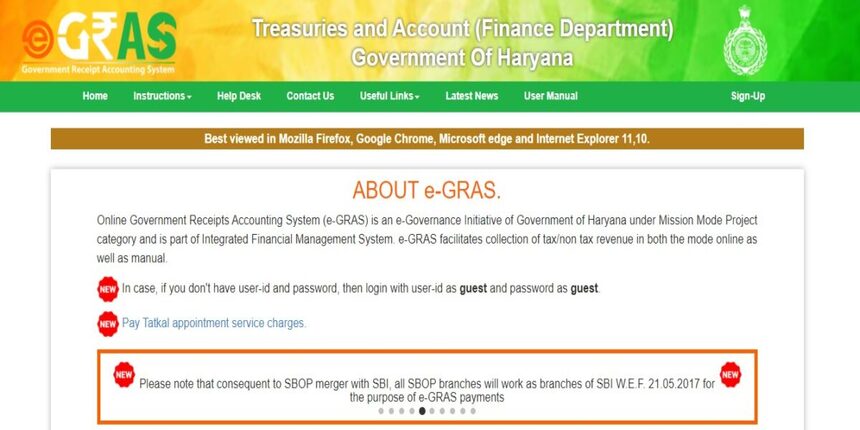
Haryana runs stamp duty payments through the e-GRAS portal, and Gurgaon buyers use the same statewide system as the rest of Haryana.
Step 1- Navigate to the official website of GRAS.
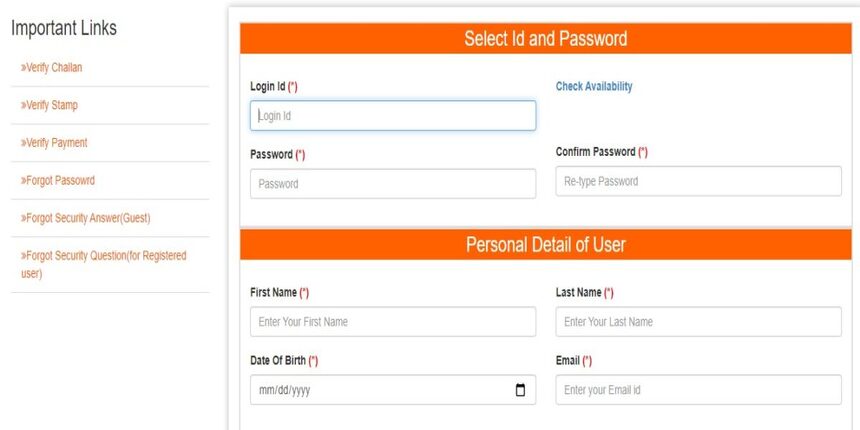
Step 2- Now you need to create an account with a username and password.
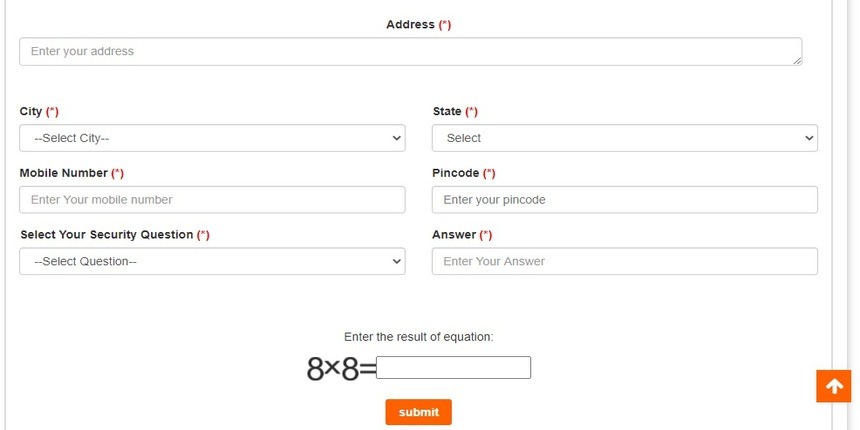
Step 3- Move on to the following page and input the property details.
Step 4- You now have to go through the stamp duty and initiate the required payment via internet banking.
Step 5- After the payment is complete, the receipt for the same will be generated. Be sure to keep this receipt handy for future references.
Stamp Paper Gurgaon Online: Step-by-Step Process
To pay stamp duty and registration charges online, use the e-GRAS Haryana portal (egrashry.nic.in). The steps are:
- Visit the e-GRAS portal and sign up, or continue as a guest.
- Select the department and head of account for stamp duty and registration.
- Enter the property and party details and generate your Government Reference Number (GRN).
- Pay through net banking, debit card or credit card.
- Generate the e-stamp and save the receipt and GRN.
- Book an appointment on the state e-Registry portal and visit the Sub-Registrar Office with your original documents.
For small documents like rent agreements and affidavits, authorised e-stamping vendors can also issue an e-stamp. If you’d rather go offline for a physical Gurgaon stamp paper, papers above ₹10,000 come from the district treasury office, and the payment goes into the designated State Bank of India account under the head “0030-Stamp and Registration”.
Documents Required for Property Registration in Gurgaon
- Executed sale deed with complete property description
- Proof of ownership, such as a jamabandi fard or a certified copy of the previous registered deed
- PAN and Aadhaar (or other identity proof) of the buyer, seller and two witnesses
- Address proof of all parties and recent passport-size photographs
- Latest property tax receipt or no-dues certificate where required
- NOC or approvals from planning authorities, and the approved plan or layout, where applicable
- GRN and e-stamp receipts for stamp duty and registration fee
If you’re buying an under-construction home, also check the builder’s RERA registration and approvals. Confirm the full list with the Sub-Registrar Office or a lawyer.
Property Registration Process in Gurgaon, Step by Step
- Verify the circle rate and calculate your stamp duty and registration fee.
- Finalise the sale deed draft and collect all documents.
- Pay online through e-GRAS and download the e-stamp and receipts.
- Book your slot on the e-Registry portal.
- Visit the Sub-Registrar Office on the appointment date with originals.
- Complete identity verification and signing, then collect the registered deed.
Pay the stamp duty before the sale deed is executed. Register the deed within four months of execution, since delays can attract a fee.
Tax Benefits on Stamp Duty and Registration Charges
If you buy a residential property, the stamp duty and registration charges you pay can be claimed under Section 80C, inside the overall ₹1.5 lakh limit. There are catches. It works only under the old tax regime, only in the year you actually pay, and it can’t be carried forward. Co-owners can each claim their share, and if you sell within five years the deduction is reversed. Provisions are being renumbered under the new Income-tax Act, so confirm with a tax advisor.
Penalties for Non-Payment or Underpayment of Stamp Duty
Pay stamp duty before the deed is registered. Late payment may bring a penalty and interest as notified. If you declare a value below the circle rate, the Collector can reassess the market value under Section 47-A of the Haryana stamp duty law, recover the shortfall and add penalties. Check the current circle rate before you sign.
Conclusion
You can’t avoid stamp duty and registration charges in Gurgaon, but you can plan for them. Stamp duty depends on location and who is buying, the registration fee follows a slab capped at ₹50,000, and both are charged on the higher of agreement value and circle-rate value. Since circle rates were revised in April 2026, check your sector’s current rate before you close a deal, and use the official portals for every payment.
Frequently Asked Questions:
1. What is the current stamp duty rate in Gurgaon?
Stamp duty in Gurgaon is 7 percent for male buyers and 5 percent for female buyers within municipal limits. Outside municipal limits, the rates drop to 5 percent for men and 3 percent for women. Joint ownership between a man and woman is charged at 6 percent within municipal limits. Registration charges follow a slab structure capped at Rs 50,000.
2. How much do registration charges cost in Gurgaon?
Registration charges in Gurgaon follow Haryana’s statewide slab system rather than a flat 1 percent. The fee rises with property value up to a maximum cap of Rs 50,000 for high-value properties. This is calculated separately from stamp duty and applies regardless of buyer gender.
3. Is stamp duty different for resale property in Gurgaon?
No. Stamp duty on a resale flat in Gurgaon is identical to a new flat, 7 percent for men and 5 percent for women within municipal limits. The only real cost difference between new and resale is GST, which applies to under-construction purchases but not resale property.
4. What is the gift deed stamp duty in Gurgaon for blood relatives?
Gift deeds to blood relatives, including spouse, parents, children and siblings, attract a concessional stamp duty rate in Gurgaon, generally around 3 percent rather than the full sale rate. This concession applies only to recognised blood relations under Haryana’s stamp rules, so it’s worth confirming the current rate and eligible relationships with the Sub-Registrar before proceeding.
5. How much does a female buyer save on stamp duty in Gurgaon?
A female buyer pays 5 percent stamp duty compared to 7 percent for a male buyer within municipal limits, a 2 percent saving. On a Rs 1 Crore flat, that’s Rs 2,00,000, and on a Rs 2 Crore property common in premium Gurgaon sectors, the saving climbs to Rs 4,00,000.
6. What is the stamp duty on a rent agreement in Gurgaon?
Stamp duty on a rent agreement in Gurgaon is a small fixed amount based on the annual rent and security deposit, not the property’s market value. Leases up to 11 months don’t require compulsory registration, though registering is advisable for stronger legal standing. Leases beyond 11 months require both stamping and registration.
7. How is stamp duty in Gurgaon calculated?
Stamp duty is calculated on whichever is higher between your agreement value and the government’s collector rate for that specific sector or colony. If you buy below the collector rate, stamp duty is still charged on the collector rate, so it’s worth checking the current rate before finalising your price.
8. Can stamp duty in Gurgaon be paid online?
Yes. Stamp duty in Gurgaon is paid through the e-GRAS portal at egrashry.nic.in, the same system used across Haryana. You enter the district, tehsil, buyer category and agreement value, and the portal calculates stamp duty and registration fee automatically before you pay via net banking, UPI, card or NEFT.
9. What documents are needed for property registration in Gurgaon?
Key documents include Aadhaar and PAN cards for both buyer and seller, passport photographs, the sale deed on e-stamp paper, the stamp duty payment receipt from e-GRAS, an Encumbrance Certificate, the Jamabandi or mutation extract, property tax receipts, society NOC, and the RERA certificate for new projects. Both parties generally need to be present in person.
10. Is there a tax deduction available on stamp duty paid in Gurgaon?
Yes, up to Rs 1,50,000 under Section 80C of the Income Tax Act, but only for new residential property and only if you’re filing under the old tax regime. Resale flats, plots and commercial property don’t qualify for this deduction.