

Buying property in Gujarat is easier on the wallet than in many states, but the government charges still add up. Whether it is a flat in Ahmedabad, a shop in Surat or a plot in Vadodara, stamp duty and registration charges add close to 6 percent to your cost – and there is a distinctive twist in Gujarat that can save a family real money if the home is registered in a woman’s name.
This guide covers the current 2026 rates, how the women’s concession actually works (it is not what most people assume), and the separate charges for gift deeds, rent agreements, mortgages and affidavits. It also explains the Jantri rate, walks through calculation with examples, and shows you how to pay online through the GARVI portal.
- What Is Stamp Duty in Gujarat?
- Stamp Duty and Registration Charges in Gujarat 2026 – Current Rates
- Women’s Concession in Gujarat – How It Actually Works
- What Is the Jantri Rate in Gujarat?
- How to Calculate Stamp Duty and Registration Charges in Gujarat
- Stamp Duty in Gujarat for Residential Property
- Gift Deed Stamp Duty in Gujarat
- Stamp Duty on Rent Agreement in Gujarat
- Stamp Duty on Mortgage Deed in Gujarat
- Stamp Duty on Affidavit in Gujarat
- Stamp Duty Charges in Gujarat by Instrument – Quick Table
- Documents Required for Property Registration in Gujarat
- How to Pay Stamp Duty Online in Gujarat (GARVI Portal)
- Looking for the Gujarat Stamp Duty Rate Chart (PDF)?
- Tax Benefit on Stamp Duty in Gujarat
- Quick Reference – Stamp Duty and Registration in Gujarat
- Conclusion
What Is Stamp Duty in Gujarat?
Stamp duty in Gujarat is a tax you pay to the state government on the instrument – the document – that transfers or creates a right in property. It is levied under the Gujarat Stamp Act (the Bombay Stamp Act, 1958 as applied to Gujarat), which adapts the Indian Stamp Act framework for the state.
Registration is a separate charge under the Registration Act, 1908, collected at the Sub-Registrar Office. Paying stamp duty makes your sale deed legally valid; registration records your ownership in the public land records. A document that is not properly stamped has weak legal standing – it cannot be used as evidence in court, and the Sub-Registrar can refuse to register it until the shortfall and any penalty are cleared.
The term “dastavej”: in Gujarat you will often hear the sale deed called the dastavej. Dastavej simply means the formal legal document – the sale deed, gift deed or agreement – and dastavej stamp duty is the stamp duty payable on that document, which for a property sale is the standard 4.9 percent.
Stamp Duty and Registration Charges in Gujarat 2026 – Current Rates
Gujarat keeps its headline rate simple: a flat stamp duty that does not change with the property value, plus a small registration fee. Here is the current 2026 structure for a normal sale deed.
|
Charge Component |
Male Buyer |
Female Buyer (sole owner) |
|
Basic stamp duty |
3.5% |
3.5% |
|
Surcharge (40% of basic) |
1.4% |
1.4% |
|
Total stamp duty |
4.9% |
4.9% |
|
Registration fee |
1% |
Waived (0%) |
|
Total statutory cost |
5.9% |
4.9% |
The stamp duty rate in Gujarat is 4.9 percent for everyone. That figure is a 3.5 percent basic duty plus a surcharge of 1.4 percent (the surcharge is 40 percent of the basic duty). It is the same whether the buyer is a man or a woman.
Women’s Concession in Gujarat – How It Actually Works
This is the point most buyers and even many websites get wrong. In Gujarat, women do not get a lower stamp duty. The stamp duty is 4.9 percent for men and women alike. The benefit for women comes entirely through the registration fee.
- For a male buyer, registration is 1 percent of the property value
- For a property registered in a woman’s sole name, the 1 percent registration fee is fully waived
- If the property is jointly owned with a male co-owner, the standard 1 percent registration fee applies
- The waiver applies to the registration fee only – the 4.9 percent stamp duty is still payable
What it saves: on a ₹60 lakh flat, a woman registering in her sole name pays ₹2,94,000 stamp duty and nothing in registration, while a male buyer pays ₹2,94,000 stamp duty plus ₹60,000 registration. That ₹60,000 saving is why many Gujarat families register the home in the woman’s name.
You will see some sources quote a 3.9 percent stamp duty for women. Treat that with caution and confirm on the GARVI portal – the widely applied position is that stamp duty is 4.9 percent for all, and the woman’s benefit is the registration-fee waiver.
What Is the Jantri Rate in Gujarat?
The Jantri rate is Gujarat’s government-notified minimum value for a property – the equivalent of the circle rate or guideline value used in other states. Stamp duty and registration are always calculated on the higher of your actual transaction value or the Jantri rate for that location.
- If you buy a flat for ₹55 lakh but the Jantri value works out to ₹60 lakh, duty is charged on ₹60 lakh
- Jantri rates vary by area, plot type and construction quality, and were significantly revised in 2023
- You can look up the Jantri rate for your property on the GARVI portal before finalising the price
- Declaring a value below the Jantri rate does not reduce your duty and can invite scrutiny
How to Calculate Stamp Duty and Registration Charges in Gujarat
The calculation is straightforward once you know the value to use. First, take the higher of your agreement value or the Jantri rate. Then apply 4.9 percent for stamp duty, and add 1 percent registration (nil if the sole owner is a woman).
Worked Example – Male Buyer, ₹60 Lakh Flat in Ahmedabad
|
Item |
Calculation |
Amount |
|
Value considered (higher of the two) |
Assume ₹60,00,000 |
₹60,00,000 |
|
Stamp duty at 4.9% |
4.9% of ₹60,00,000 |
₹2,94,000 |
|
Registration fee at 1% |
1% of ₹60,00,000 |
₹60,000 |
|
Total statutory cost |
5.9% |
₹3,54,000 |
Worked Example – Female Sole Owner, Same Flat
|
Item |
Calculation |
Amount |
|
Stamp duty at 4.9% |
4.9% of ₹60,00,000 |
₹2,94,000 |
|
Registration fee (waived) |
Sole female owner |
₹0 |
|
Total statutory cost |
4.9% |
₹2,94,000 |
|
Saving vs male buyer |
|
₹60,000 |
Budget note: stamp duty and registration are generally not covered by your home loan, so keep this amount ready from your own funds when planning the purchase.
Stamp Duty in Gujarat for Residential Property
For residential property – flats, apartments and houses – the stamp duty in Gujarat is the standard 4.9 percent, the same as for most other property types. The rate does not change between a new builder property and a resale flat.
- New property from a builder: 4.9 percent stamp duty plus 1 percent registration (waived for sole female owners)
- Resale flat or house: the same 4.9 percent, calculated on the higher of price or Jantri rate
- Plot or land: also 4.9 percent; land registration charges follow the same structure
- Commercial property: the same headline duty, though the assessed value is often higher
Gujarat occasionally notifies reduced stamp duty under specific affordable-housing schemes for EWS and LIG categories. If you are buying under such a scheme, check with the local Sub-Registrar whether a concession is currently active.
Gift Deed Stamp Duty in Gujarat
A gift deed transfers property without money changing hands. The gift deed stamp duty in Gujarat depends on your relationship with the person receiving the property, and the concession for close family is significant.
|
Type of Gift |
Stamp Duty |
Registration |
|
Gift to a blood relative |
1% of property value |
1% (waived for female recipient) |
|
Gift to a non-blood relative |
4.9% (3.5% + 1.4%) |
1% (waived for female recipient) |
When property is gifted to a blood relative, the stamp duty is a concessional 1 percent of the value instead of the full 4.9 percent. On a ₹50 lakh property, that is ₹50,000 in stamp duty within the family versus ₹2,45,000 on a sale. The government keeps this rate low to encourage families to document transfers legally rather than rely on informal arrangements.
Gift to a non-relative: if the recipient is not a blood relative, the gift is charged at the full conveyance rate of 4.9 percent on the market or Jantri value, the same as a sale. So the 1 percent rate is strictly a family benefit. The value used is always the higher of the declared value or the Jantri rate.
Stamp Duty on Rent Agreement in Gujarat
Rent and lease agreements are stampable too. The stamp duty on a rent agreement in Gujarat is based on the length of the lease and the average annual rent, so a short tenancy costs far less than a long lease.
- Short agreements up to 11 months: commonly executed on nominal stamp paper (around ₹300) and not required to be registered
- Leases of 12 months or more: registration becomes mandatory, and stamp duty is charged as a percentage of the average annual rent
- The percentage rises with the term of the lease – longer leases carry a higher rate on the average annual rent
- Registration fee for a registered lease is typically 1 percent of the annual rent, subject to a minimum
A practical note: this is exactly why the 11-month rent agreement is the norm across Gujarat – it keeps stamp duty nominal and avoids compulsory registration. Because the exact percentage slabs for longer leases differ across sources, calculate your specific duty on the GARVI portal or confirm with the Sub-Registrar before signing a multi-year lease.
Stamp Duty on Mortgage Deed in Gujarat
When you take a home loan, the security you give the lender is a stampable instrument. The mortgage stamp duty in Gujarat is far lower than the sale-deed rate, which keeps borrowing costs down.
|
Type of Mortgage |
Stamp Duty |
|
Equitable mortgage (deposit of title deeds) – typical home loan |
0.1% of the loan amount, subject to a maximum cap |
|
Registered mortgage deed (without possession) |
Higher than the equitable mortgage rate – confirm on GARVI |
Most home loans in Gujarat are secured by an equitable mortgage created through the deposit of title deeds, which attracts a low 0.1 percent of the loan amount, capped at a maximum set by the state. A formally registered mortgage deed attracts a higher duty. Because the cap and the registered-mortgage rate are revised from time to time, confirm the current figures on the GARVI portal before your loan is disbursed.
Stamp Duty on Affidavit in Gujarat
Affidavits are common in property matters – for declarations of ownership, non-encumbrance or legal possession. The affidavit stamp duty in Gujarat is a small fixed amount, not a percentage.
- A general affidavit typically attracts a nominal stamp duty of around ₹50
- The exact amount can vary with the nature of the declaration and whether it relates to a specific transaction
- Affidavits are usually executed on e-stamp paper of the required value
- For any affidavit tied to a registered transaction, confirm the correct value with the Sub-Registrar or on GARVI
Stamp Duty Charges in Gujarat by Instrument – Quick Table
Here is a single view of the stamp duty charges in Gujarat across the common instruments covered in this guide.
|
Instrument |
Stamp Duty |
Registration |
|
Sale deed / dastavej |
4.9% (3.5% + 1.4%) |
1% (waived, sole female owner) |
|
Gift deed – blood relative |
1% |
1% (waived for female recipient) |
|
Gift deed – non-relative |
4.9% |
1% (waived for female recipient) |
|
Rent agreement up to 11 months |
Nominal (approx. ₹300) |
Not mandatory |
|
Lease 12 months or more |
% of average annual rent, rising with term |
1% of annual rent (min applies) |
|
Equitable mortgage (home loan) |
0.1% of loan (capped) |
As applicable |
|
Registered mortgage deed |
Higher – verify on GARVI |
As applicable |
|
General affidavit |
Approx. ₹50 |
Not applicable |
Verify before you pay: these rates and caps are revised periodically. The GARVI portal has an official stamp duty calculator and the rate schedule, so confirm the current figure for your exact instrument before executing any document.
Documents Required for Property Registration in Gujarat
Carry every document in original plus a self-attested photocopy. Both buyer and seller, along with two witnesses, must be present at the Sub-Registrar Office for verification. Missing a document usually means registration cannot be completed that day.
Identity and Personal Documents
|
Document |
Details |
|
Aadhaar card |
Original, for identity verification of all parties. |
|
PAN card |
Mandatory for both buyer and seller for property transactions. |
|
Passport-size photographs |
Recent colour photos of buyer, seller and witnesses. |
|
Address proof |
Voter ID, driving licence or a recent utility bill. |
Core Property Documents
|
Document |
Provided By |
Notes |
|
Sale deed (dastavej) |
Buyer & seller |
Drafted for the correct value and executed on the e-stamp. |
|
e-Stamp certificate |
Buyer |
Generated for the stamp duty amount via SHCIL / GARVI. |
|
Index-2 and prior deeds |
Seller |
Establish the seller’s clear title to the property. |
|
Property card / 7-12 extract |
Seller |
Land records identifying the property and holder. |
|
Property tax receipts |
Seller |
Latest receipts with no outstanding dues. |
|
Loan / mortgage papers |
Buyer |
Where the purchase is financed by a home loan. |
|
NA / approval documents |
Seller / builder |
For converted land and approved projects. |
Impounding and penalty
The Collector of Stamps can impound any document that is insufficiently stamped. An under-stamped deed cannot be used as evidence and can attract a penalty of up to ten times the deficit duty, so pay the correct amount the first time.
How to Pay Stamp Duty Online in Gujarat (GARVI Portal)
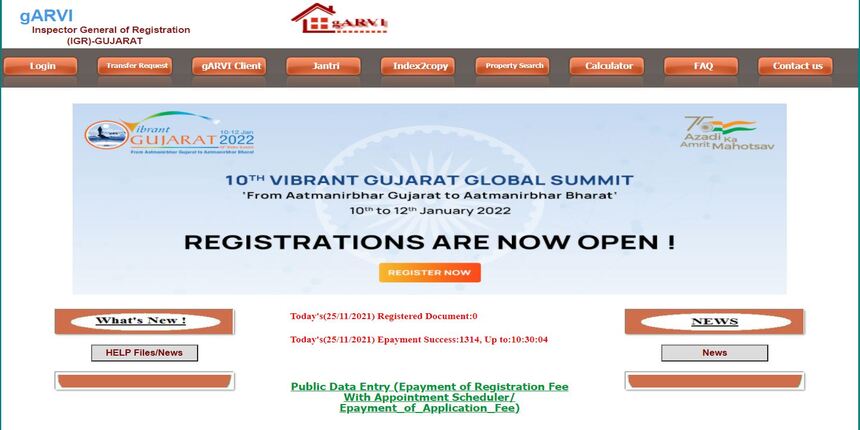
Gujarat runs its registration and stamp duty system through GARVI, the state’s online portal. Physical stamp paper has largely been replaced by e-stamping through SHCIL.
Step 1- First of all, you need to walk yourself to the website called garvi[dot]gujarat[dot]gov[dot]in
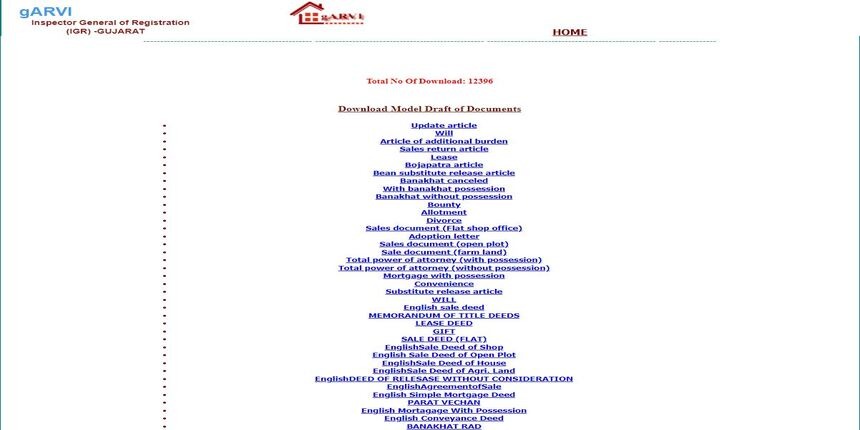
Step 2- Now choose the ‘Model Draft’ option given on the main page of the website. You have to download and fill the right draft.
Step 3- Move back to the home page and hit the option for ‘Public data entry’.
Step 4- You must go through the information given on the new page you will end up on. Once done, select the ‘I Agree’ option and proceed.
Step 5- Choose the ‘Pre Registration Data Entry’ tab in order to move ahead with the process.
Step 6- Once you are on the page, you need to finish the prompt of ‘Start registration new data entry’. After you have filled in all the required details, hit the ‘Submit registration details’ button to proceed. Now that you have registered on the website, you can move with the property registration process.
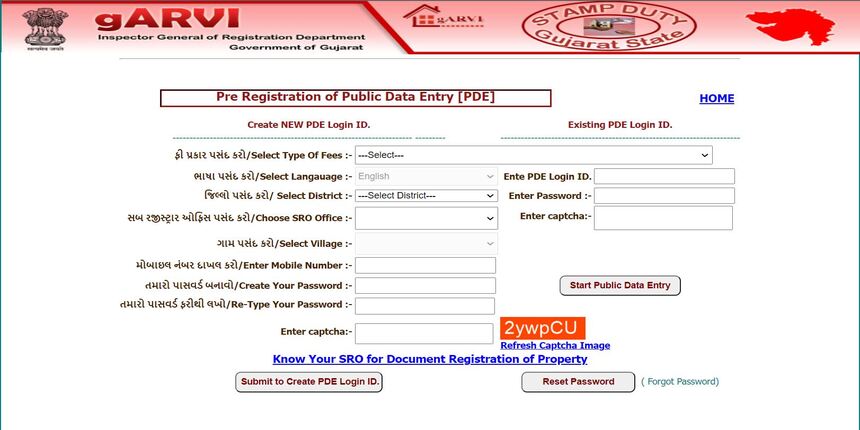
Step 7- In order to register the property, you need to head to a number of pages and fill in the required details. Here, you will find pages including the ‘Presentation step 1’, ‘Payment details’, and ‘Payment status’.
Step 8- Once you are done finishing the payment, you will get a challan copy after hitting the ‘Print details’ button.
Step 9- Now you will receive a 13-digit number which you must keep saved for any reference in the future. Take a printed copy for the e-challan for future reference.
Step 10- Finally, you now have to submit the printed copy and the
Step 11- Then you just have to submit the printout and the 13-digit number with other documents at the office of the Sub-registrar at the time of your appointment.
Stamp Duty Charges in Other States
| State | Stamp Duty Charges |
| Kolkata | Stamp Duty in Kolkata |
| Madhya Pradesh | Stamp Duty in Madhya Pradesh |
| Uttar Pradesh | Stamp Duty in Uttar Pradesh |
| West Bengal | Stamp Duty in West Bengal |
| Delhi | Stamp Duty in Delhi |
| Goa | Stamp Duty in Goa |
| Rajasthan | Stamp Duty in Rajasthan |
| Mumbai | Stamp Duty in Mumbai |
| Jammu | Stamp Duty in Jammu |
| Pune | Stamp Duty in Pune |
Looking for the Gujarat Stamp Duty Rate Chart (PDF)?
Many buyers search for a stamp duty in Gujarat PDF – a downloadable chart of rates by article. The most reliable and current version is on the official GARVI portal rather than a third-party file, because the schedule is revised from time to time.
- The GARVI portal publishes the current rate of stamp duty by article and an online calculator
- It also lets you download the Index-2 and document copies after registration
- Prefer the official portal over downloaded PDFs floating online, which may be out of date
- For a specific instrument, calculate on GARVI or confirm with the Sub-Registrar for certainty
Tax Benefit on Stamp Duty in Gujarat
Stamp duty and registration charges on a residential property can be claimed as a tax deduction, which reduces your effective cost.
- Deduction of up to ₹1,50,000 under Section 80C of the Income Tax Act in the financial year of payment
- Applies to residential house property, not to commercial property or pure plots
- Available under the old tax regime; buyers on the new regime cannot claim it
- Joint buyers can each claim their proportionate share within the overall limit
- A qualified tax adviser can confirm which regime is better for your overall situation
Quick Reference – Stamp Duty and Registration in Gujarat
|
Property Value |
Stamp Duty (4.9%) |
Registration (Male, 1%) |
Total (Male) |
Total (Female sole) |
|
₹40 lakh |
₹1,96,000 |
₹40,000 |
₹2,36,000 |
₹1,96,000 |
|
₹60 lakh |
₹2,94,000 |
₹60,000 |
₹3,54,000 |
₹2,94,000 |
|
₹80 lakh |
₹3,92,000 |
₹80,000 |
₹4,72,000 |
₹3,92,000 |
|
₹1 crore |
₹4,90,000 |
₹1,00,000 |
₹5,90,000 |
₹4,90,000 |
These figures assume the property value equals or exceeds the Jantri rate. Female totals assume sole ownership with the registration fee waived. Verify the current Jantri rate and rates on the GARVI portal before finalising your budget.
Conclusion
Stamp duty and registration charges in Gujarat come to about 5.9 percent for a male buyer – a flat 4.9 percent stamp duty plus 1 percent registration – and 4.9 percent for a woman registering in her sole name, because the registration fee is waived. That waiver, not a lower stamp duty, is the real women’s concession in Gujarat, and it is worth tens of thousands of rupees on an average home.
Beyond the sale deed, the rates vary sharply by instrument: a gift to a blood relative is just 1 percent, an 11-month rent agreement is nominal, a home loan’s equitable mortgage is only 0.1 percent, and an affidavit is a few rupees. Choosing the right instrument, and registering in the right name, can save a family a meaningful amount – all within the rules.
Check the Jantri rate for your property on GARVI, calculate the duty for your exact instrument, pay online or generate your e-stamp through SHCIL, and carry every document in original plus photocopy. Do that and registration day in Gujarat will be smooth.
Frequently Asked Questions:
1. What is the stamp duty and registration charge in Gujarat in 2026?
Stamp duty is 4.9 percent of the property value, made up of a 3.5 percent basic duty and a 1.4 percent surcharge, and it is the same for men and women. Registration is 1 percent for male buyers and fully waived when a woman is the sole owner. Both are charged on the higher of the agreement value or the Jantri rate.
2. Is stamp duty lower for women in Gujarat?
The stamp duty itself is 4.9 percent for everyone. The benefit for women is that the 1 percent registration fee is fully waived when the property is registered in a woman’s sole name. If a man is a joint owner, the standard 1 percent registration fee applies.
3. What is the stamp duty on a gift deed in Gujarat?
A gift to a blood relative attracts a concessional stamp duty of 1 percent of the property value, instead of the full 4.9 percent. A gift to a non-blood relative is charged at the standard 4.9 percent. The value used is the higher of the declared value or the Jantri rate.
4. What is the dastavej stamp duty in Gujarat?
Dastavej means the formal legal document, such as a sale deed. For a property sale, the dastavej stamp duty is the standard 4.9 percent of the value – a 3.5 percent basic duty plus a 1.4 percent surcharge – payable on the higher of the transaction value or the Jantri rate.
5. What is the stamp duty on a rent agreement in Gujarat?
It depends on the lease term and the average annual rent. Short agreements up to 11 months are commonly executed on nominal stamp paper of around ₹300 and do not need registration. Leases of 12 months or more must be registered, with stamp duty charged as a percentage of the average annual rent that rises with the term.
6. What is the mortgage stamp duty in Gujarat?
For a typical home loan secured by an equitable mortgage through deposit of title deeds, stamp duty is 0.1 percent of the loan amount, subject to a maximum cap. A formally registered mortgage deed attracts a higher duty. Confirm the current cap and rate on the GARVI portal before your loan is disbursed.
7. What is the affidavit stamp duty in Gujarat?
A general affidavit attracts a small fixed stamp duty of around ₹50, executed on e-stamp paper. The exact amount can vary with the nature of the declaration, so for an affidavit tied to a registered transaction, confirm the correct value with the Sub-Registrar or on GARVI.
8. How is stamp duty calculated in Gujarat?
Take the higher of your agreement value or the Jantri rate, then apply the stamp duty rate of 4.9 percent and add 1 percent registration. For a ₹60 lakh property, a male buyer pays ₹2,94,000 stamp duty plus ₹60,000 registration, totalling ₹3,54,000; a sole female owner pays only the ₹2,94,000 stamp duty.
9. What is the Jantri rate in Gujarat?
The Jantri rate is Gujarat’s government-notified minimum property value, similar to the circle rate elsewhere. Stamp duty and registration are charged on the higher of your actual transaction value or the Jantri rate. Jantri rates vary by location and were significantly revised in 2023; you can check them on the GARVI portal.
10. Can I pay stamp duty online in Gujarat?
Yes. Stamp duty and registration fees are paid online through the GARVI portal, and e-stamp certificates are generated through SHCIL. You can also use GARVI to calculate stamp duty, check the Jantri rate, submit document details and book a Sub-Registrar appointment.