Buying a flat in Jaipur, a plot in Jodhpur or a house in Udaipur? The deal price is only one part of the bill. Stamp duty, surcharges and the registration fee come on top.
Many buyers budget for the 6% and stop there. This guide explains the current registry charges in Rajasthan, how to work them out and how to pay through e-Panjiyan.
{{auto-toc}}
What Is Stamp Duty in Rajasthan?
Stamp duty is a tax the state collects on documents that transfer property. The sale deed is the most common one. In Rajasthan, it is charged under the Rajasthan Stamp Act, 1998.
Paying it is not optional. A deed without the right stamp duty cannot be registered or used as evidence in court.
What Are Registration Charges?
Rajasthan Registration charges are the fee to record the deed in government records at the sub-registrar office, under the Registration Act, 1908. Property registration charges in Rajasthan are 1% of the property value.
Once registered, your name enters the official record. That is what lets you take a loan or sell the property later.
Stamp Duty vs Registration Charges: Key Differences
|
Point |
Stamp Duty |
Registration Charges |
|
What it is |
Tax on the property document |
Fee to record the document |
|
Law |
Rajasthan Stamp Act, 1998 |
Registration Act, 1908 |
|
Rate in Rajasthan |
6% (men), 5% (women) |
1% for all |
|
Surcharge |
Yes, 33% of the duty |
No |
|
Paid through |
e-GRAS or e-stamp |
e-GRAS, at the time of registration |
|
Purpose |
Makes the deed legally valid |
Puts ownership on public record |
Latest Stamp Duty and Registration Charges in Rajasthan 2026
The table below shows the registry charges in Rajasthan for a standard sale deed. The rate is the same in every district. Jaipur, Kota, Ajmer and Bikaner all follow it.
|
Buyer Type |
Stamp Duty |
Surcharges (33% of duty) |
Registration Fee |
Effective Total |
|
Male |
6% |
1.98% |
1% |
8.98% |
|
Female (sole owner) |
5% |
1.65% |
1% |
7.65% |
|
Joint (male and female) |
6% |
1.98% |
1% |
8.98% |
A joint deed in the names of a husband and wife is charged at the male rate. So a flat registry charge in Rajasthan is lower for a woman only when she is the sole owner.
What Is the 20% Labour Cess and Why Is It Charged?
Most guides call the extra charge a “20% labour cess.” That is only half the story. Two separate surcharges are added on the stamp duty you owe.
The first is the Section 3-B surcharge of 20%. It funds the protection and care of cows in the state. Many sites call this the cow cess or the labour cess. The second is the Section 3-A surcharge. It goes into basic infrastructure and local bodies. The Rajasthan Finance Department raised it from 10% to 13% through a notification dated 11 February 2026.
Both are charged on the stamp duty amount, not on the property value. Say your stamp duty comes to Rs 3,00,000. The 20% surcharge adds Rs 60,000. The 13% surcharge adds Rs 39,000. That is almost Rs 1 lakh extra on a Rs 50 lakh flat. It is the line most buyers forget to budget for.
Factors Affecting Stamp Duty in Rajasthan
The stamp charges in Rajasthan are not the same for every buyer. A few things change the final amount:
- Buyer’s gender: A woman buying alone pays 5%. Men and joint buyers pay 6%.
- Buyer’s category: Women from SC, ST or BPL groups and some buyers with a disability can get a lower rate.
- DLC rate: If the DLC value is higher than your deal price, duty is charged on the DLC value.
- Type of property: A flat, a plot, a house and a shop each have different DLC rates.
- Location: Urban and rural areas, and even two streets in the same city, can have different DLC rates.
- Type of deed: A sale deed, gift deed and lease deed each attract a different rate.
DLC Rate in Rajasthan and Why It Matters
DLC stands for District Level Committee. Each district committee fixes the minimum value of land and buildings in its area. It works like the circle rate in Delhi or the ready reckoner rate in Maharashtra.
Your stamp duty is charged on whichever is higher: your sale price or the DLC value. That is why the DLC rate matters so much.
- If you buy a plot for Rs 40 lakh and the DLC value is Rs 45 lakh, duty is charged on Rs 45 lakh.
- DLC rates are revised from time to time, so check them close to your registration date.
- Plot registry charges in Rajasthan depend heavily on the DLC rate, since land makes up the full value.
How to Check the DLC Rate Online
- Go to the e-Panjiyan portal at epanjiyan.rajasthan.gov.in.
- Click on the “DLC Rate” option on the home page.
- Select your district, area type (urban or rural) and sub-registrar office.
- Choose the colony or village, and the land use.
- Note the rate per square metre or square yard, and multiply it by your area.
How to Calculate Stamp Duty and Registration Charges with Rajasthan Stamp duty Calculator
You can work out the registry stamp duty in Rajasthan in five simple steps:
- Step 1: Find the DLC value of your property.
- Step 2: Take the higher of the DLC value and your sale price.
- Step 3: Apply 6% (men or joint) or 5% (woman) to get the stamp duty.
- Step 4: Add 33% of the stamp duty as surcharge.
- Step 5: Add 1% of the property value as the registration fee.
Here is how it works with real numbers.
Example 1: Male Buyer, Rs 50 Lakh Flat in Jaipur
|
Item |
Calculation |
Amount |
|
Property value |
Higher of DLC or sale value |
Rs 50,00,000 |
|
Stamp duty |
6% of Rs 50,00,000 |
Rs 3,00,000 |
|
Surcharge (Section 3-B) |
20% of Rs 3,00,000 |
Rs 60,000 |
|
Surcharge (Section 3-A) |
13% of Rs 3,00,000 |
Rs 39,000 |
|
Registration fee |
1% of Rs 50,00,000 |
Rs 50,000 |
|
Total |
About 8.98% |
Rs 4,49,000 |
Example 2: Female Buyer, Same Property
|
Item |
Calculation |
Amount |
|
Stamp duty |
5% of Rs 50,00,000 |
Rs 2,50,000 |
|
Surcharge (Section 3-B) |
20% of Rs 2,50,000 |
Rs 50,000 |
|
Surcharge (Section 3-A) |
13% of Rs 2,50,000 |
Rs 32,500 |
|
Registration fee |
1% of Rs 50,00,000 |
Rs 50,000 |
|
Total |
About 7.65% |
Rs 3,82,500 |
She saves Rs 66,500 on the same flat. The only change is whose name is on the deed.
Example 3: Male Buyer, Rs 1 Crore Property
|
Item |
Calculation |
Amount |
|
Stamp duty |
6% of Rs 1,00,00,000 |
Rs 6,00,000 |
|
Surcharge (Section 3-B) |
20% of Rs 6,00,000 |
Rs 1,20,000 |
|
Surcharge (Section 3-A) |
13% of Rs 6,00,000 |
Rs 78,000 |
|
Registration fee |
1% of Rs 1,00,00,000 |
Rs 1,00,000 |
|
Total |
About 8.98% |
Rs 8,98,000 |
Quick Reference Table by Property Value
|
Property Value |
Total for Male Buyer (8.98%) |
Total for Female Buyer (7.65%) |
|
Rs 20 lakh |
Rs 1,79,600 |
Rs 1,53,000 |
|
Rs 30 lakh |
Rs 2,69,400 |
Rs 2,29,500 |
|
Rs 50 lakh |
Rs 4,49,000 |
Rs 3,82,500 |
|
Rs 75 lakh |
Rs 6,73,500 |
Rs 5,73,750 |
|
Rs 1 crore |
Rs 8,98,000 |
Rs 7,65,000 |
Stamp Duty Charges in Other States
| State | Stamp Duty Charges |
|---|---|
| Maharashtra | Stamp Duty in Maharashtra |
| Gujarat | Stamp Duty in Gujarat |
| Uttar Pradesh | Stamp Duty in Uttar Pradesh |
| West Bengal | Stamp Duty in West Bengal |
| Delhi | Stamp Duty in Delhi |
| Madhya Pradesh | Stamp Duty in Madhya Pradesh |
| Karnataka | Stamp Duty in Karnataka |
| Goa | Stamp Duty in Goa |
| Andhra Pradesh | Stamp Duty in Andhra Pradesh |
| Kerala | Stamp Duty in Kerala |
| Haryana | Stamp Duty in Haryana |
| Uttarakhand | Stamp Duty in Uttarakhand |
| Jharkhand | Stamp Duty in Jharkhand |
| Assam | Stamp Duty in Assam |
| Odisha | Stamp Duty in Odisha |
| Himachal Pradesh | Stamp Duty in Himachal Pradesh |
| Chhattisgarh | Stamp Duty in Chhattisgarh |
| Tamil Nadu | Stamp Duty in Tamil Nadu |
| Jammu and Kashmir | Stamp Duty in Jammu and Kashmir |
| Bihar | Stamp Duty in Bihar |
Stamp Duty for Different Property Types
The rate stays the same across property types. What changes is how the value is worked out.
Residential Flats
Flat registry charges in Rajasthan are worked out on the DLC rate for built-up area. Floor and building age can affect the value.
Residential Plots
For plots, the DLC rate per square metre decides the cost. Land registry charges in Rajasthan for farmland follow the agricultural DLC rate, which is often much lower.
Villas and Independent Houses
House registry charges in Rajasthan cover both land and construction. So house registration charges in Rajasthan are often higher than for a flat at the same price.
Commercial Property
Shops and offices pay the same rates. But commercial DLC rates are usually higher, which raises the final bill.
Deed-Wise Stamp Duty Charges in Rajasthan
Not every property document is a sale deed. Here is a quick summary of common deeds. Rates are revised from time to time, so confirm the current figure on e-Panjiyan before you execute any deed.
|
Type of Deed |
Stamp Duty |
|
Sale deed (men and joint) |
6% + surcharges |
|
Sale deed (woman, sole owner) |
5% + surcharges |
|
Gift deed to specified close relatives |
2.5% + surcharges |
|
Gift deed to a non-relative |
6% (same as sale) |
|
Partition deed among family |
Concessional rate on the share separated |
|
Power of attorney to sell, given to a non-relative |
Same as a sale deed |
|
Partnership deed |
Fixed Rs 2,000 |
|
Rent or lease deed |
Depends on rent and lease period |
Gift Deed
A gift to a father, mother, husband, son, brother or sister attracts 2.5% stamp duty. A gift to a non-relative is charged at the full sale rate. Surcharges and the 1% registration fee still apply.
Lease and Rent Deed
The duty depends on the rent and the lease period. An 11 month rent agreement costs very little. A 20 or 30 year lease is charged much higher.
Power of Attorney
A power of attorney to a close family member attracts a small fixed duty. If it lets a non-relative sell your property, Rajasthan charges it like a sale, on market value.
Loan Agreement and Mortgage Deed
A simple loan agreement carries a small fixed duty. A mortgage is charged as a percentage of the loan amount, subject to a cap. Banks usually add it to processing charges.
Partnership Deed
The partnership deed stamp duty in Rajasthan is a fixed Rs 2,000, whatever the capital. LLP agreements are charged differently and can go higher.
Partition Deed
A partition deed splits a joint property among co-owners. Family partitions get a concessional rate, charged on the shares separated, not the full property.
Exemptions, Rebates and Concessions on Stamp Duty in Rajasthan
Rajasthan offers a few concessions that can bring the cost down:
- A woman buying property in her name alone pays 5% stamp duty instead of 6%.
- Women from SC, ST and BPL categories may get a further rebate, bringing the duty close to 4%.
- Buyers with a certified disability can also qualify for a concessional rate.
- Homes allotted under PMAY and the Chief Minister Jan Awas Yojana can get relief on duty.
- Gifts to close family members are charged at 2.5% instead of the full rate.
How to Pay Stamp Duty in Rajasthan
You can pay stamp duty in Rajasthan online or offline. online Stamp paper rajasthan is faster and leaves a clean record.
Online Payment via e-Panjiyan and e-GRAS
- Visit epanjiyan.rajasthan.gov.in and create a citizen login.
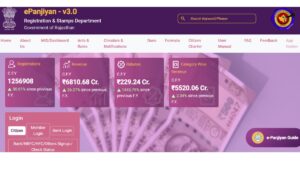
- Fill in the property and party details for the deed.
- The portal calculates stamp duty, surcharges and registration fee.
- You are taken to e-GRAS, the state’s online payment system.
- Pay by net banking, debit card or UPI.
- Download the e-GRAS challan or e-stamp and keep a printout for the sub-registrar.
Payment Through Banks
- Generate a challan on e-GRAS and pay at an authorised bank counter.
- Some banks also issue e-stamp certificates for smaller deeds.
- Keep the receipt and challan number for the SRO.
Offline Payment at the Sub-Registrar Office
- Licensed stamp vendors sell Rajasthan stamp paper in fixed values.
- Physical stamp paper is fine for small deeds like affidavits and rent agreements.
- For high-value sale deeds, e-stamp or e-GRAS is the safer choice.
- Check that the stamp paper is in the buyer’s name.
Property Registration Process in Rajasthan
Here is the full process to register your flat, house or plot.
Step 1: Verify Property Documents
Check the seller’s past sale deeds, jamabandi and approved plan. Make sure there are no unpaid dues or loans.
Step 2: Calculate Stamp Duty on DLC Rate
Compare the DLC value with the sale price. Work out all charges on the higher figure.
Step 3: Pay Stamp Duty and Generate e-Stamp
Pay through e-GRAS and download the challan or e-stamp.
Step 4: Book a Sub-Registrar Appointment
On e-Panjiyan, enter deed details and pick a slot at your sub-registrar office.
Step 5: Visit the SRO with Witnesses
Buyer, seller and two witnesses must attend with original documents and self-attested copies.
Step 6: Document and Biometric Verification
The officer checks the papers. Everyone gives photos and fingerprints, and the parties sign.
Step 7: Download the Registered Deed
Collect the deed or download a certified copy from e-Panjiyan. Then apply for mutation.
Documents Required for Property Registration in Rajasthan
Identity Documents
|
Document |
Who Provides It |
|
Aadhaar card |
Buyer, seller and witnesses |
|
PAN card |
Buyer and seller |
|
Passport size photos |
Buyer and seller |
|
Address proof (voter ID, passport or driving licence) |
All parties |
Property Documents
|
Document |
Who Provides It |
|
Sale deed draft |
Buyer and seller |
|
e-GRAS challan or e-stamp |
Buyer |
|
Previous sale deeds (title chain) |
Seller |
|
Jamabandi or land record |
Seller |
|
Approved site plan or building plan |
Seller |
|
Latest property tax receipts |
Seller |
|
NOC from society or development authority (if needed) |
Seller |
|
Rebate proof (caste, BPL or disability certificate) |
Buyer, if claiming a concession |
Penalties for Non-Payment or Late Payment of Stamp Duty
Underpaying stamp duty can cost far more than paying it right the first time.
- A deed with less stamp duty than required is not accepted as evidence in court.
- The Collector (Stamps) can recover the shortfall along with a penalty and interest.
- The penalty can run to several times the unpaid amount in serious cases.
- A deed must be presented for registration within four months of signing.
- Late registration attracts a fine on top of the registration fee.
Tax Benefits on Stamp Duty and Registration Charges
Stamp duty and registration fees can be claimed as a deduction of up to Rs 1.5 lakh, the benefit earlier covered by Section 80C. It applies only in the year you pay. It covers only a residential house under the old tax regime. Joint owners can each claim their share. The Income Tax Act, 2025 has renumbered sections from April 2026, so confirm with your CA.
Common Mistakes to Avoid During Property Registration
- Budgeting only for the 6% duty and forgetting the surcharges and 1% registration fee.
- Not checking the DLC rate before agreeing on a price.
- Showing a lower price in the deed to save duty.
- Adding a male co-owner and losing the women’s concession without knowing it.
- Missing the rebate certificate on registration day.
- Forgetting to apply for mutation after registration.
Tips to Save on Stamp Duty Legally
- Register the property in a woman’s name alone, if it suits your family’s plans. This saves 1% plus the surcharge on it.
- Check if you fall under a concession category, such as SC, ST, BPL or disability.
- For family transfers, compare a gift deed with a sale. A gift to close relatives costs much less.
- Claim the tax deduction in the year you pay, if you are under the old regime.
- Negotiate close to the DLC rate. Paying more than the DLC value means paying duty on the higher price.
Official Government Portals for Rajasthan Property Registration
|
Portal |
What You Can Do |
|
e-Panjiyan (epanjiyan.rajasthan.gov.in) |
Check DLC rates, calculate duty, book appointments, get certified copies |
|
IGRS Rajasthan (igrs.rajasthan.gov.in) |
Department notices, rate notifications, office details |
|
e-GRAS (egras.raj.nic.in) |
Pay stamp duty and registration fee online |
|
Apna Khata (apnakhata.rajasthan.gov.in) |
Check jamabandi and land records |
Conclusion
The government charges in Rajasthan come to about 8.98% for a male or joint buyer and 7.65% for a woman buying alone. Stamp duty is the biggest part. The surcharges add close to 2% more, and registration is a flat 1%. Check the DLC rate first. Work out the total with a calculator. Pay through e-GRAS, book your slot on e-Panjiyan and carry every original document. Do these things in order, and registration day goes smoothly.
Frequently Asked Questions:
1. What is the stamp duty in Rajasthan for female buyers in 2026?
A woman buying property in her name alone pays 5% stamp duty. The 33% surcharge on the duty and the 1% registration fee are added, so the total comes to about 7.65%. Women from SC, ST or BPL groups may pay less.
2. Is there a transfer duty in Rajasthan?
No. Rajasthan does not charge a separate transfer duty. It adds surcharges on the stamp duty instead, which works out to about 1.98% of the property value for a male buyer.
3. How can I pay stamp duty online in Rajasthan?
Log in to e-Panjiyan, enter the deed details and let the portal calculate the duty. You are then sent to e-GRAS to pay by net banking, card or UPI. Download the challan or e-stamp after payment.
4. Can I register property online in Rajasthan?
Partly. Payment and booking happen online, but both parties and two witnesses must visit the sub-registrar office.
5. What is the stamp duty on a gift deed in Rajasthan?
A gift to a father, mother, husband, son, brother or sister is charged at 2.5%, plus surcharges and the 1% registration fee. A gift to a non-relative is charged at the full sale rate.
6. What is the stamp duty on a lease deed in Rajasthan?
It depends on the rent and lease period. Short rent agreements cost little, while long leases cost much more.
7. What happens if stamp duty is underpaid in Rajasthan?
The deed cannot be used as evidence until the shortfall is paid. The Collector (Stamps) can recover the missing duty along with interest and a penalty, which can be several times the unpaid amount.
8. Which department regulates stamp duty in Rajasthan?
The Department of Registration and Stamps, Rajasthan, headed by the Inspector General, manages stamp duty and registration.
9. Can I claim a tax benefit on stamp duty?
Yes, under the old tax regime. You can claim up to Rs 1.5 lakh for stamp duty and registration on a residential house in the year you pay. The benefit is not available under the new regime or for plots.
10. How do I calculate total registration cost in Rajasthan?
Take the higher of the sale price and the DLC value. Apply 6% or 5% stamp duty. Add 33% of that duty as surcharge. Then add 1% of the value as the registration fee. For a Rs 50 lakh flat, a man pays about Rs 4,49,000 in total.