

A man buying a flat in Lucknow for Rs 50 lakh hands over Rs 4 lakh to the government before he even gets the keys. A woman buying the same flat pays Rs 50,000 less. And if that same flat is being passed from father to son instead of sold on the open market, the bill drops to around Rs 26,000. The same property can have three completely different stamp duty amounts, and most buyers in UP never check which bracket they fall into until they are standing at the Sub-Registrar’s counter.
That gap is basically the whole story of stamp duty in Uttar Pradesh. The state charges more than most on a straight sale, but it’s also unusually generous to families and to women, and knowing which rule applies to you can save a real amount of money.
- Stamp Duty in Uttar Pradesh: The Basic Numbers
- Why the Women’s Rebate Matters More Than It Used To
- Gift Deed Stamp Duty in Uttar Pradesh: The Part Everyone Should Know About and Almost Nobody Does
- Property Registration Charges in Uttar Pradesh
- How the Circle Rate Actually Works
- A Few Worked Examples
- How to Pay Stamp Duty on Property Online in Uttar Pradesh?
- Stamp Duty on Property in Uttar Pradesh, by Type
- Documents You’ll Need at the Sub-Registrar Office
- Registering Through IGRS UP
- Getting Some of It Back at Tax Time
- Quick Reference: Stamp Duty and Registration in Uttar Pradesh
- The Short Version
Stamp Duty in Uttar Pradesh: The Basic Numbers
Here’s the current structure for a standard sale deed:
|
Buyer Category |
Stamp Duty |
Registration Fee |
|
Male |
7% |
1% |
|
Female (sole owner) |
6% |
1% |
|
Joint (male and female) |
6.5% |
1% |
|
Joint (two women) |
6% |
1% |
|
Joint (two men) |
7% |
1% |
So a man ends up paying about 8 percent of the property value in total, and a woman pays around 7 percent. Registration is a flat 1 percent; no matter who’s buying that part, it never changes. There’s occasionally a small extra surcharge, somewhere in the Rs 1,000 to 2,000 range, tacked on to the registration fee, and it applies whether you’re buying a flat, a plot, or a commercial unit.
One thing that trips people up: both charges are calculated on whichever is higher, your actual sale price or the government’s circle rate for that area. Negotiate a flat down to Rs 40 lakh, and if the circle rate is Rs 50 lakh, you’re paying duty on Rs 50 lakh regardless. Declaring a lower price on paper doesn’t lower your bill. It just risks a penalty.
Why the Women’s Rebate Matters More Than It Used To
For years, the 1 percent discount for women buyers was almost a footnote. It only applied to properties worth up to Rs 10 lakh, which meant the maximum you could actually save was Rs 10,000 not nothing, but not enough to change anyone’s decision.
That changed in July 2025. The UP Cabinet extended the rebate to cover property worth up to Rs 1 crore, and now it applies to the entire value, not just a slice of it. Practically, that means:
- A woman buying a Rs 50 lakh home saves Rs 50,000 over what a man would pay
- On a full Rs 1 crore purchase, the saving is a full Rs 1,100,000
That’s a meaningful enough difference that couples buying together sometimes register the property solely in the wife’s name just to capture it. Joint ownership between a man and woman still sits at 6.5 percent, so it doesn’t get you the full discount; only a sole female owner gets the complete 6 percent rate. Worth thinking through before you decide whose name goes on the deed.
Gift Deed Stamp Duty in Uttar Pradesh: The Part Everyone Should Know About and Almost Nobody Does
This is where UP genuinely stands out compared to most other states.
If you’re transferring property to a blood relative, spouse, child, parent, sibling, grandparent, or grandchild, the stamp duty isn’t a percentage at all. It’s a flat Rs 5,000, plus a Rs 1,000 processing fee, and the registration charge is capped at Rs 20,000. On a property worth Rs 50 lakh, that brings the total cost down to roughly Rs 26,000, against Rs 400,000 for a regular sale at the same value.
Gift a property to someone who isn’t a blood relative, though, and none of this applies. You’re back to the full 7 percent, treated exactly like a sale.
The concession came in through an August 2023 Cabinet decision and has been clarified a few times since. Most recently, in January 2026, the state extended similar treatment to family partition deeds, capping those at a nominal Rs 5,000 as well so dividing property among siblings or heirs no longer means paying percentage-based duty on the whole thing.
If there’s one mistake worth avoiding here, it’s this: plenty of families still draft a full sale deed for what’s essentially a parent-to-child transfer, simply because nobody told them the flat rate exists. State the relationship clearly, carry proof of it, and confirm eligibility on the IGRS portal before you draft anything. It’s a fairly small step that saves a genuinely large amount of money.
Property Registration Charges in Uttar Pradesh
Registration is the part people tend to overlook because the number is smaller, but it’s still a flat 1 percent of the value, same for men, women, and joint owners, same across flats, plots, and commercial units. There’s occasionally a small surcharge on top, in the Rs 1,000 to 2,000 range. The one case where it drops sharply is a blood-relative transfer, where the registration fee is capped at Rs 20,000 no matter how valuable the property is. So on a Rs 75 lakh property bought in the open market, registration alone comes to Rs 75,000, separate from the stamp duty. It’s what gets your name into the public record, which is what eventually lets you take a loan against the property or sell it without a title dispute.
How the Circle Rate Actually Works
The circle rate is the government’s floor value for property in a given area, per square meter, set by the District Magistrate and revised now and then. Every stamp duty and registration calculation in UP runs off the higher of two numbers: your declared sale value or this circle rate.
What that means in practice: check the circle rate before you agree on a price. Buyers regularly negotiate a number with the seller and then discover at the registration stage that the circle rate is higher, which pushes up their duty unexpectedly. NCR districts like Noida, Greater Noida and Ghaziabad carry circle rates well above what you’d see in Agra or Varanasi, so the same 7 percent rate produces very different rupee amounts depending on where you’re buying.
A Few Worked Examples
Male buyer, Rs 50 lakh property in Lucknow
|
Item |
Amount |
|
Stamp duty (7%) |
Rs 350,000 |
|
Registration (1%) |
Rs 50,000 |
|
Total |
Rs 400,000 |
Female buyer, same property
|
Item |
Amount |
|
Stamp duty (6%) |
Rs 300,000 |
|
Registration (1%) |
Rs 50,000 |
|
Total |
Rs 350,000 |
That’s a Rs 50,000 saving purely from who the buyer is.
Blood relative transfer, any value
|
Item |
Amount |
|
Flat stamp duty |
Rs 5,000 |
|
Processing fee |
Rs 1,000 |
|
Registration (capped) |
Up to Rs 20,000 |
|
Total |
About Rs 26,000 |
Also worth keeping in mind: stamp duty and registration usually aren’t covered by your home loan. Banks fund the property price, not the government charges on top of it. So budget for roughly 8 percent of the value in cash, less if you’re buying as a woman, and much less if it’s a family transfer.
Stamp Duty Charges in Other States
| State | Stamp Duty Charges |
| Maharashtra | Stamp Duty in Maharashtra |
| Gujarat | Stamp Duty in Gujarat |
| Madhya Pradesh | Stamp Duty in Madhya Pradesh |
| West Bengal | Stamp Duty in West Bengal |
| Delhi | Stamp Duty in Delhi |
| Haryana | Stamp Duty in Haryana |
| Rajasthan | Stamp Duty in Rajasthan |
| Mumbai | Stamp Duty in Mumbai |
| Gurgaon | Stamp Duty in Gurgaon |
| Pune | Stamp Duty in Pune |
How to Pay Stamp Duty on Property Online in Uttar Pradesh?
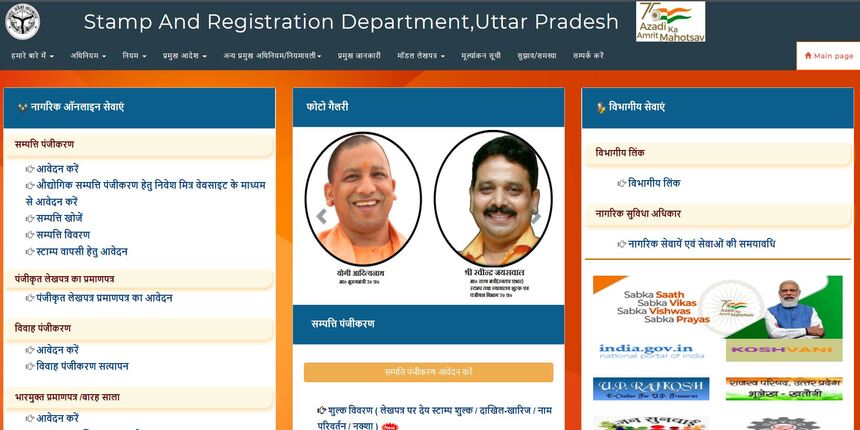
Firstly, login to the Uttar Pradesh Stamp and Registration Department Portal. Here the page will open in Hindi initially, but after selecting the option of changing language you can now change the Hindi language to English.
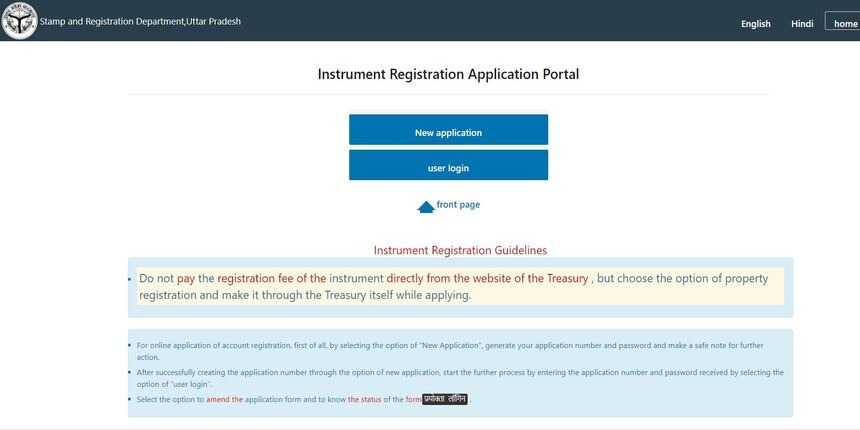
Once you have switched your language, now apply for registration and generate your own application number by selecting the ‘New Application’ choice.
Stamp Duty on Property in Uttar Pradesh, by Type
The headline rates apply fairly consistently across flats, plots, independent houses, and commercial units: 7 percent for men, 6 percent for women, on whichever value is higher. Agricultural land is the exception; it’s often taxed lower, somewhere around 3 to 5 percent, though the rate varies by district.
Lease agreements are handled separately too, calculated on rent and lease term rather than property value, so if you’re signing a long-term lease rather than buying outright, the math looks different.
Documents You’ll Need at the Sub-Registrar Office
Both buyer and seller need to show up in person along with two witnesses for biometric verification, and missing even one document can mean the registration doesn’t go through that day. Keep originals plus self-attested photocopies of:
- Aadhaar card, for everyone involved
- PAN card, mandatory for buyer and seller
- Passport-size photographs
- Voter ID, driving license, or passport as address proof
- The sale or gift deed itself, drafted correctly
- Circle rate printout from IGRS UP
- Encumbrance Certificate confirming no prior claims
- Previous title documents, for resale property
- Latest property tax receipts
- Approved building plan
- Proof of relationship, if you’re claiming the family transfer rate
Registering Through IGRS UP
Uttar Pradesh runs the whole process online through igrsup.gov.in, and e-stamping has become the standard way to pay.
The general flow: look up the circle rate for your exact plot or flat on the portal, work out what you owe, draft the deed through a licensed writer or advocate, pay through the IGRS gateway or generate an e-stamp, and book a Sub-Registrar Office slot using the Property Registration Apply option. Show up with both parties, witnesses, and the full document set for verification. Once that’s done, the deed gets registered, and you can download it directly from the portal.
Getting Some of It Back at Tax Time
If it’s a residential property, you can claim stamp duty and registration as a deduction under Section 80C, up to Rs 150,000, in the year you paid it. This deduction only applies under the old tax regime and only for residential house property, not for commercial space or a bare plot. Joint buyers can each claim their share within the overall cap. If you received the property as a gift from a specified relative, that gift is exempt from income tax under Section 56(2)(x).
Quick Reference: Stamp Duty and Registration in Uttar Pradesh
|
Property Value |
Male (7%) |
Female (6%) |
Registration (1%) |
Male Total |
|
Rs 25 lakh |
Rs 175,000 |
Rs 150,000 |
Rs 25,000 |
Rs 200,000 |
|
Rs 50 lakh |
Rs 350,000 |
Rs 300,000 |
Rs 50,000 |
Rs 400,000 |
|
Rs 75 lakh |
Rs 525,000 |
Rs 450,000 |
Rs 75,000 |
Rs 600,000 |
|
Rs 1 crore |
Rs 700,000 |
Rs 6,00,000 |
Rs 100,000 |
Rs 800,000 |
The female column uses the 6 percent rate, which applies up to Rs 1 crore. A blood-relative transfer costs a flat Rs 5,000 plus Rs 1,000 processing regardless of value it doesn’t scale with the table above at all. These numbers assume your sale value is at or above the circle rate; if it isn’t, the circle rate is what gets used instead. Worth double-checking the current rebate and circle rate on IGRS UP before you lock in a budget, since both get revised from time to time.
The Short Version
Uttar Pradesh isn’t cheap for a straightforward sale. 8 percent for a man, 7 percent for a woman is on the higher side compared to several other states. But the state makes up for it with two concessions that are genuinely hard to find elsewhere in India: the flat Rs 5,000 rate for transfers between blood relatives, and a women’s rebate that, since mid-2025, actually makes a difference on properties up to Rs 1 crore.
Before you fix a price with a seller, look up the circle rate. Before you draft a deed for a family transfer, check whether the flat rate applies instead of paying the full percentage by mistake. And carry every document the Sub-Registrar’s office will ask for, because a single missing paper is usually enough to send you home and make you come back another day.
Frequently Asked Questions:
1. What is the stamp duty and registration charge in Uttar Pradesh in 2026?
Stamp duty is 7 percent for men, 6 percent for a sole female owner and 6.5 percent for joint male and female ownership, plus a flat 1 percent registration fee. So the total is about 8 percent for men and 7 percent for women, calculated on the higher of your sale value or the circle rate.
2. What is the stamp duty in Uttar Pradesh for women?
A sole female owner pays 6 percent stamp duty against 7 percent for a man, a 1 percent concession. Since July 2025, this rebate applies on the full value for property up to Rs 1 crore, so a woman buying a Rs 50 lakh home saves Rs 50,000, compared with a maximum saving of Rs 10,000 under the earlier rules.
3. What is the gift deed stamp duty in Uttar Pradesh?
A gift or transfer to a blood relative such as a spouse, child, parent or sibling attracts a flat stamp duty of just Rs 5,000 plus a Rs 1,000 processing fee, with registration capped at Rs 20,000, regardless of value. A gift to a non-relative is charged at the full 7 percent of the market value.
4. What is the stamp duty on property in Uttar Pradesh?
Stamp duty on property in UP is 7 percent for men and 6 percent for women, on the higher of the sale value or the circle rate. The same rates apply to flats, plots, houses and commercial units, while agricultural land is often lower, in the region of 3 to 5 percent.
5. What are the property registration charges in Uttar Pradesh?
Property registration charges in UP are a flat 1 percent of the value, the same for men, women and joint owners and for all property types. A small surcharge may apply on top. For a blood-relative transfer, the registration fee is capped at Rs 20,000 regardless of value.
6. How is stamp duty calculated in Uttar Pradesh?
Take the higher of your sale value or the circle rate, apply 7 percent (male) or 6 percent (female) stamp duty, then add 1 percent registration. For a Rs 50 lakh property, a male buyer pays Rs 3,50,000 stamp duty plus Rs 50,000 registration, totalling Rs 4,00,000.
7. What is the circle rate in Uttar Pradesh?
The circle rate is the government’s minimum property value per square metre, fixed by the District Magistrate for each locality and revised periodically. Stamp duty is charged on the higher of your declared sale price or the circle rate, so you cannot lower duty by declaring a smaller amount.
8. What is the stamp duty for a family partition deed in Uttar Pradesh?
Following a January 2026 UP Cabinet decision, stamp duty on a family partition deed is capped at a nominal Rs 5,000, in line with the blood-relative transfer concession. This makes formal partition among family members far cheaper than the earlier percentage-based duty.
9. Can I pay stamp duty online in Uttar Pradesh?
Yes. Stamp duty and the registration fee are paid online through the IGRS UP portal at igrsup.gov.in, with e-stamping the preferred mode. You calculate the charges, pay through the gateway, book a Sub-Registrar slot and attend for biometric verification.
10. Can I claim a tax benefit on stamp duty in Uttar Pradesh?
Yes. Under Section 80C of the Income Tax Act you can claim a deduction of up to Rs 1.5 lakh for stamp duty and registration charges on a residential property, in the year of payment. It is available only under the old tax regime and only for residential house property.