
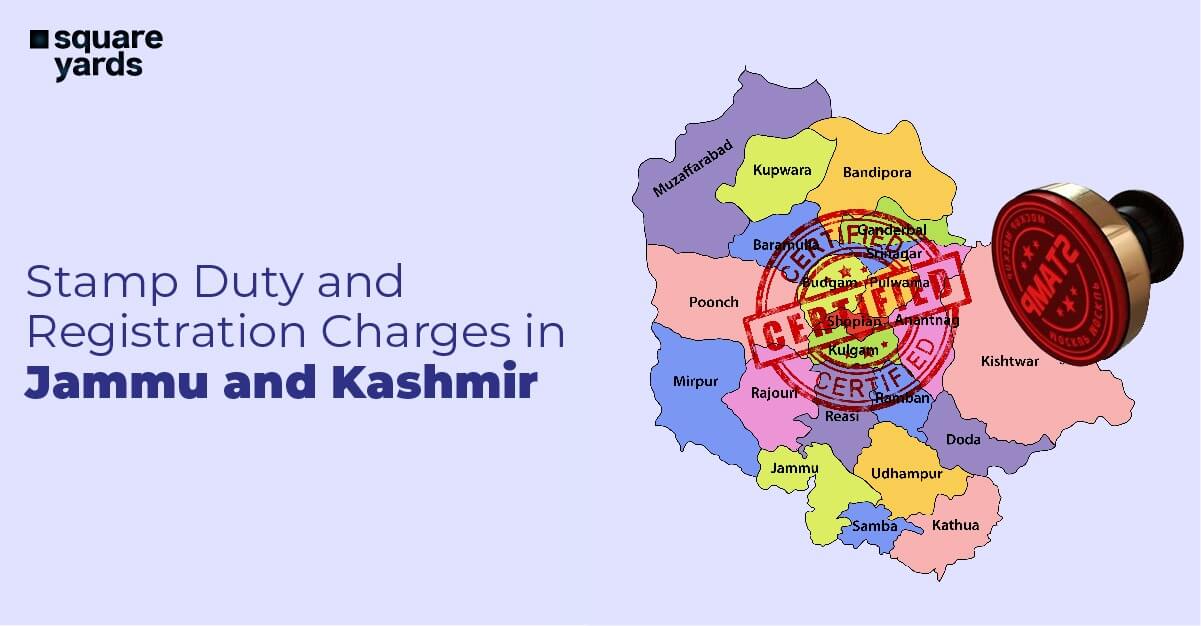
Jammu’s property market has been getting a fair bit of fresh attention lately, now that buyers from outside the region are actually allowed in. Doesn’t matter if it’s a flat in Gandhi Nagar, a plot on the edge of town, or a house in Trikuta Nagar, two government charges land on top of the price either way: stamp duty and a registration fee.
Two things set Jammu apart from most of the rest of India. Women get one of the largest stamp duty concessions going, and since 2019, outsiders can finally buy here too. This guide walks through the current 2026 rates, who’s allowed to buy what, the gift deed waiver that came in last year, and the actual registration process with IGR Jammu and Kashmir.
- What Is Stamp Duty in Jammu?
- Stamp Duty and Registration Charges in Jammu 2026: Current Rates
- Women’s Stamp Duty Concession in Jammu: One of India’s Largest
- Can Non-Residents Buy Property in Jammu?
- Gift Deed and Intra-Family Transfers in Jammu
- Circle Rate and How Charges Are Calculated in Jammu
- Property Registration Charges in Jammu
- Stamp Duty by Deed Type in Jammu
- Documents Required for Property Registration in Jammu
- How to Register Property and Pay Stamp Duty in Jammu
- Tax Benefit on Stamp Duty in Jammu
- Quick Reference: Stamp Duty and Registration in Jammu
- Conclusion
What Is Stamp Duty in Jammu?
Stamp duty is a tax the Jammu and Kashmir administration charges on the document that transfers property rights, usually the sale deed. Pay it, and your deed becomes legally valid, the kind of paper a court will actually recognise. It applies the same way across both the Jammu and Kashmir divisions of the Union Territory.
Registration is a different charge, under a different law, the Registration Act. Once you’ve paid stamp duty, the deed still needs to be recorded at the local Sub-Registrar Office and entered into government records. Skip either step and you don’t really have clear ownership, which becomes a problem the moment you try to get a home loan, sell the place, or settle a dispute over who actually owns it.
So: stamp duty makes the document legal, registration gets it on record. In Jammu you pay both, and both are calculated on whichever is higher, your sale value or the circle rate.
Stamp Duty and Registration Charges in Jammu 2026: Current Rates
Stamp duty changes depending on who’s buying. Registration doesn’t, everyone pays the same 1.2 percent regardless of gender. Here’s where things stand in 2026.
|
Buyer Category |
Stamp Duty |
Registration Fee |
Total |
|
Male |
7% |
1.2% |
8.2% |
|
Female |
3% |
1.2% |
4.2% |
|
Joint (male and female) |
5% |
1.2% |
6.2% |
Men pay 7 percent, women pay 3 percent, and a joint male-female purchase splits the difference at 5 percent. Add the 1.2 percent registration fee to any of these and you get the real cost, roughly 8.2 percent for a man, 4.2 percent for a woman, on the higher of sale value or circle rate.
One thing worth flagging: a fair number of older articles still quote a 1 percent registration fee for Jammu and Kashmir. That’s outdated. Since the 2019 reorganisation, it’s 1.2 percent on sale deeds. Use that number, and double-check it on the IGR portal before you budget around it.
Women’s Stamp Duty Concession in Jammu: One of India’s Largest
This is really the headline feature of buying property in Jammu. Women pay 3 percent stamp duty. Men pay 7. That’s a full 4 percentage point gap, among the largest anywhere in India.
- A woman buyer pays 3% stamp duty against 7% for a man, a 4% saving
- On a Rs 50 lakh property, that works out to a Rs 2,00,000 saving in stamp duty alone
- Joint male-female ownership lands in between, at 5%
- The concession only touches stamp duty; the 1.2% registration fee is identical for everyone
There’s a common mix-up worth clearing up here. Back in 2018, the state government waived stamp duty for women entirely, so they paid nothing. That full exemption didn’t survive the 2019 reorganisation. Women now pay 3 percent instead of zero. If you’ve come across a claim that women pay no stamp duty in Jammu, that’s old information, though 3 percent is still about as good as it gets nationally.
Can Non-Residents Buy Property in Jammu?
For decades, this was the wall nobody outside the region could get past. That changed in 2019. Before then, only permanent residents, “state subjects,” could own property here at all.
- After the abrogation of Article 370 and Article 35A, and the Jammu and Kashmir Reorganisation Act, 2019, effective 31 October 2019, the market opened up
- Any Indian national can now buy non-agricultural property, flats, residential plots, commercial space, whether or not they hold a J&K domicile
- Agricultural land is still off-limits to non-domicile buyers
- Beyond that restriction, the buying and registration process runs the same as anywhere else in India
If you’re buying from outside the region, check the land classification before anything else. Agricultural land simply isn’t available to you regardless of budget. For a flat or a residential or commercial plot, though, you register in Jammu the same way locals do, paying the same 7 or 3 percent stamp duty and the same 1.2 percent registration fee.
Gift Deed and Intra-Family Transfers in Jammu
A gift deed moves property without any money changing hands, and a recent budget change made this considerably cheaper for families in Jammu.
- The April 2025 Jammu and Kashmir budget waived stamp duty entirely on intra-family gift deeds
- The 1.2% registration fee still applies to these
- A gift to someone outside the family doesn’t get this treatment, standard rates apply
- Registration fees on gift and relinquishment deeds can vary with the transaction value rather than sitting at a flat rate
Practically, this means handing property to a spouse, child, parent, or sibling in Jammu now costs just the registration fee, no stamp duty at all, a real saving compared to a straight sale deed. Gifts from specified relatives also stay out of income tax entirely, under Section 56(2)(x). Since budget provisions get renotified year to year, it’s worth confirming the current position for your specific relationship on the IGR portal before you rely on it.
Circle Rate and How Charges Are Calculated in Jammu
Every charge here runs off whichever number is bigger: your declared sale value, or the circle rate. The circle rate is the government’s own minimum valuation, set district by district, sometimes down to the tehsil, village, ward, or locality.
Say you buy a plot for Rs 40 lakh, but the circle rate has it at Rs 45 lakh. Duty gets charged on Rs 45 lakh. The Sub-Registrar checks against the notified value, so declaring a lower price on paper doesn’t actually lower your bill.
Worked Example: Male Buyer, Rs 50 Lakh Property
|
Item |
Calculation |
Amount |
|
Value considered (higher of the two) |
Assume Rs 50,00,000 |
Rs 50,00,000 |
|
Stamp duty at 7% (male) |
7% of Rs 50,00,000 |
Rs 3,50,000 |
|
Registration fee at 1.2% |
1.2% of Rs 50,00,000 |
Rs 60,000 |
|
Total statutory cost |
8.2% |
Rs 4,10,000 |
Worked Example: Female Buyer, Same Property
|
Item |
Calculation |
Amount |
|
Stamp duty at 3% (female) |
3% of Rs 50,00,000 |
Rs 1,50,000 |
|
Registration fee at 1.2% |
1.2% of Rs 50,00,000 |
Rs 60,000 |
|
Total statutory cost |
4.2% |
Rs 2,10,000 |
|
Saving vs male buyer |
Rs 2,00,000 |
Worked Example: Male Buyer, Rs 1 Crore Property
|
Item |
Calculation |
Amount |
|
Stamp duty at 7% (male) |
7% of Rs 1,00,00,000 |
Rs 7,00,000 |
|
Registration fee at 1.2% |
1.2% of Rs 1,00,00,000 |
Rs 1,20,000 |
|
Total |
8.2% |
Rs 8,20,000 |
Home loans generally don’t cover stamp duty and registration, so keep this amount ready separately, from your own pocket. The gap between what a man and a woman pay is genuinely large in Jammu. Registering the property in a woman’s name can save a couple of lakh on a mid-sized purchase, which is not a small thing.
Property Registration Charges in Jammu
Registration charges in Jammu run at 1.2 percent of the property value on a sale deed, and that figure holds across the whole Union Territory.
- The fee is 1.2% of whichever is higher, the circle rate or your sale value, on a sale deed
- Same rate for male, female, and joint buyers, no gender difference, no cap
- Gift and relinquishment deeds can carry a registration fee that moves with the transaction value
- A flat 1% figure floating around online is outdated, left over from before the 2019 reorganisation
On a Rs 60 lakh property, that’s Rs 72,000 in registration fees alone, separate from stamp duty. It’s what actually secures your name in the public record, and that record is what lets you prove ownership later, complete mutation, borrow against the property, or sell it without complications down the line.
Stamp Duty Charges in Other States
| State | Stamp Duty Charges |
| Maharashtra | Stamp Duty in Maharashtra |
| Gujarat | Stamp Duty in Gujarat |
| Goa | Stamp Duty in Goa |
| Madhya Pradesh | Stamp Duty in Madhya Pradesh |
| Delhi | Stamp Duty in Delhi |
| Noida | Stamp Duty in Noida |
| Andhra Pradesh | Stamp Duty in Andhra Pradesh |
| Mumbai | Stamp Duty in Mumbai |
| Bangalore | Stamp Duty in Bangalore |
| Assam | Stamp Duty in Assam |
| Jharkhand | Stamp Duty in Jharkhand |
Stamp Duty by Deed Type in Jammu
The sale deed gets most of the attention, but different documents are taxed differently under the stamp law as it applies here.
|
Instrument |
How It Is Charged |
|
Sale / conveyance deed |
7% male, 3% female, 5% joint, plus 1.2% registration |
|
Intra-family gift deed |
Stamp duty waived; 1.2% registration retained |
|
Gift to a non-relative |
Standard rates apply |
|
Relinquishment deed |
Registration fee varies with the transaction value |
|
Mortgage deed |
Charged on the loan amount as per the schedule |
|
Lease deed |
Based on rent and lease term |
These deed-wise rates and any concessions get renotified year by year, and they were revised fairly recently after the 2019 reorganisation. Before you execute anything, confirm the exact figure for your instrument on the IGR portal or directly with the Sub-Registrar.
Documents Required for Property Registration in Jammu
Bring everything in original, plus a self-attested photocopy of each. Buyer, seller, and two witnesses all need to show up in person at the Sub-Registrar Office for verification. Miss one document and registration usually just doesn’t happen that day, no exceptions.
Identity and Personal Documents
|
Document |
Details |
|
Aadhaar card |
For identity verification of all parties |
|
PAN card |
Mandatory for both buyer and seller |
|
Passport-size photographs |
Recent colour photos of buyer, seller and witnesses |
|
Address / ID proof |
Voter ID, driving licence or passport for all parties and witnesses |
Core Property Documents
|
Document |
Provided By |
Notes |
|
Sale or gift deed |
Buyer & seller / donor |
Drafted for the correct value, executed on the e-stamp |
|
Circle rate reference |
Buyer verifies |
Government market value used as the base for duty |
|
Fard (record of rights) |
Seller |
Land record identifying the property and holder |
|
Land map (Tatima / Aks Shajra) |
Seller |
Plot map matching the records |
|
Encumbrance / prior deeds |
Buyer verifies |
Establish clear title and no prior charges |
|
Domicile certificate (if applicable) |
Buyer |
For agricultural land, restricted to domicile holders |
|
Property tax receipts |
Seller |
Latest receipts with no outstanding dues |
Before you settle on a price, check the circle rate for the locality, and if you’re a non-domicile buyer, confirm the land is genuinely non-agricultural. Duty runs on the higher of your value or the circle rate, and agricultural land is off the table entirely for outside buyers, so these two checks head off both a budget surprise and, worse, a purchase that can’t legally go through.
How to Register Property and Pay Stamp Duty in Jammu
Jammu and Kashmir has largely moved to e-stamping and online registration through the Registration Department, so a good chunk of this can start online before you ever walk into the Sub-Registrar’s office.
- Check the circle rate for your property and work out the stamp duty and registration fee
- Buy an e-stamp for the duty amount, safer than the old physical stamp paper
- Draft the sale or gift deed with the correct value and party details
- Book a Sub-Registrar appointment and show up with both parties and two witnesses
- Complete verification, pay the registration fee, sign the deed
- Collect the registered deed and apply for mutation to update the revenue records
Tax Benefit on Stamp Duty in Jammu
Stamp duty and registration on a residential property can actually be claimed back as a deduction, which takes some of the sting out of the upfront cost.
- Deduction of up to Rs 1,50,000 under Section 80C, in the financial year you pay
- Only for a self-occupied residential house, not commercial property, not a bare plot
- Only under the old tax regime, buyers on the new regime don’t get this
- Joint buyers can each claim their share, within the overall limit
- Separately, a gift from a specified relative stays exempt from income tax under Section 56(2)(x)
Quick Reference: Stamp Duty and Registration in Jammu
|
Property Value |
Male (7%) |
Female (3%) |
Registration (1.2%) |
Male Total |
|
Rs 25 lakh |
Rs 1,75,000 |
Rs 75,000 |
Rs 30,000 |
Rs 2,05,000 |
|
Rs 50 lakh |
Rs 3,50,000 |
Rs 1,50,000 |
Rs 60,000 |
Rs 4,10,000 |
|
Rs 75 lakh |
Rs 5,25,000 |
Rs 2,25,000 |
Rs 90,000 |
Rs 6,15,000 |
|
Rs 1 crore |
Rs 7,00,000 |
Rs 3,00,000 |
Rs 1,20,000 |
Rs 8,20,000 |
The female total is just the female stamp duty plus 1.2 percent registration, and that gap against a male buyer stays wide at every price point. These figures assume the sale value matches or exceeds the circle rate. Worth checking the current circle rate and rates on the IGR Jammu and Kashmir portal before you lock in a budget.
Conclusion
Add it up and stamp duty plus registration in Jammu comes to about 8.2 percent for a man, 4.2 percent for a woman: 7 or 3 percent stamp duty, plus a flat 1.2 percent registration fee, on whichever is higher between your sale value and the circle rate. That gender gap is about as wide as it gets in India, so putting the property in a woman’s name is a genuine saving, not just a technicality.
Two things really define buying here. Women pay 3 percent now, down from a full waiver before 2019, still one of the better deals going. And since the 2019 reorganisation, buyers from anywhere in India can pick up non-agricultural property, though agricultural land stays reserved for domicile holders. A recent budget also cleared stamp duty off family gift deeds entirely, leaving just the registration fee to pay.
Check the circle rate, confirm the land classification, get your e-stamp, draft the deed properly, book the Sub-Registrar appointment, and follow through with mutation afterward. Do that in order and registration day tends to go smoothly.
Frequently Asked Questions:
1. What is the stamp duty and registration charge in Jammu in 2026?
Stamp duty is 7 percent for men, 3 percent for women, and 5 percent for joint male-female ownership, plus a 1.2 percent registration fee on sale deeds. That totals roughly 8.2 percent for men and 4.2 percent for women, on the higher of your sale value or the circle rate.
2. What is the stamp duty in Jammu for women?
Women pay 3 percent against 7 percent for men, a 4 percent gap that’s among the largest in the country. On a Rs 50 lakh property, that saves a woman buyer Rs 2,00,000 in stamp duty alone. Registration stays the same 1.2 percent for everyone.
3. Do women still pay no stamp duty in Jammu and Kashmir?
No, that’s outdated. The state government fully waived stamp duty for women in 2018, but the exemption ended with the 2019 reorganisation. Women now pay 3 percent instead of zero, still one of the more generous rates in India, just not free anymore.
4. Can non-residents buy property in Jammu?
Yes. Since the abrogation of Article 370 and the Jammu and Kashmir Reorganisation Act, 2019, any Indian national can buy non-agricultural property here, flats, plots, commercial space. Agricultural land remains restricted to J&K domicile holders.
5. What are the property registration charges in Jammu?
1.2 percent of the property value on a sale deed, the same whether you’re male, female, or buying jointly, with no cap. It’s separate from stamp duty. Anything quoting a flat 1 percent is out of date since the 2019 reorganisation.
6. What is the stamp duty on a gift deed in Jammu?
Since the April 2025 budget, intra-family gift deeds carry no stamp duty at all. The 1.2 percent registration fee still applies. Gifting to someone outside the family doesn’t get this waiver, standard rates kick in instead.
7. How is stamp duty calculated in Jammu?
Take the higher of your sale value or the circle rate, apply 7 percent if you’re a man or 3 percent if you’re a woman, then add 1.2 percent registration. On a Rs 50 lakh property, a male buyer pays Rs 3,50,000 in stamp duty plus Rs 60,000 registration, Rs 4,10,000 total.
8. What is the stamp duty in Jammu and Kashmir?
The same across the whole Union Territory: 7 percent for men, 3 percent for women, 5 percent for joint ownership, plus 1.2 percent registration on sale deeds. Identical rules apply in both the Jammu and Kashmir divisions, on the higher of sale value or circle rate.
9. Can I pay stamp duty online in Jammu?
Yes. Jammu and Kashmir has shifted to e-stamping, more secure than the old paper system, with registration handled through the Registration Department. Buy the e-stamp, book your Sub-Registrar slot, get through verification, pay the registration fee, and the deed is done.