
If you are planning to buy a land, flat, or a house in Jharkhand, you need to budget for the stamp duty and registration charges, not just the property price. These are government charges that you have to pay when the property is transferred to your name legally. If you skip them or pay less than your ownership papers can become legally weak. This guide covers the current stamp duty in Jharkhand, how it is calculated, the rates in different cities of jharkhand, the documents you need, and the full registration process, so you know what to expect before you sign anything.
- What is Stamp Duty in Jharkhand?
- Stamp Duty and Registration Charges in Jharkhand 2026 (Current Rates)
- Factors Considered While Calculating Stamp Duty
- How Property Value Is Decided for Stamp Duty in Jharkhand
- How to Calculate Stamp Duty and Registration Charges in Jharkhand
- How to Check Slot Availability for Property Registration
- Stamp Duty and Registration Charges for Different Deeds
- Gift Deed Stamp Duty in Jharkhand
- Property Registration Charges in Jharkhand: Land, Flat & House
- City-wise Stamp Duty and Registration Charges (Ranchi, Jamshedpur, Dhanbad, Bokaro, Deoghar, Hazaribagh, Giridih)
- How to Pay Stamp Duty in Jharkhand
- Documents Required for Property Registration in Jharkhand
- Stamp Duty Exemptions and Concessions in Jharkhand
- Penalty for Non-Payment or Late Payment of Stamp Duty
- Common Mistakes Buyers Make During Property Registration in Jharkhand
- How to Download or Verify an e-Stamp Online in Jharkhand
- Conclusion
What is Stamp Duty in Jharkhand?
Stamp duty is a tax that the Jharkhand government charges on documents used to transfer property legally, such as sale deeds, gift deeds, lease deeds, and mortgage deeds. It is collected by the Department of Revenue, Registration and Land Reforms under the Indian Stamp Act, 1899. Paying this tax is what makes your property document legally valid. A document that has not been stamped, or is under stamped, cannot be used as proof in court.
Registration charges are a separate fee. They are paid along with stamp duty to get the transaction officially recorded in government records. So when people search for stamp duty, they usually mean both these charges together, since they are almost always paid at the same time, either online through the e-Nibandhan portal or offline at the local Sub-Registrar office.
Stamp Duty and Registration Charges in Jharkhand 2026 (Current Rates)
The stamp duty in jharkhand is same for everyone there is no concession as per the gender or anything.So you don’t need to check different slabs based on who is buying the property.
|
Charge |
Rate |
Applies To |
|
Stamp Duty |
4% of property value |
All buyers, male, female, and joint |
|
Registration Fee |
3% of property value |
All buyers, male, female, and joint |
|
Total (Stamp Duty + Registration) |
Around 7% of property value |
Standard sale or conveyance deed |
|
Service/Document Fee |
Around ₹30 per page |
Charged in addition to the above |
Property value here means the higher amount between what you and the seller have agreed to pay and the government’s circle rate for that area. This is the same base used across the state, whether you call it jharkhand stamp duty charges or registry charges in jharkhand, both terms mean the same 4% plus 3% structure explained above.
Worked Example: Calculating Stamp Duty on a ₹50 Lakh Property
Let’s say you are buying a property worth ₹50,00,000 (₹50 lakh). This could be your agreement value or the circle rate, whichever turns out to be higher.
|
Component |
Calculation |
Amount |
|
Stamp Duty |
4% of ₹50,00,000 |
₹2,00,000 |
|
Registration Fee |
3% of ₹50,00,000 |
₹1,50,000 |
|
Total Government Charges |
7% of ₹50,00,000 |
₹3,50,000 |
|
Service/Document Fee |
Around ₹30 per page |
₹300 to ₹600 |
So on a ₹50 lakh property, you should keep around ₹3.5 lakh ready for stamp duty and registration alone. The overall registry percentage in Jharkhand works out to about 7%, and this does not include legal fees, drafting charges, or mutation costs, so it helps to plan for those separately too.
Factors Considered While Calculating Stamp Duty
The 4% and 3% rates are fixed, but a few things decide what final amount you actually pay. Here is what affects your stamp duty bill in practice:
- Circle rate versus agreement value: The Sub-Registrar always applies stamp duty on whichever amount is higher between the circle rate set by the government and the price you have agreed with the seller. Even if you strike a good deal below the circle rate, you will still be charged on the circle rate.
- Location of the property: Properties that lie inside local bodies or municipal areas can attract additional charges on top of the base rate while rural land usually does not.
- Type of property: Residential, commercial, agricultural and industrial properties are valued differently and this changes the base amount on which stamp duty is calculated.
- Type of deed being used: A sale deed, a gift deed, a lease deed and a mortgage deed are all treated differently under the law so the same property can attract different charges depending on how the transfer is documented.
- Age and condition of construction: For flats and independent houses whether the building is new or old and how much built‑up area it has affects the valuation used for stamp duty.
- How the property will be used: A property bought for personal use and one bought for commercial or rental purposes can sometimes be valued differently by the Sub-Registrar.
How Property Value Is Decided for Stamp Duty in Jharkhand
Before you can work out how much stamp duty you owe, you first need to know which value it applies to. The Jharkhand Registration Department publishes area wise circle rates through the Jharbhoomi portal, and this is the government’s own estimate of what land and property in that area is worth. Stamp duty is always charged on whichever is higher, the circle rate or your actual agreement value, never on the lower of the two.
- Circle rates are set by the district administration for each Anchal or Mouza (these are the local revenue divisions) and are revised from time to time.
- You can look up the current land registry rate for your area on the Jharbhoomi portal before you finalise a deal, so there are no surprises later.
- If the price you agree to pay is lower than the circle rate, the Sub-Registrar will still charge stamp duty based on the circle rate.
- It is a good idea to check the government rate of land in your locality early in the buying process. It has a direct effect on your final registration cost, separate from whatever price you and the seller settle on.
How to Calculate Stamp Duty and Registration Charges in Jharkhand
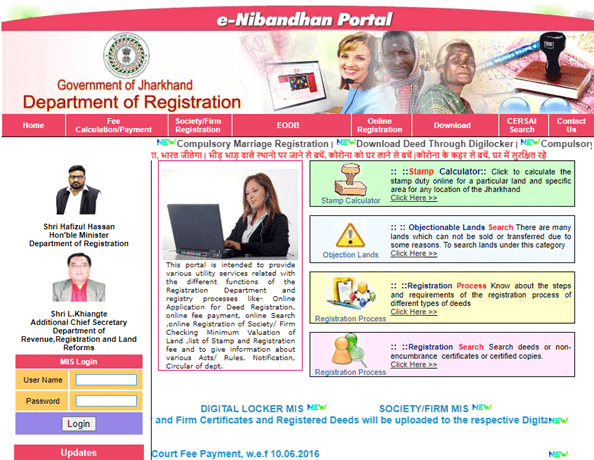
To calculate stamp duty in Jharkhand, you can use the official e-Nibhandhan website. Follow these simple steps:
Step 1: Go to http://regd[dot]jharkhand[dot]gov[dot]in/jars/website/ and click on the Stamp Duty Calculator from the home page.
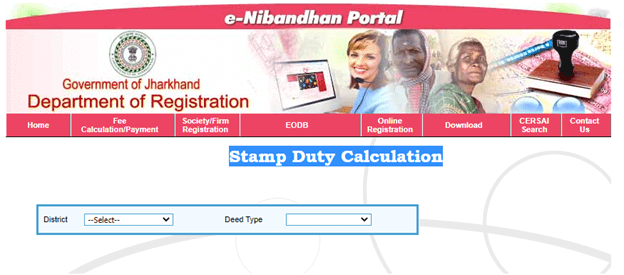
Step 2: A new page will open. Here, you have to choose your district and deed type.
Step 3: Type in all the details related to the deed and click on the ‘Add’ option to calculate your stamp duty charge successfully.
Stamp Duty Charges in Other States
| State | Stamp Duty Charges |
|---|---|
| Maharashtra | Stamp Duty in Maharashtra |
| Gujarat | Stamp Duty in Gujarat |
| Uttar Pradesh | Stamp Duty in Uttar Pradesh |
| West Bengal | Stamp Duty in West Bengal |
| Delhi | Stamp Duty in Delhi |
| Madhya Pradesh | Stamp Duty in Madhya Pradesh |
| Rajasthan | Stamp Duty in Rajasthan |
| Karnataka | Stamp Duty in Karnataka |
| Telangana | Stamp Duty in Telangana |
| Goa | Stamp Duty in Goa |
| Andhra Pradesh | Stamp Duty in Andhra Pradesh |
| Kerala | Stamp Duty in Kerala |
| Uttarakhand | Stamp Duty in Uttarakhand |
| Assam | Stamp Duty in Assam |
| Punjab | Stamp Duty in Punjab |
| Odisha | Stamp Duty in Odisha |
| Himachal Pradesh | Stamp Duty in Himachal Pradesh |
| Chhattisgarh | Stamp Duty in Chhattisgarh |
| Tamil Nadu | Stamp Duty in Tamil Nadu |
| Jammu and Kashmir | Stamp Duty in Jammu and Kashmir |
| Bihar | Stamp Duty in Bihar |
| Haryana | Stamp Duty in Haryana |
How to Check Slot Availability for Property Registration
You need to book an online appointment after registering your property in Jharkhand. The procedure for that is as follows:
Step 1: Visit the e-Nibandhan portal to check slot availability.
Step 2: Open the online appointment system page. Enter details like – application ID, mobile number, email address, and presenter. Then type an appointment date that suits your schedule.
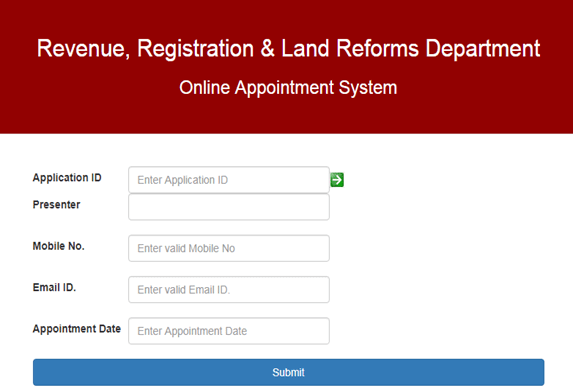
Step 3: Lastly, click on the ‘Submit’ button to confirm your appointment.
Stamp Duty and Registration Charges for Different Deeds
Most property sales in Jharkhand fall under the standard 4% plus 3% structure, but a few types of legal documents are treated differently.
|
Deed Type |
Stamp Duty |
Registration Fee |
Notes |
|
Sale Deed / Conveyance Deed |
4% |
3% |
Standard rate used for a normal property sale |
|
Gift Deed |
Based on value slabs (see below) |
Based on the same slabs |
Rate depends on how much the gifted property is worth |
|
Lease Deed |
Based on rent and lease term |
As applicable |
Calculated on the annual rent or premium, not on the full property value |
|
Mortgage or Loan Agreement |
Small, loan linked amount |
As applicable |
Usually lower than the sale deed rate, confirm the exact figure with your bank or the Sub-Registrar, since it depends on the loan amount and the type of mortgage |
|
Power of Attorney (Property) |
Fixed, small fee |
As applicable |
Check the current fee at the Sub-Registrar office |
|
Will |
Nil |
Nil |
Wills do not attract stamp duty in Jharkhand, same as the rest of India |
If you are specifically checking registration mortgage charges or stamp duty in Jharkhand for loan agreement, remember these are not calculated the same way as a sale deed. Banks usually handle this as part of your home loan paperwork, and the amount is much smaller than what you pay on the actual property sale deed.
Gift Deed Stamp Duty in Jharkhand
You still have to pay stamp duty when a property is transferred as a gift in Jharkhand. The difference is that instead of a flat percentage, gift deeds use value based slabs. If you are looking up gift deed registration charges in Jharkhand, here is how the calculation works:
- If the value of the gift is up to ₹1,000, the stamp duty is a flat ₹31.50.
- If the value is more than ₹1,000 but not more than ₹10,000, the stamp duty is ₹31.50 for the first ₹1,000, plus ₹21 for every additional ₹500 or part of ₹500 above that.
- If the value is more than ₹10,000, the stamp duty is ₹31.50 for every ₹500 of the gift’s value.
- The usual service fee of around ₹30 per page also applies on top of this.
- Some sources mention lower rates or waivers for gifts between blood relatives, but there is no single concession that is clearly and currently notified for all cases. Before you go ahead, confirm the exact rate for your relationship with the donor at the Sub-Registrar office or through the e-Nibandhan portal.
Property Registration Charges in Jharkhand: Land, Flat & House
The base property registration charges in Jharkhand, 4% stamp duty and 3% registration fee, apply whether you are registering vacant land, a flat, or a house. Still, there are some practical differences between the three that are worth knowing before you register.
Land Registration Charges in Jharkhand
- Land registration charges in Jharkhand are worked out on whichever is higher, the circle rate from the Jharbhoomi Record of Rights or the price you have agreed to pay.
- Check the land registry charges that apply to your Anchal or Mouza before you commit to a deal, since circle rates can be very different between rural and urban plots, even within the same district.
- Buying land in Jharkhand comes with extra legal checks that most other states don’t have. The Chotanagpur Tenancy Act, 1908 restricts the transfer of tribal land to non-tribals across most of the Chotanagpur region, which includes Ranchi. The Santhal Pargana Tenancy Act, 1949 applies similar restrictions in Santhal Pargana districts such as Dumka, Deoghar, and Godda.
- Always check the land’s status under these two Acts with the local Sub-Registrar or Anchal office before you proceed. This is specific to Jharkhand, and it can decide whether the plot can even be legally registered in your name.
Flat Registration Charges in Jharkhand
- The same 4% plus 3% rate applies to a flat’s sale price or its circle rate valuation, whichever is higher.
- For under construction flats, stamp duty is usually paid at the time of the builder buyer agreement or at possession and final registry, depending on how the builder structures the sale.
- Charges collected by the housing society or RWA for transfer or NOC are separate from, and additional to, the state’s stamp duty and registration fee.
House Registration Charges in Jharkhand
- For an independent house, the registered value covers both the land and the building on it, so the circle rate valuation is usually higher than for a similar sized empty plot.
- Any extra floors, extensions, or renovations should be mentioned correctly in the sale deed, since these can change the assessed value of the property.
City-wise Stamp Duty and Registration Charges (Ranchi, Jamshedpur, Dhanbad, Bokaro, Deoghar, Hazaribagh, Giridih)
The 4% stamp duty and 3% registration fee are fixed by the state, so they apply the same way in every city and district of Jharkhand. That said, buyers in urban local body areas should be aware of a proposed change. The state government has put out a draft called the Jharkhand Municipal Land/Building Transfer Surcharge Rules, 2026, for public feedback. It proposes a 10% surcharge on top of the total stamp duty and registration fee for property transfers within urban local bodies and industrial townships, to help fund municipal infrastructure. This has not been finalized yet, so check the latest status before you register.
|
City |
Stamp Duty |
Registration Fee |
Local Notes |
|
4% |
3% |
Urban local body area, the proposed 10% municipal surcharge would apply here first once notified |
|
|
4% |
3% |
Falls under a notified area committee, check the current local surcharge status |
|
|
4% |
3% |
No major municipal surcharge is currently reported |
|
|
Bokaro |
4% |
3% |
Industrial township area, confirm with the local Sub-Registrar |
|
Deoghar |
4% |
3% |
Falls under Santhal Pargana Tenancy Act restrictions for non-tribal land purchases |
|
Hazaribagh |
4% |
3% |
Standard state rate applies |
|
Giridih |
4% |
3% |
Standard state rate applies |
If you are checking registry charges in Ranchi specifically, the base calculation is the same as the rest of the state, 4% plus 3%. But since Ranchi is an urban local body, it is the city most likely to be affected first if the proposed municipal surcharge is approved, so keep an eye on updates if you are registering property there.
How to Pay Stamp Duty in Jharkhand
Jharkhand allows you to pay stamp duty and registration charges both online and offline, and most buyers now prefer paying online since it is faster and gives an instant digital record.
Before you start, it helps to know your total amount payable. Use the calculation method shown earlier in this guide, confirm your area’s circle rate, and keep your PAN, Aadhaar, and property details ready. This saves time whichever method you choose, and avoids repeated trips to the Sub-Registrar office to fix small errors.
Online Payment (e-Stamp / e-Nibandhan)
Paying online is the quickest way to complete this step, and it also gives you a digital record you can download anytime.
- Go to the state’s e-Nibandhan portal (regd.jharkhand.gov.in) or JharSewa (jharsewa.jharkhand.gov.in). Both run on the NGDRS system used for document registration across several states.
- Register or log in using your mobile number and basic personal details.
- Enter the property details, including the names of both parties and the type of deed you are registering. Then select the stamp duty and registration head for your transactio
- Pay the calculated amount using banking, a debit card, a credit card or UPI.
- Save the e-stamp certificate or payment challan.
If you are not comfortable with the online process, most Sub-Registrar offices also have facilitation counters where staff can help you complete the payment and booking steps.
Offline Payment (Stamp Paper, Franking, Demand Draft)
If you prefer to pay in person there are three ways to do it in Jharkhand:
Physical stamp paper: Buy non-judicial stamp paper of the required value from a licensed stamp vendor or the local treasury office. This is the more traditional method and is still accepted for many types of documents.
Franking: Take your document to a bank branch that offers franking services. The bank. Endorses the document to show the value has been paid, which is often used for lower value agreements.
Demand. Pay Order: For the remaining balance you can pay through a demand draft. Pay order made out in favour of the Sub-Registrar. This is commonly combined with stamp paper or franking for higher value transactions.
Documents Required for Property Registration in Jharkhand
- Sale deed or gift deed draft, prepared and checked in advance
- Previous title documents also called the parent document or chain of ownership papers showing how the property passed from one owner to the next
- Encumbrance certificate confirming there is no loan or legal claim pending against the property
- Record of Rights (RoR) or Khatian Khesra copy, from Jharbhoomi for land parcels
- Identity proof of both buyer and seller such as Aadhaar Card and PAN Card
- Address proof of both parties
- Passport size photographs of the buyer the seller and both witnesses
- Two witnesses along with their identity and address proof
- Latest property tax receipt showing dues are cleared
- e-Stamp certificate or challan as proof that stamp duty and registration fee have been paid
- No Objection Certificate, where it applies such as for a housing society transfer a bank release, in case of a home loan or tribal land clearance
- Power of Attorney if either party is signing through a representative instead of in person
- Building plan approval or completion certificate for an independent house or a newly built flat
- Sale agreement if one was signed earlier as part of the transaction
Keeping all of these documents required for property registration in Jharkhand ready before my appointment reduces the chance of delays at the Sub-Registrar office.
Stamp Duty Exemptions and Concessions in Jharkhand
Right now, Jharkhand applies the same 4% stamp duty and 3% registration fee to every buyer, regardless of gender. There is no separate, lower rate for women buyers at the moment. An earlier scheme that gave women a stamp duty waiver was rolled back in 2020 because of revenue concerns, so if you are checking registry charges in Jharkhand for female buyers, the standard rate is what applies, the same as for male or joint ownership.
Beyond gender, a small number of exemptions or concessions may apply in specific situations, such as certain family partition deeds, transfers under specific government schemes, or charitable transfers. These are not automatic. You usually need supporting documents to claim them, so it is best to confirm eligibility directly with the Sub-Registrar or through the e-Nibandhan portal rather than assume you qualify.
Separately, you can claim the stamp duty and registration amount you paid as a deduction under Section 80C of the Income Tax Act, 1961, up to ₹1.5 lakh, subject to conditions. It is also worth remembering that the CNT Act and SPT Act restrictions on tribal land, covered earlier in this guide, work as a separate eligibility check in parts of Jharkhand. They decide whether a land transfer can happen at all, which is a different question from what rate of stamp duty applies.
Penalty for Non-Payment or Late Payment of Stamp Duty
Paying stamp duty on time is not something you can avoid or put off. According to the Indian Stamp Act, 1899 which’s in effect in Jharkhand, a document that is not stamped properly or is not stamped at all cannot be used as proof in court or accepted by any government office until the missing amount is paid. If such a document is taken or held by an official they can ask for the missing stamp duty plus a fine of up to ten times the amount that was missing. A person who signs a document that is not properly stamped on purpose can also be punished under the law.
In addition to the part, a sale deed that is not registered or is wrongly stamped cannot be used to legally show that you own the property. This can cause problems later when you try to sell the property apply for a loan or if there is an argument, about who gets the property after someone dies. It is much better to pay the stamp duty and finish the registration on time instead of facing these problems later.
Common Mistakes Buyers Make During Property Registration in Jharkhand
- Ignoring the circle rate: Many buyers plan their budget only around the price they negotiate then get caught off guard when stamp duty is charged on a higher circle rate instead.
- Not checking land category or CNT/SPT restrictions: Buying land from a -tribal seller in a restricted area is a mistake specific to Jharkhand and it can make the whole transaction invalid.
- Paying money too early: before the title and ownership chain have actually been verified.
- Skipping mutation after registry: Without this step the property still shows the owners name in the revenue records even though the sale deed is in your name.
- Not reading the sale deed carefully: before signing the parts about property boundaries, encumbrances and possession.
How to Download or Verify an e-Stamp Online in Jharkhand
- Go to the e-Nibandhan or JharSewa portal.
- Enter your estamp certificate number, GRN (Government Reference Number) or the document details.
- Check that the certificate’s authenticity, amount and date match your transaction.
- Download the PDF copy of the verified e-stamp. Save it for your records.
- Keep a printed copy in a place. You will need it on registration day. Again later, for resale, loan applications or legal reference.
Conclusion
Stamp duty and registration charges in Jharkhand add up to around 7% of your property’s value, which is a simple, uniform structure compared to many other states. Still, it pays to be careful. Confirm the circle rate before you finalise any deal keep your documents such as title papers, encumbrance certificate and e-stamp challan ready in advance and complete mutation after registry so your ownership is properly recorded in government files. Getting these basics at the start saves you from penalties, delays and disputes later.
Frequently Asked Questions:
1. How do I calculate stamp duty and property registration charges in Jharkhand?
Add the stamp duty (4% of the property’s value) and the registration fee (3% of the property’s value) using whichever is higher between the circle rate and the agreement value. This usually works out to about 7% of the property’s value plus a small per page service fee.
2. What is the formula for calculating stamp duty?
Stamp Duty = Applicable Rate multiplied by the higher of the Circle Rate or the Agreement Value. In Jharkhand this rate is 4% for a sale deed and the registration fee is calculated separately at 3%.
3. What are the property registration charges in Jharkhand?
The registration fee in Jharkhand is 3% of the propertys value charged in addition to the 4% stamp duty, which brings the government charge to around 7% of the property value.
4. What is the current stamp duty rate in Jharkhand?
As of 2026 stamp duty in Jharkhand is 4% of the property value. This applies to all buyers.
5. Are registry charges in Jharkhand different for female buyers?
No. Jharkhand currently charges the 4% stamp duty and 3% registration fee for male, female and joint buyers. There is no concessional rate for women right now.
6. What is the gift deed stamp duty in Jharkhand?
Gift deed stamp duty is calculated in slabs, ₹31.50 for gifts up to ₹1,000 ₹31.50 plus ₹21 for every ₹500 (or part of it) for gifts between ₹1,000 and ₹10,000 and ₹31.50 per ₹500 of value for gifts above ₹10,000.
7. How can I pay stamp duty online in Jharkhand?
You can pay through the -Nibandhan portal (regd.jharkhand.gov.in) or JharSewa (jharsewa.jharkhand.gov.in) using net banking, a card or UPI and then download your e-stamp certificate as proof.
8. Where can I check the government or circle rate of land in my area in Jharkhand?
You can check the circle rate sometimes called the govt rate of land for your area on the Jharbhoomi portal or by asking at your local Anchal (revenue circle) office.
9. What documents are required for property registration in Jharkhand?
Key documents include the sale or gift deed previous title papers, identity proof of both parties, two witnesses, with ID proof, an encumbrance certificate, property tax receipts and the e- challan proving payment of stamp duty and registration fee.
10. Is there a property registration fee calculator for Jharkhand?
Yes. Several online calculators let you enter your property value and location to get an estimate of the stamp duty and registration fee based on the current 4% plus 3% structure.