
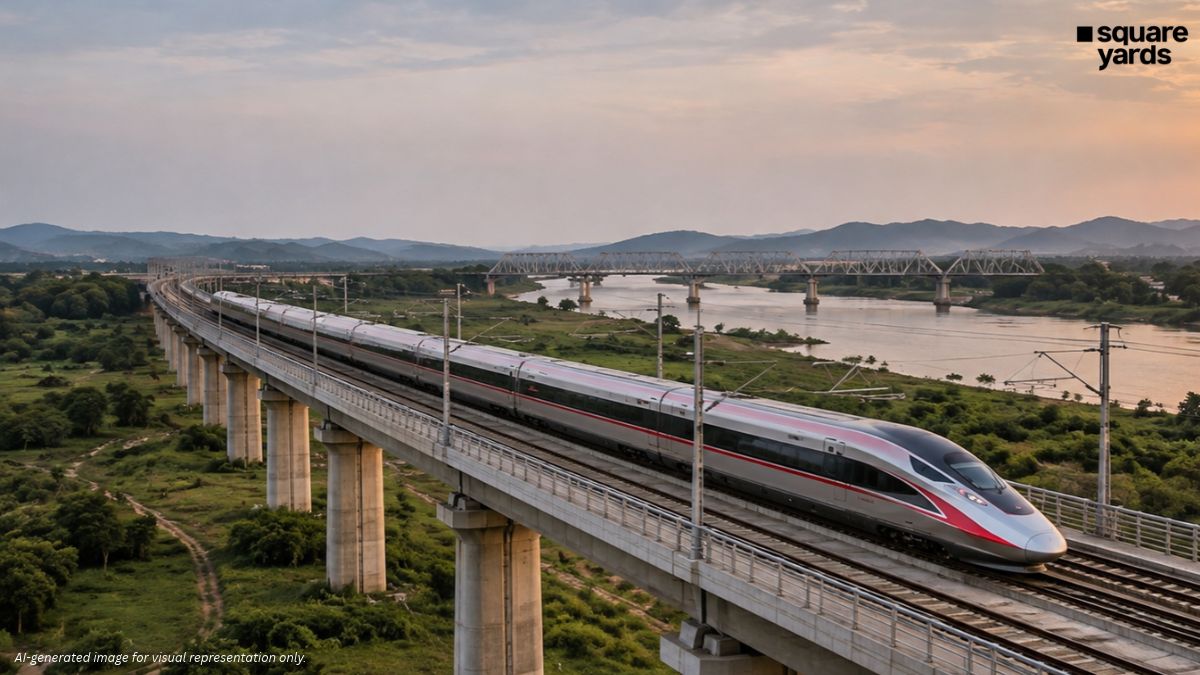
Prime Minister Narendra Modi has approved the northern bullet train corridor, which will create a high-speed rail network linking Delhi to major cities across Uttar Pradesh, Bihar and West Bengal. The proposed route will connect Delhi with Agra, Kanpur, Lucknow, Ayodhya, Prayagraj, Varanasi, Patna and Siliguri before extending to Guwahati. The Delhi-Guwahati journey is expected to take less than 8 hours, while travel between Delhi and Agra could take just 59 minutes.
The approval, announced on October 31, comes as India plans to expand its bullet train network through 7 high-speed rail corridors announced in the Union Budget 2026-27. These routes cover major cities across western, southern, northern, and eastern India, with a combined proposed network of nearly 4,000 km. The corridor is expected to improve access to industrial and business hubs along the route, bringing new areas into focus for housing, commercial projects, and land development.
Northern bullet train corridor: Route and proposed travel time
The corridor will pass through major cities in North and East India, connecting Delhi with important urban centers in Uttar Pradesh, Bihar and West Bengal. It is expected to reduce inter-city travel time and improve access between cities that currently require longer road or rail journeys.
|
Proposed Route |
Expected Travel Time |
|
Delhi to Agra |
59 minutes |
|
Delhi to Kanpur |
1 hour 45 minutes |
|
Delhi to Lucknow |
2 hours 12 minutes |
|
Delhi to Varanasi |
3 hours 33 minutes |
|
Varanasi to Lucknow |
1 hour 21 minutes |
|
Varanasi to Patna |
1 hour |
|
Varanasi to Prayagraj |
33 minutes |
The route is expected to connect Delhi with Agra and Kanpur before moving towards Lucknow, Ayodhya, Prayagraj and Varanasi. It will then continue towards Patna and Siliguri. The extension to Guwahati takes the proposed network beyond Siliguri and brings the Northeast into the high-speed rail expansion plan.
How will the corridor impact infrastructure across North India
The proposed corridor is expected to influence infrastructure development and real estate activity across the connected cities. Faster inter-city travel may improve access to employment centers, business districts, and residential markets. It could also bring more attention to locations around future stations, particularly where road networks and existing development support rail connectivity.
Delhi-NCR could see stronger regional connectivity
Delhi will serve as the starting point for the proposed northern route, connecting it to major cities across Uttar Pradesh and Bihar. Faster rail access to Agra, Kanpur, and Lucknow could strengthen regional travel and business links with the National Capital Region (NCR).
For the property market, the improved connection could support demand in areas with access to the proposed high-speed rail network. Delhi-NCR’s existing road, metro, and expressway infrastructure could also help link the high-speed rail system to residential and commercial hubs. The final impact will depend on the station’s location and how it integrates with the existing transport network.
Agra and Kanpur could see improved connectivity and development
Agra and Kanpur are among the first major cities on the proposed route after Delhi. A 59-minute trip between Delhi and Agra could improve access for tourists, businesses, and regular travelers. This could boost demand for hospitality, retail, and commercial development, particularly in well-connected areas.
Kanpur, an important industrial and commercial center in Uttar Pradesh, could benefit from faster access to Delhi and other cities along the corridor. Improved connectivity may support business travel and enhance the appeal of locations near industrial and commercial areas. Residential development could also benefit from improved access to employment centers.
Lucknow, Ayodhya and Prayagraj could see infrastructure growth
The proposed corridor will connect Lucknow to Delhi in about 2 hours and 12 minutes. This could strengthen the city’s connection to the NCR and support business and residential activity. Improved rail access may also increase demand for commercial space and housing in areas near major roads and employment hubs.
Ayodhya and Prayagraj could benefit from improved access for religious tourism and related business activity. Better connectivity may support the development of hotels, retail spaces, restaurants, and other visitor-focused infrastructure. Residential and commercial projects around transport hubs could also attract greater attention as the network develops.
Varanasi and Patna could benefit from stronger regional links
The proposed Delhi-Varanasi journey, about 3 hours and 33 minutes, could improve access to one of Uttar Pradesh’s major urban and tourism centers. Varanasi’s role as a religious tourism and business destination may support further demand for hospitality, retail, and commercial infrastructure.
The Varanasi-Patna journey is expected to take about one hour. This could improve travel between the two cities and strengthen business links across eastern Uttar Pradesh and Bihar. Better access may also draw more attention to residential and commercial areas around the proposed stations, depending on supporting infrastructure and local demand.
Siliguri could see improved connectivity with northern markets
Siliguri is an important commercial and transportation hub in North Bengal. Its proposed connection to Varanasi and other cities along the northern route could improve access to larger markets and support business activity.
The corridor may also spur further development of hospitality, retail, and commercial spaces as connectivity improves. For the residential market, locations near future stations and existing transport links could attract greater interest from homebuyers and investors.
The long-term outlook for the property market
With the northern bullet train corridor now approved and other routes announced in the Union Budget, India is moving toward a broader high-speed rail network connecting major cities nationwide. The proposed expansion could affect travel times, business activity, and real estate development across several regions.
For the property market, the next key developments will be finalizing routes, station locations, project costs, and construction schedules. While the corridor could support residential, commercial, and hospitality development across the connected cities, the impact on the real estate market will depend on the pace of execution and broader economic activity.