
Kerala has one of the highest property transfer costs in India. Whether you are buying an apartment in Kochi, a plot in Thrissur or a house in Kozhikode, stamp duty and registration charges add close to 10 percent on top of the price – a serious amount that first-time buyers routinely underestimate. On a ₹60 lakh home, that is ₹6 lakh in government charges alone.
This guide covers the current 2026 rates, explains Kerala’s distinctive fair value system, and breaks down the separate charges for land, gift deeds, power of attorney and mortgages. It also walks you through calculations with worked examples, the documents you need, and how to pay online through e-stamping and the PEARL portal.
- What Is Stamp Duty in Kerala?
- Stamp Duty and Registration Charges in Kerala 2026 : Current Rates
- Kerala’s Fair Value System
- How to Calculate Stamp Duty and Registration Charges in Kerala
- Stamp Duty for Land Registration in Kerala
- Gift Deed Stamp Duty in Kerala
- Power of Attorney Stamp Duty in Kerala
- Stamp Duty on Other Instruments in Kerala
- Is There a Stamp Duty Concession for Women in Kerala?
- House Registration Charges in Kerala : What Is Included
- Documents Required for Property Registration in Kerala
- How to Pay Stamp Duty Online in Kerala
- Penalties for Undervaluation in Kerala
- Stamp Duty for NRI Buyers in Kerala
- Tax Benefit on Stamp Duty in Kerala
- Quick Reference : Stamp Duty and Registration in Kerala
- Conclusion
What Is Stamp Duty in Kerala?
Stamp duty in Kerala is a tax the state government levies on the instrument – the document – that transfers a right in property, most commonly the sale deed. It is governed by the Kerala Stamp Act, 1959, and paying it is what makes your deed legally valid and admissible as evidence.
Registration is a separate step under the Registration Act, 1908. The deed is recorded at the local Sub-Registrar’s Office, entering it into the government’s permanent public record. Under Section 35 of the Kerala Stamp Act, a document that is not properly stamped cannot be used as evidence in court, and the Sub-Registrar can refuse to register it until the correct duty and any penalty are paid.
In short: stamp duty is the tax on the document, and the registration fee is the charge for recording it. In Kerala you pay both, and both are calculated on the same value base.
Stamp Duty and Registration Charges in Kerala 2026 : Current Rates
For a standard sale deed, Kerala charges a high stamp duty plus a registration fee. Here is the current 2026 structure for a residential property.
|
Charge Component |
Rate |
Applies To |
|
Stamp duty |
8% |
The higher of sale value or fair value |
|
Registration fee |
2% |
The same value base |
|
Total (standard sale deed) |
About 10% |
Payable by the buyer |
The stamp duty rate in Kerala is 8 percent for a normal sale deed, and the registration fee is 2 percent, so the standard total is about 10 percent of the value. This is among the highest combined rates of any Indian state, which makes accurate budgeting especially important here.
Kerala’s Fair Value System
Kerala does not simply charge duty on the price you negotiate. The Registration Department fixes a fair value – nyayavila – a benchmark minimum value for land in every village and municipality, revised periodically. Your duty is calculated on the higher of the actual sale consideration or this fair value.
- If you buy a plot for ₹40 lakh but the fair value works out to ₹45 lakh, duty is charged on ₹45 lakh
- Fair value varies sharply by location – prime areas in Kochi or Thiruvananthapuram are far higher than rural panchayats
- You can check the fair value for any location on the Kerala Registration Department website or at the Sub-Registrar’s Office
- You can never pay duty on less than the fair value, even if you genuinely paid a lower price
How to Calculate Stamp Duty and Registration Charges in Kerala
The calculation is straightforward once you fix the value. Take the higher of your sale consideration or the fair value, then apply 8 percent for stamp duty and 2 percent for the registration fee.
Worked Example : ₹50 Lakh Property
|
Item |
Calculation |
Amount |
|
Value considered (higher of the two) |
Assume ₹50,00,000 |
₹50,00,000 |
|
Stamp duty at 8% |
8% of ₹50,00,000 |
₹4,00,000 |
|
Registration fee at 2% |
2% of ₹50,00,000 |
₹1,00,000 |
|
Total statutory cost |
10% |
₹5,00,000 |
Worked Example : ₹60 Lakh Apartment in Kochi
|
Item |
Calculation |
Amount |
|
Stamp duty at 8% |
8% of ₹60,00,000 |
₹4,80,000 |
|
Registration fee at 2% |
2% of ₹60,00,000 |
₹1,20,000 |
|
Total statutory cost |
10% |
₹6,00,000 |
Worked Example : ₹1 Crore Property
|
Item |
Calculation |
Amount |
|
Stamp duty at 8% |
8% of ₹1,00,00,000 |
₹8,00,000 |
|
Registration fee at 2% |
2% of ₹1,00,00,000 |
₹2,00,000 |
|
Total |
10% |
₹10,00,000 |
Budget note: at 10 percent, Kerala’s charges are large in absolute terms – a full ₹10 lakh on a ₹1 crore property. Lenders may or may not fold these into the loan, so plan for them from your own savings well before registration day.
Stamp Duty for Land Registration in Kerala
The rates for land are the same as for any other property. The stamp duty for land registration in Kerala is 8 percent, and the land registration charges are 2 percent, both calculated on the higher of your sale value or the fair value fixed for that survey number.
- Open plots and agricultural land follow the same 8 percent plus 2 percent structure as flats and houses
- The fair value for land is location-specific, so always check the current nyayavila before agreeing a price
- For inherited or jointly held land, a partition or settlement deed may attract lower concessional rates than a sale
- Verify the survey number, extent and boundaries against the records to avoid mismatches at the counter
A practical point: because land values in Kerala can differ substantially from the fair value, and because duty is charged on the higher figure, confirming the exact fair value for your plot is the single most useful step before you finalise a land purchase.
Gift Deed Stamp Duty in Kerala
A gift deed transfers property without money changing hands. The gift deed stamp duty in Kerala depends entirely on your relationship with the person receiving the property, and gifting within the family is dramatically cheaper than a sale.
|
Recipient |
Stamp Duty |
Registration Fee |
|
Close family (spouse, children, parents, siblings) |
2% |
2% |
|
Anyone else |
8% |
2% |
A gift to a close relative at 2 percent stamp duty is one of the biggest legitimate savings available in Kerala. On a ₹50 lakh property, a family gift deed costs ₹1,00,000 in stamp duty instead of ₹4,00,000 on a sale. The gift deed registration charges of 2 percent still apply, so the total for a family gift is about 4 percent against 10 percent for a sale.
Get the relationship right: the concessional rate applies only to defined close relatives, and the deed must establish the relationship correctly. A gift drafted to a relative outside the concessional list is taxed at the full 8 percent – an expensive mistake to discover at the registration counter, so it is worth having a property lawyer draft a family transfer.
Power of Attorney Stamp Duty in Kerala
A power of attorney (POA) lets someone act on your behalf, and it is common in Kerala property matters – especially for the state’s large community of NRIs who cannot attend registration in person. The power of attorney stamp duty in Kerala depends on the type of POA.
|
Type of Power of Attorney |
Stamp Duty |
|
General POA for sale or transfer |
Rs 1,000 |
|
Irrevocable POA coupled with interest (e.g. consideration paid) |
5% of the property value |
A straightforward general POA authorising someone to sign and register a deed on your behalf attracts a modest fixed stamp duty of Rs 1,000. But if the POA is irrevocable and coupled with interest – typically where money has changed hands and the POA effectively transfers control of the property – it is treated almost like a conveyance and taxed at 5 percent of the property value.
For NRIs: a POA executed abroad must be notarised and then apostilled for Hague Convention countries, or attested by the Indian Consulate otherwise, before it can be used for registration in Kerala. Because this takes time, start the POA well before your registration date.
Stamp Duty on Other Instruments in Kerala
Kerala stamp duty is instrument-specific. Beyond sale and gift deeds, here are the common instruments and their rates.
|
Instrument |
Stamp Duty |
Notes |
|
Sale / conveyance deed |
8% |
+2% registration fee |
|
Gift to family |
2% |
+2% registration fee |
|
Settlement deed – family |
2% |
Common for parents transferring to children |
|
Settlement deed – others |
8% |
+2% registration fee |
|
Simple mortgage |
5% |
On the loan amount |
|
Equitable mortgage (deposit of title deeds) |
0.1% |
If within 30 days of deposit |
|
Partition among co-owners |
Concessional |
Charged on the excess share received |
|
Release deed |
8% |
On the value of the right released |
|
Lease up to 1 year |
1% |
On the total rent |
|
Will |
Nil |
No stamp duty; nominal fee if registered |
Verify before you pay: instrument rates, family concessions and exemptions are revised periodically by the state. Always confirm the current rate for your exact instrument at the Sub-Registrar’s Office or with a qualified advocate before you draft the deed.
Is There a Stamp Duty Concession for Women in Kerala?
No. Unlike some north Indian states that offer 1 to 2 percent lower stamp duty when property is registered in a woman’s name, Kerala has no state-wide gender-based concession. The 8 percent rate on a sale deed is the same whether the buyer is a man or a woman.
Kerala’s concessions are relationship-based, not gender-based. The reduced 2 percent rate applies to family transfers – gift, settlement and partition deeds between close relatives – regardless of gender. You may see some websites claim a women’s discount in Kerala; treat that with caution and confirm at the Sub-Registrar’s Office, because the state-wide position is that no gender concession applies to a normal sale.
House Registration Charges in Kerala : What Is Included
When buyers search for house registration charges in Kerala, they usually mean the total cost of registration day, not just the registration fee. Here is what you are actually paying on a ₹60 lakh house.
|
Charge |
Rate |
Amount (₹60 lakh) |
|
Stamp duty |
8% |
₹4,80,000 |
|
Registration fee |
2% |
₹1,20,000 |
|
Total statutory cost |
10% |
₹6,00,000 |
These are the government charges only. On top of this you may pay document-writing charges, e-stamping fees, legal fees for drafting and title verification, and brokerage if an agent is involved. Property registration charges in Kerala therefore run a little above the headline 10 percent once these extras are added, so keep a small buffer in your budget.
Documents Required for Property Registration in Kerala
Carry every document in original plus a self-attested photocopy. Both parties, or their POA holders, must appear before the Sub-Registrar with two witnesses for verification. A missing document usually means registration cannot be completed that day.
Identity and Personal Documents
|
Document |
Details |
|
Aadhaar card |
Original, for identity verification of all parties. |
|
PAN card |
Mandatory for both buyer and seller for property transactions. |
|
Passport (for NRIs) |
Valid passport and visa/OCI details where a party is an NRI. |
|
Passport-size photographs |
Recent colour photos of buyer, seller and witnesses. |
Core Property Documents
|
Document |
Provided By |
Notes |
|
Sale deed |
Buyer & seller |
Drafted with an e-stamp certificate for the correct value. |
|
e-Stamp certificate |
Buyer |
Generated via SHCIL with a unique identification number. |
|
Prior / chain deeds |
Seller |
Establish the seller’s clear title to the property. |
|
Encumbrance Certificate |
Buyer verifies |
Confirms the property is free of registered charges. |
|
Land tax receipts |
Seller |
Latest receipts with no outstanding dues. |
|
Possession / location certificate |
Seller |
From the village office for land parcels. |
|
Power of Attorney (if applicable) |
Absent party |
Notarised and apostilled or consulate-attested for NRIs. |
Stamp paper validity
An e-stamp or stamp paper in Kerala is valid for six months from the date of issue. Buyer and seller must both be present at execution, so align the e-stamp date with your registration slot and do not buy the stamp too far in advance.
Stamp Duty Charges in Other States
| State | Stamp Duty Charges |
| Maharashtra | Stamp Duty in Maharashtra |
| Gujarat | Stamp Duty in Gujarat |
| Goa | Stamp Duty in Goa |
| Madhya Pradesh | Stamp Duty in Madhya Pradesh |
| Jammu & Kashmir | Stamp Duty in Jammu & Kashmir |
| Noida | Stamp Duty in Noida |
| Andhra Pradesh | Stamp Duty in Andhra Pradesh |
| Mumbai | Stamp Duty in Mumbai |
| Bangalore | Stamp Duty in Bangalore |
| Assam | Stamp Duty in Assam |
| Jharkhand | Stamp Duty in Jharkhand |
How to Pay Stamp Duty Online in Kerala
The registration of the property can be done online as well as offline. For offline mode, the purchaser needs to visit the administrator’s office to perform the formalities. On the other hand, online registration can be made by following some steps as follows:
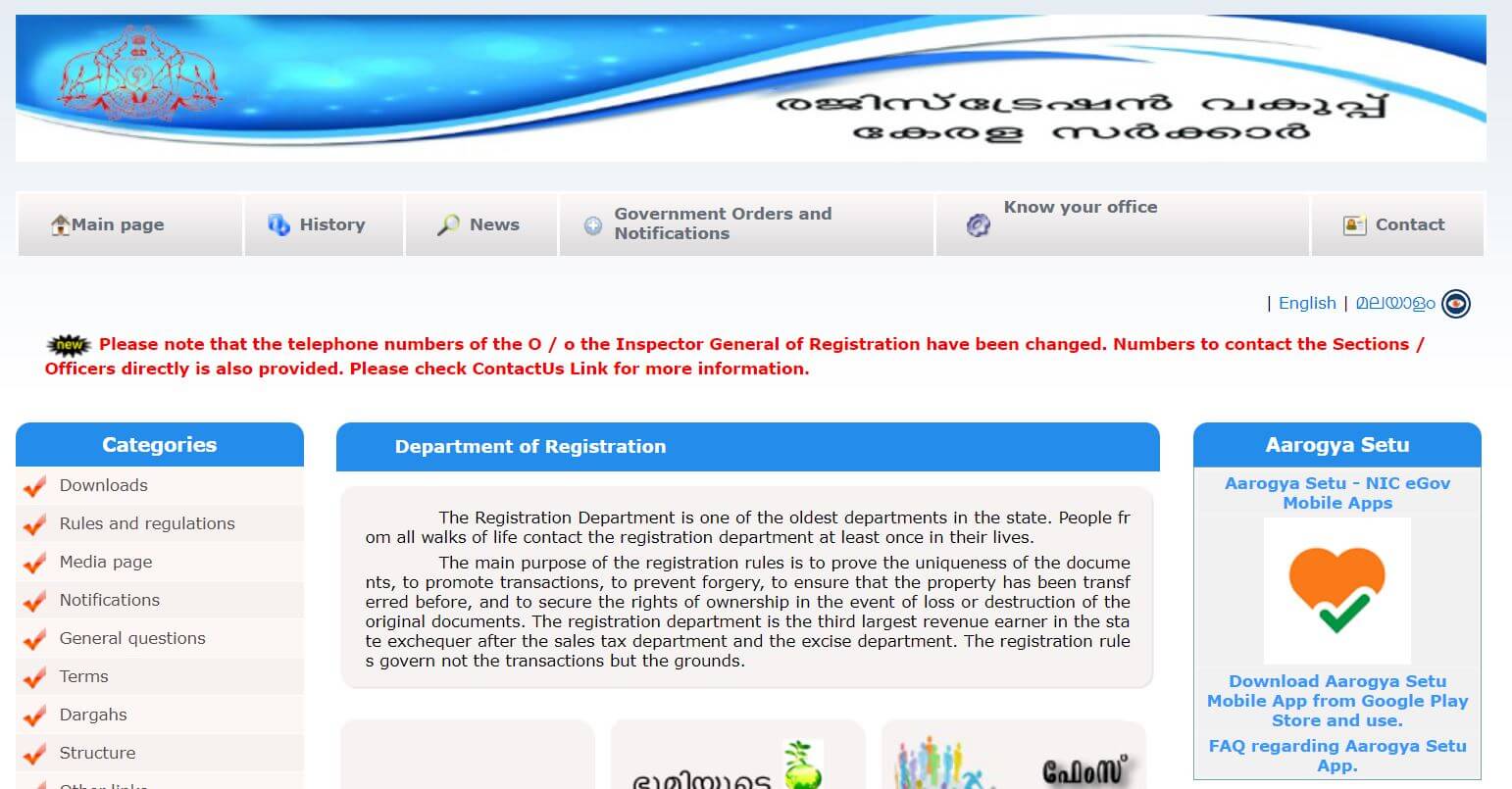
1. Visit the official website of the Registration Department, Kerala – keralaregistration[dot]gov[dot]in
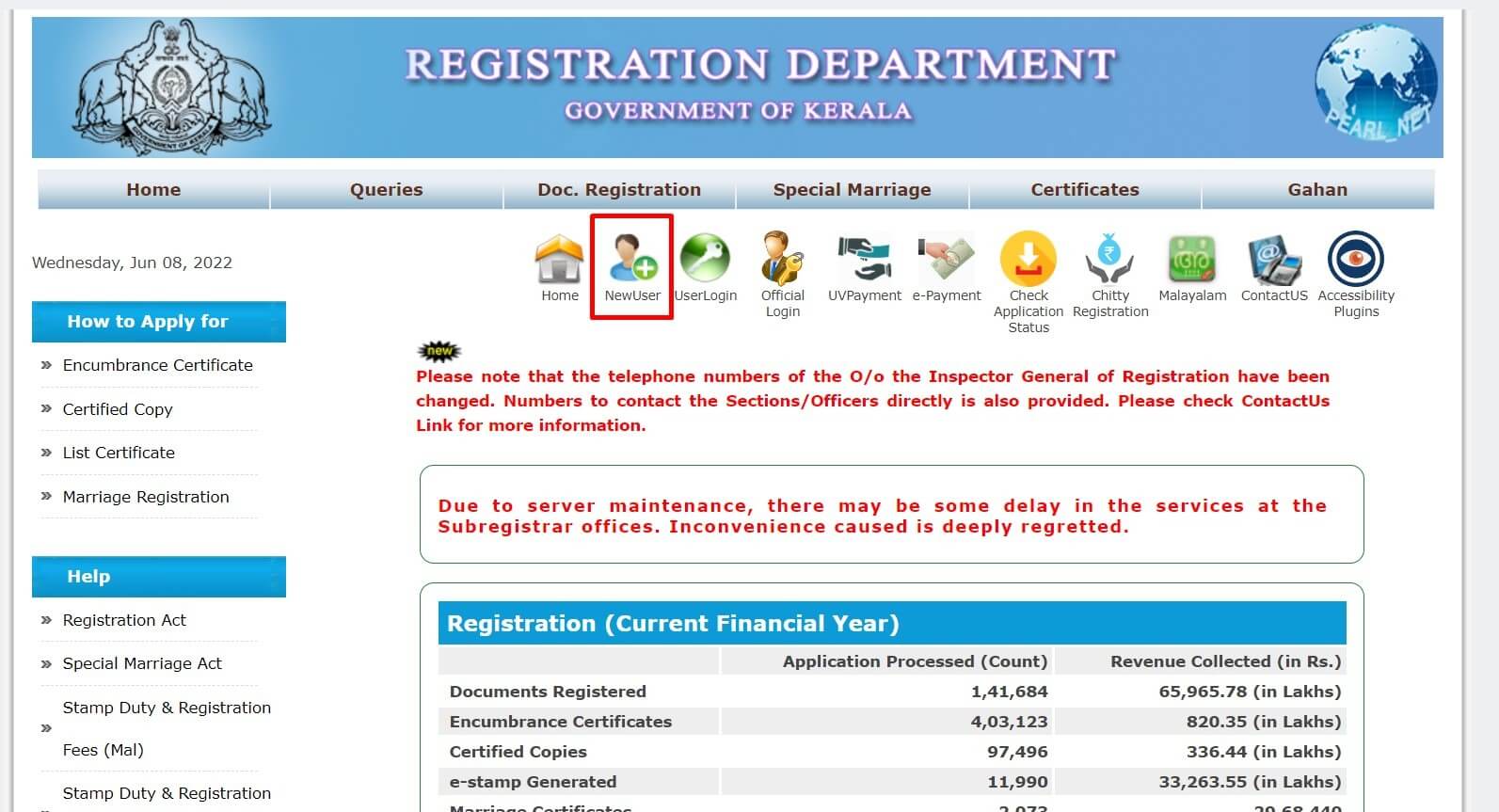
2. Click on the ‘New user’ option and fill in the details as required.
3. You will receive an OTP on your registered mobile number and email id.
4. Once OTP is verified, then a successful text will appear on your screen.
5. After completing the registration details, log in.
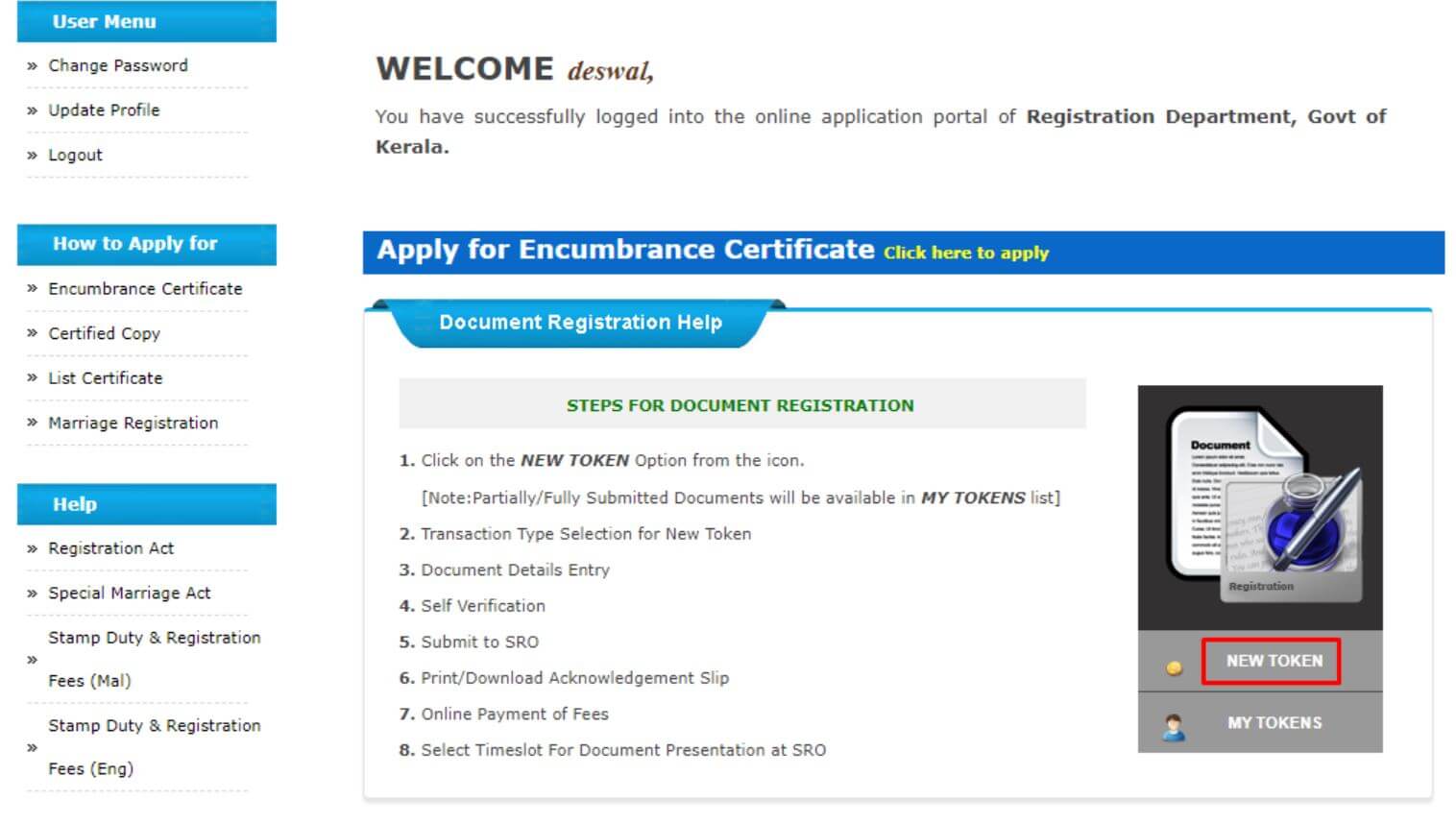
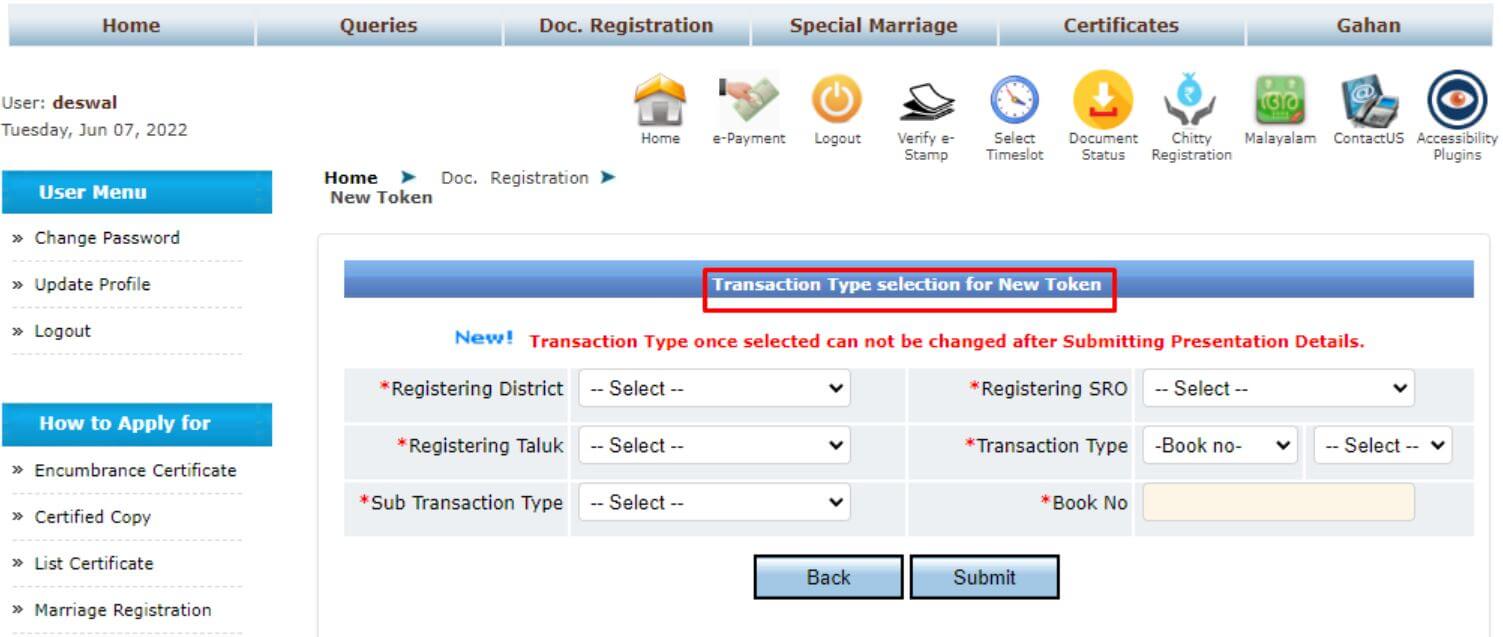
6. Click on the ‘New token’ under the document registration help.
7. Select the transaction type by choosing ‘New Token’. If you wish to make a payment of more than 1 lakh, then select the payment form for e-stamp.
8. Fill in the details for Claimant & Executants, and real estate building data.
9. After filling out the credentials for self-verification and applying for the e-stamp method, submit it to the SRO (Sub-Registrar’s Office).
10. Click on the ‘Pay’ option under online payment to continue the payment process.
11. To access the e-stamp, click on ‘view details.’ A serial number and GRN will be printed on the e-stamp that is generated.
12. Choose the time slot for the verification of the documents at the SRO.
Note: On that day and time, reach the office to submit the documents.
Penalties for Undervaluation in Kerala
Because the combined rate is 10 percent, there is always a temptation to write a lower price into the deed. In Kerala this is both difficult and risky.
- The Sub-Registrar can refuse to register a deed valued below the fair value, or insist you pay duty on the fair value
- Under Section 46A of the Kerala Stamp Act, the Revenue Department can demand the deficit duty plus a penalty of up to ten times the shortfall
- Under Section 35, an under-stamped instrument is inadmissible as evidence, weakening your title in any future dispute
- Undervaluation also creates a capital-gains mismatch that resurfaces when you eventually resell
Stamp Duty for NRI Buyers in Kerala
Kerala has a very large NRI community, so this deserves a note. The rates are identical for NRIs – there is no separate NRI stamp duty. The differences are procedural.
- Stamp duty and registration are the same 8 percent and 2 percent that resident buyers pay
- Payment must comply with FEMA – funds routed through an NRE or NRO account in Indian rupees
- An NRI who cannot attend registration executes a POA, notarised and apostilled or consulate-attested abroad
- Where the seller is an NRI, the buyer must deduct TDS under Section 195 and deposit it with the Income Tax Department
Because the POA and remittance steps take time, NRI buyers should begin the paperwork well before fixing a registration date.
Tax Benefit on Stamp Duty in Kerala
Given how high Kerala’s charges are, the available tax deduction is worth claiming.
- Deduction of up to ₹1,50,000 under Section 80C of the Income Tax Act in the financial year of payment
- Applies to residential house property, not to commercial property or pure plots
- Available under the old tax regime; buyers on the new regime cannot claim it
- Joint buyers can each claim their proportionate share within the overall limit
- A qualified tax adviser can confirm which regime works better for your overall situation
Quick Reference : Stamp Duty and Registration in Kerala
|
Property Value |
Stamp Duty (8%) |
Registration (2%) |
Total (10%) |
|
₹40 lakh |
₹3,20,000 |
₹80,000 |
₹4,00,000 |
|
₹60 lakh |
₹4,80,000 |
₹1,20,000 |
₹6,00,000 |
|
₹80 lakh |
₹6,40,000 |
₹1,60,000 |
₹8,00,000 |
|
₹1 crore |
₹8,00,000 |
₹2,00,000 |
₹10,00,000 |
|
₹1.5 crore |
₹12,00,000 |
₹3,00,000 |
₹15,00,000 |
These figures assume the sale value equals or exceeds the fair value. Verify the current fair value for your locality on the Kerala Registration Department website before finalising your budget, since duty is always charged on the higher figure.
Conclusion
Stamp duty and registration charges in Kerala add about 10 percent to the cost of a property – an 8 percent stamp duty plus a 2 percent registration fee – which is among the highest in India. On a ₹1 crore home that is ₹10 lakh in government charges before any home loan, legal fees or brokerage.
The things to remember about Kerala are that duty is always charged on the higher of your price or the fair value, that there is no women’s concession, and that the real savings come from relationship-based transfers. A gift or settlement to a close relative is taxed at just 2 percent, a general power of attorney is a flat Rs 1,000, and a will attracts no stamp duty at all. Choosing the right instrument for your situation can save lakhs, entirely within the rules.
Check the fair value for your property, generate your e-stamp through SHCIL, book your Sub-Registrar slot on the PEARL portal, and carry every document in original plus photocopy. Do that and registration day in Kerala will be smooth.
Frequently Asked Questions:
1. What is the stamp duty and registration charge in Kerala in 2026?
A standard sale deed attracts 8 percent stamp duty and a 2 percent registration fee, taking the total to about 10 percent of the value – among the highest in India. Both are calculated on the higher of your sale consideration or the government fair value for that location.
2. What is the stamp duty in Kerala for a sale deed?
Stamp duty on a regular sale deed in Kerala is 8 percent of the property value, calculated on the higher of your sale price or the fair value. It is paid in addition to the 2 percent registration fee, so the combined cost of a sale deed is about 10 percent.
3. What is the stamp duty for land registration in Kerala?
Land follows the same rates as other property: 8 percent stamp duty plus 2 percent land registration charges, on the higher of your sale value or the fair value fixed for that survey number. Confirm the current fair value for the plot before agreeing a price.
4. What is the gift deed stamp duty in Kerala?
A gift to a close family member such as a spouse, child, parent or sibling attracts a reduced 2 percent stamp duty plus a 2 percent registration fee. A gift to anyone outside the close-family list is charged at the full 8 percent, the same as a sale deed.
5. What is the power of attorney stamp duty in Kerala?
A general power of attorney for sale or transfer attracts a fixed stamp duty of Rs 1,000. An irrevocable power of attorney coupled with interest, where consideration has effectively passed, is treated like a conveyance and taxed at 5 percent of the property value.
6. Is there a stamp duty concession for women in Kerala?
No. Kerala has no state-wide gender-based stamp duty concession. The 8 percent rate is the same for men and women. The concessional 2 percent rate applies to relationship-based transfers such as gifts and settlements between close family members, not to the buyer’s gender.
7. How is stamp duty calculated in Kerala?
It is calculated on the higher of your sale consideration or the government fair value. Apply 8 percent for stamp duty and 2 percent for registration. For a ₹60 lakh property that is ₹4,80,000 stamp duty plus ₹1,20,000 registration, totalling ₹6,00,000.
8. What is fair value in Kerala and why does it matter?
Fair value, or nyayavila, is the minimum benchmark value the Registration Department fixes for land in every village and municipality. Stamp duty is charged on the higher of your sale price or the fair value, so you can never pay duty on less than the fair value even if you paid a lower price.
9. What are the property registration charges in Kerala?
The registration fee is 2 percent of the value, paid to record the deed at the Sub-Registrar’s Office. It is separate from the 8 percent stamp duty, and both are charged on the higher of your sale value or the fair value. Document-writing and e-stamping fees are small extras on top.
10. Can I pay stamp duty online in Kerala?
Yes. Kerala uses e-stamping through SHCIL, which issues an e-stamp certificate with a unique identification number. You book your Sub-Registrar slot through the PEARL portal and present the e-stamp at registration. You can verify any e-stamp on the SHCIL portal using its certificate number.
11. Can I claim a tax benefit on stamp duty in Kerala?
Yes. Under Section 80C of the Income Tax Act you can claim a deduction of up to ₹1.5 lakh for stamp duty and registration charges on a residential property, in the year of payment. It is available only under the old tax regime and only for residential house property.