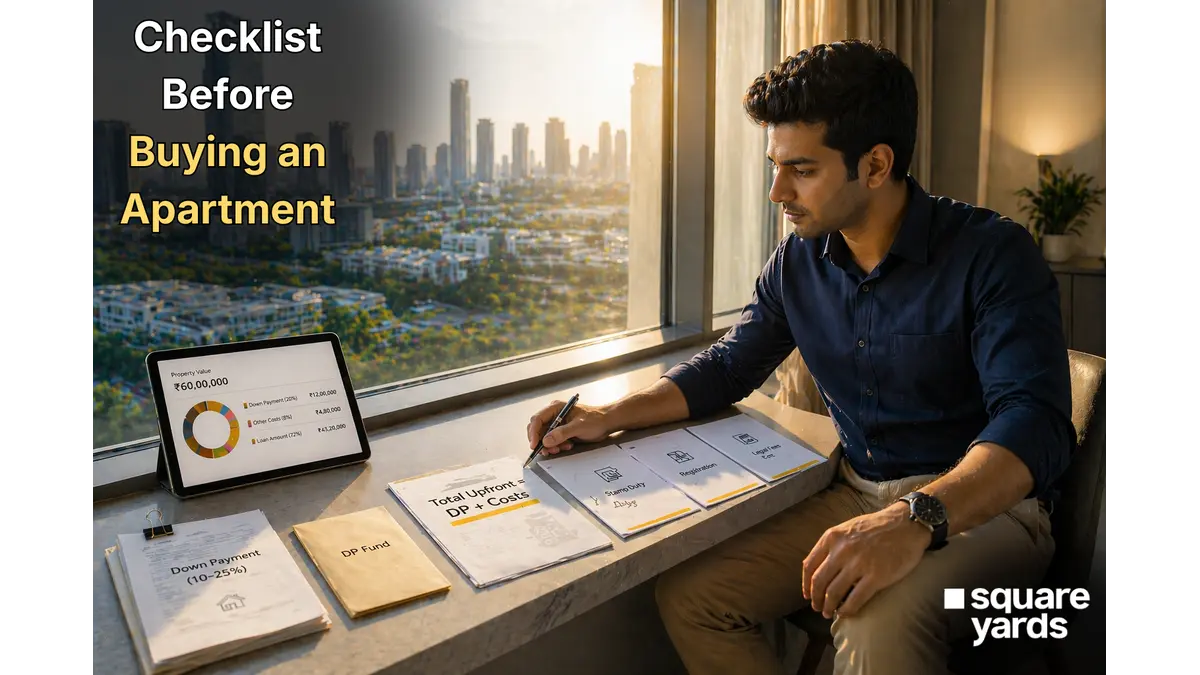
A comprehensive apartment buying checklist is the best tool a property buyer can have before committing to any real estate transaction. India’s property purchase involves multiple stakeholders—builders, banks, lawyers, and government authorities—each requiring specific documents and verifications.
This detailed apartment buying checklist by SquareYards is organized into five phases: Financial Planning, Property Shortlisting, Legal Verification, Agreement & Registration, and Post-Possession. Whether you’re buying a 1 BHK in Bengaluru or a 3 BHK in Mumbai, this 30+ point checklist ensures no critical step is missed.
Step-by-Step Guide
PHASE 1 – Financial Preparation Checklist
- Total budget defined (property + 15–20% for ancillary costs)
- CIBIL score checked (750+ preferred)
- Home loan pre-approval obtained
- Down payment funds arranged (10–20%)
- Stamp duty and registration funds set aside (5–8% of value)
- GST provision made for under-construction flat (5%)
- Emergency fund maintained (6 months EMI
PHASE 2 – Property Shortlisting Checklist
- Location evaluated (connectivity, infrastructure, school proximity)
- RERA registration verified on state portal
- Builder’s track record checked (past projects, RERA complaints)
- Carpet area noted and compared (not super built-up area)
- Flat facing and floor plan reviewed
- Amenities list documented from RERA-registered project details
- Project bank approvals confirmed (SBI, HDFC, ICICI, etc.)
- Ready-to-move vs. under-construction decision made
PHASE 3 – Legal Due Diligence Checklist
- Title deed (chain of ownership—minimum 30 years) verified by lawyer
- Encumbrance Certificate obtained (confirms no mortgage/litigation)
- Building plan approval from local municipal authority checked
- Land use clearance (NA order) confirmed
- Completion Certificate / Occupancy Certificate (for RTM) verified
- RERA registration certificate cross-checked
- Property tax receipts reviewed (no outstanding dues)
- Society NOC (for resale flats) obtained from seller
- No litigation on the property (court case check)
PHASE 4 – Agreement & Booking Checklist
- Agreement to Sell (ATS) reviewed by independent lawyer
- Possession date and delay penalty clauses confirmed
- Payment schedule (construction-linked preferred) confirmed
- All promised amenities listed in ATS
- Carpet area, floor, unit number specifically mentioned in ATS
- Cancellation/forfeiture conditions read carefully
- Booking amount receipt collected (with builder letterhead)
- ATS registered at sub-registrar’s office
PHASE 5 – Home Loan & Registration Checklist
- Home loan sanction letter received
- Loan disbursement schedule aligned with payment plan
- Stamp duty paid online (state government portal)
- Sale Deed executed on appropriate stamp paper
- Both parties present at sub-registrar’s office for registration
- Two witnesses arranged for registration
- PAN cards of both parties submitted
- Registered Sale Deed collected (or tracking number noted)
- Mutation application filed at local municipal body
PHASE 6 – Post-Possession Checklist
- Final walkthrough done before accepting possession
- All promised amenities operational (gym, parking, lift, clubhouse)
- Occupancy Certificate collected from builder
- Completion Certificate collected
- Water, electricity, gas connections applied for
- Society formation documents collected
- Maintenance charges and tenure confirmed in writing
- Any snags/defects documented and reported to builder (1-year defect liability)
- Interior work started only after structural inspection
Key Factors / Checklist
- Never skip Phase 3 (Legal Due Diligence)—it’s the most critical phase
- The ATS (Agreement to Sell) must be registered, not just stamped
- Always collect original documents; photocopies carry no legal weight
- Verify RERA on official state portal, not from builder’s document
- OC is mandatory for home loan and legal possession
- Mutation is essential for future resale and inheritance
- Defect liability period (1–5 years under RERA) protects against construction defects
- Maintenance charges post-possession can vary widely—get written confirmation
Expert Tips
- Create a physical or digital folder for every document—you’ll need them for future resale, inheritance, and tax filing.
- Request the builder to provide a ‘Handover Kit’ containing all OC, CC, NOCs, and utility connection documents at possession.
- Hire a professional home inspector before signing the possession letter—structural defects must be reported within the defect liability period.
- For resale flats, insist on a clearance certificate from the housing society confirming no outstanding dues from the previous owner.
Common Mistakes to Avoid
- Signing possession letter without conducting a thorough flat walkthrough
- Not registering the Agreement to Sell (ATS)—unregistered ATS has limited legal enforceability
- Forgetting to file for mutation after property registration
- Not documenting promised amenities in the ATS—verbal promises have no value
- Skipping Phase 3 entirely to save lawyer fees—a false economy
Conclusion
This 30+ point apartment buying checklist ensures you cover every critical aspect of India’s property purchase process—from financial planning to post-possession. Save this checklist and use it as your property buying companion.
SquareYards provides end-to-end property buying assistance: verified listings, legal document support, home loan advisory, and post-possession assistance. Find your perfect apartment on SquareYards today.