
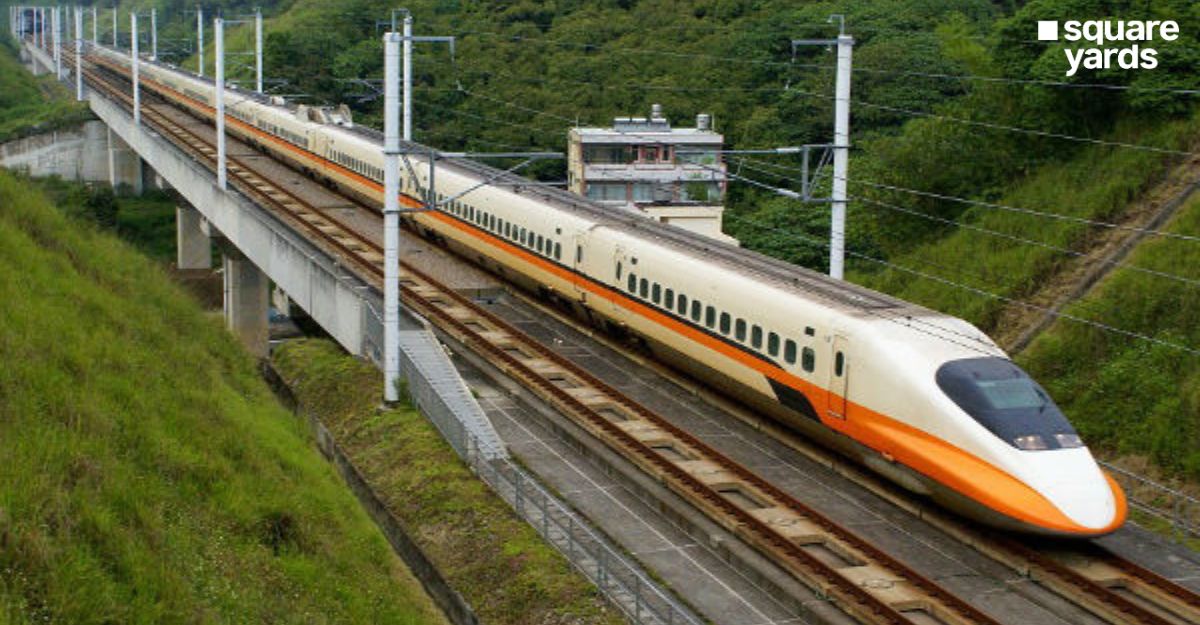
The announcement by Komatireddy Venkat Reddy on the Detailed Project Report (DPR) for the Hyderabad–Pune–Mumbai high-speed rail corridor signals something far bigger than a transport upgrade.
This isn’t just about bullet trains. It’s about redefining distance between cities that already power a large share of India’s GDP. When a 12–15 hour journey shrinks to just a few hours, the real shift isn’t in travel—it’s in behaviour. People rethink where they live. Businesses rethink where they expand. Real estate markets begin to realign.
And this is only the starting point. With a broader high-speed rail vision linking Amaravati, Hyderabad, Pune, and Mumbai, what’s emerging is not just a corridor but a powerful economic spine reshaping the western and southern growth arc of India.
Understanding the project: what exactly is being planned?
The Detailed Project Report (DPR) for the Hyderabad-Pune-Mumbai high-speed rail corridor signals that the project is moving from an idea to something more real. This is a clear plan to bring three major economic centres much closer in terms of travel time. Trains are expected to operate at speeds of 300-350 km/h, potentially reducing Hyderabad-Mumbai travel time to just a few hours, while Pune-Mumbai could turn into a sub-one-hour journey.
Ashwini Vaishnaw points to routes such as Amaravati-Hyderabad, indicating that this corridor is part of a much larger high-speed network in the making.
Key impacts and what this corridor holds:
- Travel time compression as an economic multiplier
A reduction from 12-15 hours to 3-4 hours between Hyderabad and Mumbai changes intercity movement from occasional to frequent, enabling same-day business travel and multi-city operations. - Creation of a continuous economic belt
Instead of isolated city economies, the corridor links IT (Hyderabad), manufacturing and education (Pune), and finance (Mumbai) into a more integrated economic region. - Expansion of real estate catchments
Peripheral and mid-distance locations between these cities could emerge as viable residential and commercial zones, as accessibility improves dramatically. - Decentralisation of urban pressure
With faster connectivity, population and office demand may gradually shift away from saturated cores like Mumbai toward relatively less dense cities or emerging nodes. - Rise of transit-oriented development (TOD)
Areas around proposed high-speed rail stations are likely to witness planned urban clusters mixing residential, retail, and commercial development. - Strengthening tier-2 and emerging cities
Extensions such as Amaravati-Hyderabad signal that upcoming administrative and economic centres could plug directly into high-speed networks, accelerating their growth cycles. - Investment and employment generation
Beyond operations, the construction phase itself involves large-scale capital deployment, land development, and job creation across multiple sectors.
Connectivity & Distance: Why time compression changes everything
Cities that once felt far apart start feeling much closer when travel time drops to under a few hours. This makes it easier for people to move between cities for work or business without needing to relocate. It also allows companies to operate across multiple cities more smoothly. Over time, this kind of connectivity can make different cities function like one larger, connected region rather than separate markets.
|
Route |
Estimated Travel Time |
|
Amaravati -Hyderabad |
70 minutes |
|
Amaravati – Chennai |
112 minutes |
|
Hyderabad – Pune |
1 hour 55 minutes |
|
Pune – Mumbai |
48 minutes |
|
Chennai – Bengaluru |
73 minutes |
|
Hyderabad – Bengaluru |
2 hours 8 minutes |
Impact on economy and real estate in tier-1 cities along the corridor
The Hyderabad -Pune -Mumbai high-speed rail corridor will bring these three major cities closer and help them work more like one connected region. Faster travel will make it easier for people to move between cities, improve business efficiency, and attract more investment.
In real estate, the impact will show in changing demand. In Mumbai, where property is very expensive, some people may choose to live in Pune and still work with Mumbai-based companies. This can reduce pressure on Mumbai’s housing market.
Pune is likely to see more growth, with rising demand for homes and offices as it becomes a strong alternative hub. Hyderabad will also benefit, as better connectivity can attract more companies and increase demand for good-quality housing and office spaces.
The emergence of new real estate micro-markets
High-speed rail stations do not just serve as transit points; they become economic nodes. Areas surrounding these stations tend to attract:
- Commercial office developments
- Retail and hospitality projects
- High-density residential clusters
- Mixed-use urban ecosystems
Along this corridor especially between Hyderabad and Pune, places that are currently seen as far or underdeveloped could start seeing early activity. This can include land buying, basic infrastructure work, and growing interest from developers, even before the rail line is built.
For investors and developers, the key opportunity is not in crowded city centres, but in identifying areas near future stations where growth is likely to happen next.
Challenges: what could slow down its making
- Land acquisition and rehabilitation
Acquiring continuous land across multiple states is one of the toughest parts of any infrastructure project in India. Along stretches between Hyderabad, Pune, and Mumbai, the corridor will pass through urban, semi-urban, and rural areas. This often leads to delays due to disputes or compensation disagreements, challenges around rehabilitation of affected communities, and legal issues that can slow down execution. - High capital cost and funding clarity
Bullet train projects require massive upfront investment, and securing funding through government budgets or other sources can be complex. If funding is delayed or released in phases, project timelines may stretch, costs can increase over time, and certain sections of the corridor may get prioritised over others. - Execution timelines and delays
Large infrastructure projects depend heavily on smooth coordination and timely approvals. Clearances, coordination between states, and on-ground challenges can extend timelines. Even delays in environmental approvals, design finalisation, or contractor mobilisation can significantly push the project schedule. - Ridership and pricing viability
For the project to succeed, ticket pricing needs to balance affordability with financial viability. If fares are too high, usage may remain limited to business travellers, and the idea of frequent or daily intercity commuting—which plays a key role in driving real estate change may not fully take off. - Last-mile connectivity gaps
High-speed rail is most effective when supported by strong local transport networks. If last-mile connectivity around stations is weak, the overall time advantage reduces, and the real estate potential around these hubs may not fully develop. This becomes especially important for emerging locations between Hyderabad and Pune.