If you’re planning to buy or sell property in Bihar, understanding the circle rate is essential. Also known as the collector rate, Bihar ready reckoner rate, Bihar Circle Rate or officially the Minimum Value Register (MVR), this benchmark determines the minimum property value for registration.
Why does this matter? Because stamp duty in Bihar and property registration charges in Bihar are calculated based on this rat, regardless of your negotiated deal price.
- What is the Bihar Circle Rate?
- District-Wise Bihar Circle Rate
- How Bihar Circle Rate is Determined
- Circle Rate vs Market Value in Bihar
- Impact of Circle Rate on Registration Charges in Bihar
- How to Check Bihar Land Circle Rate?
- Recent Changes in Bihar Circle Rates
- Factors Affecting Property Valuation in Bihar
- The Bottom Line
What is the Bihar Circle Rate?
The circle rate in Bihar is the minimum value set by the government, below which a property cannot be legally registered. It applies to:
- Residential land
- Commercial property
- Agricultural land
Even if you buy a property at a lower price, registration charges will still be calculated using the circle rate.
These rates are fixed by the state government along with district authorities and vary based on:
- Location (urban vs rural)
- Road type (main road vs internal road)
- Property usage (residential, commercial, agricultural)
District-Wise Bihar Circle Rate
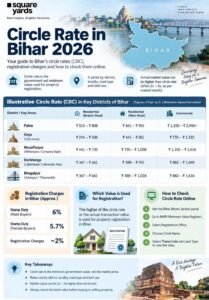
The circle rate in Bihar varies by district, locality, and property type. Urban centres, prime commercial zones, and well-connected residential areas tend to have higher rates. The rates can also vary depending on whether the land is residential, commercial, or agricultural. Moreover, if the property is on the main road, its circle rate will be higher than that of one on an inner road.
To make these variations easier to understand, we have compiled a district-wise circle rate comparison for Bihar. It is important to note that the values are illustrative, and the exact figures on the government websites are calculated on a per katha basis (1 katha = 1,361 sq ft approx.). Below is a simplified representation of how rates may vary across key districts:
|
District |
Key Localities |
Residential (Branch Road) |
Residential (Main Road) |
Commercial (Indicative) |
|
Patna |
₹515 – ₹808 |
₹661 – ₹955 |
₹1,100 – ₹2,940+ |
|
|
Premium (Boring Rd, Patliputra) |
₹1,200 – ₹2,000 |
₹1,600 – ₹2,800 |
₹2,940+ |
|
|
Gaya |
City areas |
₹294 – ₹588 |
₹441 – ₹882 |
₹735 – ₹1,322 |
|
Bodh Gaya |
₹441 – ₹735 |
₹735 – ₹1,102 |
₹1,102 – ₹1,469 |
|
|
Rural |
₹73 – ₹294 |
₹220 – ₹441 |
₹367 – ₹735 |
|
|
Muzaffarpur |
Mithanpura, Company Bagh |
₹441 – ₹735 |
₹735 – ₹1,028 |
₹1,102 – ₹1,616 |
|
Other areas |
₹294 – ₹588 |
₹515 – ₹882 |
₹735 – ₹1,322 |
|
|
Darbhanga |
Laheriasarai, Univ area |
₹367 – ₹661 |
₹588 – ₹955 |
₹882 – ₹1,469 |
|
Peripheral |
₹147 – ₹367 |
₹294 – ₹588 |
₹588 – ₹882 |
|
|
Bhagalpur |
Adampur, Tilkamanjhi |
₹367 – ₹661 |
₹588 – ₹1,028 |
₹882 – ₹1,616 |
|
Semi-urban |
₹220 – ₹441 |
₹367 – ₹735 |
₹588 – ₹1,102 |
|
|
Nalanda |
Bihar Sharif |
₹294 – ₹515 |
₹441 – ₹735 |
₹735 – ₹1,102 |
|
Rural |
₹73 – ₹220 |
₹220 – ₹441 |
₹367 – ₹735 |
|
|
Aurangabad |
Town areas |
₹220 – ₹441 |
₹367 – ₹661 |
₹588 – ₹1,028 |
|
Rural |
₹73 – ₹220 |
₹147 – ₹367 |
₹367 – ₹588 |
|
|
Samastipur / Begusarai |
Urban |
₹294 – ₹588 |
₹441 – ₹882 |
₹735 – ₹1,322 |
|
Rural |
₹73 – ₹294 |
₹220 – ₹515 |
₹441 – ₹882 |
This bihar land circle rate list clearly shows that districts like Patna command the highest property value. The prime areas in Patna, especially those near commercial hubs and main roads, have higher rates within the city due to better infrastructure, stronger connectivity, and higher demand. On the other hand, smaller towns and semi-urban districts such as Nalanda or parts of Darbhanga usually have lower circle rates. This can be attributed to limited infrastructure development, lower population density and demand. Even within the same district, circle rates can vary widely between localities. For instance, a property located near a highway, railway station, or commercial centre will have a higher valuation than one in a more remote or interior area.
How Bihar Circle Rate is Determined
The circle rate in Bihar is fixed by the Department of Registration, Excise & Prohibition, Bihar, in coordination with district administrations. At the ground level, Sub-Registrar Offices and local revenue officials collect data to build the Minimum Value Register (MVR), i.e. the official framework used for property valuation across the state.
Process of evaluation and revision
The data from actual property transactions, recent sale deeds, and prevailing market trends is consolidated. This, along with inputs from local bodies, is taken into consideration to determine realistic minimum values for different areas. Before the State Government’s approval and notification, the draft rates are reviewed at the district level. This process ensures that the Bihar property valuation balances both administrative and on-ground perspectives.
These rates are not uniform; they are defined at a mouza (locality) level, and further segmented by road type (main road vs internal road) and land use. Additionally, the updates and revisions are not done annually or even at fixed intervals. They can take place after several years, subject to market shifts and policy decisions.
Key criteria used for valuation
Several factors influence how rates are determined:
- Location (urban vs rural): Urban centres like Patna have fairly higher rates than rural areas due to higher demand and development density.
- Infrastructure & connectivity: Proximity to major roads, highways, commercial hubs, schools, and transport networks increases valuation.
- Market demand trends: Areas witnessing rapid development or investment activity tend to have higher circle rates.
- Type of land/property: Residential, commercial, and agricultural lands are valued differently, with commercial properties typically having the highest rates.
Circle Rate vs Market Value in Bihar
Understanding the difference between the circle rate and the market value helps to compare actual ranges across districts and localities. The circle rate in Bihar is the government-defined minimum set by the Department of Registration, Excise & Prohibition, Bihar, while market value reflects what buyers are currently paying. Across Bihar, market values are consistently higher because they capture real-time demand, infrastructure growth, and locality-specific appeal, factors that official rates often lag. The following table illustrates a comparison between the circle rates and market value in Bihar:
|
District |
Key Localities |
Circle Rate (₹/sq ft) |
Market Value (₹/sq ft) |
Gap |
|
Patna |
Gulzarbagh, Kankarbagh, Danapur |
₹500 – ₹950 |
₹2,500 – ₹5,500 |
3x – 5x |
|
Premium (Boring Rd, Patliputra) |
₹1,200 – ₹2,800 |
₹6,000 – ₹10,000 |
3x – 5x |
|
|
Gaya |
City areas |
₹300 – ₹900 |
₹2,000 – ₹3,500 |
2x – 3x |
|
Bodh Gaya |
₹400 – ₹1,100 |
₹2,500 – ₹4,500 |
2x – 3x |
|
|
Rural |
₹70 – ₹400 |
₹500 – ₹1,500 |
2x – 4x |
|
|
Muzaffarpur |
Mithanpura, Company Bagh |
₹400 – ₹1,000 |
₹3,000 – ₹5,500 |
3x – 5x |
|
Other areas |
₹300 – ₹900 |
₹2,000 – ₹4,000 |
2x – 4x |
|
|
Darbhanga |
Laheriasarai, Univ area |
₹350 – ₹950 |
₹2,500 – ₹4,500 |
2x – 4x |
|
Peripheral |
₹150 – ₹600 |
₹1,000 – ₹2,500 |
2x – 4x |
|
|
Bhagalpur |
Adampur, Tilkamanjhi |
₹350 – ₹1,000 |
₹2,500 – ₹4,500 |
2x – 4x |
|
Semi-urban |
₹200 – ₹700 |
₹1,500 – ₹3,000 |
2x – 4x |
|
|
Nalanda |
Bihar Sharif |
₹300 – ₹750 |
₹2,000 – ₹3,500 |
2x – 4x |
|
Rural |
₹70 – ₹400 |
₹500 – ₹1,500 |
2x – 4x |
|
|
Aurangabad |
Town areas |
₹200 – ₹650 |
₹1,500 – ₹3,000 |
2x – 4x |
|
Rural |
₹70 – ₹350 |
₹500 – ₹1,200 |
2x – 3x |
|
|
Samastipur / Begusarai |
Urban |
₹300 – ₹900 |
₹2,000 – ₹4,000 |
2x – 4x |
|
Rural |
₹70 – ₹500 |
₹500 – ₹1,500 |
2x – 3x |
Being driven by buyer demand, location advantages, and ongoing development, market prices tend to be on the higher end. On the other hand, circle rates are not revised regularly and may not accurately reflect on-ground conditions. Since the gap ranges from 2x to 5x in most districts, both values must be considered for accurate property valuation in Bihar.
Impact of Circle Rate on Registration Charges in Bihar
When a property is registered, the applicable stamp duty and registration charge are determined by a simple rule: the higher of the circle rate and the actual transaction value is applied. This means that even if a buyer purchases a property at a price below the circle rate, the charges will still be calculated based on the higher circle rate. On the other hand, if the transaction value exceeds the circle rate, the higher purchase price becomes the basis for calculation.
In Bihar, stamp duty is typically around 6% for male buyers and approximately 5.7% for female buyers. In addition, property registration charges are generally levied at around 2% of the property value. These charges together form a significant portion of the overall acquisition cost.
For example, if a property has a circle rate of ₹50 lakh but is purchased for ₹60 lakh, the higher transaction value will be used in the calculation. In this case, stamp duty in Bihar at 6% would amount to ₹3.6 lakh, while property registration charges at 2% would be ₹1.2 lakh, bringing the total registration cost to ₹4.8 lakh. Conversely, if the same property is purchased at ₹45 lakh, the charges would still be calculated on ₹50 lakh, increasing the payable amount.
This structure has important cost implications for buyers. Properties in high-circle-rate areas naturally attract higher registration costs, and even negotiated deals may not reduce expenses if the circle rate remains higher. For accurate budgeting and smoother transactions, having a full understanding of this relationship is crucial.
How to Check Bihar Land Circle Rate?
The state government provides access to circle rates through the official portal managed by the Department of Registration, Excise & Prohibition, Bihar, where rates are listed under the Minimum Value Register (MVR). To check CRC Bihar online, follow these steps:
- Visit the official Bihar Bhumi Jankari portal and navigate to the ‘MVR’ section.
- You will be directed to a form. Fill out the fields Registration Office, Circle Name, Thana Code, and Land Type carefully by choosing from the dropdown menus.
- Once all are filled, the minimum registration value per katha will be displayed, along with the applicable registration charge and stamp duty.
You can also check the total cost of the specific property you plan to purchase, including stamp duty, registration charges, and other fees, based on the negotiated price and land area. Just follow these steps:
- On the MVR form, select the Advanced Calculation option.
- In the form that appears, fill out the fields Registration Office, Circle Name, Thana Code, and Land Type carefully by choosing from the dropdown menus.
- Next, choose the Land Transaction Type and enter the total land cost and land area.
- On clicking ‘View Calculation,’ you will get the complete cost details of the property.
Recent Changes in Bihar Circle Rates
Bihar is undergoing a major revision to property valuation, with the government planning a sharp increase in the circle rate after nearly a decade. The proposed changes aim to bring official rates closer to actual market prices, especially in high-demand districts and urban centres.
According to recent developments, circle rates may rise by 300% to 400% in several areas, especially where current government values are significantly lower than market rates. This impact is expected to be most pronounced in districts such as Patna, Muzaffarpur, and Gaya, where property demand and transaction volumes have grown rapidly.
Within Patna, prime localities such as Boring Road, Patliputra Colony, and Kankarbagh are likely to see upward revisions due to the wide gap between current circle rates and prevailing market values. Similarly, areas such as Danapur and Bailey Road, which have seen steady development, are also expected to be re-evaluated.
In other districts, key urban pockets such as Bodh Gaya, Mithanpura, and Laheriasarai may also experience notable increases. However, the extent of the revision will vary depending on local demand and infrastructure growth.
Other Cities Circle Rate
| Circle Rate in Jharkhand | Jharkhand Circle Rate |
| Circle Rate in Up | Up Circle Rate |
| Circle Rate in Kolkata | Kolkata Circle Rate |
| Circle Rate in Delhi | Delhi Circle Rate |
| Circle Rate in Haryana | Haryana Circle Rate |
Factors Affecting Property Valuation in Bihar
While the circle rate in Bihar sets the minimum benchmark for property transactions, property valuation in Bihar depends on several other factors that determine a property’s true market value.
One of the most important factors is location and connectivity. Properties in well-connected areas such as Boring Road, Kankarbagh, and Bailey Road command higher prices due to proximity to commercial hubs, schools, and transport networks. Similarly, areas like Danapur have seen rising valuations due to improving connectivity with central Patna.
Ongoing and upcoming infrastructure projects such as road expansions, flyovers, and urban development initiatives can significantly boost property prices. Localities around Bodh Gaya have seen increased valuation driven by tourism-related infrastructure, while parts of Muzaffarpur, such as Mithanpura, have gained traction due to improved urban amenities.
Another key factor is the type of property. Residential, commercial, and agricultural lands are valued differently. Commercial areas like Fraser Road typically have much higher values due to business activity, whereas residential zones like Patliputra Colony are valued for livability. In contrast, agricultural land in rural districts such as Nalanda or Aurangabad is priced lower due to restrictions on use.
Demand-supply dynamics and government policies and regulations also affect valuation. Changes in land-use rules, zoning regulations, and revisions to circle rates can affect property prices.
The Bottom Line
If you’re dealing with property in Bihar, understanding the circle rate in Bihar is more than just helpful. It sets the minimum registration value and directly affects how much you’ll pay in stamp duty and other charges. Since actual property prices vary slightly by location, demand, and development, the circle rate can help prevent an incorrect valuation. That’s why checking a reliable Bihar circle rate list before making any decision can really save you from surprises. It gives a clear baseline and helps you negotiate smarter, whether you’re buying or selling. Most importantly, don’t skip verifying the latest circle rate in Bihar on the official government portal. A quick check can go a long way in helping you plan your budget better and make a more confident, informed property decision.
FAQs - Bihar Circle Rate
1. What is the current circle rate in Bihar?
Circle rates vary widely based on district, locality, land type, and road category, with no single statewide rate. For example, prime areas like Boring Road are around ₹22 lakh per katha, while mid-range areas like Kankarbagh may range from ₹7–13 lakh per katha. In rural districts like Nalanda, it can be as low as ₹1–4 lakh per katha.
2. Is the circle rate different in each Bihar district?
Yes, each district has its own set of circle rates. Even within a district, rates differ across localities and property classifications.
3. Where can I check the official Bihar circle rate list?
You can check the official rates on the Bihar Bhumi Jankari portal. The data is available under the Minimum Value Register (MVR) section for each locality.
4. How is stamp duty calculated in Bihar?
Stamp duty is calculated on the higher of the transaction value or the circle rate. It is typically around 6% for male buyers, with slight concessions for female buyers.
5. Does the circle rate apply to agricultural land in Bihar?
Yes, circle rates apply to agricultural land as well. These rates are usually lower than residential or commercial land and vary by location.
6. Can the circle rate be lower than the market rate in Bihar?
Yes, market value is often higher than the circle rate, especially in prime urban areas. This happens because circle rates are revised periodically rather than in real time.
7. How often are circle rates updated in Bihar?
Circle rates are revised periodically in response to government assessments. However, updates may happen after several years rather than annually.
8. Is the circle rate the same for rural and urban areas in Bihar?
No, circle rates are significantly higher in urban areas compared to rural regions. This is due to better infrastructure, connectivity, and higher demand in cities.
9. What happens if the property value is below the circle rate in Bihar?
In such cases, registration charges are still calculated based on the circle rate. This prevents undervaluation of property transactions.
10. How does the circle rate affect property tax in Bihar?
The circle rate mainly affects stamp duty and registration costs at the time of purchase. Property tax is calculated separately by local municipal authorities based on different criteria.