
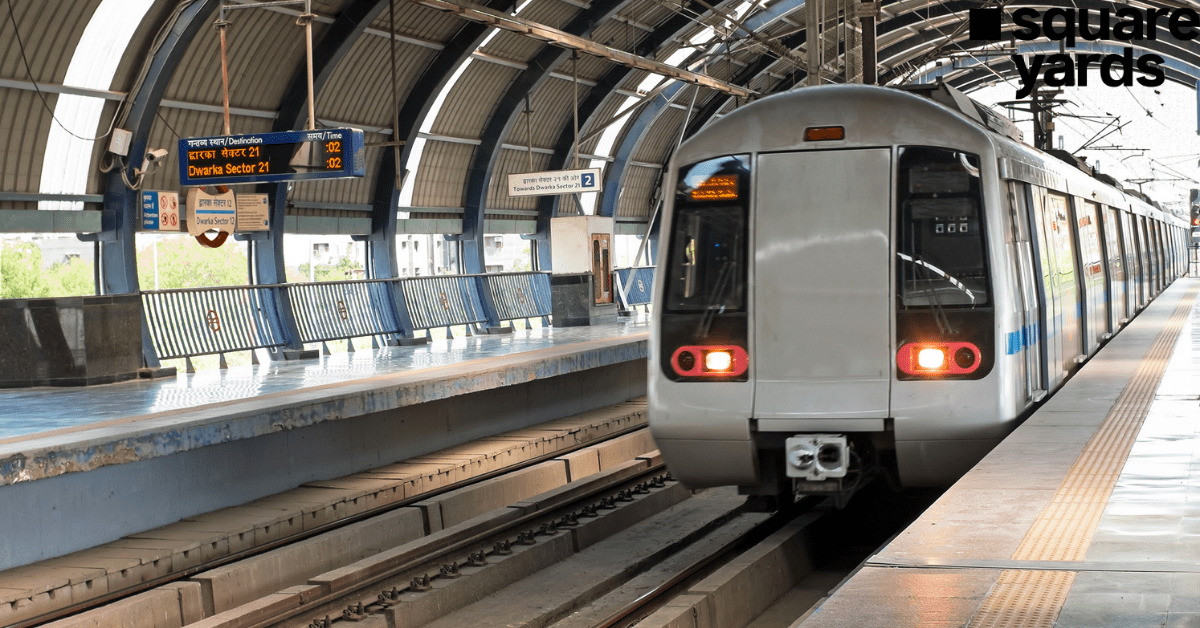
Delhi Metro Phase-IV is moving ahead with visible progress across key corridors after a recent government review, while Phase-V(A) begins to take shape. The expansion will ease congestion, improve cross-city travel, and unlock new real estate potential across underserved micro-markets.
Delhi Metro’s Phase-IV expansion has recently gained momentum, with Phase-V(A) entering the construction stage. The latter involves the construction of twin tunnels (Up and Down lines) using shield TBMs between Shivaji Stadium and Central Secretariat stations, and a cut-and-cover tunnel from Central Secretariat to Kartavya Bhawan. Two fully underground stations at Central Secretariat and Kartavya Bhawan, along with associated entry–exit structures and connecting subways, are also in the pipeline.
Under Phase-IV, the RK Ashram Marg Station is being developed as a major interchange between the Blue and Magenta Lines, making it a key node in the expanded network. Officials highlighted that complex tunnelling works, especially beneath railway lines near Sabzi Mandi and in crowded stretches like Sadar Bazar, have been carried out using specialised engineering techniques, underscoring the scale and complexity of Phase-IV works.
Phase-IV spans over 100 km and includes corridors such as Janakpuri West–RK Ashram Marg, Majlis Park–Maujpur and Aerocity–Tughlakabad, cutting across West, North and Central Delhi. Meanwhile, Phase-V(A), approved in 2025–26, will add a largely underground corridor from RK Ashram Marg to Indraprastha, passing through high-security and heritage zones such as Central Secretariat, India Gate and Bharat Mandapam.
Improved mobility to fill structural connectivity gaps
Phases IV and V(A) of the Delhi Metro are expected to address long-standing pressure points within the city’s mobility grid. The Janakpuri West–RK Ashram Marg corridor alone links residential hubs in West Delhi with dense commercial and institutional areas in Central Delhi, cutting across neighbourhoods such as Janakpuri, Uttam Nagar, Pitampura, Ashok Vihar, Azadpur and Karol Bagh.
Stations such as RK Ashram Marg, Inderlok, Azadpur and Central Secretariat are being designed to integrate multiple lines, redistributing passenger flow away from overburdened hubs like Rajiv Chowk. This is expected to reduce congestion on key arterial routes, including Ring Road and Pusa Road, where peak-hour traffic remains a persistent bottleneck.
The underground sections through Sadar Bazar and Nabi Karim are also significant. In Delhi’s most densely populated wholesale and retail districts, infrastructure upgrades have been rendered ineffective by space limitations. Metro connectivity here is expected to formalise and streamline daily commuter movement, especially for traders and workers dependent on unreliable road transport.
Phase-V(A)’s Central Delhi alignment further strengthens this shift by linking administrative and institutional zones directly to the metro grid. By improving access to areas around Central Vista and Pragati Maidan, the corridor is expected to reduce vehicular load in high-security zones while improving last-mile connectivity for both employees and visitors.
Real estate value concentrated around stations
The widespread metro expansion plan is expected to impact several micro-markets across the city. Areas such as Janakpuri, Uttam Nagar, Pitampura and Prashant Vihar, located along the Janakpuri–RK Ashram Marg stretch, are witnessing increased interest due to improved connectivity prospects and reduced travel times to Central Delhi.
In central districts such as Karol Bagh, Paharganj, and Nabi Karim, the introduction of new underground stations is expected to unlock value in locations where access constraints have been common. Enhanced connectivity in these dense urban pockets could drive both commercial activity and rental demand, particularly for small businesses.
Interchange hubs are likely to see the sharpest appreciation. Nodes such as RK Ashram Marg, Azadpur, and New Delhi are expected to emerge as high-value transit-oriented zones with multiple intersecting routes. Mixed-use development and higher footfall-driven commercial activity are expected here.
Peripheral and relatively underserved areas in North and Northwest Delhi may also benefit as connectivity to employment centres improves. However, unlike earlier metro phases that triggered broad-based price appreciation, the current cycle is expected to be more corridor-specific, with value concentrated around stations, interchanges and newly connected dense clusters.