
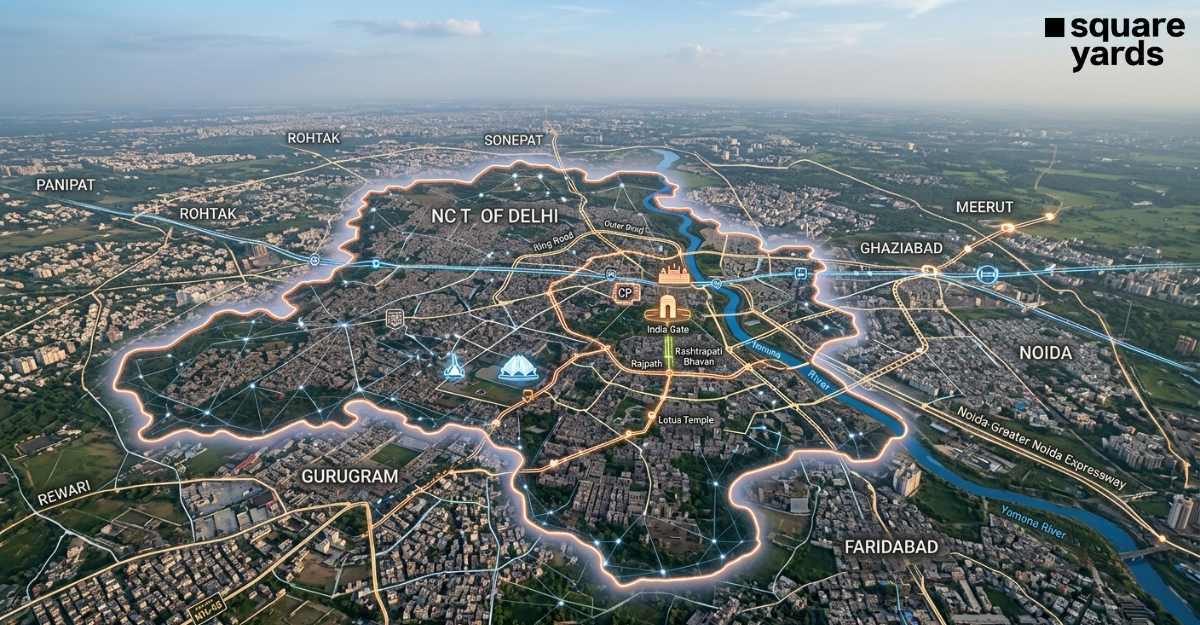
The National Capital Region (NCR) is preparing for one of its biggest urban transformations yet. Under the proposed Regional Plan 2041, the government has outlined an ambitious vision to create up to 8 new townships across Delhi-NCR and significantly improve regional connectivity through high-speed transport corridors.
The proposal aims to reduce pressure on Delhi, distribute economic activity across surrounding cities, and create a 30-minute NCR through Regional Rapid Transit System (RRTS) corridors, expressways, and metro expansions.
If implemented as planned, the project could reshape the region’s infrastructure and influence real estate development across Haryana, Uttar Pradesh, and Rajasthan over the next 15 years.
What is the NCR Regional Plan 2041?
The NCR Regional Plan 2041 is the long-term development blueprint prepared by the National Capital Region Planning Board (NCRPB). Recently cleared by the NCR Planning Board, the draft focuses on decentralizing growth rather than concentrating jobs, housing, and infrastructure within Delhi.
The plan estimates that Delhi-NCR’s population could grow from nearly 5.8 crore in 2011 to around 11.3 crore by 2041. Accommodating this population will require large investments in housing, transport, public utilities, and commercial infrastructure. Government estimates suggest that nearly Rs 20 lakh crore may be required over the coming years to build the necessary infrastructure and civic facilities.
Eight new townships at the center of the plan
One of the biggest highlights of the Regional Plan 2041 is the proposal to develop up to eight townships across the NCR. Most of these proposed urban centers are expected to come up along major transport corridors where future RRTS lines, expressways, and industrial corridors are planned.
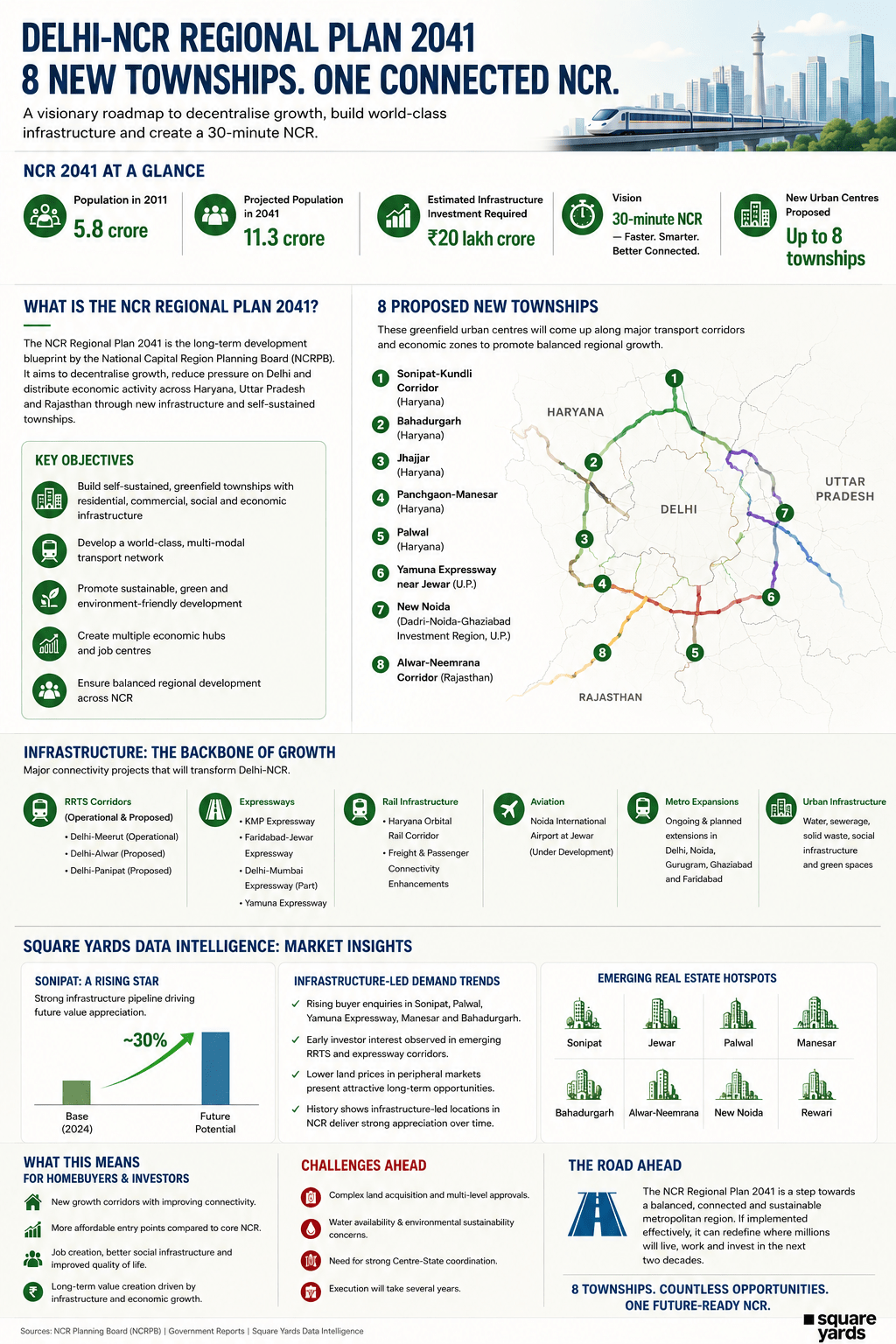
The proposed locations include:
- Sonipat-Kundli corridor
- Bahadurgarh
- Jhajjar
- Panchgaon-Manesar
- Palwal
- Yamuna Expressway near Jewar
- New Noida (Dadri-Noida-Ghaziabad Investment Region)
- Alwar-Neemrana corridor
These townships are envisioned as self-sustaining urban centers with residential neighborhoods, commercial districts, educational institutions, healthcare facilities, and employment hubs, rather than merely functioning as satellite towns.
Infrastructure remains the biggest growth driver
Connectivity forms the backbone of the Regional Plan 2041. The proposal includes expansion of the Regional Rapid Transit System (RRTS), new expressways, metro extensions, and orbital rail projects to reduce travel time between Delhi and neighboring cities.
Several ongoing infrastructure projects already support this vision, including:
- Delhi-Meerut RRTS
- Delhi-Alwar RRTS (proposed)
- Delhi-Panipat RRTS (proposed)
- Kundli-Manesar-Palwal (KMP) Expressway
- Haryana Orbital Rail Corridor
- Faridabad-Jewar Expressway
- Noida International Airport at Jewar
Together, these projects aim to improve accessibility across NCR while opening new development corridors outside Delhi.
Square Yards Data Intelligence: Infrastructure is already shaping demand
Square Yards Data Intelligence indicates that infrastructure-led development is already influencing buyer sentiment across emerging NCR markets. Among the strongest examples is Sonipat, where improved connectivity via the KMP Expressway, industrial development, and future transit infrastructure have strengthened market confidence. According to Square Yards Data Intelligence, the city’s residential market has the potential to witness nearly 30% price appreciation as infrastructure projects progress. Similarly, locations around the Yamuna Expressway, Palwal, and emerging corridors near Manesar have witnessed increasing buyer inquiries as investors anticipate long-term infrastructure-led growth.
The pattern reflects a broader trend seen across the NCR over the past decade: major infrastructure projects often create new investment destinations long before full completion.
Transit-oriented development could reshape future housing
One important feature of the Regional Plan 2041 is its emphasis on Transit-Oriented Development (TOD). Instead of allowing scattered urban expansion, the plan encourages higher-density residential and commercial development around transit stations.
This approach allows people to live closer to public transport while reducing dependence on private vehicles. For developers, TOD policies could unlock new development opportunities around future RRTS stations, metro corridors, and expressways. For homebuyers, improved connectivity may increase the attractiveness of emerging markets that currently remain relatively affordable compared to established locations such as Gurugram and Noida.
Which locations could benefit the most?
If the proposed infrastructure projects are implemented according to schedule, several peripheral markets may emerge as major real estate destinations over the next decade.
These include Sonipat, Jewar, Palwal, Manesar, Bahadurgarh, Alwar-Neemrana, New Noida, and Rewari. Many of these locations already benefit from lower land prices than in the central NCR while offering proximity to future transport infrastructure. As connectivity improves, these markets could attract residential buyers, logistics companies, manufacturing units, and commercial developments.
What does this mean for homebuyers and investors?
For homebuyers, the Regional Plan 2041 signals where future infrastructure investments are likely to be concentrated. For investors, it highlights the next generation of growth corridors that may benefit from improving connectivity over the long term. However, investment decisions should not be based solely on proposed announcements. Buyers should evaluate project approvals, infrastructure timelines, and local development before making purchasing decisions.
History shows that infrastructure has consistently been one of the strongest drivers of property value creation in NCR. Markets such as Noida, Greater Noida, and Gurugram witnessed significant appreciation after the arrival of metro connectivity, expressways, and commercial development. If the Regional Plan 2041 is implemented as envisioned, the next wave of growth could gradually shift towards emerging corridors such as Sonipat, Jewar, Manesar, Palwal, and Alwar.
Challenges remain
Despite the ambitious vision, implementation remains the biggest challenge. Large-scale infrastructure projects require multiple approvals, land acquisition, environmental clearances, and coordination between the Center and participating states. Water availability is another concern, particularly for some of the proposed townships planned along the KMP corridor. Environmental experts have also raised concerns regarding conservation zones, groundwater management, and protection of the Aravalli ecosystem as urban expansion gathers pace. As with previous regional infrastructure projects, execution is likely to take several years rather than occur immediately.