
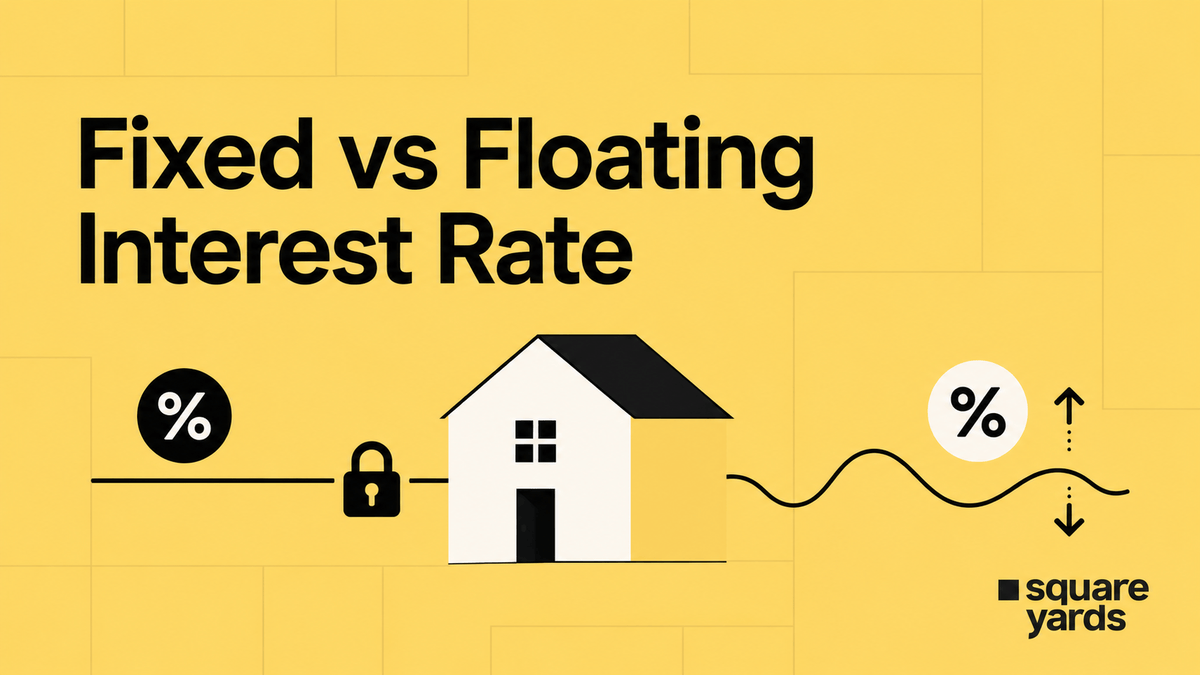
- Why the fixed vs floating interest rate decision matters more than most buyers think
- How the EBLR works: why floating rates move faster than they did before 2019
- Fixed vs floating interest rate: a numerical comparison for 2026
- When fixed rate wins, when floating rate wins
- The hybrid option: fixed for two to five years, then floating
- Kiran’s decision: why a self-employed architect chose fixed over floating
- Fixed vs floating interest rate: the quick decision guide
Why the fixed vs floating interest rate decision matters more than most buyers think
Consider a Rs 50 lakh loan over 20 years. At a fixed rate of 9.50 percent, your monthly EMI is approximately Rs 46,607 and your total interest outflow over 20 years is roughly Rs 61.86 lakh. At a floating rate of 8.75 percent that stays stable throughout, your EMI is Rs 44,167 and your total interest is approximately Rs 56.01 lakh. The difference is Rs 5.85 lakh in total interest paid. That is not a rounding error. That is a car.
But the floating rate does not stay stable. That is the whole point. It moves with the RBI repo rate. If the repo rises by 50 basis points, your floating rate goes up by the same amount at the next quarterly reset, adding roughly Rs 1,800 to the monthly EMI on a Rs 50 lakh loan. If it falls by 50 basis points, the same EMI drops by Rs 1,800.
Over a 20-year horizon, most studies of the RBI’s rate cycle show floating-rate borrowers pay less in total interest than fixed-rate borrowers. Rate cuts have historically outweighed hikes over long periods. But that statistical truth does not help a borrower who cannot absorb a Rs 4,000 EMI spike in the third year of their loan when a kitchen renovation budget already consumed their savings buffer.
The decision is not about the direction of rates. It is about your household’s ability to absorb EMI movement. If your monthly cash flow is tight enough that a 5 percent EMI increase would require a lifestyle change, fixed rate is worth its premium.
How the EBLR works: why floating rates move faster than they did before 2019
Since October 2019, all new floating-rate home loans from banks must be linked to an External Benchmark Lending Rate. The most common benchmark is the RBI repo rate. When the RBI changes the repo rate, the loan rate resets at the next quarterly interval, automatically, by the same amount.
Before 2019, loans were linked to MCLR (Marginal Cost of Funds-based Lending Rate), which was an internal bank calculation that moved more slowly and less predictably than the repo rate. The EBLR change was good for borrowers in a rate-cut environment because the benefit reached them faster. It is the same mechanism in reverse when rates rise.
The practical implication: if the RBI cuts the repo rate by 25 basis points in August 2026 (the next scheduled MPC review), a borrower on an EBLR-linked floating rate will see their rate reduce by 25 basis points at the next quarterly reset, within three months. That is meaningfully faster than the old MCLR system.
Your loan agreement should specify the reset frequency (quarterly for most EBLR-linked loans) and whether the reset reduces your EMI or your tenure. Ask your bank explicitly before signing. Both options are legitimate. Tenure reduction saves more total interest. EMI reduction improves monthly cash flow.
Fixed vs floating interest rate: a numerical comparison for 2026
Loan amount: Rs 50 lakh. Tenure: 20 years. Three scenarios.
| Scenario | Effective rate | Monthly EMI (approx) | Total interest over 20 years |
|---|---|---|---|
| Fixed rate | 9.50% throughout | ₹46,607 | ₹61.86 lakh |
| Floating rate (stable) | 8.75% throughout | ₹44,167 | ₹56.01 lakh |
| Floating rate rises 1% | Moves to 9.75% from year 3 | ₹47,741 (revised) | ~₹64.30 lakh |
| Floating rate falls 1% | Moves to 7.75% from year 3 | ₹41,538 (revised) | ~₹49.70 lakh |
These are illustrative figures. The actual EMI and interest depend on your specific lender, the reset frequency, and how the rate moves over the actual loan tenure. The key insight from the table is the range on the floating side: if rates fall by 1 percent, you save Rs 12 lakh in total interest compared to the fixed-rate loan. If they rise by 1 percent, you pay Rs 2.44 lakh more than the fixed option. The asymmetry favours floating over long tenures.
When fixed rate wins, when floating rate wins
Fixed rate wins when:
- You are in an environment where further rate hikes are likely
- Your income is variable or seasonal and you cannot absorb EMI increases
- Your loan tenure is short (5 to 7 years), where the stability benefit outweighs the rate premium
- You need to present predictable housing costs to a family budget or a business plan
Floating rate wins when:
- Interest rates are at or near a cyclical high and cuts are anticipated (this describes 2026)
- Your loan tenure is long (15 years or more), where historical data strongly favours floating
- You have financial flexibility to absorb temporary EMI increases of Rs 3,000 to Rs 5,000 per month
- You plan to make prepayments (no prepayment penalty on floating-rate loans for individuals, per RBI)
The hybrid option: fixed for two to five years, then floating
Several lenders offer a hybrid structure where the rate is fixed for the first two to five years, then converts to floating for the remainder. This gives you EMI predictability in the early years of a loan (when household budgets are often tightest: new property, potential renovation costs, possible career transition), while allowing you to benefit from the floating rate in years 6 onwards when your income and cash flow are more established.
The hybrid rate is typically slightly higher than a pure floating rate at disbursement but lower than a pure fixed rate. The spread depends on the lender and the fixed period chosen.
One risk worth flagging. When the fixed period ends and you convert to floating, the floating rate you receive is the then-prevailing market rate, not locked to the rate at the time of disbursement. In a rising rate environment, the conversion moment can produce a spike. Understand this before signing a hybrid product.
Kiran’s decision: why a self-employed architect chose fixed over floating
This is the conversation we have most often with self-employed buyers in the Rs 60 to 80 lakh bracket.
Kiran was 38, an independent architect running a small firm in Ahmedabad, taking a Rs 70 lakh home loan on a 3 BHK in the SG Highway micro-market. His CIBIL score was 764 and he had held the firm for nine years, so approval was not the problem. The problem was income consistency. A strong year in commercial project fees might net Rs 24 lakh. A slow year could be Rs 14 lakh. His take-home had the shape of a wave, not a steady line.
The floating rate at ICICI Bank was 8.75 percent. The fixed rate from HDFC was 9.40 percent for a 5-year term (hybrid). The floating EMI was Rs 61,417. The hybrid-fixed EMI was Rs 64,942 in year one, the same for five years.
Kiran chose the HDFC hybrid product. The extra Rs 3,525 a month was a real cost. But in the years when project fees ran lean, he knew precisely what he owed. He had no interest in absorbing a potential Rs 5,000 EMI spike during a year when two commercial clients had delayed payments by a combined Rs 9 lakh.
“Every calculator I ran told me floating rate was the smarter long-term choice. But a calculator does not know that my income runs in cycles, not in salary credits. The Square Yards advisor understood that in the first ten minutes. We went with the HDFC hybrid product. Five years of knowing exactly what I owe every month was worth every rupee of the extra EMI.”
A small note on this story. The buyer’s real name and a few identifying details have been changed to protect the privacy of our customers. The story and the outcome are real, shared with the buyer’s written consent.
Fixed vs floating interest rate: the quick decision guide
- Self-employed with variable income, or short tenure (under 7 years): fixed or hybrid.
- Salaried with stable income, long tenure (15 years plus), financial cushion to absorb Rs 3,000 to Rs 5,000 EMI movement: floating.
- Uncertain rate view, but want stability in early years: hybrid (fixed for 2 to 5 years).
- Planning to prepay significantly in years 3 to 7: floating (no prepayment penalty).
For the EMI comparison at your actual loan amount and tenure, run both rates through the Square Yards EMI calculator. Our home loan eligibility criteria guide explains how the rate type interacts with your overall eligibility. Our how to improve home loan eligibility guide covers how to negotiate a lower spread before you choose the rate type. And our tax benefits on home loan guide shows how the interest deduction under Section 24(b) changes your after-tax cost of the loan for both rate types.
Fixed vs Floating Interest Rate on Home Loan: EBLR, Switching and Rate FAQs
1. Which is better, fixed or floating interest rate on a home loan in India in 2026?
For most long-tenure borrowers (15 years or more) with stable salaried income, floating rate is statistically better. In 2026, with the repo rate at 5.25 percent, the environment broadly favours floating. For self-employed borrowers with variable income or short tenures, fixed rate offers predictability worth its premium.
2. What is the difference between floating vs fixed interest rate on home loan?
A fixed rate stays constant throughout the loan tenure. Your EMI does not change regardless of RBI action. A floating rate changes when the RBI revises the repo rate, resetting quarterly under the EBLR framework. Fixed rates are currently 50 to 150 basis points above floating rates.
3. What is the EBLR and how does it affect floating home loan rates?
EBLR stands for External Benchmark Lending Rate. Since October 2019, all new floating-rate home loans must be linked to an external benchmark (most commonly the RBI repo rate). When the repo changes, the loan rate adjusts at the next quarterly reset by the same amount.
4. Can I switch from fixed to floating or vice versa after taking a loan?
Yes. Most lenders allow switching for a conversion fee of 0.25 to 1 percent of the outstanding principal. Switching from fixed to floating is beneficial when rates fall significantly. Switching from floating to fixed is beneficial in rising rate environments.
5. Is there a prepayment penalty on floating rate home loans in India?
No. RBI guidelines prohibit banks from charging a prepayment penalty on floating-rate home loans for individual borrowers. This means floating-rate borrowers can make lump-sum prepayments at any time without penalty.
6. What is a hybrid home loan interest rate?
A hybrid home loan has a fixed rate for the initial period (typically 2 to 5 years), then converts to floating for the remaining tenure. It offers EMI stability during the early phase while allowing the borrower to benefit from rate cuts later.
7. What happens to my EMI when RBI cuts the repo rate?
For EBLR-linked floating loans, your lender must reduce your interest rate at the next quarterly reset. Your lender then offers you the option to reduce your EMI or reduce your tenure. Reducing tenure saves more total interest.
8. What is the current floating home loan rate in India in 2026?
Floating home loan rates start at approximately 8.50 percent at SBI and PNB, and 8.75 percent at HDFC, ICICI and Axis Bank, for eligible borrowers with CIBIL score of 750 or above.