
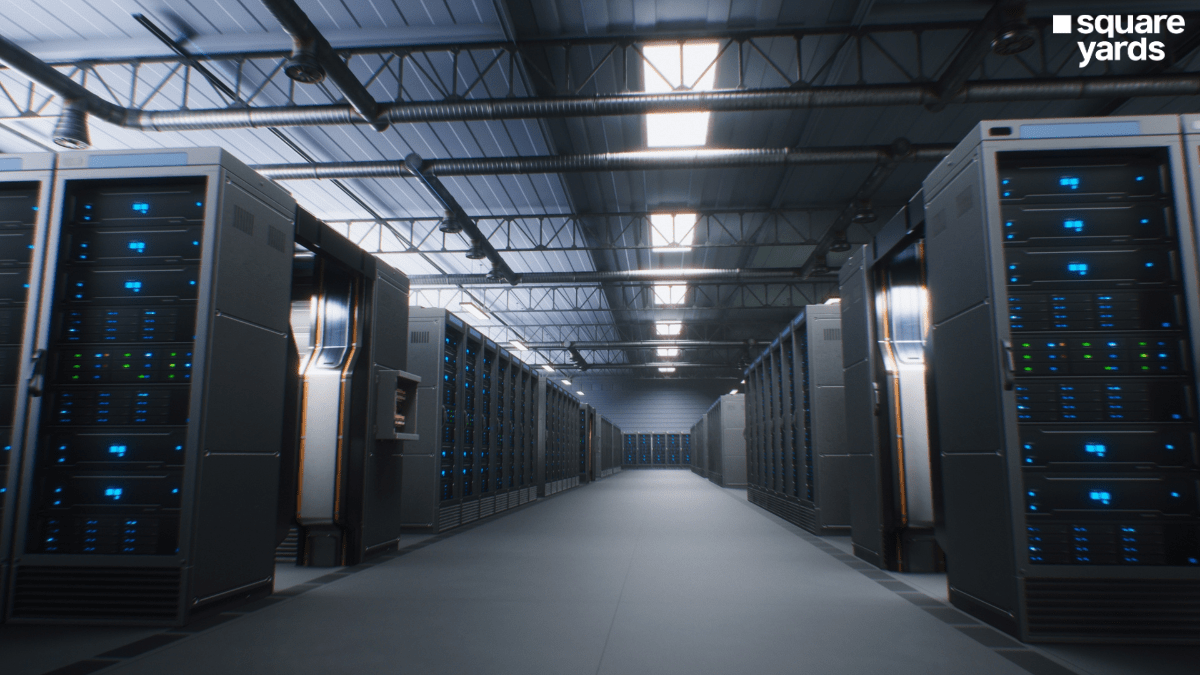
The Quiet Land Grab: How India’s AI Data Center boom is rewriting real estate maps
For decades, the biggest tenants in Indian commercial real estate were people- IT professionals filling office towers in Bengaluru, bankers in Mumbai’s BKC, back-office teams in Gurugram. In 2026, the most aggressively courted tenant doesn’t commute, doesn’t need parking, and never leaves the building. It’s a server rack!
In the second quarter of 2026, data centers attracted 38% of all private equity inflows into Indian real estate, overtaking office assets, the segment that has dominated institutional investing for a decade. Offices took 30%, residential 16%. That inversion, reported by Savills India, is not a blip. It is the clearest signal yet that India’s next real estate cycle will be shaped less by where people work and more by where machines think.
Why AI Changed What a “Data Center” Actually Is
Here is where the story becomes a genuine real estate story rather than a technology story. The AI wave hasn’t just increased demand for data centers, it has changed their physical DNA.
Traditional server facilities ran at power densities of roughly 10 kW per rack. AI-ready campuses now demand 100 kW or more per rack, along with liquid cooling systems, dedicated electrical substations, and vastly larger footprints. Hyperscalers, the global cloud giants, are no longer leasing standard buildings. They are commissioning custom-built, single-tenant campuses designed around their compute loads, often securing power connections years before construction begins.
The real estate implications are enormous. Consider the scale of capital lined up: investment commitments in India’s data center industry are projected to exceed $100 billion by 2027, according to CBRE, after nearly $60 billion in commitments between 2019 and 2024.
Jefferies projects capacity to grow five-fold by 2030 to 8 GW on the back of $30 billion in capex, while Kotak Institutional Equities estimates data centers could consume 4–5% of India’s total power capacity by FY30. Market researcher Mordor Intelligence pegs capacity growth from 1.3 GW in April 2025 to 4.7 GW by 2030.
Every gigawatt of that capacity translates into land acquired, industrial-grade construction contracted, transmission corridors built, and thousands of jobs in engineering, operations, and maintenance. A data center may house machines, but it is built, powered, cooled, and guarded by people — people who need homes, schools, hospitals, and high streets nearby.
What this means for land, housing, and rentals
For landowners and land investors, the effect is already visible: parcels near reliable power infrastructure, fibre routes, and submarine cable landings have re-rated. Land prices in established micro-markets such as Navi Mumbai and parts of Hyderabad have risen enough to narrow India’s historical cost advantage, though the Budget 2026 tax holiday for eligible foreign cloud companies (extending until 2047) keeps the overall economics compelling.
For homebuyers and renters, the impact is indirect but real. Data center clusters anchor long-term employment — construction phases lasting years, followed by permanent operations, security, and facility-management roles. Housing demand in adjoining residential belts tends to firm up gradually rather than spike, which historically produces healthier, more durable price appreciation than hype-driven corridors.
For commercial and warehousing players, data centers behave like an anchor tenant for an entire district: ancillary suppliers, equipment vendors, backup-power providers, and logistics operators cluster around them, lifting demand for industrial sheds and flexi-office space.
The Caution List: What Could Go Wrong
Balance matters, and the risks here are specific. Power is the choke point, by 2030, Indian data centers could consume around 57 TWh annually, straining grids in Mumbai, Chennai, and Hyderabad. Execution gaps are widening between announced capacity and operational megawatts; investors and landowners betting on announcements rather than commissioned projects can get stranded. Speculative land pricing around rumored sites is already evident in some corridors — a data center is a 3-year build, and premature price run-ups can reverse. Water and environmental concerns around cooling-intensive facilities may invite tighter regulation. And industry veterans themselves warn that herd-driven overbuilding could create a capacity glut even if AI demand itself is real.
Key Takeaways
Infrastructure has always been the invisible hand behind Indian property wealth, expressways made Dwarka Expressway, metros made Whitefield. The data center is different in one respect: it is both the infrastructure and the tenant. It brings its own power lines, its own fibre, its own decade-long lease — and then quietly upgrades everything around it.
For investors, the lesson from H1 2026 is that institutional money has already moved; retail attention usually follows 12-24 months later. For homebuyers, the smarter question is no longer just “how far is the metro?” but “what is being built on that fenced industrial plot nearby?” The corridors that answer both questions well are where the next decade’s value will quietly compound.