
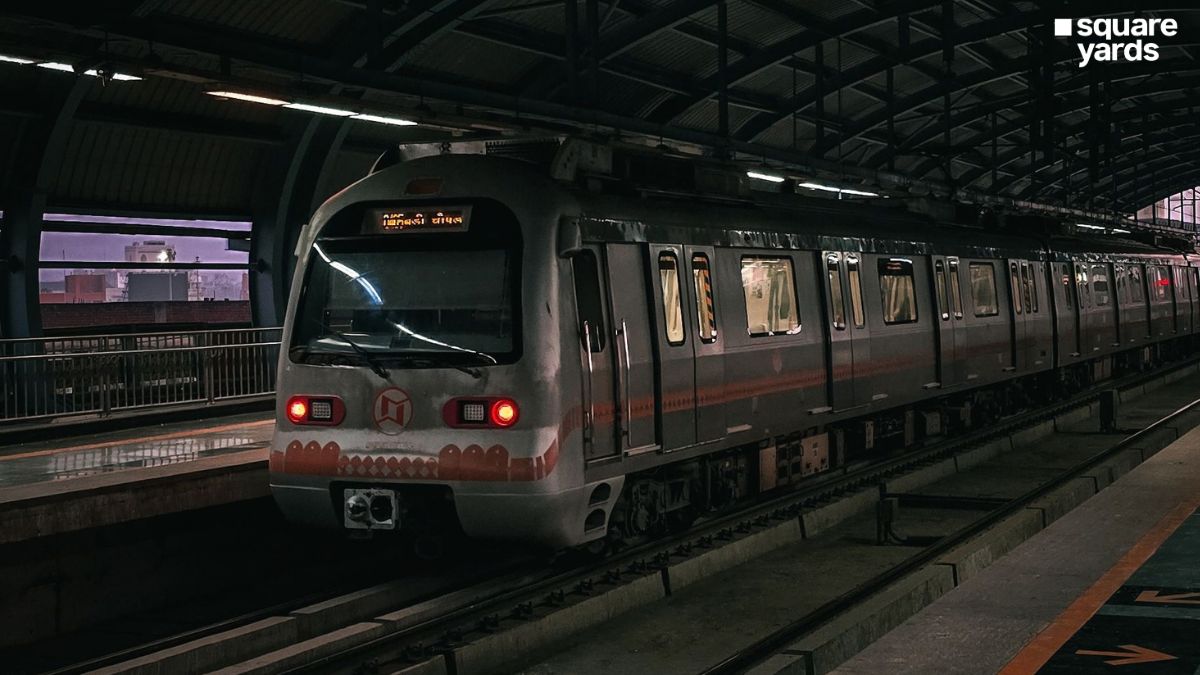
Haryana has approved the Rs 1,662-crore civil works package for the Gurugram Metro Phase 2, clearing the way for tendering on the Sector 9-Cyber City stretch. The 14.5-km corridor will connect several established residential areas of Old Gurgaon with Udyog Vihar and Cyber City, creating a stronger residential-to-employment link across the city.
Gurugram Metro Rail Limited (GMRL) is expected to float the works tender in the first week of October, moving the long-delayed package to the bidding stage. The approval comes after nearly two months of waiting for the Phase 2 tender and is significant for the project’s broader 2029 completion target.
For Gurugram’s real estate market, the more important development is the route itself. Phase 2 will extend metro connectivity deeper into Old Gurgaon, linking residential sectors and established neighborhoods with Udyog Vihar and Cyber City, two of the city’s major employment and commercial destinations.
Phase 2 to connect Sector 9 with Cyber City through Old Gurgaon
The Phase 2 package covers the 14.5-km Sector 9-Cyber City stretch, with 14 stations planned along the route. It will extend metro connectivity through several established residential areas of Old Gurgaon, including sectors around 3, 4, 5 and 7, as well as Ashok Vihar, Palam Vihar and its extension, Bajghera Road and nearby sectors, before reaching the major employment hubs of Udyog Vihar and Cyber City.
The wider Millennium City Centre-Cyber City corridor spans around 28.5 km. Its first 15.3-km phase, connecting Millennium City Center with Sector 9, is already under construction and is scheduled for completion in 2028. With the Phase 2 civil works now approved, the project has cleared its major remaining tender hurdle and is moving closer to becoming a continuous metro corridor across Gurugram.
Rs 1,662-crore package includes flyover-cum-metro structures
The civil works package also includes around 2 km of flyover-cum-metro structures designed to address two busy road corridors.
Around 1.2 km of the structure will be built along Old Delhi Road, while another 800 meters will be developed on Bajghera Road. The design will allow the metro alignment to pass above the busy road corridors while maintaining road connectivity below. The structures will be constructed as deposit work for the Gurugram Metropolitan Development Authority (GMDA).
Old Gurgaon residential markets gain access to major employment hubs
Gurugram Metro Phase 2’s real estate significance lies in the relationship between the residential and employment markets it connects.
Several of the localities on the route are established residential areas, while Udyog Vihar and Cyber City are major destinations for employment and commercial activity. A metro connection between the two could make public transport more practical for residents living in Old Gurgaon while also widening the potential residential catchment for people working in these employment hubs.
Sector 4, Sector 5 and Sector 9 show different property market profiles
Current property data shows that the connected markets are not uniform. In Sector 4, the average asking price stood at Rs 10,500 per sq ft as of June 2026. Apartment prices were also reported at Rs 10,500 (psf), while the locality’s rental yield stood at 3.54%. Average rents ranged from Rs 17,150 a month for 1BHK homes to Rs 38,600 for 3BHK units.
Sector 5 had an average asking price of Rs 11,450 (psf). Its apartment segment was at the same level, while the locality recorded an average rental rate of Rs 20 (psf) and a rental yield of 2.10%.
Further along the corridor, Sector 9 recorded an average asking price of Rs 8,050 (psf). Prices moved up from Rs 7,000 (psf) in September 2025 to Rs 8,050 (psf) by March 2026 and remained at that level through June. Its rental yield stood at 2.53%, with average monthly rents of Rs 25,300 for 2BHK and Rs 33,050 for 3BHK homes.
Palam Vihar remains a higher-priced residential market
Palam Vihar is another important residential node on the Phase 2 route. Square Yards puts the locality’s average asking price at Rs 12,600 (psf), with a 6.3% increase in the latest reported period. Palam Vihar Extension, meanwhile, stood at Rs 13,900 (psf) but recorded a 20.21% QoQ decline, indicating a significant recent correction.
For buyers and investors, the more relevant question is how improved public transport changes accessibility within individual neighborhoods and whether better access to employment centers translates into stronger residential and rental demand over time.
Udyog Vihar gives the corridor a strong employment anchor
At the eastern end of the Gurugram Metro Phase 2 route, Udyog Vihar provides an important commercial and employment anchor.
Square Yards places the average asking price for office space in Udyog Vihar at Rs 16,650 (psf), while residential apartments in the locality are priced at around Rs 7,750 (psf). The residential rental yield is reported at 1.44%, with average rents ranging from Rs 18,100 for 1BHK units to Rs 34,150 for 3BHK homes.
If the metro reduces dependence on road-based travel for workers, the residential markets along the route could become more accessible to a wider pool of employees working in Udyog Vihar and Cyber City.
Metro connectivity could narrow Old and New Gurgaon’s access gap
Gurugram has seen substantial development in newer residential and commercial corridors, while several established parts of Old Gurgaon have remained comparatively dependent on road connectivity.
Phase 2 could change that equation by bringing a continuous metro link through established neighborhoods and towards Cyber City. The project is also expected to provide interchange opportunities with the existing Rapid Metro and the proposed Namo Bharat Rail corridor, adding to its wider network value.
Areas close to stations, road interchanges and established residential clusters may gain greater visibility among buyers and tenants looking for access to Gurugram’s employment centers. Existing prices, housing stock, rental demand, station proximity and the quality of last-mile connectivity will all influence how individual markets respond.