
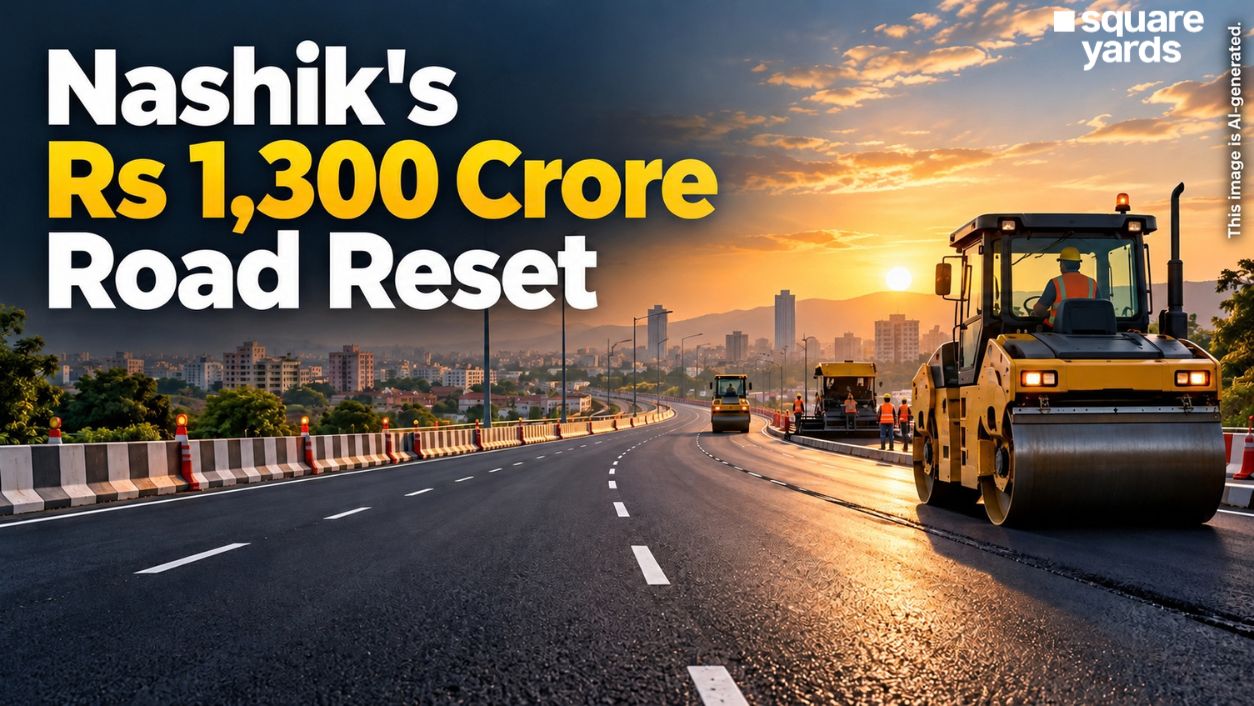
Every 12 years, Nashik hosts one of the largest gatherings on Earth. In 2015, nearly 3 crore devotees came to the Godavari for the Simhastha Kumbh. The next one runs from October 31, 2026, to July 24, 2027. This time, the city isn’t just preparing for crowds. It’s rebuilding its road network.
The Nashik Municipal Corporation (NMC) is moving into the main construction phase of a roughly Rs 1,230–1,400 crore program covering 28 major city roads and four bridges. In parallel, the state is building a ring road of about 66 km and upgrading the highways that feed into the city. For anyone watching Nashik property, this is the most important infrastructure cycle in a decade.
28 roads, one utility duct, zero repeat digging
The city program covers 28 road works across about 120 km, executed by 18 contractors. Nearly half the roads are being rebuilt with white-topping, a concrete surface laid over existing asphalt that lasts far longer than tar.
The bigger idea sits underground. NMC is laying a single utility duct for water, sewerage, power cables, gas pipelines, and optical fiber. Once a road is done, it shouldn’t need to be dug up again. Mahanagar Natural Gas has been barred from further digging beyond approved roads for two years.
The work schedule paused base work through the monsoon. Concrete surfacing was set to begin in October, with a December 2026 target for the bulk of it and a hard deadline of March 2027.
The ring road changes the map
The Nashik ring road is the long-term game-changer. Civil works worth Rs 3,954 crore were sanctioned in March 2026. The full project, including land, is valued at over Rs 7,600 crore. It’s a four-lane road with room to go to six lanes, and includes 29 vehicle underpasses and seven viaducts. Construction has started on all seven packages, with a March 2027 target.
A ring road does one simple thing: it takes trucks and through traffic out of the city. That makes inner neighborhoods quieter and opens peripheral land to planned development.
Highways into Nashik
The state has also earmarked about Rs 2,270 crore for regional roads. That includes six-laning and concreting of the Nashik–Trimbak Road (Rs 350 crore), widening of the Nashik–Dindori–Vani Road (Rs 100 crore), and a Rs 50 crore upgrade of the Janori–Ozar airport road.
Reading the Numbers: What Square Yards Data Says Right Now
Nashik’s market was already moving before this phase began. According to Square Yards data, the city’s median asking price rose from Rs 4,500 per sq ft in March 2026 to Rs 5,100 per sq ft in June 2026.
|
Micro-market |
Avg price (Rs /sq ft, Jun 2026) |
Trend |
Typical rent |
|
6,250 |
+12.79% YoY |
2 BHK Rs 25,000; 3 BHK Rs 27,500 |
|
|
4,200 |
+3.7% QoQ |
1 BHK Rs 11,350; 3 BHK Rs 31,000 |
|
|
4,300 |
+0.98% QoQ |
— |
|
|
Nashik city |
5,100 (median) |
Up from 4,500 in Mar 2026 |
1 BHK Rs 11,300; 2 BHK Rs 14,000 |
What this means: The gap is the story. Nasik West, home to Gangapur Road, has grown nearly 13% in a year. Nasik East and South have barely moved. That suggests buyers are paying for proven connectivity and social infrastructure. They haven’t yet priced in the areas where new roads are still under construction.
For investors, that gap is the opportunity. For end users, it’s a reminder that the cheapest pocket isn’t always the best value.
The Rental Yield: Why 2027 could be a turning point for landlords
Nashik rents today are modest. Square Yards data puts the city average at about Rs 11,300 for a 1 BHK and Rs 14,000 for a 2 BHK. In Nasik West, 2 BHK rents average around Rs 25,000.
A simple calculation shows why that matters. A 950 sq ft 2 BHK in Nasik West at Rs 6,250 per sq ft costs about Rs 59 lakh. At Rs 25,000 a month, that’s a gross yield of roughly 5%, well above the 2.5-3.5% common in many metros.
Rental demand should build in 2 waves starting next year:
Wave 1: The Kumbh months (late 2026 to mid-2027)
Officials, police, contractors, volunteers, media teams, and service staff will need housing for weeks or months. Furnished flats near Panchavati, Trimbak Road, and Nashik Road are likely to see short-stay demand and premium rents. This spike is temporary. Landlords shouldn’t treat it as the new normal.
Wave 2: The post-Kumbh reset (2027 onward)
This is the durable part. Once the ring road and concrete roads are in place, commute times inside the city should fall. Better roads to Ozar airport and the highways improve access for professionals linked to Nashik’s industrial belts and the Mumbai-Pune corridor.
For landlords, this creates a second rental market alongside long-term leases: short stays. Furnished homes, serviced apartments, and homestays near Panchavati, Tapovan, and the Trimbak Road corridor can earn more during peak periods like Shravan, Mahashivratri, long weekends, and the Kumbh itself. Filling even a few nights a month at short-stay rates can push the effective yield above the roughly 5% a standard lease delivers.
The trade-off is real. Short-stay income is seasonal, vacancies are higher, and furnishing, cleaning, and management eat into returns. There’s also a twist that buyers often miss: faster roads can cut overnight stays. When the six-laned Trimbak Road and the ring road make a Trimbakeshwar trip a comfortable day trip from Mumbai or Pune, some pilgrims will simply skip the hotel. The winners will be properties close enough to the temples and ghats that staying over is still the easier choice.
Religious tourism also lifts commercial rents along pilgrim routes, where shops, eateries, and small hospitality units benefit from higher, steadier footfall.
Micro-Markets to Watch
Gangapur Road and Trimbak Road: the premium corridor
Gangapur Road is Nashik’s most established address. Apartment prices here rose about 13% recently. The Nashik–Trimbak six-laning strengthens its link to Trimbakeshwar and the Satpur industrial area. Expect steady price growth, not a jump. This market is already partly priced.
Panchavati and Adgaon: the Kumbh core
Panchavati sits next to Ramkund, the heart of the Kumbh. Ghat works and the Rs 20 crore Panchavati-Tapovan road add to its appeal. Adgaon, at Rs 4,800 per sq ft, offers a newer stock option nearby. Short-stay rentals could do well here in 2027.
Nashik Road and Jail Road: the value gateway
Nashik Road and Jail Road remain among the city’s more affordable areas, at about Rs 3,500-4,350 per sq ft. The railway station will handle a big share of pilgrim traffic. These pockets suit first-time buyers and yield-focused investors.
Pathardi Phata and Indira Nagar: the highway edge
Pathardi Phata (about Rs 3,900 per sq ft) and Indira Nagar (about Rs 4,200 per sq ft, +1.5%) sit close to the Mumbai–Agra highway and the ring road alignment. They combine affordability with improving access. This is where many mid-income families are likely to look next.
Ozar and Dindori Road: the long bet
The Janori–Ozar airport road and Nashik–Dindori widening push growth outward. Land here is a five-to-seven-year play. It’s a good fit for patient investors and warehousing, but not for buyers who need a ready neighborhood today.
Key Takeaways
- Nashik is spending well over Rs 10,000 crore across city roads, the ring road, and regional highways, all timed around Simhastha 2027.
- Square Yards data shows a two-speed market: Nasik West is up nearly 13% YoY, while East and South are flat to mildly positive. That gap may narrow as new roads are completed.
- Rents are still affordable, and gross yields near 5% in prime corridors are attractive. Expect a short Kumbh spike in 2027, followed by steadier, connectivity-led rent growth.
- The best value lies where infrastructure is under construction but not yet priced in. Only buy there if you can handle delay risk.
The Kumbh lasts a few months. The roads stay for decades. Kumbh crowds will leave in 2027, but the ring road, concrete roads, and utility ducts will shape where Nashik lives, works, and invests through 2040. That’s what buyers should be pricing, not the event itself.